













| Language / Culture | Name of Mars | Attestation |
|---|---|---|
| Archaic Latin | Marmar, Mars | Carmen Arvale |
| Old Latin | Mars Pater, Marte (dative) | Cato, De agricultura 141 (mid-2nd century BCE) |
| Old Latin / poetic | Māvors, Māvortis | Poetic and archaic usage |
| Oscan | Māmers | Oscan dedications of central and southern Italy |
38 min read
MARS
author: High Priest Zevios Metathronos
co-author: Novice Priest Karnonnos
I. Names
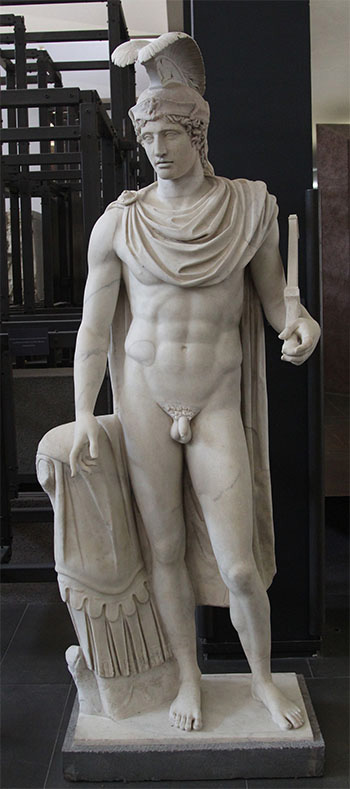
Mars in white marble sculpture, middle 2nd century CE, possible copy of 5th century Greek original, Vatican Museums
The Latin name Mārs (genitive Mārtis), which in Old Latin and poetic usage also appears as Māvors (Māvortis), is cognate with Oscan Māmers (Māmertos). The oldest recorded Latin form, Mamart-, is likely of foreign origin. It has often been explained as deriving from Maris, the name of an Etruscan child-god, though scholars debate the precise relationship between the two deities, especially as Laran is the Etruscan god of war.1
Earlier scholarship linked the name to the Vedic storm deities known as the Maruts under a reconstructed Proto-Indo-European term māwort-, but this etymology is now largely rejected in modern Indo-Europeanist studies. Mars may ultimately reflect a thematic connection to the Proto-Indo-European god Perkwunos, originally possessing characteristics of a thunderer, and it should be noted that this reflects a larger tradition of dual storm and war gods, as even the Etruscan Laran is shown as capable of wielding lightning.2
Latin adjectives derived from Mars include Mārtius and mārtiālis, which give rise to English terms such as "martial," as in martial arts or martial law, and names like Marcus, Mark, and Martin. The month of March (Martius) is named after him, aligning with the start of the military campaigning season and the traditional Roman new year in earlier calendars.3
The earliest securely dated occurrences of the name in Latin are archaic and formulaic. The Carmen Arvale, the hymn of the Arval Brethren preserved on a stone of 218 CE but recording language centuries older, calls upon the god three times as Marmar and Mars, while the war god's oldest cult titles cluster around the spear kept in the Regia. The dative Marte and the invocation Mars pater stand in Cato's farming manual of the mid-second century BCE, the oldest connected Latin prose to address the god directly.4,5
Sources: Bonfante, Etruscan Life and Afterlife (1986); York, "Romulus and Remus, Mars and Quirinus" (1988); Dauzat, Dictionnaire étymologique (1980); the Carmen Arvale in Remains of Old Latin IV; Cato, De agricultura 141.1,2,3,4,5
II. Roman History
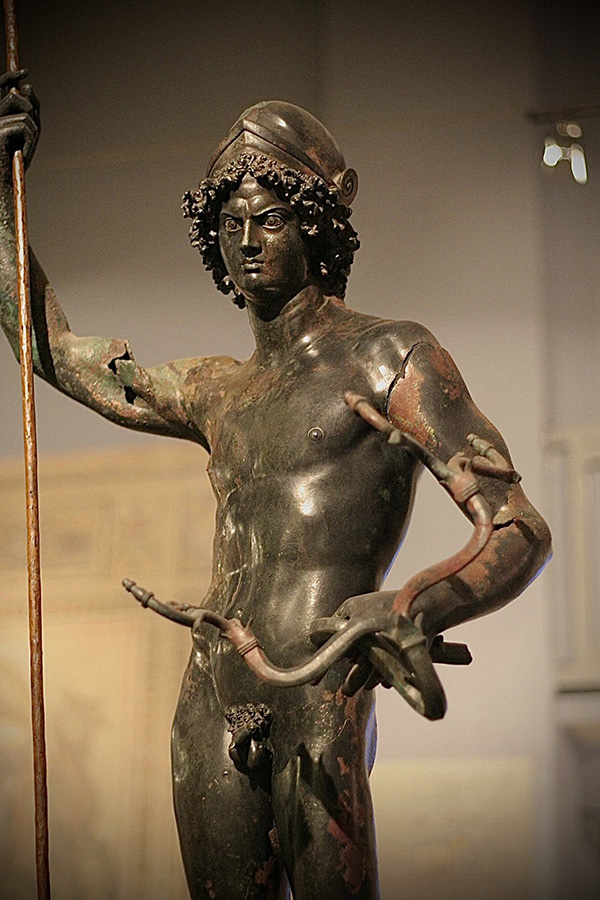
Zeugma Mars with serpentin emotif discovered in 2000, 2nd to 3rd century CE, Zeugma Mosaic Museum
The Birth of the God
Much like Ares, traditionally the son of Zeus and Hera, the Roman god Mars is generally regarded as the child of Jupiter and Juno. However, in the version recounted by Ovid, Mars is born solely from Juno. In this narrative, Jupiter had previously bypassed the maternal role by bringing forth Minerva directly from his own head, without the involvement of a mother. Seeking to replicate this feat, Juno turned to the goddess Flora for guidance on conceiving without a male counterpart. Flora provided a magical flower and demonstrated its potency on a heifer, which immediately became fertile; she then plucked one of these flowers and, touching Juno's abdomen with it, caused her to conceive. Juno withdrew to Thrace and the shores of the Sea of Marmara, where she gave birth to Mars.6
Ovid recounts this origin story in his Fasti, a poetic exploration of the Roman calendar. The tale may help explain why the Matronalia, a celebration honoring Juno in her role as a goddess of childbirth, takes place on the first day of March, the month dedicated to Mars and, in some later traditions, regarded as his birthday. In the earliest Roman calendar, March marked the beginning of the year, as opposed to January, which belongs to Janus.7
Since Ovid is the sole source for this version, it is uncertain whether he was preserving an older Italic tradition or creating a literary invention of his own. Regardless, by including it, he underscores a dimension of Mars that connects him with vegetation and growth, portraying him as a deity not wholly separate from feminine generative power, something that is especially apparent in his consorts.8
Virtus and the Ideal of Manhood
The idea of virility, understood as a form of life force (vis) or excellence (virtus), was a defining attribute of Mars. In early Roman literature, virtus primarily referred to courage displayed in battle. For example, in Plautus' play The Braggart Soldier, the character Artotrogus flatters the boastful Pyrgopolynices by claiming that even Mars himself would not dare compare his martial achievements. Similarly, in the prologue of Casina, the audience is urged to win through true bravery, vincite virtute vera, reinforcing the martial connotations of the term.9,10
Over time, however, the meaning of virtus broadened to include wisdom and strategic intelligence, likely influenced by Greek cultural ideas linking military skill with intellect, an association embodied by Athena, with the aspect not being as prevalent in the Roman Minerva. As this concept evolved, so too did the character of Mars, who came to represent not only raw combat ability but also the qualities of leadership and generalship. One scholar has argued that, as the embodiment of virtus, Mars came to symbolize the ideal of Roman masculinity, and by the third century CE his worship was especially prominent among Roman soldiers and legions.11
The Guardian and the Seasons
Several festivals dedicated to Mars, such as the Tubilustrium and Armilustrium, were associated with purification rites known as lustration, intended to ward off harmful influences. These associations suggest that Mars also functioned as a protective or guardian deity. This protective role may have reinforced his connection to warfare; according to Servius, during times of conflict a spear was shaken in the Regia while invoking Mars with the phrase "Mars vigila," calling on him to watch over the Roman people.12
Mars was further linked to a cycle of seasonal festivals marking the beginning and end of the Roman military campaigning period. In March, rituals such as the dances of the Salii signaled the start of campaigns, while October ceremonies, including the October Horse and Armilustrium, marked their conclusion. These observances coincided with key agricultural periods, reflecting Mars' dual identity as both a war deity and a guardian of rural life. By the second and third centuries CE, however, this seasonal pattern diminished in importance, as Roman troops increasingly campaigned year round.13
Father of Romulus and Remus
Mars is the divine father of Romulus and Remus in the foundational myth of Rome. As the Roman god of war, his paternity gives the twins semi-divine status, links Rome's origins to martial valor and divine favor, and explains why animals sacred to him, the she-wolf and woodpecker, protect the infants. Rhea Silvia, also called Ilia, daughter of Numitor the rightful king of Alba Longa and a Vestal Virgin forced into chastity by her usurping uncle Amulius, is impregnated by Mars. This violates her vows but is presented as divine intervention. Amulius orders the twins drowned in the Tiber; they survive, wash ashore, and are suckled by a she-wolf and fed by a woodpecker, both animals sacred to Mars.14
"Here, then, the babes lay, and the she-wolf of story here gave them suck, and a woodpecker came to help in feeding them and to watch over them. Now these creatures are considered sacred to Mars, and the woodpecker is held in especial veneration and honour by the Latins, and this was the chief reason why the mother was believed when she declared that Mars was the father of her babes."
Plutarch, Life of Romulus 414
The deified figure of Romulus came to be identified with Quirinus, a form often associated with Mars as Mars Quirinus. Within the Capitoline Triad, composed of Jupiter, Mars, and Quirinus, Mars and Quirinus were nevertheless treated as distinct deities, even if they may share a common origin. Each god possessed his own dedicated priest, or flamen, though the specific duties of the Flamen Martialis and Flamen Quirinalis are not clearly differentiated in surviving sources. In this aspect as Mars Quirinus, the god functioned as a guardian of the Quirites, the civilian body organized into curiae whose formal oaths were required in the ratification of treaties, so that he acted as a divine guarantor of agreements. As one traditional formulation expresses it, when the god is active in warfare he is known as Mars Gradivus, and when he presides in a state of peace he is called Quirinus.15
The divine parentage of Romulus and Remus is further expounded in Virgil's Aeneid. Jupiter prophesies his role in Book 1, connecting the descendants of Aeneas by way of the Alban kings to Ilia and the birth of the twins. Mars is invoked further in the battle scenes, and Romulus is later shown in the Parade of Heroes in Book 6 as the son of Mars with divine features inherited from his father.16
III. Epithets
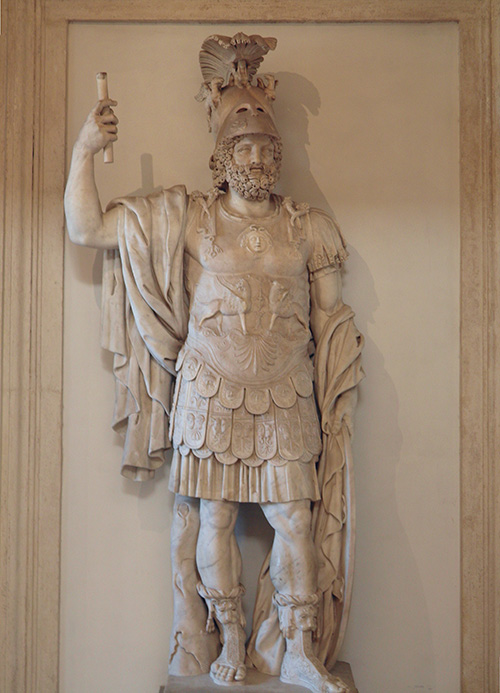
Colossal Statue of Mars Ultor sometimes identified as Pyrrhus, early 2nd century CE, Capitoline Museums
| Epithet | Meaning | Domain |
|---|---|---|
| Mars Pater | Father Mars | Agriculture, the suovetaurilia, devotio |
| Mars Gradivus | The Strider, the Marcher | The army marching to war, Porta Capena |
| Mars Quirinus | Mars of the Quirites | The citizen body at peace, oaths, treaties |
| Mars Ultor | The Avenger | Imperial cult, the Forum of Augustus |
| Mars Silvanus | Mars of the Woodland | Boundaries, fields, livestock |
| Mars Augustus | August Mars | Imperial cult, the salus of the emperor |
| Mars Alator | The Huntsman (Britain) | Provincial interpretatio |
| Mars Camulus | Tribal war god (Gaul, Britain) | Provincial interpretatio |
| Mars Lenus | Healing, protection (Treveri) | Provincial interpretatio |
| Mars Loucetius | Light, thunder (Rhine) | Provincial interpretatio |
| Mars Rigisamus | Greatest King (Britain, Gaul) | Provincial interpretatio |
| Mars Cocidius | Hunting, boundaries (Britain) | Provincial interpretatio |
Sources: the Roman cult titles in Palmer, The Archaic Community of the Romans (1970), and Rich, "Augustus's Parthian Honours" (1998); Cooley, "Beyond Rome and Latium" (2006), for Mars Augustus; the forty-nine Gallo-Roman dedications collected in the corpus of Mars with Celtic epithets.15,17,18,19
Mars, even among the Roman gods, had an especially wide variety of titles and epithets of immense importance, both to the Imperial cult and to a variety of cultural groups across the empire. Not only were some of these simply titles, but in some instances they were considered aspects of Mars or even distinct gods unto themselves. Mars Gradivus, "the Strider" or "the Marcher," was invoked before armies marched out to war and led Roman forces into battle; his temple outside the Porta Capena was the site where generals and troops performed rituals before departing on campaign, symbolizing the transition from civic to military space.15
Mars Ultor, "the Avenger," was perhaps the most politically charged epithet, the aspect under which Augustus built his famous temple in the Forum of Augustus. It embodied divine vengeance and justice, particularly in avenging the assassination of Caesar and recovering the military standards lost to the Parthians at the Battle of Carrhae in 53 BCE. Mars Pater, "Father Mars," was by contrast the oldest form of address, invoked in agricultural prayers and rituals, especially by the Arval Brethren and in the suovetaurilia, and emphasizing the god's protective and generative power over fields, livestock, and the Roman people; Mars Pater is among the several gods invoked in the ritual of devotio, by which a general offered himself in battle to secure a Roman victory.17,20
Mars Quirinus, previously mentioned, was associated with the peaceful, civic aspect of the god and linked to the deified Romulus and the citizen body at peace, served by the Flamen Quirinalis and honored by the Salii Collini on the Quirinal Hill. Mars Silvanus expressed the god's role as a guardian of boundaries and the threshold between cultivated land and wilderness, though there is speculation that this title was meant as a dual invocation of both gods rather than Silvanus' name being used as an epithet. Mars Augustus, finally, marked the affiliation of the god with the Imperial cult, and altars to Mars Augustus might be set up to further the well-being, the salus, of the emperor.5,15,18
In the provinces Mars was identified with local deities, resulting in a variety of syncretic forms attested in inscriptions and dedications; it should be stated that not every one of these gods is necessarily Mars or an aspect thereof. Mars Alator was the huntsman of Britain, Mars Albiorix the king of the land among the Gauls, Mars Caturix the king of battle of the Helvetii, Mars Camulus a tribal war god of Gaul and Britain, Mars Lenus a healer of the Treveri, Mars Loucetius a god of light and thunder on the Rhine, Mars Rigisamus the greatest king in Britain and Gaul, Mars Segomo a god of victory in Gaul, Mars Condatis a god of waters and healing in Britain, Mars Belatucadrus and Mars Cocidius local powers of war, hunting and boundaries in Britain.19,21
IV. Temples, Sacred Sites, and Priesthood
The Temple of Mars Ultor in the Forum of Augustus
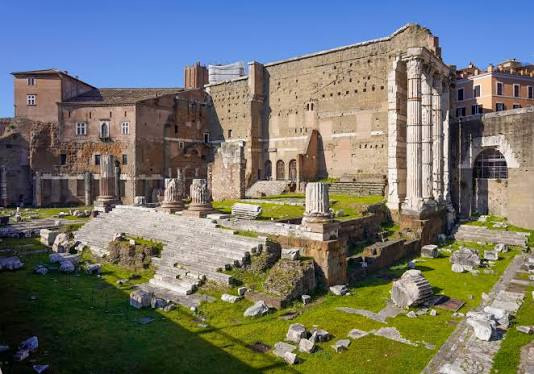
Temple of Mars Ultor located in the Forum of Augustus in Rome
The most famous temple dedicated to Mars, and often considered the most glorious, was the Temple of Mars Ultor, built by Augustus in the Forum of Augustus and dedicated in 2 BCE. The temple was a masterpiece of Augustan architecture and propaganda, featuring grand Corinthian columns, a high podium, and an interior housing statues of Mars, Venus, and the deified Julius Caesar. It served as the repository for the recovered military standards lost to the Parthians, the site for military commissions and triumphal adjudications and the departure of governors, and a symbol of divine vengeance and the restoration of Roman honor.17
By any measure the temple was monumental in scale. It rose upon a podium about three and a half meters in height, accessed by a wide staircase of twenty steps, and the platform extended to approximately 50 by 115 meters. Along the front stood eight towering columns of Carrara marble, each reaching a height of around eighteen meters, and three of these columns still stand at the northeastern edge of the forum. Inside stood three principal statues: at the center an imposing Mars Ultor in full military armor, gripping a spear and a shield; to his right a Venus with Cupid, from whom the Julii traced their lineage; on the left an image of Julius Caesar in his deified form as Divus Julius.22
The Temple of Mars Gradivus outside the Porta Capena
The earliest temple in Rome dedicated specifically to Mars lay beyond the Porta Capena, one of the entrances in the Servian Wall from which the Via Appia extended southward. Even in antiquity the exact date of its foundation was uncertain, some traditions linking it to a vow of the Latin War of 388 BCE and others suggesting an earlier origin, but by the Republican era the temple had acquired significant religious authority and its placement carried clear symbolic weight. Situated just outside the pomerium, it reflected the Roman religious law forbidding armed forces within the sacred limits, so that this extramural space became the proper setting for military rites; commanders preparing for campaigns visited the temple, the sacred spear of Mars was brought there from the Regia, and generals enacted the ritual shaking of weapons while invoking the phrase "Mars vigila." Only after completing this rite was an army considered formally entrusted to the god's protection.23
The Altar of Mars in the Campus Martius
In Rome's foundational legend, before the city itself existed, the plain between the city and the Tiber was the ground from which Romulus was carried to the divine realm by a storm; after the overthrow of Tarquinius Superbus, Rome's final Etruscan ruler, it was consecrated to Mars. Each spring Roman men gathered there before departing on campaign, and the citizen body assembled for major religious observances; aside from a modest altar of Mars near the center, the area remained largely undeveloped until the fifth century BCE.24
The central altar of Mars also played a key role in the census ritual known as the lustratio exercitus, conducted after the registration of citizens according to their military obligations. During this ceremony a suovetaurilia, a sacrifice of pig, sheep and bull, was led around the assembled populace before being offered to Mars, an act that ritually enclosed and purified the citizen body and renewed its readiness for military service. Held every five years, the rite was among the most solemn in the Roman religious calendar, with the Campus Martius as its focal point. Under Augustus the Campus underwent extensive redevelopment directed by Marcus Agrippa, and what had once been a largely open field was reshaped into a monumental urban landscape that both honored Mars and expressed the authority of the Augustan regime.25,26
Priesthoods and Cult Officials
The Flamen Martialis served as the high priest of the official state cult dedicated to Mars, belonging to the flamines maiores, the three most prominent among the fifteen flamens. In this capacity he presided over public ceremonies held on days sacred to Mars, including the ritual display and shaking of the god's sacred spears when Rome prepared for war. During the Larentalia the Flamen Martialis performed libations in honor of Acca Larentia, the wife of Faustulus who had raised the twins, and like the other major flamens he was subject to strict religious restrictions that limited his ability to pursue military or political roles; in the 240s BCE Aulus Postumius Albinus was prevented from taking up his command because the Pontifex Maximus, Lucius Caecilius Metellus, enforced the rule that a Flamen Martialis could not leave the city.27,28
The Salii, tied to the Latin salius, "to leap," and thus often called the leaping priests of Mars, were a group of twelve patrician youths said to have been established by the king Numa Pompilius. They were attired in archaic military dress, embroidered tunics, breastplates, short red cloaks, swords, and the pointed headdress known as the apex, and their principal duty was to safeguard the twelve sacred bronze shields, the ancilia, of a distinctive figure-eight shape. According to tradition one of these shields fell from the sky during Numa's reign, and on the advice of the nymph Egeria eleven identical copies were made to conceal the original, Egeria foretelling that as long as the true shield was preserved Rome would maintain its supremacy. Each March the Salii processed through the city performing ritual dances and chanting the Carmen Saliare, which Ovid remarked had already become obscure in his own time; during the imperial period the Senate ordered that the name of Augustus be incorporated into the chant.29,30
Lastly, the Arval Brothers, Fratres Arvales, were a priestly college responsible for performing agricultural rites to ensure the fertility of fields and the protection of crops and livestock. Their most important ceremony, the Ambarvalia, involved sacrifices to Mars Pater and processions around the boundaries of agricultural land.31
V. Symbols
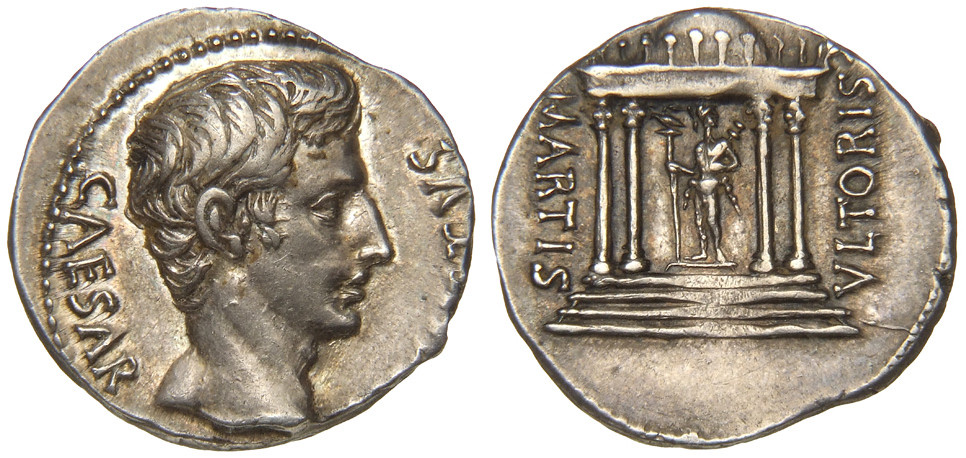
Coin of Augustus, about 19 BC, mint possibly Colonia Patricia (Córdoba), from the Metz denarius hoard (3.88 g). Obverse: CAESAR AVGVSTVS, head of Augustus. Reverse: MARTIS VLTORIS, Mars standing in a round temple of four columns, holding a legionary eagle and a standard. RIC I² 72. Münzkabinett, Staatliche Museen zu Berlin, 2359601.
Public domain. Münzkabinett, Staatliche Museen zu Berlin · Source and licence
Public domain. Münzkabinett, Staatliche Museen zu Berlin · Source and licence

The spear, hasta, was Mars's primary symbol, both in art and ritual. The sacred spear kept in the Regia was believed to move spontaneously as an omen of war or crisis; generals performed the Mars vigila ritual by shaking the spear before campaigns, and it was said to move on its own before moments of war or crisis, most famously before the assassination of Julius Caesar.32
The shield, ancile, was the second great symbol. As noted, the twelve sacred shields were carried by the Salii in their processions; according to myth one shield fell from heaven during Numa's reign and eleven copies were made to protect the original, and the shields symbolized Rome's divine protection and were among the city's most sacred objects. The combined spear and shield are the origin of the symbol of Mars, also used to denote males. Mars is often depicted wearing a crested helmet, galea, typically in the plumed Neo-Attic style, symbolizing discipline, preparedness, and martial virtue.29
The wolf, lupus, especially the she-wolf who suckled Romulus and Remus, is a central symbol of Mars's connection to Rome's founding and the untamed forces at the boundary of civilization. At the Battle of Sentinum in 295 BCE the appearance of the wolf of Mars, the Martius lupus, was a sign that Roman victory was to come. The wolf is an immediate contrast to the domestic dog, and its importance also ties Mars to the Norse Tyr, who sacrifices his hand to the wolf Fenrir.33
The woodpecker, picus, was sacred to Mars in Italic tradition, associated with prophetic knowledge and divine guidance; in some versions of the founding myth a woodpecker brings food to Romulus and Remus. Plutarch describes it as a bold and vigorous bird whose powerful beak could bore into oak trees until reaching their core, a strength believed to carry divine potency, so that the beak of the picus Martius was thought to possess protective qualities.34,35
Among the Latin peoples the woodpecker was held in such esteem that its flesh was not eaten, and it played an important role in augury. A mythic figure named Picus, sometimes described as a son of Mars, retained prophetic abilities even after being transformed into a woodpecker; the Umbrian word peiqu also means "woodpecker," and the Italic people known as the Picenes were believed to derive their name from this bird, which guided them during a ritual migration, the ver sacrum, undertaken in honor of Mars. In the land of the Aequi, Mars was said to possess an ancient oracle where prophecies were delivered by a woodpecker perched upon a wooden column.36
Mars was often represented as a young warrior in statuary, but it appears his features throughout the period of Roman conquests became more extreme than those of Ares, such as his large eyes representing the terror of war and the serpent. In imperial contexts, he is represented with a beard, elaborate armor with embellishment and a grandiose helm, a style of representation very rare in Greece.
VI. Mars as Head of the Roman Military
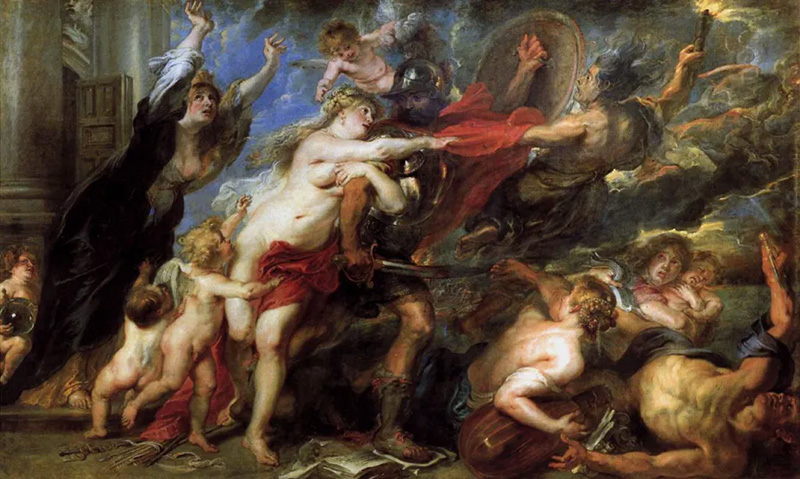
The Consequences of War, Peter Paul Rubens, 1638-9
Mars as the head of the military constitued something different from what moost Greek cities accorded Ares. For Rome, Mars stood second only to Jupiter and became guarantor of the state in matters of war. Historians perceive this in a particular way, as for example, Kurt Raaflaub drew a sharp contrast: the same function that Greece kept at a distance, Rome placed right at the heart of public religion..37
The soldier's cult was the most evident manifestation of this level. Mars represented virtus, courage and excellence, as a definition for the Roman man. By the Imperial period, Mars was seen as the archetype of Roman masculinity to which the Legions dedicated more offerings than to any god except Jupiter. His worship in the form of rites were carried to the frontiers of Rome by the armies, while the very calendar of campaigning ceason was built around his sacred rites beginning and ending.11,13
The god was also responsible for the transition from a youth to an adult warrior. The Campus Martius (the "Field of Mars") was the area in Rome in which the boys would train as well as the grounds upon which the citizens of Rome would assemble and be cleansed through lustratio exercitus; thus entrance into the military ranks meant a youth had entered into the very lands of Mars himself. The Salii, or twelve leaping priests, were themselves youthful sons of patricians; and as they marched through Rome at the beginning of each March carrying their sacred shields, it symbolized the coming of age for both the new year and its soldiers under the protection of the god.25,29
The god's discipline reached into the ideology of fair combat. Petronius could put into a freedman's mouth the proverb that Mars loves a fair fight, an ideal of the level field even where the speaker meant it with a sneer, and the same association tied the god to the Roman insistence that war be waged by rule and rite rather than by mere slaughter. Mars was the god of the army as an institution, not of butchery.38
VII. Mars and Venus
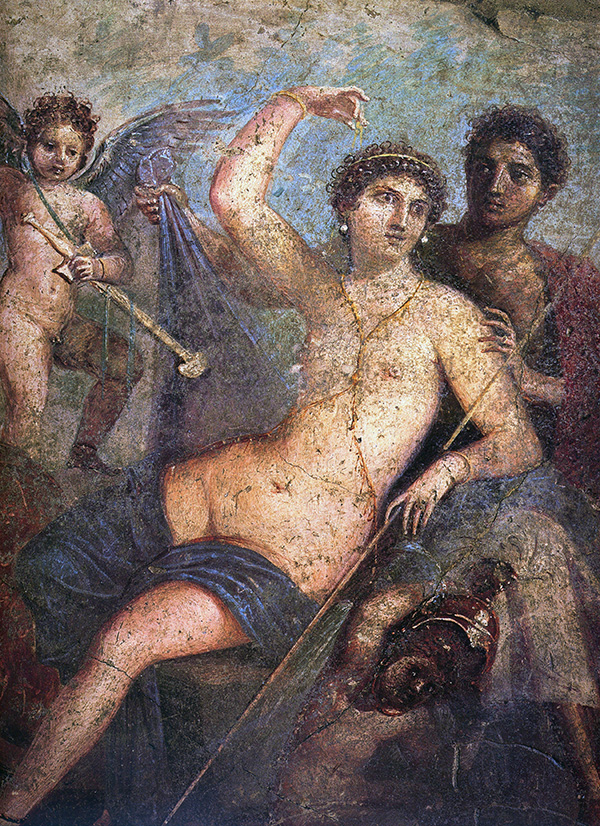
Mars and Venus of Pompeii, House of Mars and Venus
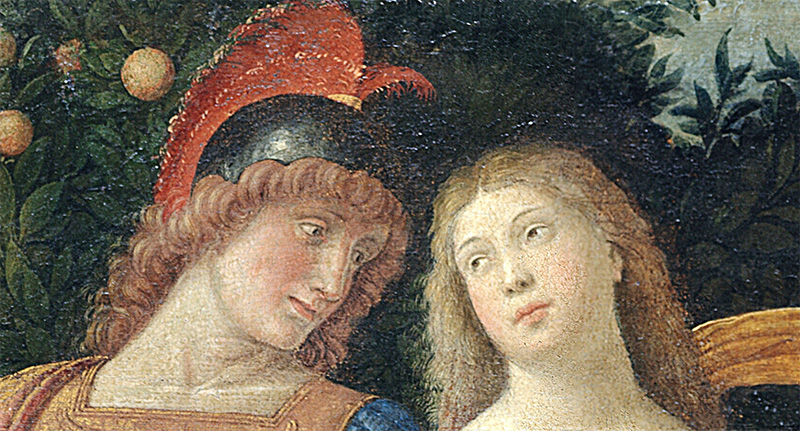
Mars and Venus, the Parnassus, Mantegna, 1497
By the end of the Roman republic, Mars and Venus had become a standard pair in Roman religion among the people. The earliest evidence for their visual association with each other is from about 217 BCE, when the "lectisternium" of that year paired the gods on couches in couples, and therefore coupled the god of war (Mars) to the goddess of love (Venus). In this way, the pairing of Mars and Venus would become perhaps the most popular subject for Roman artists, where the usually fierce warrior god, was tamed and softened by his loving wife's arms.39
The union through literature kept a note of Mars tied and softened. Reposianus's late poem focuses on the moment Gradivus almost breaks strong bonds that restrain him; love itself restrains him lest he hurt Venus's arms. The strongest god is held fast by the weakest of ties and this contradiction is the poem's whole argument.40
It is the funerary use of the couple that gives the popular cult its strangest depth. A large amount of Roman tombs (sarcophagi) have Mars & Venus represented as the perfect lovers; the dead duos are depicted in the form of the god and goddess. The interpretation is that the armed warrior turns to the beautiful woman who welcomes him into her arms. The romantic coupling of the war god and the love goddess becomes, in the tomb, a guarantee that love will endure even death itself and thus the soldier's dead body was buried under a symbol of love, not victory.39,41
The ambiguity of the couples, however, is suggestive of the fact that we cannot identify them as married necessarily, because their nudity and and embrace seems to contradict formal Roman representations of marriage. Even the erotic or love context can be put into doubt, though the exchange of glance is highly suggestive. On the other hand, the husband-wife connection is suggested by the inscriptions of Claudia Semne, for example, where they explicitly call her the “sweetest wife” and uxor of Marcus Ulpius Crotonensis and recording statues of including as Venus in the shrines within her funerary garden.
Unlike Ares, the Roman Mars had a wife in the form of the goddess Nerio, who is named for courage. In this way the Roman Mars enjoyed a fuller domestic life than did his Greek counterpart. Aulus Gellius preserved the memory of Nerio Martis; she was a martial power personified as the god's consort. Antiquarians by his time were already finding Nerio to be both ancient and somewhat obscure.42
VIII. The Ancient Mars

Mars, 15th c. manuscript of Épître d'Othéa by Christine de Pizan, British Library
The Arval Brethren brought those oldest of rituals into a documented history. An organization of twelve priests in line with the recorded Salli conducted yearly rituals to bless and protect the land's fertile earth. As part of this ritual, they would document their actions on stone at the sacred grove of the Dea Dia outside of Rome. There is an unusually complete record of their activities there. They connectedthe military (war) aspect with the soil by performing rituals for Mars Pater, who received the suovetaurilia from the army as well as the offerings protecting the crops.4,31
The Carmen Arvale, which were the hymns sung by the Brethren, represent the depth of antiquity for this deity. The Carmen Arvale are preserved in stone from 218CE. Its language had become so ancient by that point that both the priests who recited it and the scholars who transcribed it were unable to fully interpret it. The Carmen Arvale has survived as one of the oldest and least interpretable Latin texts. In calling upon the Lares and upon Marmar (an old reduplicated form of the god's name), the Carmen Arvale requests that he allow no ruin to befall the people.4,43
The same antiquity of the myth of sacred shields and the Priests who leaped preserved a rite whose meaning Ovid himself admitted he no longer could understand. When king Numa ruled, one sacred anvil fell from the sky and eleven copies were made to hide it. This anvil tied the god to Salian priests and their incomprehensible Carmen Salitianus chant which was as impenetrable to classical Romans as the Hymn of the Arvales. Egeria prophesized that Rome would endure as long as this shield was kept safe.29,43
IX. Mars and His Tie to the Republican and Imperial State
Mars was woven into machinery of the Roman state from its legendary beginning as the divine father of Romulus, Romulus himself and Quirinus. According to Dionysius of Halicarnassus, Brutus swore his first oath of vengeance to Mars after ejecting the royal Tarquinii for the noblewoman Lucretia's rape, thus the founding act of the Republic invoked Mars as a witness.44
The god was prone to avenge civil crimes which had threatened the states own order. According to Livy, the Decemvirate and the outrage at Verginia being violated were criminal trespasses of Roman virtue by which the god of the community was outraged and where the war gods desire for injustice to be quenched ould apply beyond the battlefield to protect the health of the body politic. Mars thus machinated the brutal downfall of the most repressive politicians.45
Later on in the end of the Republic, Augustus vowed the temple of Mars Ultor at Philippi during the war to avenge Caesar's murder. He finally dedicated this temple in Forum bearing his own name. Mars Avenger became the divine sponsor of new order and guardian of standards recovered from Parthia. Suetonius recorded this vow and Ovid gave Mars the words of the Avenger who is called to be present and to guide righteous blades.46,47
The Imperial Cult tied the god to the ruler over all provinces. Altars dedicated to Mars Augustus were built to guard the safety (salus) of each individual ruling Princeps. The god that led the Roman army was now an assurance of the power of the empire. His name would be combined with the name of each Emperor in dedication stones from Britain to Africa. The relationship of this war god with Rome lasted longer than any changes in Rome itself.18,21
X. Mars as Father of the Romans
In Cato’s agricultural treatise, there is the earliest known prayer to the gods for Mars as Father. In this prayer, the paterfamilias has asked that Father Mars will ward off diseases and ruin, allow the fruit trees, vineyards and orchards to flourish, and allow the shepherds and their flocks to be healthy. The god being petitioned was a protector of the field and its boundaries. Therefore the farmer-citizen who prayed to him, had achieved an aspect of the Roman ideal that owed no debt to any Greek model.5
The poets of the Empire address him as the author of the Roman race, and Rutilius Namatianus, writing as the Western Empire failed, still calls upon Mars as the parent of his people, the divine ancestor from whom the Romans took their descent and their character. The claim was genealogical and moral since to be sons of Mars meant to inherit his virtus.48,49
Ovid writes that when Romulus named the month after his own father, Mars, that is why March was at the beginning of the old Roman calendar as a testament to the god who had beget the founder. According to Ovid, the Romans gave honor to no power greater than to Mars; therefore Mars' being at the head of the months is evidence of this.49
The prophecy of Jupiter in Book I of the Aeneid of Virgil connects Rhea Silvia's sons by Mars (the founders) with the walls they established and the population they named, so the divine ancestry from Mars to his children is converted into the basis of their divinely sanctioned authority to rule.16
The fatherhood in the story had a promise for as long as there were graves. This is the epitome of Justin for Pompeius Trogus claims that Romans traced their ancestry back to him altogether. It was this same inheritance that made it possible for Rome to have a "martial" fate; it also established each Roman as part of a divine family tree.50
XI. The Festivals of Mars
| Festival | Date | Observance |
|---|---|---|
| Equirria | 27 February | Chariot or horse races on the Campus Martius |
| Feriae Marti (dies natalis) | 1 March | Birthday of Mars, also sacred to his mother Juno |
| Second Equirria | 14 March | A second day of chariot races |
| Mamuralia | 14 or 15 March | Driving out of Mamurius Veturius, the "old Mars" |
| Agonium Martiale | 17 March | An obscure sacrificial observance |
| Tubilustrium | 23 March | Purification of the war trumpets and the deploying army |
| October Horse | 15 October | Chariot race and Rome's only known horse sacrifice |
| Armilustrium | 19 October | Purification of arms; weapons stored for winter |
Sources: Varro, De lingua Latina 6.13; the Calendar of Filocalus; Lydus, De mensibus; Ovid, Fasti 3; Polybius, Histories; Scullard, Festivals and Ceremonies of the Roman Republic (1981).29,51,52,53,54,55
The Festivals of Mars defined each end of the Roman yearly military campaign from late February until late October. The first festival in this cycle was the Equirria (the Horse Races) that took place on 27th February on the Field of Mars. It was followed by the Feriae Marti (the Festival of Mars), where he celebrated his birthday at the start of the Roman New Year. There he was also united with his mother Juno on the same day as the Matronalia. Then there were the processions of the Salii, carrying the Sacred Shields, and in mid-March came the Mamuralia, at which a figure known as Mamurius Veturius was forced out of Rome (perhaps an old Mars) so that room could be made for the new.29,51
Purification as emphasis gave this time a rhythm of consecration with the Tubilustrium on 23 March of cleansing triumpets used for war, around the very time troops were about to deploy, preparing Rome for fighting that year. At the far end of the season, on the fifteenth there was a chariot race and sacrifice of the winning right horse, the only sacrifice of horses known at Rome, and the Armilustrium on the nineteenth when weapons were purified and stored for the winter. This closed the god's year as troops returned.29,54,55
According to Vincent Rosivach, it is notable that many of the festivals dedicated to Mars (the god of war) included lustrations and purifications, which were meant to cleanse the community of evil. Therefore, in opening the "season of battle," Mars, the god responsible for unleashing an army, was also called upon to protect the community from harm. The Roman year started and ended with Mars because he was capable of both sending armies out to fight and cleansing them afterwards.12,55
Sources and Bibliography
- Larissa Bonfante. Etruscan Life and Afterlife: A Handbook of Etruscan Studies. Detroit: Wayne State University Press, 1986. For the cognate forms Māvors, Oscan Māmers and the archaic Mamart-, and the debated relationship of the Latin name to the Etruscan Maris and the war god Laran.
- Michael York. "Romulus and Remus, Mars and Quirinus." Journal of Indo-European Studies 16, nos. 1–2 (Spring/Summer 1988): 153–72. For the rejected derivation from the Vedic Maruts and the thematic link of Mars to the Proto-Indo-European thunder god Perkwunos.
- Albert Dauzat. Dictionnaire étymologique des noms de famille et prénoms de France. Paris: Larousse, 1980. For the Latin adjectives Mārtius and mārtiālis and the derived names Marcus, Mark and Martin and the month of March.
- The Carmen Arvale and the acts of the Arval Brethren, in E. H. Warmington, ed. and trans., Remains of Old Latin, Volume IV: Archaic Inscriptions. Loeb Classical Library 359. Cambridge, MA: Harvard University Press, 1940. For the archaic hymn preserved on the stone of 218 CE, its invocation of Marmar and Mars, and its language already obscure in antiquity.
- Cato the Elder. On Agriculture. Translated by W. D. Hooper and Harrison Boyd Ash. Loeb Classical Library 283. Cambridge, MA: Harvard University Press, 1934. See De agricultura 83 and 141. For the prayer to Father Mars for the health of crops, vines, orchards, shepherds and flocks, and for Mars Silvanus in the rural offering.
- Ovid. Fasti. Translated by James G. Frazer. Revised by G. P. Goold. Loeb Classical Library 253. Cambridge, MA: Harvard University Press, 1931. See 5.229–260. For the birth of Mars from Juno alone by the flower of Flora, and her withdrawal to Thrace and the Sea of Marmara.
- W. Warde Fowler. The Roman Festivals of the Period of the Republic. London: Macmillan, 1908. For the Matronalia of the first of March, the birthday of Mars, and the place of March at the head of the old Roman year.
- Carole E. Newlands. Playing with Time: Ovid and the Fasti. Ithaca, NY: Cornell University Press, 1995. For the argument that Ovid's unique account of the god's birth underscores a vegetative and generative dimension of Mars.
- Richard Broxton Onians. The Origins of European Thought about the Body, the Mind, the Soul, the World, Time and Fate. Cambridge: Cambridge University Press, 1951. For the idea of virility as life force (vis) and excellence (virtus) as a defining attribute of Mars.
- Plautus. Miles Gloriosus, lines 11–12, and Casina prologue. Translated by Wolfgang de Melo. Loeb Classical Library 163 and 61. Cambridge, MA: Harvard University Press, 2011–2012. For Artotrogus' flattery that Mars would not compare his deeds, and the exhortation to win through true bravery, vincite virtute vera.
- Claire Lindgren. Classical Art Forms and Celtic Mutations: Figural Art in Roman Britain. Park Ridge, NJ: Noyes Press, 1980. For the argument that as the embodiment of virtus Mars symbolized the ideal of Roman masculinity, and for his prominence among soldiers by the third century CE.
- Vincent J. Rosivach. "Mars, the Lustral God." Latomus 42, no. 3 (1983): 509–21. For the lustral character of the festivals of Mars, the Tubilustrium and Armilustrium, and the god's role as a protector or guardian, with the Servian notice of the spear shaken in the Regia and the cry Mars vigila.
- Matthew Dillon and Christopher Matthew, eds. Religion and Classical Warfare: The Roman Republic. Barnsley: Pen and Sword, 2020. For the cycle of March and October festivals framing the campaigning season and its decline in the second and third centuries CE.
- Plutarch. Lives, Volume I: Life of Romulus 4. Translated by Bernadotte Perrin. Loeb Classical Library 46. Cambridge, MA: Harvard University Press, 1914. For the she-wolf and woodpecker sacred to Mars, the belief in the god's paternity of the twins, and the alternative that Amulius ravished Rhea Silvia in armor.
- Robert E. A. Palmer. The Archaic Community of the Romans. Cambridge: Cambridge University Press, 1970. For Mars Quirinus as guardian of the Quirites and guarantor of oaths and treaties, and the formula distinguishing Mars Gradivus in war from Quirinus in peace.
- Virgil. Aeneid. Translated by H. Rushton Fairclough, revised by G. P. Goold. Loeb Classical Library 63–64. Cambridge, MA: Harvard University Press, 1999. See Aeneid 1.273–277, 6.777–780 and 9.1–end. For the prophecy of Jupiter tracing the line from Ilia's sons by Mars to the walls of Rome, Romulus as the son of Mars, and the god powerful in war aiding the Latins.
- J. W. Rich. "Augustus's Parthian Honours, the Temple of Mars Ultor and the Arch in the Forum Romanum." Papers of the British School at Rome 66 (1998): 71–128. For Mars Ultor as the avenger of Caesar and recoverer of the standards lost at Carrhae, and the Temple of Mars Ultor as repository of the recovered aquilae.
- A. E. Cooley. "Beyond Rome and Latium: Roman Religion in the Age of Augustus." In Religion in Republican Italy, edited by Celia E. Schultz and Paul B. Harvey Jr., Yale Classical Studies 33. Cambridge: Cambridge University Press, 2006. For the honorific Mars Augustus marking the god's affiliation with the Imperial cult and the salus of the emperor.
- "Mars with Celtic Epithets: Forty-Nine Latin Inscriptions." Gallo-Roman Latin dedications, corpus of continental Celtic sources. For the provincial identifications Mars Alator, Albiorix, Caturix, Camulus, Lenus, Loucetius, Rigisamus, Segomo, Condatis, Belatucadrus and Cocidius.
- Calvert Watkins. "Some Indo-European Prayers: Cato's Lustration of the Fields." In How to Kill a Dragon: Aspects of Indo-European Poetics. Oxford: Oxford University Press, 1995. For Mars Pater in the suovetaurilia and the archaic structure of the Roman lustral prayer.
- Tyler Franconi. "Provincial Cults of Mars in the Roman Empire." In Roman in the Provinces: Art on the Periphery of Empire, edited by Lisa R. Brody and Gail L. Hoffman. Chestnut Hill, MA: McMullen Museum of Art, 2014. For the range of provincial cults of Mars and their local character.
- L. Richardson Jr. A New Topographical Dictionary of Ancient Rome. Baltimore: Johns Hopkins University Press, 1992. S.v. Mars Ultor, aedes. For the dimensions of the Temple of Mars Ultor, its columns of Carrara marble, and the three cult statues of Mars, Venus and Divus Julius.
- Editors of RomanMythology.com. "The Temples of Mars in Ancient Rome." RomanMythology.com, 2026. For the temple of Mars Gradivus outside the Porta Capena, its extramural setting, and the rite of the sacred spear and the cry Mars vigila before campaigns.
- Paul W. Jacobs II and Diane Atnally Conlin. Campus Martius: The Field of Mars in the Life of Ancient Rome. New York: Cambridge University Press, 2015. For the consecration of the plain to Mars after the expulsion of Tarquinius Superbus and the modest early altar at its center.
- William Smith. "Lustratio." In A Dictionary of Greek and Roman Antiquities. London: John Murray, 1875. For the lustratio exercitus, the suovetaurilia led around the citizen body, and its five-yearly performance on the Campus Martius.
- Samuel Ball Platner and Thomas Ashby. A Topographical Dictionary of Ancient Rome. London: Oxford University Press, 1929. For the Augustan redevelopment of the Campus Martius under Agrippa and the earlier Martian sacred sites incorporated within it.
- John Scheid. An Introduction to Roman Religion. Translated by Janet Lloyd. Edinburgh: Edinburgh University Press, 2003. For the office of the Flamen Martialis among the flamines maiores and the restrictions of the major flaminate.
- Livy. History of Rome, Volume V: Books 21–22, with the epitomes. Translated by B. O. Foster. Loeb Classical Library. Cambridge, MA: Harvard University Press, 1929. Periocha 19. For Lucius Caecilius Metellus, Pontifex Maximus, preventing the Flamen Martialis Aulus Postumius Albinus from leaving the city.
- Ovid. Fasti, Book 3, lines 259–392. Translated by James G. Frazer, revised by G. P. Goold. Loeb Classical Library 253. Cambridge, MA: Harvard University Press, 1931. For the shield fallen from heaven, the eleven copies made on Egeria's advice, the Salii and their obscure Carmen Saliare, and the god's symbols.
- Res Gestae Divi Augusti 10. In Velleius Paterculus. Res Gestae Divi Augusti, translated by Frederick W. Shipley, Loeb Classical Library 152. Cambridge, MA: Harvard University Press, 1924. For the incorporation of the name of Augustus into the hymn of the Salii.
- C. Bennett Pascal. "Tibullus and the Ambarvalia." American Journal of Philology 109, no. 4 (1988): 523–36. For the Arval Brothers, the Ambarvalia, and the sacrifices to Mars Pater in the lustration of the fields.
- Aulus Gellius. Attic Nights 4.6.1, and Cassius Dio, Roman History 44.17.2. Loeb Classical Library 195 and 66. Cambridge, MA: Harvard University Press, 1927 and 1916. For the sacred spear of the Regia moving of itself as an omen, most famously before the assassination of Julius Caesar.
- Livy. History of Rome, Volume IV: Books 8–10. Translated by B. O. Foster. Loeb Classical Library 191. Cambridge, MA: Harvard University Press, 1926. See 10.27. For the wolf of Mars, the Martius lupus, appearing at the Battle of Sentinum in 295 BCE as a sign of Roman victory.
- Plutarch. Moralia, Volume II: Roman Questions 21. Translated by Frank Cole Babbitt. Loeb Classical Library 245. Cambridge, MA: Harvard University Press, 1928. For the woodpecker sacred to Mars as a bold and vigorous bird whose beak could bore through oaks to their core.
- Pliny. Natural History, Volume VII: Books 24–27. Translated by W. H. S. Jones. Loeb Classical Library 393. Cambridge, MA: Harvard University Press, 1956. See 27.60. For the protective potency of the beak of the picus Martius and its association with the peony gathered by night.
- Dionysius of Halicarnassus. Roman Antiquities, Volume I: Books 1–2. Translated by Earnest Cary. Loeb Classical Library 319. Cambridge, MA: Harvard University Press, 1937. See 1.14.5. For the woodpecker of the Picenes and the oracle of Mars in the land of the Aequi where a woodpecker delivered prophecy from a wooden column.
- Kurt A. Raaflaub, ed. War and Peace in the Ancient World. Malden, MA: Blackwell, 2007. For the contrast between the Greek contempt for Ares and the Roman elevation of Mars to a central place in public religion second only to Jupiter.
- Petronius. Satyricon. Translated by Michael Heseltine, revised by E. H. Warmington. Loeb Classical Library 15. Cambridge, MA: Harvard University Press, 1913. See 45. For the proverb that Mars loves a fair fight, spoken by a freedman in a sardonic context.
- Robert Schilling. "Venus." In Dictionnaire des mythologies et des religions des sociétés traditionnelles et du monde antique, edited by Yves Bonnefoy. Paris: Flammarion, 1981. For the visual coupling of Mars and Venus by 217 BCE and the lectisternium evidence for their pairing.
- Reposianus. De concubitu Martis et Veneris (The Intrigue of Mars with Venus). In Minor Latin Poets, Volume II, translated by J. Wight Duff and Arnold M. Duff, Loeb Classical Library 434. Cambridge, MA: Harvard University Press, 1934. For the image of Gradivus restrained by love from bursting the bonds lest he hurt the arms of Venus.
- Michael Koortbojian. "The Mytho-Historical Coupling of Mars and Venus on Roman Sarcophagi." In Myth, Meaning and Memory on Roman Sarcophagi. Berkeley: University of California Press, 2015. For the funerary use of Mars and Venus as the ideal loving pair, the dead husband and wife rendered as the god and goddess.
- Aulus Gellius. Attic Nights 13.23. Translated by John C. Rolfe. Loeb Classical Library 200. Cambridge, MA: Harvard University Press, 1927. For Nerio Martis, the goddess Valor as the wife of Mars in the old cult, and the antiquarian memory of the pairing.
- Gary Forsythe. A Critical History of Early Rome: From Prehistory to the First Punic War. Berkeley: University of California Press, 2005. For the archaic character of the Carmen Arvale and Carmen Saliare, the antiquity of the war god's cult, and the shield myth of Numa and the Salii.
- Dionysius of Halicarnassus. Roman Antiquities, Volume III: Books 5–6. Translated by Earnest Cary. Loeb Classical Library 357. Cambridge, MA: Harvard University Press, 1940. See 4.84 and 5.1. For Brutus swearing his oath of vengeance for Lucretia by Mars at the founding of the Republic.
- Livy. History of Rome, Volume II: Books 3–4. Translated by B. O. Foster. Loeb Classical Library 133. Cambridge, MA: Harvard University Press, 1922. See Book 3. For the outrage against Verginia and the decemvirate presented among the civil crimes against Roman order.
- Suetonius. Lives of the Caesars, Volume I: Divus Augustus 29. Translated by J. C. Rolfe. Loeb Classical Library 31. Cambridge, MA: Harvard University Press, 1914. For the vow of the Temple of Mars Ultor at Philippi and its dedication in the Forum of Augustus.
- Ovid. Fasti 5.545–598. Translated by James G. Frazer, revised by G. P. Goold. Loeb Classical Library 253. Cambridge, MA: Harvard University Press, 1931. For Mars Ultor called upon to be present and to guide the blades of the righteous avengers of Caesar.
- Rutilius Namatianus. De reditu suo. In Minor Latin Poets, Volume II, translated by J. Wight Duff and Arnold M. Duff, Loeb Classical Library 434. Cambridge, MA: Harvard University Press, 1934. See 1.67–68. For the invocation of Mars as the author and parent of the Roman race in the failing Western Empire.
- Ovid. Fasti, Book 3, lines 73–98. Translated by James G. Frazer, revised by G. P. Goold. Loeb Classical Library 253. Cambridge, MA: Harvard University Press, 1931. For Romulus naming the first month for his father Mars and the claim that the ancients honored the war god above all.
- Justin. Epitome of the Philippic History of Pompeius Trogus. Translated by J. C. Yardley. Atlanta: Scholars Press, 1994. For the origin myth tracing the Roman people to the god of war.
- Varro. On the Latin Language. Edited and translated by Roland G. Kent. Loeb Classical Library 333. Cambridge, MA: Harvard University Press, 1938. See 6.13. For the Equirria of February and March and the March observances of the god.
- The Calendar of Filocalus (Chronography of 354). In Inscriptiones Latinae Antiquissimae, CIL I². For the entry of the first of March as the dies natalis of Mars, a feria also sacred to Juno.
- John Lydus. De mensibus (On the Months). Edited by Richard Wünsch. Leipzig: Teubner, 1898. For the mid-March rite of driving out the old Mars, the Mamuralia.
- Polybius. The Histories. Translated by W. R. Paton, revised by F. W. Walbank and Christian Habicht. Loeb Classical Library. Cambridge, MA: Harvard University Press, 2010. For the October Horse, the chariot race and the sacrifice of the right-hand horse.
- H. H. Scullard. Festivals and Ceremonies of the Roman Republic. London: Thames and Hudson, 1981. For the reconstruction of the festival year of Mars, the Armilustrium of 19 October, and the lustral purification of arms stored for winter.