




14 min read
The Wolf of Apollo
author: High Priest Zevios Metathronos
λύκος (lýkos)
Apollo Lykeios, Leto the she-wolf, Zeus Lykaios, the wolf of Mars and the wolves of Odin: the power of the bond.
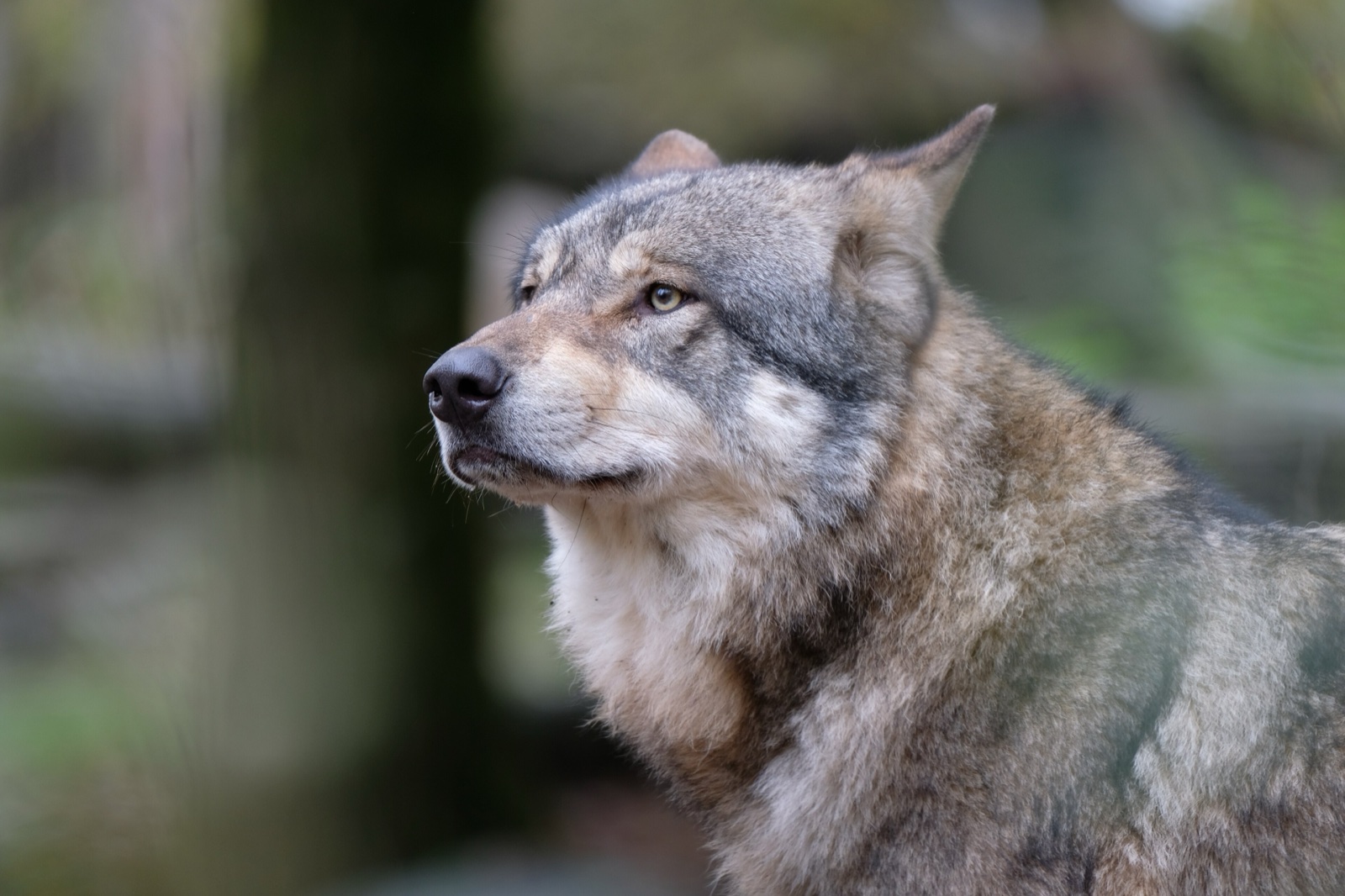
Musicaline · CC BY-SA 4.0 · Wikimedia Commons

The wolf is the beast of the bond. Apollo took His name Lykeios from it, a she-wolf nursed the sons of Mars on the Tiber, and Odin feeds 2 wolves from His own table; when the bond breaks, the wolf becomes Fenrir.
| Realm | Beasts of the Earth |
|---|---|
| Greek | λύκος (lýkos); λύκαινα (lýkaina), she-wolf |
| Latin | lupus; lupa (she-wolf) |
| Other Names | Old Norse vargr, úlfr; the wolves Geri and Freki; Fenrir |
| Species | Canis lupus (grey wolf) |
| Gods | Apollo Lykeios, Leto, Zeus Lykaios, Mars (Ares), Odin (Geri and Freki) |
| Material Capacity | Family packs, defended territories, a long-range howl and treks of more than 1,600 km |
| Spiritual Capacity | The power of the bond: fidelity and governed appetite within Ma'at, and its reverse, the devouring of Izfet |
| Element and Sphere | Earth and twilight; the forest edge, the mountain altar and the hearth |
The Living Animal
The grey wolf, Canis lupus, is one of the most wide-ranging land animals; its original range covered most of the Northern Hemisphere[1]. In Yellowstone males weigh 100 to 130 pounds (45 to 59 kg) and females 80 to 110 pounds (36 to 50 kg)[2]. Wolves can run at 55 to 70 km/h[1].
The pack is a family. The wolf biologist L. David Mech concluded that the typical pack is a family, with the adult parents guiding the group in a division of labour[3]; packs are made up of the breeding pair and their offspring, including young of previous years[1]. Most young wolves leave their natal pack between 1 and 3 years of age[1].
Each family holds land. A pack's territory ranges from 130 to 13,000 square kilometres and is defended against intruders[1]; in Yellowstone a home range runs from 300 to 500 square kilometres, varying with pack size, food and season[2]. Scent marks carry messages between neighbouring packs[1], and prey is found by chance or by scent[1].
The howl is the wolf's voice across distance. Howling is the one form of wolf communication intended for long range: wolves use it to locate one another and rally together, to keep strangers away and to guard pups and kills[4].
The wolf's endurance is the stuff of record. Daily movements can reach 200 km, at a usual pace of 8 km/h[1]. The collared wolf OR-7 left his pack in north-eastern Oregon in September 2011 and crossed into California on 28 December, averaging some 15 air miles a day[5]; by then he had covered more than 1,000 miles (1,600 km) and become the first documented wolf in California since 1924[6].
From this animal came the dog. The grey wolf was the first species to give rise to a domestic population, and ancient genomes show dogs to be closer overall to ancient wolves of eastern Eurasia than to those of the west[7]. The story of that descent belongs to The Dog.
The Spiritual Capacity: The Power of the Bond
In Zevism the wolf is the power of the bond. It lives by fidelity to its family, its land and its leaders, and it shows what that fidelity becomes in 2 conditions: under the Gods it guards, nourishes and serves; cut loose from Them it devours. The wolf is the test of whether a strong appetite stands within Ma'at or outside it.
The wolf stands first beside the God of light. At Athens the Lykeion was sanctuary of Apollo from the beginning, and there the God was first called Lykeios[8]; the epithet was read as "the wolf-god"[9]. At Argos a wolf fell on a herd before the walls and overcame its bull, and Danaus, taking the sign as sent by Apollo, founded the temple of Apollo Lykios[8]. The Temple knows Apollo as Helios, Mithra, Utu and Shamash[10]: the wolf is the guardian at the side of the solar God.
Leto, mother of Apollo, came to Delos as a she-wolf. Aristotle reports the tale told to explain why wolves give birth within 12 days of the year: in so many days Leto was brought from the Hyperboreans to Delos in the form of a she-wolf, for fear of Hera[11]. In the Temple's reading the wolf-mother carries the light into the world: the sun's birth is guarded by the animal of the bond.
On Mount Lykaion the wolf is judgment. Lycaon brought a human infant to the altar of Zeus Lykaios and was turned at once from a man into a wolf[12]; the Arcadians said that afterward a man would become a wolf at the rite of Zeus Lykaios and return to human form after 9 years only if he abstained from human flesh[12]. Zeus Lykaios is the Sovereign who answers impiety: the man who breaks the sacred bond takes the shape of his own hunger.
In the North the 2 conditions stand side by side. Odin, in the Temple's teaching a face of Zeus, feeds His wolves Geri and Freki from His own table and lives on wine alone[13]. Fenrir is the wolf outside the bond: the Gods bound him, and Tyr lost His hand in the wolf's mouth[14]; at Ragnarök the fetters burst, the wolf runs free, and Odin goes out to fight him[15]. Fenrir answers to Izfet, the chaos that Ma'at keeps at bay[16]: dissolution with jaws, devouring order itself.
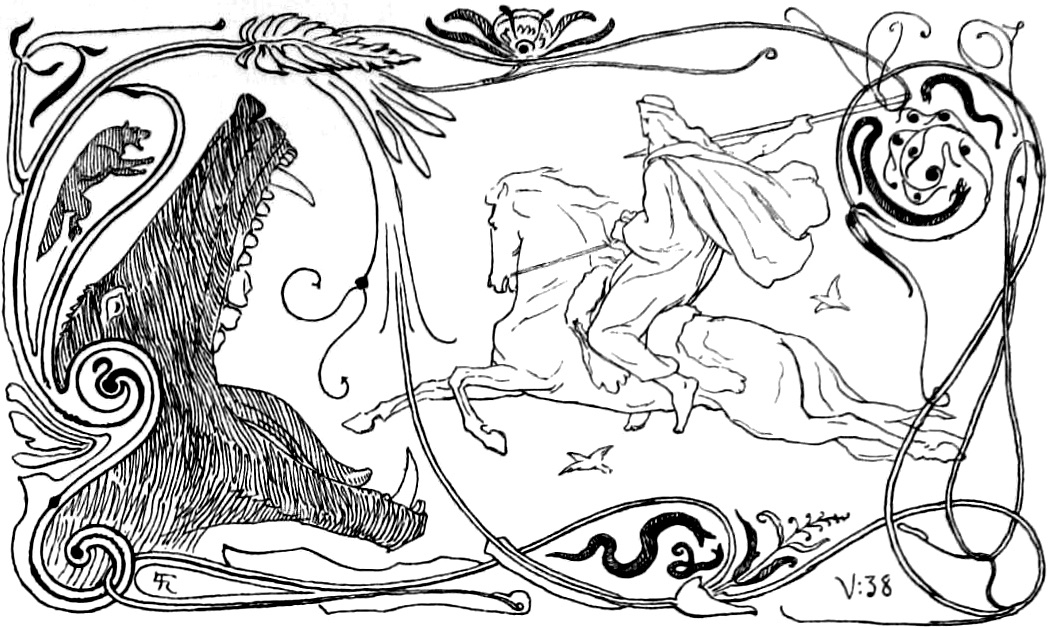
Lorenz Frølich · Public domain · Wikimedia Commons

Where Matter and Spirit Meet
The living wolf and the Zevist wolf are the same creature read at 2 depths. Each capacity of the body is the visible form of a capacity of the soul.
- The family pack. The pack is parents and children, guided by the elders in a division of labour. This is the soul's power of fidelity and of order in the household: each member strong, each in its place. The wolves of Odin eat from His table; the soul that keeps its bonds eats from the table of the Gods.
- The defended territory. Each pack holds and marks its land. In the soul this is the boundary Ma'at draws: the clear line between what is one's own and what is not. Fenrir is the wolf without a territory, a hunger that recognises no limit; the Zevist keeps the boundary that the wolf keeps.
- The howl. The wolf's one long-range voice gathers the family and warns the stranger. It belongs to the throat chakra, the centre of the word: speech that binds the people together across distance and sets the limit against the intruder.
- The long trek. A single wolf crossed more than 1,600 km to found a new family. This is the persistence of the will on the path of Arete: the soul that keeps moving, day after day, toward its own territory in the Gods.
- The wolf that became the dog. The first domestic animal came from the wolf. The wild power, brought into the bond with humankind, turned into the most faithful of companions: the image of every passion that, governed, becomes a servant of the soul.
The Gods and Their Many Names
The wolf gathers around 3 powers across the Indo-European world: the God of light who takes its name, the Sovereign who judges and feeds it, and the God of war whose sons it nursed. In Hellas these are Apollo, Zeus Lykaios and Ares; at Rome the war God is Mars, whom the Temple knows as Ares[10]; in the North the Sovereign is Odin, a face of Zeus, and the wolf unbound is Fenrir.
| Civilization | God (and the Temple's identity) | The Bond with the Animal | Witness |
|---|---|---|---|
| Athens | Apollo Lykeios (Helios, Mithra) | His sanctuary, the Lykeion, where He was first called Lykeios | Pausanias 1.19.3[8] |
| Argos | Apollo Lykios | A wolf overcomes the bull of the herd; Danaus founds the temple | Pausanias 2.19.3-4[8] |
| Delos | Leto, mother of Apollo | Comes from the Hyperboreans to Delos as a she-wolf in 12 days | Aristotle, History of Animals 6.35[11] |
| Arcadia | Zeus Lykaios | Lycaon turned into a wolf at the altar of Zeus; the earth altar on the summit of Lykaion | Pausanias 8.2.3, 8.38.7[12][17] |
| Rome | Mars (Ares, Montu) | Named father of the twins; the she-wolf suckles them; the wolf sacred to Mars | Livy 1.4.2-7; Plutarch, Romulus 4.2[18][19] |
| Rome | The legions | The wolf among the 5 legionary standards before Marius | Pliny, Natural History 10.16[20] |
| Scandinavia | Odin (Zeus) | Feeds His wolves Geri and Freki | Grímnismál 19[21] |
| Scandinavia | Odin against Fenrir | The wolf, bound by the Gods, runs free at Ragnarök; Odin fights him and Vidar avenges Him | Völuspá 44, 53-54[15] |
The thread is the bond itself. Apollo, Leto and Mars stand with the wolf that guards and nourishes: the she-wolf of Delos brings the God of light to His birth, and the she-wolf of the Tiber nurses the sons of Mars. Zeus Lykaios and Odin stand above the wolf as its masters, feeding it or judging it.
Where the bond fails, the same animal turns against the order of the world: Lycaon in Arcadia, Fenrir in the North. In the Temple's teaching Zeus, Jupiter and Odin are 1 Sovereign, and the wolf under every name shows the same law: hunger serves when it is bound to the God, and devours when it breaks free.
Ancient Witnesses
The witnesses speak in Greek, Latin and Old Norse. Aristotle tells of the she-wolf Leto, Pausanias of Lycaon and Zeus Lykaios, Livy of the she-wolf of the Tiber, and the Grímnismál of the wolves of Odin.
Aristotle, History of Animals 6.35 [11]
φασὶ γὰρ πάντας τοὺς λύκους ἐν δώδεχ’ ἡμέραις τοῦ ἐνιαυτοῦ τίκτειν.
Τούτου δὲ τὴν αἰτίαν ἐν μύθῳ λέγουσιν, ὅτι ἐν τοσαύταις ἡμέραις τὴν Λητὼ παρεκόμισαν ἐξ Ὑπερβορέων εἰς Δῆλον, λύκαιναν φαινομένην διὰ τὸν τῆς Ἥρας φόβον.For they say that all wolves give birth within 12 days of the year.
The cause of this they tell in a myth: that in so many days they brought Leto from the Hyperboreans to Delos, in the form of a she-wolf, for fear of Hera.Aristotelis Opera, vol. 4, ed. I. Bekker (Oxford, 1837) · Translation: Temple of Zeus. Aristotle adds that whether this is truly the time of gestation has not yet been observed.
Pausanias, Description of Greece 8.2.3 [8]
Λυκάων δὲ ἐπὶ τὸν βωμὸν τοῦ Λυκαίου Διὸς βρέφος ἤνεγκεν ἀνθρώπου καὶ ἔθυσε τὸ βρέφος καὶ ἔσπεισεν ἐπὶ τοῦ βωμοῦ τὸ αἷμα, καὶ αὐτὸν αὐτίκα ἐπὶ τῇ θυσίᾳ γενέσθαι λύκον φασὶν ἀντὶ ἀνθρώπου.
But Lycaon brought a human infant to the altar of Zeus Lykaios, slew the infant and poured its blood upon the altar; and at once, they say, upon that deed he became a wolf instead of a man.
Pausaniae Graeciae Descriptio, ed. F. Spiro (Leipzig, 1903) · Translation: Temple of Zeus. Perseus Hopper: Perseus:text:1999.01.0159, book 8.
Livy, Ab Urbe Condita 1.4.6 [18]
lupam sitientem ex montibus, qui circa sunt, ad puerilem vagitum cursum flexisse;
eam summissas infantibus adeo mitem praebuisse mammas, ut lingua lambentem pueros magister regii pecoris invenerita thirsty she-wolf from the hills round about turned her course toward the crying of the children;
she lowered her teats to the infants so gently that the keeper of the royal flock found her licking the boys with her tongue.Titi Livi ab urbe condita, ed. W. Weissenborn and M. Müller (Leipzig: Teubner) · Translation: Temple of Zeus. The sentence is reported speech introduced by "tenet fama", "the story holds". The edition prints the correction eam for the manuscript reading ear.
Gera ok Freka seðr gunntamiðr hróðigr Herjaföður;
en við vín eitt vápngöfugr Óðinn æ lifir.Geri and Freki the battle-trained, glorious Father of Hosts, feeds;
but on wine alone the weapon-proud Odin ever lives.Poetic Edda, Heimskringla.no text · Translation: Temple of Zeus, compared with H. A. Bellows (1923). Odin, in disguise as Grímnir, is the speaker.
Universal Significance
The wolf's name still sits in the schools of Europe. The Lykeion, where Aristotle taught, took its name from an epithet of Apollo probably understood as "wolfish", from lykos, "wolf"; French lycée, the state secondary school, carries the same name[22]. The Lykeion lay outside and east of the walls of Athens and served for gymnastic and military exercises; Aristotle set up his school there on his return to Athens in 335 BC[9].
Rome made the she-wolf its emblem. Livy tells how a thirsty she-wolf turned to the cries of the exposed twins and suckled them, and he adds that some thought the shepherds' wife Larentia had been called lupa among them[18]. Plutarch writes that the she-wolf and the woodpecker were held sacred to Mars[19], and Pliny records that before Marius gave the legions the eagle alone, the wolf marched among their standards[20]; the eagle's own story belongs to The Eagle.
The bronze Lupa Capitolina, given to the Roman people by Pope Sixtus IV and kept in the Capitoline Museums as inv. MC1181, is dated by the museum to the 5th century BC as Etruscan or Magna Graecian work[23]. Science has challenged that date. Radiocarbon dating places the casting between 1021 and 1153 AD at 95% confidence[24], and a 2021 thermoluminescence study judged the traditional Etruscan origin ruled out, in good agreement with a medieval date[25]. The twins beneath her are a later addition, attributed by some to Pollaiolo[23].
The wolf returned to the lands it had lost. In Yellowstone the last pack was killed in 1926; in 1995 and 1996, 31 grey wolves from western Canada were released in the park, and 10 more from north-western Montana followed in 1997[26].
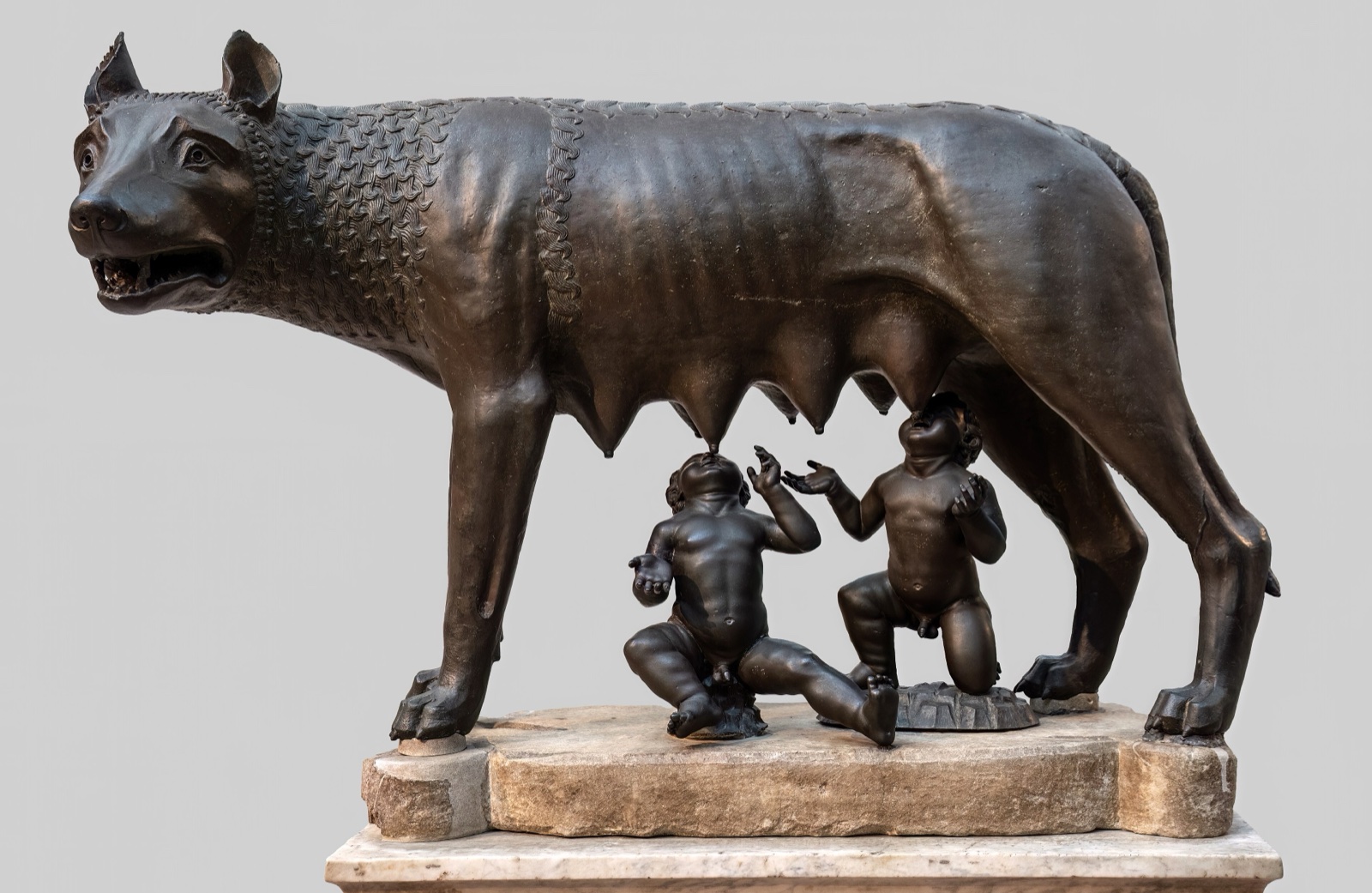
Unknown · CC0 · Wikimedia Commons

In Zevist Contemplation
The Zevist uses the wolf's image to keep the bonds of life within Ma'at: fidelity to family and Gods, clear boundaries, the governed appetite. The practices below require no priest and promise no more than the soul achieves by its own effort.
- The pack around the hearth. Name the members of the family, by blood or by choice, and hold each in the heart for 1 breath. The wolf's strength comes from the pack; so does the Zevist's. Renew a duty owed to 1 of them in deed, not only in thought.
- The howl at the throat. Breathe into the throat chakra and sound a long, low vowel on the out-breath, as the wolf sends its voice across the hills. Then examine speech: let the word gather and protect, never scatter the family or wound the stranger without cause.
- The binding of Fenrir. When an appetite strains to break its limit, recall the Gods binding the wolf. Do not feed the hunger and do not deny that it exists: bind it, firmly and without hatred, and keep the hand of Tyr in mind, the price courage pays for order.
- The wolves at Odin's table. Before eating, give the first portion of attention to the Gods, as Odin feeds Geri and Freki from His own table. The appetite that receives its food from the hand of the Sovereign serves Him; this is Arete in the body's daily life.
The wolf has no older symbol page on the site. Read with it Apollo, the God of the Lykeion, and Ma'at, the order that keeps Fenrir bound.
Continue exploring
Related Pages
- The Gods: Apollo
- The Gods: Zeus
- The Gods: Ares
- The Gods: Maat
- Sacred Animal: The Dog of Hecate
- Sacred Animal: The Jackal of Anubis
- Sacred Animal: The Bear of Artemis
- Previous: The Bear of Artemis
- Next: The Jackal of Anubis
- All 32 Sacred Animals
- All symbols