













13 min read
Ἡ Ἱερὰ Τέχνη: The Alchemy of the Soul
author: High Priest Zevios Metathronos
The Greek alchemists of Egypt practised an art that later writers called sacred and divine, and they marked the stages of its Great Work by colour; the Latin West came to count 3, black, white and red, with the gold at the end. The Temple reads the sacred art as the Work done on a human being. A soul is cleared in the blackening, when the old order dissolves and buried things rise; it's formed in the whitening, when the person cuts a self out of rough stone by habit and trial; and it's tinctured in the gold, when its order becomes unity within and a golden life without. This index gathers the 3 teachings, sets the stages side by side, and shows how each is lived at once inwardly and outwardly, in Meditation and Theurgy, and in the liturgy of Zevism.
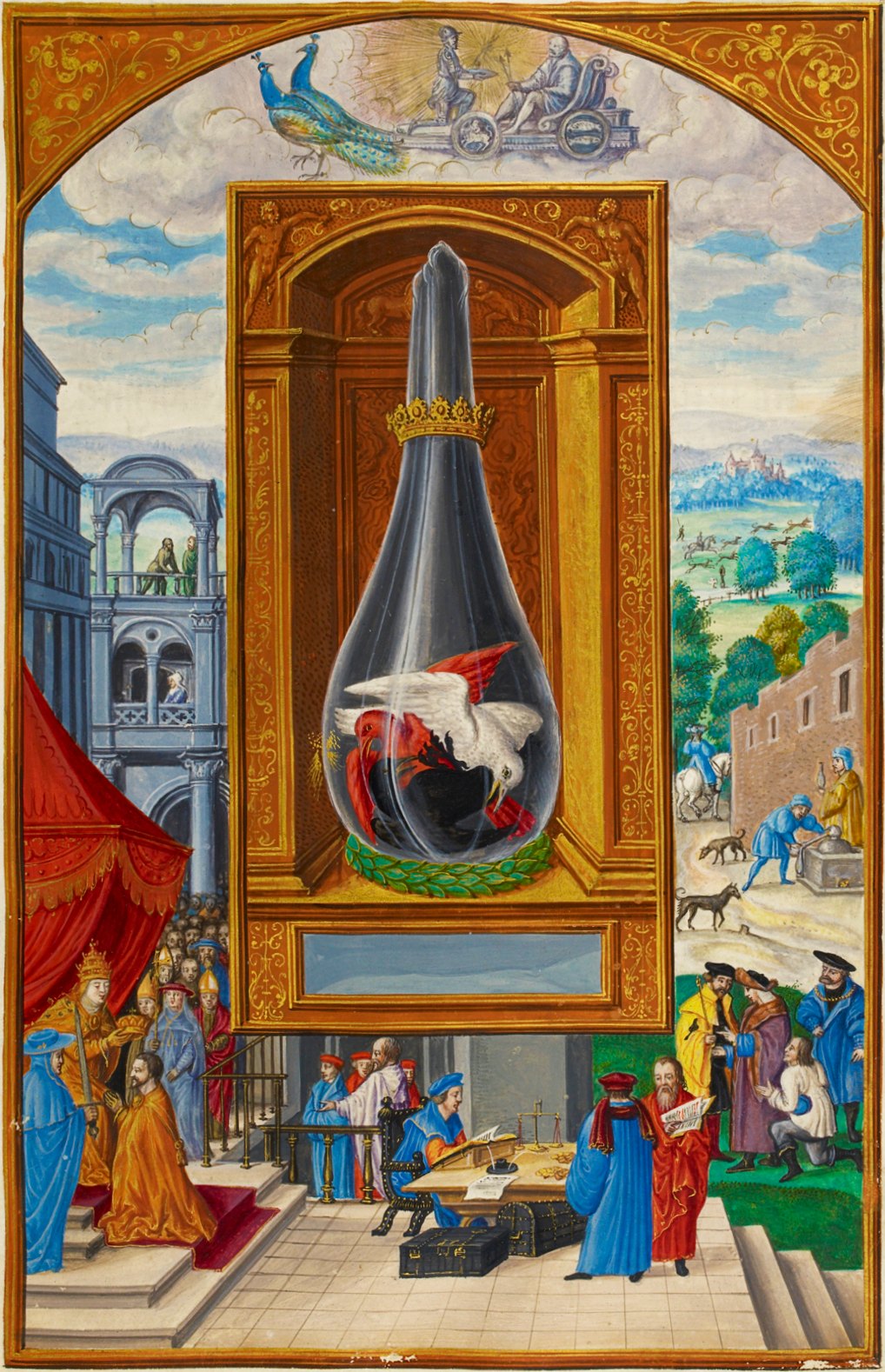
The awakening and its night: the reassessment of reality, old conflicts rising, confusion as the door to the search, and the clearing of the laboratory.
Read the first teaching →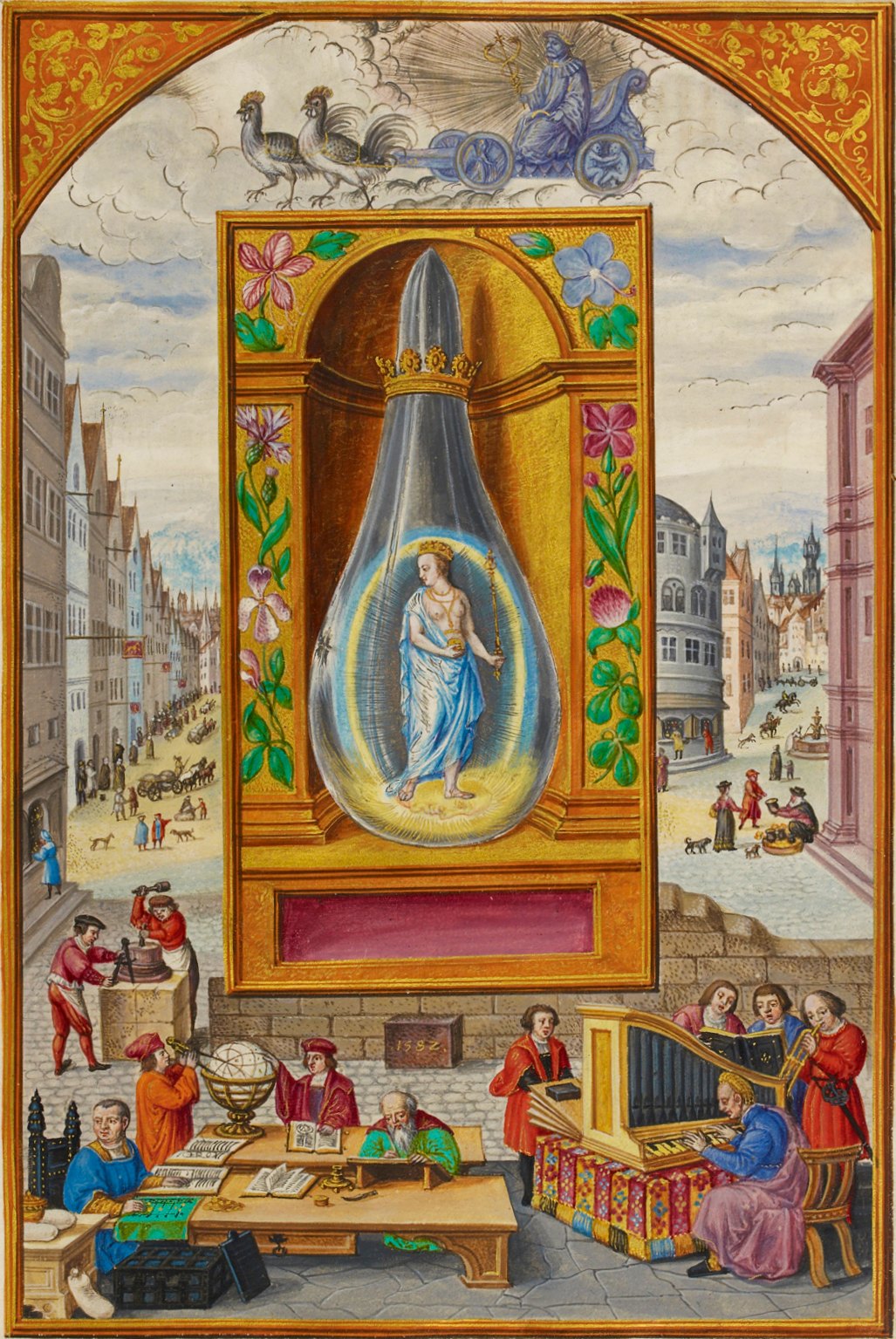
The forming of the self: the people born of stones, Plotinus' statue, Michelangelo's marble, the Masonic ashlar, and trials as the chisel.
Read the second teaching →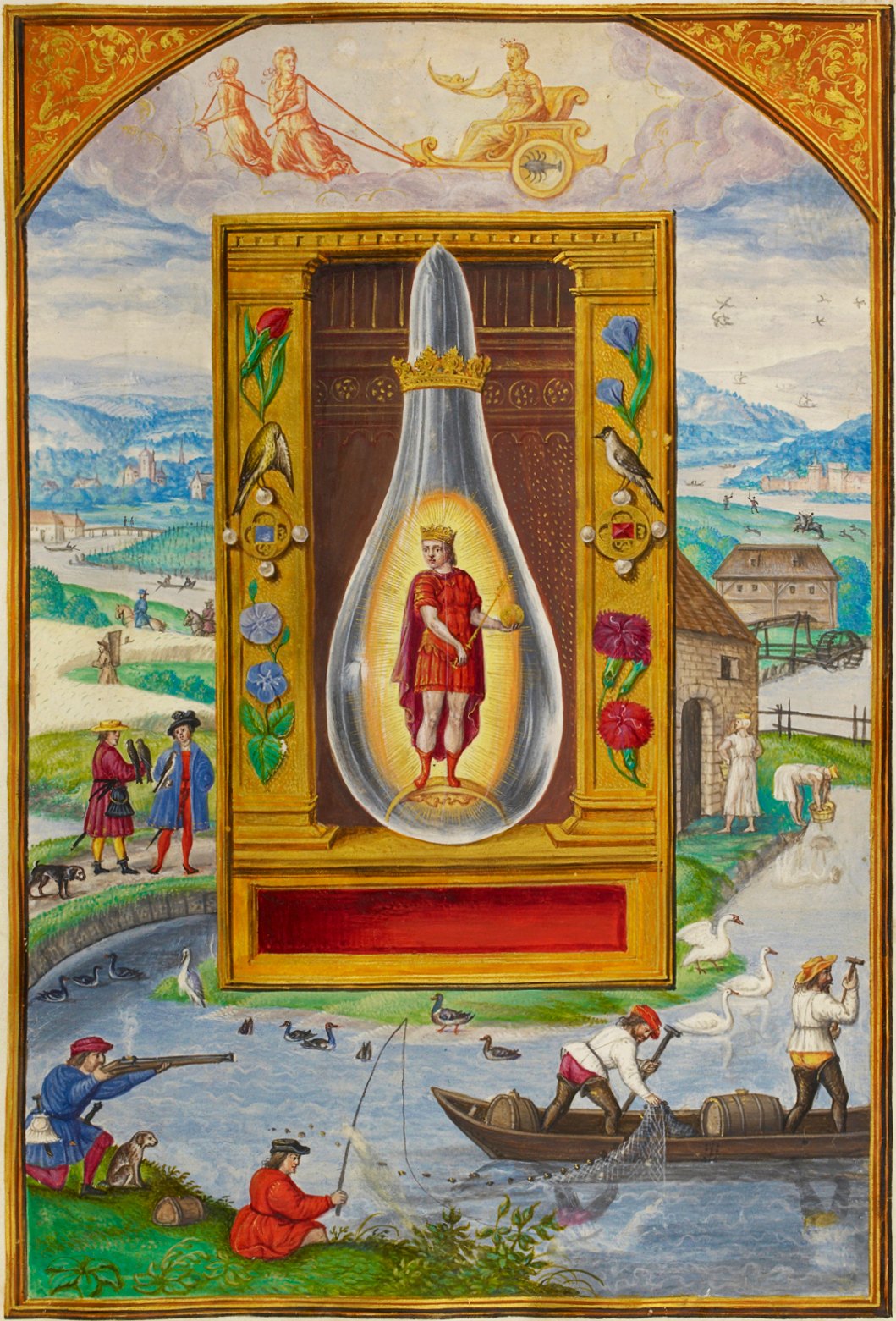
The refined soul: gold as the child of Zeus, the touchstone, unity within and a golden life without, and the Work in the liturgy.
Read the third teaching →The 3 flasks above come from the Splendor Solis, a German alchemical manuscript whose earliest copy is dated 1531 to 1532; the plates shown are from the copy of 1582 in the British Library. In the first a black bird lies beneath a white and a red one; in the second a white queen stands in the vessel; in the third a red king stands on the moon in a golden light.1
The Sacred Art and the Great Work
Alchemy was born in Roman Egypt, where the crafts of the dyers, metalworkers and glassmakers met Greek natural philosophy; its historian Lawrence Principe places the union of the 2 traditions "probably in the third century AD."2 Its oldest writings are Greek. The books that circulated under the name of Democritus, from the 1st century and older than the discipline in its full form, preserve its first formula: "Nature delights in nature, and nature conquers nature, and nature masters nature."3 Zosimos of Panopolis, around 300 AD, traced the art to the Egyptian temples, and later writers called it the divine and sacred art.4
From the beginning the art had 2 faces. In the vessel, matter was dissolved, washed and tinctured; in the operator, the soul passed through the same stages. Zosimos described his work in visions of altars, priests and a body turned into spirit, and the Hermetic treatise On Rebirth, from the same Greco-Egyptian world, describes a soul cleansed of its "tormentors" and reborn in Mind.4, 5 In the 20th century Jung renewed the inner reading, and showed that the alchemists' stages map the transformation of the psyche.6
The Greek alchemists marked the stages by colour: μελάνωσις, the blackening; λεύκωσις, the whitening; ξάνθωσις, the yellowing; and ἴωσις, the final tincture. In the West the 4 were reduced to 3, black, white and red, around the 15th and 16th centuries.7, 6 The Temple follows the 3: chaos, form and gold.
For Zevism the sacred art is a description of the Great Work, the transmutation of a human essence towards the divine that the Temple calls Theosis and Plato called ὁμοίωσις θεῷ κατὰ τὸ δυνατόν, becoming like God as far as is possible.8, 9 The alchemists sought gold in the vessel. The Zevist seeks the gold that the Gods placed in the soul, which Plato called "divine gold from the Gods, always in the soul."10
Μέλαν πρῶτον, εἶτα λευκόν, τέλος χρυσοῦν.
First black, then white, at last gold.
The 3 Stages at a Glance
| Stage | Greek and Latin | Colour | The Work Within | The Work Without | In Meditation and Theurgy | In the Liturgy | The Teaching |
|---|---|---|---|---|---|---|---|
| I | μελάνωσις, nigredo | Black | The old order dissolves; buried emotions and old programming rise to be cleared | Beliefs, habits, bonds and the use of time reassessed | Cleansing: the Basic Meditation Program, aura cleaning, Freeing the Mind, self-observation; protection | The Initiation, the oath given to the fire; the Genesia and the Winter Solstice | Μελάνωσις: Alchemical Chaos |
| II | λεύκωσις, albedo | White | The matter washed; a self formed by habit, measure and trial | A structured day, a trained body, steady conduct | Construction: the Foundation, the programmes, the Pythagorean review, the Ethics, alignment; banishing | The Baptism's water and oil; the Name; the Anthesteria and the Spring Equinox | Λεύκωσις: The Rough Stone and the Living Statue |
| III | ἴωσις, rubedo | Red and gold | The soul made one; a light that feeds itself | Speech, conduct, work, family and service as the soul's gold | Ascent: Meditation on Zeus and on the Spirit, the serpent meditations, the Magnum Opus; the theurgic works | The Baptism's fire; the Thargelia and the Summer Solstice; the Funeral's passage to the Gods | Ἴωσις: The Alchemical Gold |
Within and Without at the Same Time
Every stage of the Work happens in 2 places at once, and the Temple teaches them together. The Greek sources insist on it. Plato's just man first becomes "one out of many" within, and "then at last" acts in money, the care of the body, public life and private dealings, measuring every outer act by whether it preserves the inner order.10
Socrates' prayer to Pan asks for both in a single breath: "grant that I become beautiful within, and that whatever I have outside be friendly to what is within."12 Heraclitus said that "the road up and the road down are one and the same," and the Emerald Tablet carried the principle into the alchemists' books: "what is below is like what is above."11, 13
The inner and the outer Work feed each other: a cleared soul makes a clearer life and a reordered life steadies the soul, and the gold within becomes speech, work, family and service, which refine the gold in turn. Heinrich Khunrath drew the doctrine in a single hall in 1595: on one side the adept kneels in his oratory, on the other his furnaces burn.14 The Zevist works in the same hall.
- In the blackening. Within, the old order dissolves, and what was buried rises to be cleared. Without, the life is reassessed: beliefs, habits, friendships, the use of time, sometimes the relation to an old religious community. The Temple's teaching on the first stage sets out both, and the signs by which the night can be read.15
- In the whitening. Within, the self is formed by habit, measure and trial, and the many parts of the soul learn to work as one. Without, the day takes a structure, the body is trained, and conduct becomes steady. The Baptism gives the formed self its Name.16
- In the gold. Within, the soul is one, and its light feeds itself. Without, the order shines into speech, conduct, work, family, charity and community, and the refined person improves what he touches as the alchemists' stone turned base metal into gold.17
Ὁ ἔσω κόσμος τὸν ἔξω κοσμεῖ.
The order within sets in order the world without.
The Work in Meditation and Theurgy
The Temple's Meditation and Theurgy sections already hold the tools of every stage. Its meditations are arranged by level and by the part of the person each develops, physical, emotional, intellectual and of the soul, with a final category, Ascend, for the practices that lift the soul towards the Gods; its Theurgy section gathers the Heavenly Powers.18, 19 Read through the alchemy of the soul, they fall into 3 movements:
- Cleansing, for the blackening. Power meditation is, in the Temple's words, "a psychic cleaning house": it brings repressed emotions up so that they can leave.20 The Basic Meditation Program, the cleaning of the aura, the detaching of unwanted energies, the Self-Observation and Recollection meditations and the Temple's teaching on freeing the mind from Christianity and Islam clear the laboratory; the meditation for protection keeps it safe while it's open.18, 21
- Construction, for the whitening. The Foundation Meditation, the programmes in order, the Pythagorean Day Meditation with its evening review, the Ethics meditations, the alignment of the chakras, the study levels and the physical programmes give the self its form; the banishing ritual guards the sacred space in which the work is done.18, 19
- Ascent, for the gold. The Meditation on Zeus, the Mer Ka Ba, the Meditation on the Spirit, the serpent meditations, Freeing the Soul and the Words of Power move the soul's own powers upward, and the Magnum Opus itself is "released in time," when its meaning can be understood.18, 22 The theurgic works, healing, the light of the stars and the magickal squares of Zeus, become the natural activity of a soul whose gold has begun to shine.19
Iamblichus gives the rule that governs all 3: "it's not thinking that links theurgists to the Gods," but sacred acts and symbols "understood by the Gods alone";23 the human hand does the Work, and the Gods complete it.
The Work in the Liturgy
Zevism celebrates the 3 stages in its rites, and the teaching on the gold sets the liturgy out in full.17 In brief:
- The Initiation enacts the blackening. The signed prayer is burned in the flame, the old allegiance is renounced, and the candidate asks to be moved "from Ignorance to Truth."24
- The Baptism enacts the whole Work in order. The water washes the initiate "of falsehood, ignorance, and spiritual bondage"; the oil seals the form; the flame is "the light of Zeus"; and the 2 names, of "the world of men" and of "the world of the spirit," teach that the refined person lives within and without at once.25
- The festivals walk the Work through the year. The Genesia meets mortality; the Winter Solstice celebrates "the rebirth of the light out of the longest darkness"; the Anthesteria brings "purification by fire and water"; the Thargelia celebrates "sacred union"; the Summer Solstice "the triumph of light"; the Thalysia "the first harvest."26
- The rites of life carry it across a lifetime. From the hidden name of the Amphidromia to the Funeral, in which "the dead are sanctified, the soul empowered, and its way to the Elysian Fields blessed."26
- The day carries it daily. The prayer of Socrates at morning, the line to Hephaestus before work, water, oil and flame at the altar, and the Pythagorean review at night.17
How to Read the 3 Teachings
The 3 teachings can be read in order, and they're written to be read so. The first is for the newcomer in the night and for everyone who has known it; the second for the long middle of the path, when the self is built; the third for the end of the Work and for the liturgy that celebrates all of it. Each stands on its own, with its sources, its images, its practice, its failures and its rewards.
The stages also return. The alchemists dissolved and fixed their matter again and again, and a human life does the same at higher levels: a new depth of the soul brings a small new night, a new form, a new tincture. The Temple's teaching on the Great Work holds that the whole may take more than 1 lifetime, each life reaching its full worth in the pursuit.8 A Zevist may find himself in the gold in one part of his life and in the blackening in another, and the teachings serve both at once.
The Work begins in the dark, and it ends in a gold that the Greeks called the child of Zeus.28 Between them lies the long labour of form, and the Gods stand beside the one who undertakes it.
Μέλαν, λευκόν, χρυσοῦν· ἓν τὸ ἔργον.
Black, white, gold: the Work is one.
High Priest Zevios Metathronos
Temple of Zeus Foundation
Sources & References
- Splendor Solis, British Library, Harley MS 3469, dated 1582: the flask series, plates 12 to 18 (ff. 23 to 29); shown here plate 13, f. 24 (the black bird beneath the white and the red), plate 17, f. 27 (the white queen) and plate 18, f. 29 (the red king on the moon). Earliest copy, Berlin, Kupferstichkabinett, 78 D 3, dated 1531 to 1532.
- L. M. Principe, The Secrets of Alchemy, Chicago, University of Chicago Press, 2012 (dated 2013), ch. 1, "Origins: Greco-Egyptian Chemeia."
- M. Martelli, The Four Books of Pseudo-Democritus, Leeds, Maney, 2013, p. 11: Ἡ φύσις τῇ φύσει τέρπεται, καὶ ἡ φύσις τὴν φύσιν νικᾷ, καὶ ἡ φύσις τὴν φύσιν κρατεῖ.
- K. A. Fraser, "Baptised in Gnôsis: The Spiritual Alchemy of Zosimos of Panopolis," Dionysius 25, 2007, pp. 33 to 54.
- Corpus Hermeticum 13 (On Rebirth), 13.3 and 13.7 to 9. Ed. A. D. Nock and A.-J. Festugière, Corpus Hermeticum II, Paris, 1945.
- C. G. Jung, Psychology and Alchemy, Collected Works 12, trans. R. F. C. Hull, 2nd ed., Princeton, 1968, §§333 to 334.
- H. G. Liddell, R. Scott and H. S. Jones, A Greek-English Lexicon, 9th ed., Oxford, 1940, s.vv. λεύκωσις, ξάνθωσις, ἴωσις.
- Temple of Zeus, Theosis: The Magnum Opus.
- Temple of Zeus, ὁμοίωσις θεῷ: Becoming a God, on Plato, Theaetetus 176b.
- Plato, Republic 416e (χρυσίον … θεῖον παρὰ θεῶν ἀεὶ ἐν τῇ ψυχῇ) and 443c to e (ἕνα γενόμενον ἐκ πολλῶν … οὕτω δὴ πράττειν ἤδη). Greek, J. Burnet, Platonis Opera 4, Oxford, 1905.
- Heraclitus, fr. 22 B60 Diels-Kranz: ὁδὸς ἄνω κάτω μία καὶ ὡυτή, from Hippolytus, Refutation of All Heresies 9.10.4.
- Plato, Phaedrus 279b to c. Greek, J. Burnet, Platonis Opera 2, Oxford, 1910.
- Tabula Smaragdina, Latin vulgate of the 12th century, as printed in De alchemia, Nuremberg, 1541: Quod est inferius est sicut quod est superius; first preserved in the Arabic Kitāb Sirr al-khalīqa (late 8th or early 9th century).
- Heinrich Khunrath, Amphitheatrum Sapientiae Aeternae, 1595; 2nd ed., Hanau, 1609: the plate of the Oratorium and Laboratorium.
- Temple of Zeus, Μελάνωσις: Alchemical Chaos and the Dark Night of the Soul.
- Temple of Zeus, Λεύκωσις: The Rough Stone and the Living Statue.
- Temple of Zeus, Ἴωσις: The Alchemical Gold, Within and Without, with its section on the Work in the liturgy.
- Temple of Zeus, Meditation: the power and awareness meditations by level (Beginning, Intermediate, Advanced, Information) and by category (Physical, Emotional, Intellectual, Soul, Ascend).
- Temple of Zeus, Magick and Theurgy: "the powers of the mind and soul, built on power meditation"; the Theurgy section of the Heavenly Powers.
- High Priest Zevios Metathronos and Pythia, Zevism and Power Meditation: "Power meditation is a psychic cleaning house, so to speak."
- High Priest Zevios Metathronos, Freeing the Mind from Christianity and Islam: A Mandatory Step.
- Temple of Zeus, Theosis (Magnum Opus), the meditation page: "released in time."
- Iamblichus, On the Mysteries 2.11, 96.13 to 97.2 Parthey.
- Temple of Zeus, Becoming an Initiate.
- Temple of Zeus, The Zevist Baptism.
- Temple of Zeus, Zevist Rites and Holidays.
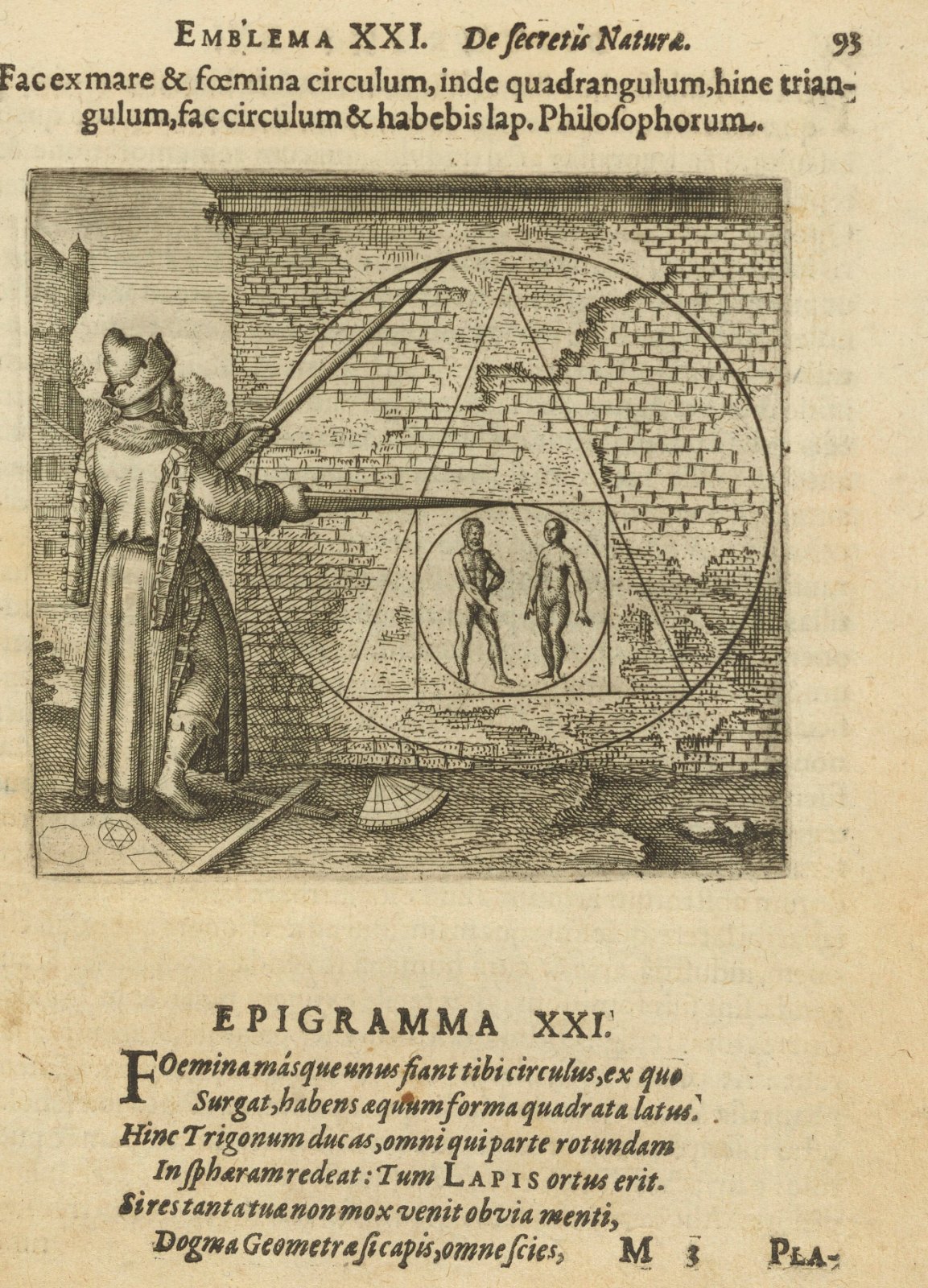
- Michael Maier, Atalanta Fugiens, Oppenheim, 1617 (edition of 1618 shown), Emblem 21, Fac ex mare et foemina circulum, engraving by Matthäus Merian; copy in the Science History Institute, Philadelphia.
- Pindar, fragment 222 Snell-Maehler: Διὸς παῖς ὁ χρυσός, from the scholia on Pythian 4.