













41 min read
Ἴωσις: The Alchemical Gold, Within and Without
author: High Priest Zevios Metathronos
Stage III · Rubedo
The Great Work ends in gold. The Greek alchemists called the last stages ξάνθωσις, the yellowing, and ἴωσις, the final tincture, which Jung matched with the reddening that the Latin West called rubedo; at its end stood the gold and the stone that turns what it touches into gold. In a human being the gold is the soul made one: cleared in the blackening, formed in the whitening, and now tinctured through, so that its order shines inwardly as peace and outwardly as a life. An ancient note on Pindar preserves lines that call gold the child of Zeus, and Plato said that the God mixed gold into the souls of those fit to rule. This teaching sets out the third stage of the sacred art: what the gold is and how it's tested; how the refined soul appears within and without at the same time, as Socrates asked of the Gods in his prayer by the Ilissus; how the whole alchemical process is manifested in a single human life; how Meditation and Theurgy finish the gold; how Zevism celebrates the 3 stages in its rites, its year and its daily prayer; and what follows when the gold is false and when it's true.
The Gold in Plain Words
The third teaching answers the same 6 plain questions for the gold.
What it is. The third stage of the Great Work in a human being: the refined state, in which the soul is one, its parts in harmony, its light its own, and its life outside an expression of its order inside. Plato's just man becomes "entirely one out of many, temperate and harmonised," and acts from that unity in everything he does.2
What it leaves behind. The struggles of the first 2 stages: the confusion of the night and the strain of the chisel. The refined soul still works, and works more, but it works from peace.
How it comes. Suddenly, after long labour. Plato's Diotima says that the one who has been led rightly through the stages of love "will suddenly see something wonderful in its nature," and that this is the thing "for the sake of which all the earlier toils were."3
How it's tested. On the touchstone. The Greeks tested gold by rubbing it on a dark stone, the βάσανος, and they gave the same word to every trial of a person's worth.4, 5
Within and without. At once. Socrates prayed to "become beautiful within, and that whatever I have outside be friendly to what is within."6 The gold that stays inside and never reaches the life is incomplete, and so is the gilding that covers a life with nothing inside.
How it multiplies. The alchemists' stone had a property beyond its own value: projected onto base metal, it turned the metal into gold. The refined person has the same property in the human world, and improves what he touches: a family, a work, a community.
Ξάνθωσις and Ἴωσις: The Dawn and the Tincture
The Greek alchemists counted 4 colours in the Work. After the blackening and the whitening came ξάνθωσις, the yellowing, and ἴωσις, which the lexicon glosses as "refinement" and "the making of a tincture."7 The word comes from ἰός, the rust or bloom that forms on metal, and it named the final colouring that gives the prepared matter its virtue. Zosimos and Olympiodorus both use it.7 Jung matched it with the Latin rubedo and rendered it as the reddening, and he records that around the 15th and 16th centuries the yellowing "gradually fell into disuse," leaving 3 colours: black, white and red.8
The Temple keeps both Greek terms in this teaching. Ξάνθωσις is the dawn of the gold: the first sunlight on the whitened matter, when the formed self begins to shine with something that isn't only its own effort. Ἴωσις is the tincture: the colour that goes all the way through, so that the change can no longer be scraped off.
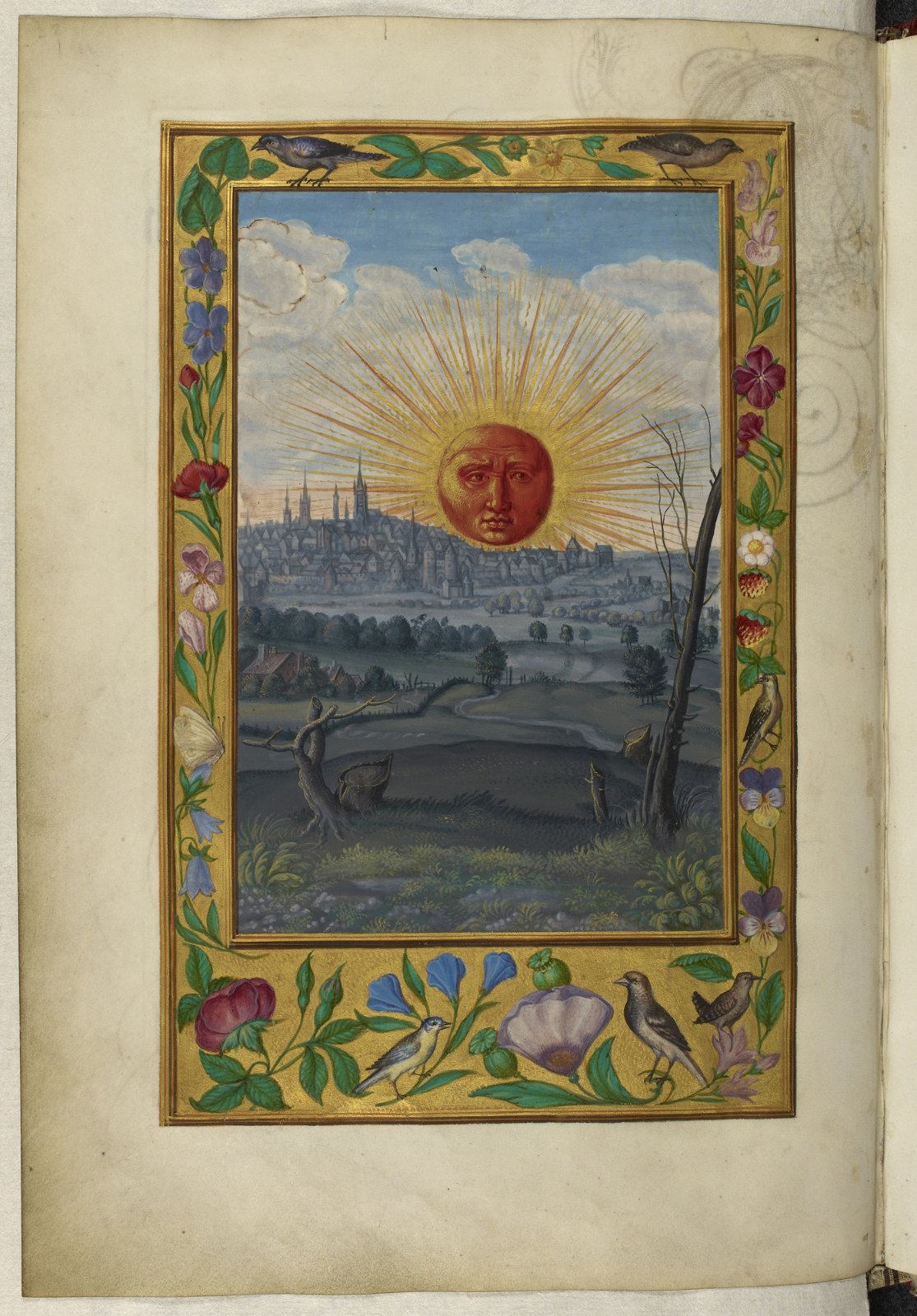
The alchemists painted the final stage as a king and as a union. In the Splendor Solis, the last flask of the planetary series holds a young king in red, standing on a crescent moon in a golden light, with orb and sceptre.1 In the Rosarium Philosophorum, printed at Frankfurt in 1550, the first series of woodcuts culminates in the crowned, winged figure of the Rebis, the double being in whom the opposites of the Work, sun and moon, king and queen, stand united in one body.9
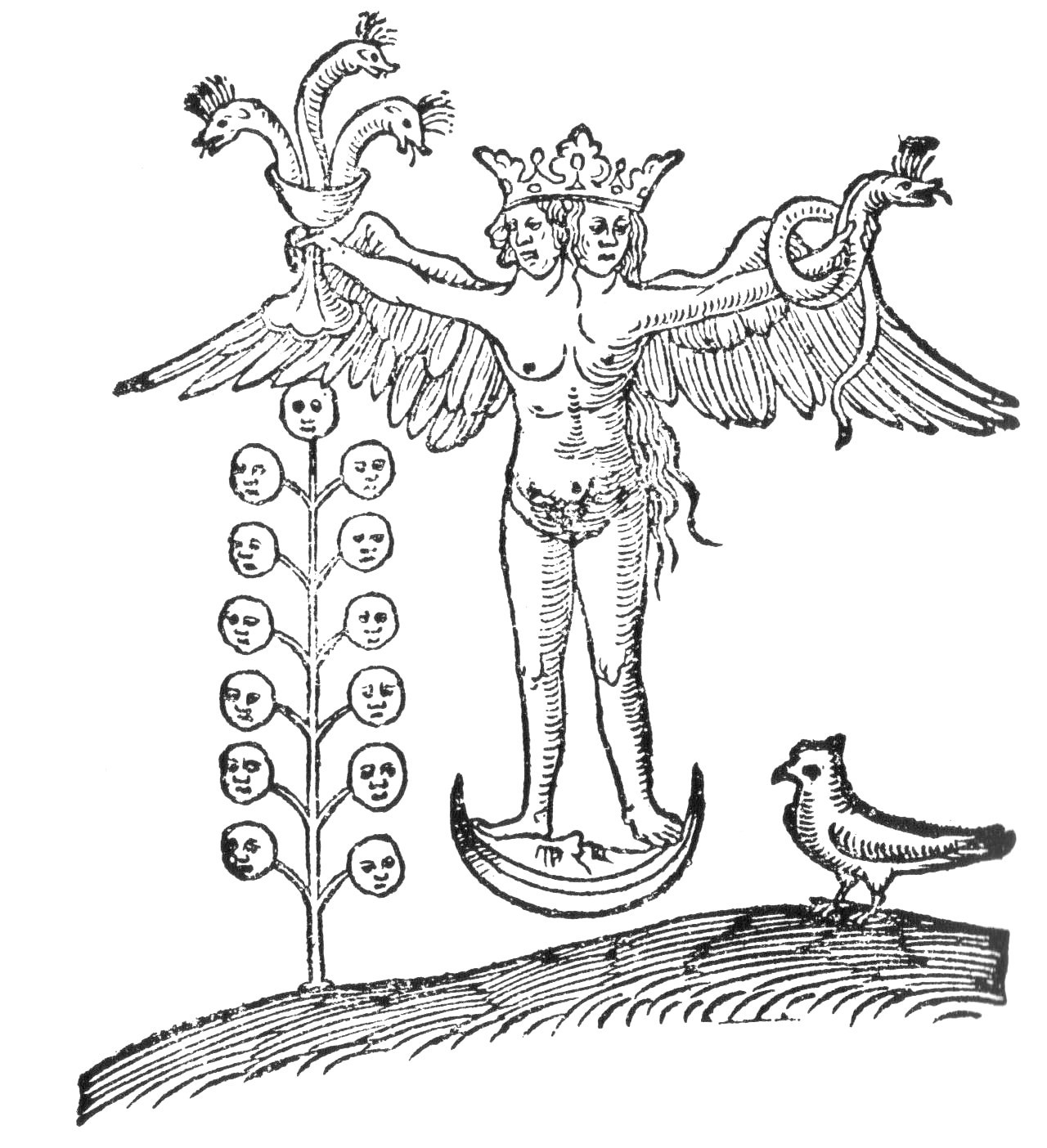
Jung read these images as the goal of individuation, the union of the conscious and the unconscious in a single, whole person; he used the first 10 woodcuts of the Rosarium to illustrate the stages of that union.10 The Temple reads them as the alchemists drew them: the opposites that were dissolved in the black and separated in the white are joined in the red, and the joining makes a being greater than either part.
Ὁ μὲν ἐπιβεβλημένος χρυσὸς ἀποξεῖται, ὁ δὲ δι᾽ ὅλου βεβαμμένος μένει.
Gold laid on the surface is scraped away; gold dyed through and through remains.
Gold Is the Child of Zeus
The Greeks had a saying about gold, preserved in an ancient note on Pindar's 4th Pythian ode, where the poet calls the golden fleece "imperishable." The commentator explains that gold doesn't decay, and quotes lines that editors assign to Pindar, though the note names Sappho just before them:
Pindar, fragment 222 Snell-Maehler, from the scholia on Pythian 4 11
Διὸς παῖς ὁ χρυσός· κεῖνον οὐ σὴς οὐδὲ κὶς δάπτει.
"Gold is the child of Zeus; neither moth nor weevil devours it."
For a Zevist, the line defines the goal of the Work. The gold the alchemists sought and the gold of the refined soul are Zeus' children: incorruptible, untouched by the small creatures that eat away everything perishable, shining with the light of their Father. Pindar's 1st Olympian, the ode that opened the ancient collections of his victory songs, begins with the same metal: "Best is water; and gold, like a blazing fire in the night, shines out above all lordly wealth," ὁ δὲ χρυσὸς αἰθόμενον πῦρ ἅτε διαπρέπει νυκτί.12 Gold shines most in the night. The gold of the third stage shines against the blackness of the first.
Plato put the same gold inside the soul. In the "noble lie" of the Republic, the citizens are told that "the God, as he fashioned you, mixed gold into the birth of those of you fit to rule."2
Later in the same book he states the doctrine without the story: the guardians must be told "that they have divine gold and silver from the Gods always in their soul, and have no need of the human kind besides," and that it isn't holy to mix the possession of the divine gold with the possession of mortal gold.2 The Greek is χρυσίον … θεῖον παρὰ θεῶν ἀεὶ ἐν τῇ ψυχῇ, "divine gold from the Gods, always in the soul."
That phrase is the Temple's doctrine of the gold in 8 words. The Gods placed the gold in the soul, and it's there "always," ἀεί; the Work uncovers it. The blackening clears away what covered it, the whitening gives it a form to fill, and the third stage lets it tincture the whole person. Socrates, opened like a Silenus, showed images "divine and golden" within.3
Ὁ χρυσὸς ἤδη ἔνεστιν ἐν τῇ ψυχῇ· τὸ δὲ ἔργον αὐτὸν ἀποκαλύπτει.
The gold is already in the soul; the Work uncovers it.
The Touchstone: How the Gold Is Tested
Gold in the ancient world was tested on the βάσανος, a hard black stone. Rubbed across it, true gold left a streak of its own colour; base metal left a different one. The poet Theognis of Megara, in the 6th century BC, used the test to describe a faithful man:
Theognis 449 to 452 4
εὑρήσεις δέ με πᾶσιν ἐπ᾽ ἔργμασιν ὥσπερ ἄπεφθον χρυσόν, ἐρυθρὸν ἰδεῖν τριβόμενον βασάνῳ, τοῦ χροιῆς καθύπερθε μέλας οὐχ ἅπτεται ἰὸς οὐδ᾽ εὐρώς, αἰεὶ δ᾽ ἄνθος ἔχει καθαρόν.
"You'll find me in all my deeds like refined gold, red to look at when rubbed on the touchstone: no dark tarnish touches its surface, nor mould; it always keeps its bloom pure."
The 4 lines hold the whole sacred art in miniature, written centuries before the first alchemist. The gold is ἄπεφθος, "refined," boiled clean in the fire. It shows "red," ἐρυθρόν, on the stone. The "dark" tarnish, μέλας ἰός, can't touch it, and its bloom stays "pure," καθαρόν. Black, refining, red and pure: the stages of the Work are already the vocabulary of a Greek poet describing a trustworthy man.
The touchstone gave the Greek language its word for every trial. Βάσανος came to mean any testing of worth, and its verb, βασανίζειν, to put to the test. Socrates uses the image in the Gorgias, when he finds in Callicles a man frank enough to examine his beliefs:
Plato, Gorgias 486d 5
εἰ χρυσῆν ἔχων ἐτύγχανον τὴν ψυχήν, ὦ Καλλίκλεις, οὐκ ἂν οἴει με ἅσμενον εὑρεῖν τούτων τινὰ τῶν λίθων ᾗ βασανίζουσιν τὸν χρυσόν, τὴν ἀρίστην, πρὸς ἥντινα ἔμελλον προσαγαγὼν αὐτήν, εἴ μοι ὁμολογήσειεν ἐκείνη καλῶς τεθεραπεῦσθαι τὴν ψυχήν, εὖ εἴσεσθαι ὅτι ἱκανῶς ἔχω καὶ οὐδέν με δεῖ ἄλλης βασάνου;
"If my soul were in fact made of gold, Callicles, don't you think I'd be glad to find one of those stones on which they test gold, the best one? I would bring my soul to it, and if the stone agreed that my soul had been well cared for, I would know for certain that I'm in good condition and need no other test."
The refined soul welcomes the touchstone. A person whose virtue is gilt avoids every test; a person whose virtue is gold seeks the best stone he can find. Theognis gives the reason elsewhere in his poems: counterfeit gold is easy for a wise man to detect, but a false friend's mind is the most counterfeit thing the God made for mortals, and "you can't know the mind of a man or a woman until you've tested it."4 Life provides the stone, and the gold shows its colour on it.
Ὁ χρυσὸς τὴν βάσανον οὐ φοβεῖται.
Gold doesn't fear the touchstone.
Gold and Gilt: Reading the Third Stage
The third stage is the easiest of the 3 to imitate, because its marks are visible and its cost is hidden. The Ancients left enough to tell the gold from the gilt, and the table sets their marks side by side:
| Mark | True Gold | Gilt | Witness |
|---|---|---|---|
| Under testing | Shows its own colour and welcomes the touchstone | Avoids every test, or blames the stone | Plato, Gorgias 486d; Theognis 449 to 4525, 4 |
| Within and without | Beauty within, and a life friendly to it | A polished life over an unformed soul, or an inner experience that never reaches the life | Plato, Phaedrus 279b to c; Republic 443c to e6, 2 |
| Towards others | Multiplies, and improves what it touches | Hoards, or sells the gold for status and control | Plato, Republic 416e to 417a2 |
| Towards itself | Measure: as much gold as a temperate man can carry | Inflation, "egocentric and conscious of nothing but its own existence" | Plato, Phaedrus 279c; Jung, CW 12 §5636, 8 |
| Over time | Keeps its bloom pure and renews the Work at every turn of the year | Tarnishes as soon as the practice stops | Theognis 451 to 452; the Temple's festivals4, 14 |
| Its source | Divine gold from the Gods, always in the soul | Borrowed brilliance; a copy of someone else's form | Plato, Republic 416e; Pindar, Pythian 2.722, 12 |
Pindar's command applies at the end of the Work as at its middle: γένοι᾽ οἷος ἐσσὶ μαθών, "become such as you are, having learned it."12 The gold of each soul has its own colour, and the third stage brings out that colour and no other.
One Out of Many: The Gold Within
The inner gold has a definite shape in the Greek sources, and the shape is unity. Plato's description of justice in the soul, which the second stage used as a plan for building, is in the third stage a description of the finished house. The just person, having set his house in order, ruled and arranged himself, become his own friend and tuned the 3 parts of his soul like the notes of a scale, is "entirely one out of many, temperate and harmonised," παντάπασιν ἕνα γενόμενον ἐκ πολλῶν, σώφρονα καὶ ἡρμοσμένον.2 The many voices that quarrelled in the blackening and were trained in the whitening now sing as one.
Plotinus describes what the purified soul becomes in itself: "form and rational principle, altogether bodiless and intellectual, and wholly of the divine," ὅλη τοῦ θείου, "whence comes the spring of beauty."15 The Hermetic treatise On Rebirth gives the experience in the first person. Hermes, describing his own rebirth, says: "I am not now what I was before; I have been born in Mind"; and his son Tat, once the last of the tormentors has fled, says: "Father, I see the universe, and myself in Mind," Πάτερ, τὸ πᾶν ὁρῶ καὶ ἐμαυτὸν ἐν τῷ νοΐ.16
The gold arrives suddenly, after long preparation. Diotima's teaching in the Symposium leads the lover up through the beauty of bodies, souls, laws and knowledge, and then:
Plato, Symposium 210e 3
ὃς γὰρ ἂν μέχρι ἐνταῦθα πρὸς τὰ ἐρωτικὰ παιδαγωγηθῇ, θεώμενος ἐφεξῆς τε καὶ ὀρθῶς τὰ καλά, πρὸς τέλος ἤδη ἰὼν τῶν ἐρωτικῶν ἐξαίφνης κατόψεταί τι θαυμαστὸν τὴν φύσιν καλόν, τοῦτο ἐκεῖνο, ὦ Σώκρατες, οὗ δὴ ἕνεκεν καὶ οἱ ἔμπροσθεν πάντες πόνοι ἦσαν.
"Whoever has been guided this far in the things of love, beholding beautiful things in their right order, will now come to the end of love's ways and will suddenly see something wonderful in its nature, beautiful: this, Socrates, is the very thing for the sake of which all the earlier toils were."
"All the earlier toils," οἱ ἔμπροσθεν πάντες πόνοι: the blackening and the whitening were for this. The 7th of the letters that have come down under Plato's name describes the same arrival in the language of fire. The highest knowledge, it says, can't be put into words like other learning, "but from long association with the matter itself and from living with it, suddenly, like light kindled from a leaping spark, it is born in the soul and from then on nourishes itself," ἐξαίφνης, οἷον ἀπὸ πυρὸς πηδήσαντος ἐξαφθὲν φῶς, ἐν τῇ ψυχῇ γενόμενον αὐτὸ ἑαυτὸ ἤδη τρέφει.17
A fire that feeds itself is the alchemists' tincture in another image: once caught, it burns by its own substance, and so do the virtues, the bond with the Gods and the peace of the refined soul.
Jung's word for the inner gold was the Self, the whole personality that individuation brings into being, and his definition matches the Greek unity: "Individuation means becoming a single, homogeneous being."18 The Temple adds what the Greek sources add: the unity of the soul is a likeness to the Gods, and it's their light that the gold reflects.
Ἐξαίφνης τὸ φῶς· ἀλλ᾽ ἐκ πολλῆς συνουσίας.
The light comes suddenly, but out of long companionship.
The Gold Without: How the Refined Soul Lives
The gold doesn't stay inside. Plato's sentence on the unified soul runs straight on into the world, and its second half is the doctrine of the outer gold:
Plato, Republic 443e 2
οὕτω δὴ πράττειν ἤδη, ἐάν τι πράττῃ ἢ περὶ χρημάτων κτῆσιν ἢ περὶ σώματος θεραπείαν ἢ καὶ πολιτικόν τι ἢ περὶ τὰ ἴδια συμβόλαια, ἐν πᾶσι τούτοις ἡγούμενον καὶ ὀνομάζοντα δικαίαν μὲν καὶ καλὴν πρᾶξιν ἣ ἂν ταύτην τὴν ἕξιν σῴζῃ τε καὶ συναπεργάζηται, σοφίαν δὲ τὴν ἐπιστατοῦσαν ταύτῃ τῇ πράξει ἐπιστήμην.
"Then at last he acts, if he acts at all, whether in making money, or in the care of the body, or in public affairs, or in private dealings; and in all of these he believes and names as just and beautiful the action that preserves this inner condition and helps to bring it about, and as wisdom the knowledge that presides over such action."
First the inner unity; "then at last," οὕτω δὴ … ἤδη, the action, in money, the body, public life and private agreements. And the measure of every outer act is whether it preserves and builds the inner state. The outer life is the inner gold put into circulation, and it feeds back into the gold that produced it.
Socrates' prayer at the end of the Phaedrus asks for this double gold:
Plato, Phaedrus 279b to c 6
ὦ φίλε Πάν τε καὶ ἄλλοι ὅσοι τῇδε θεοί, δοίητέ μοι καλῷ γενέσθαι τἄνδοθεν· ἔξωθεν δὲ ὅσα ἔχω, τοῖς ἐντὸς εἶναί μοι φίλια. πλούσιον δὲ νομίζοιμι τὸν σοφόν· τὸ δὲ χρυσοῦ πλῆθος εἴη μοι ὅσον μήτε φέρειν μήτε ἄγειν δύναιτο ἄλλος ἢ ὁ σώφρων.
"Dear Pan, and all you other Gods of this place, grant that I become beautiful within, and that whatever I have outside be friendly to what is within. May I count the wise man rich, and may I have as much gold as only a temperate man could carry and take away."
Beauty within, and an outer life friendly to it. The prayer even names gold, and names the measure of it: as much as a temperate man can carry. The outer gold of the refined person is the gold of a life whose possessions, habits, work and relationships are friends to the soul.
The principle runs through Greek thought from its beginning, and Heraclitus put it into 6 words: "The road up and the road down are one and the same," ὁδὸς ἄνω κάτω μία καὶ ὡυτή.19
The Hermetic tradition carried it into the alchemists' most famous text. The Emerald Tablet, which survives first in an Arabic book of the late 8th or early 9th century and reached Latin in the 12th, says in its 2nd sentence, in the wording printed at Nuremberg in 1541: Quod est inferius est sicut quod est superius, et quod est superius est sicut quod est inferius, ad perpetranda miracula rei unius, "what is below is like what is above, and what is above is like what is below, for the performing of the wonders of the one thing."20
The reborn Tat of the Hermetic dialogue says the same from within: "I am in heaven, in earth, in water, in air; I am in animals, in plants; in the womb, before the womb, after the womb; everywhere."16
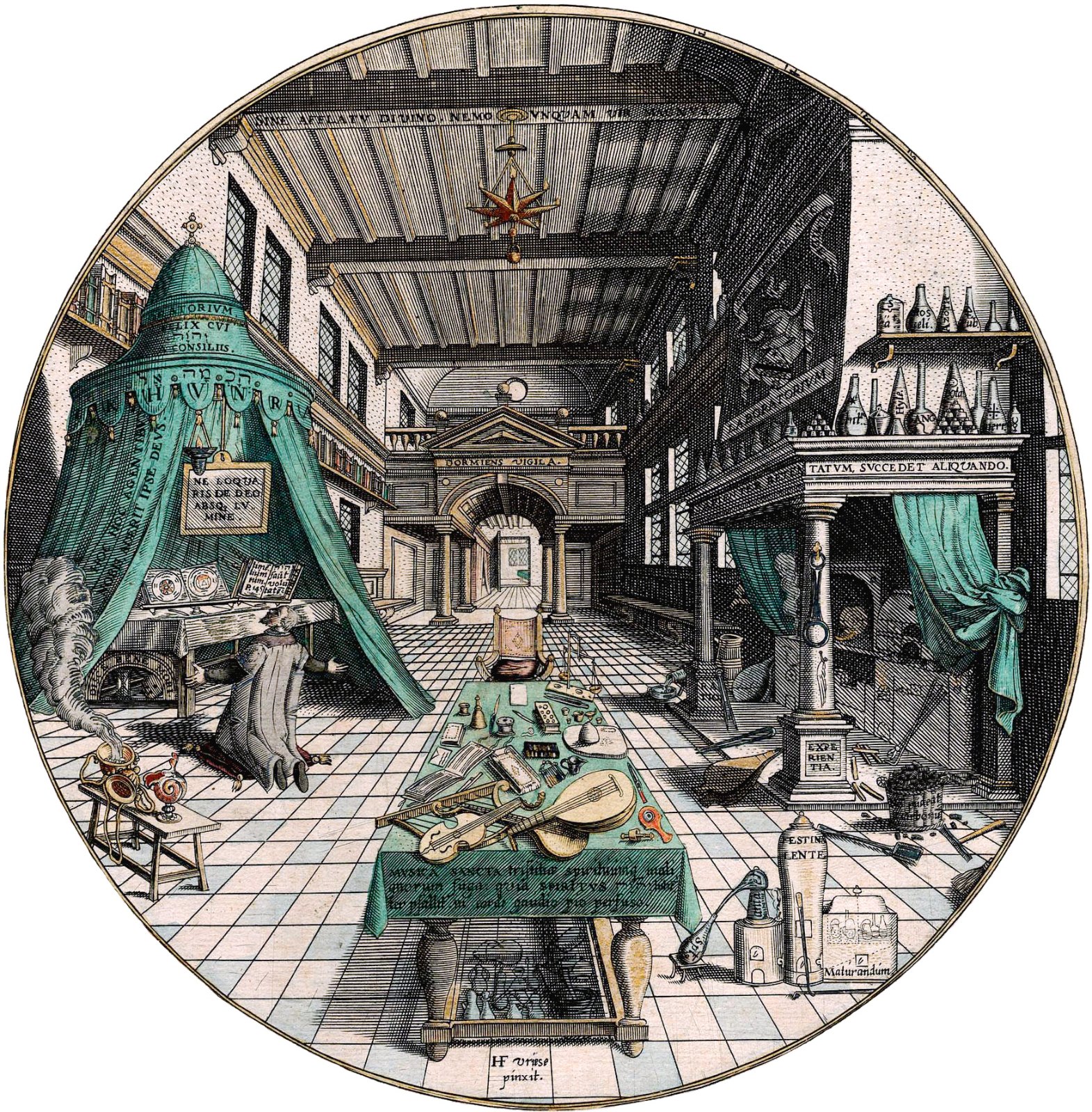
The alchemist Heinrich Khunrath drew the doctrine in a single hall. In the most famous plate of his Amphitheatrum Sapientiae Aeternae, the adept kneels in prayer in his oratory on the left, while on the right stands his laboratory with its furnaces; between them is a table of musical instruments.21 Prayer and work, the inner and the outer Work, share one room. Khunrath's interpreters read the hall through the motto ora et labora, pray and work, and the plate invites the play on words that hides both in the room's own name, lab-oratorium.
The outer gold has concrete marks, and the Temple's teachings name them:
- Speech. The refined person speaks nobly, and the Temple's teaching on noble speech sets this as a spiritual discipline.22 The tongue is the first place where the inner order shows.
- Conduct and courtesy. Good manners and kindness, in the Temple's words, are a discipline of the soul.23 Courtesy is the gold's ordinary daily colour.
- The body. The trained and cared-for body, at a healthy level, upholds the soul and carries its energy.24
- The house and the family. The order of the soul extends to the home, to the raising of children, which the Temple's teaching on Zevist parenting sets out stage by stage.25
- Work and wealth. Plato's just man acts justly "in making money"; the refined person works well, earns honestly, and keeps his gold the friend of his soul.2, 6
- Charity. The Temple's teaching on charity calls it a good heart, a clear mind and help that lifts people up.26 The stone that hoards its power has lost its virtue.
- Community. The perfect ashlar takes its place in the building, and the refined person strengthens the Temple and the people around him.
Καλὸς τἄνδοθεν, τὰ δ᾽ ἔξωθεν τοῖς ἐντὸς φίλια.
Beautiful within, and the things without friendly to what is within.
The Alchemical Process Manifested in Man
The 3 stages are one Work, and in a human life they appear as one story. A person is born with the gold of the Gods in his soul and lives for years under the crust of what the world has put on him. He meets the Truth, and the crust begins to crack: old certainties dissolve, old conflicts rise, and he passes through the night.
He clears his laboratory, washes his matter, and begins to give himself a form by daily habit and accepted trial. The form takes years, and at a certain point, suddenly, the light catches and feeds itself, the soul becomes one, and its order shines outward into everything it touches.
The table sets the 3 stages side by side as they appear in every part of a life:
| Dimension | I. Μελάνωσις, Nigredo | II. Λεύκωσις, Albedo | III. Ἴωσις, Rubedo |
|---|---|---|---|
| The soul | Dissolution; buried contents rise; confusion and resistance | Washing and forming; habits set into character | Unity: "one out of many"; a light that feeds itself |
| The mind | Old beliefs examined and released | True opinions tied down by reasoning | Knowledge born "like light from a leaping spark" |
| The feelings | Grief and anger let out | Measure and steadiness | Peace that doesn't depend on circumstances |
| The body | Rest and care while the vessel is stirred | Training: stress, recovery, adaptation | A body that upholds the soul and carries its energy |
| The life without | Reassessment of habits, bonds and time | A structured day; the 24-inch gauge | Speech, conduct, work, family and charity as the soul's gold |
| Meditation | Cleansing: aura cleaning, Freeing the Mind, self-observation | Construction: Foundation, programmes, Pythagorean review, alignment | Ascent: Meditation on Zeus, on the Spirit, the serpent meditations, the Work released in time |
| Theurgy | Protection; the bond kept through the night | Banishing, protection, the sacred works made habit | Union through the works and symbols the Gods understand |
| The liturgy | Initiation: the signed oath given to the fire | Baptism: the water, the oil and the Name | The fire of the Baptism; the Solstice of light; the Funeral's passage to the Gods |
| Greek witness | Plato's cave; Plutarch's dark journey | Plotinus' statue; Ovid's stones | Theognis' gold; Socrates' prayer |
The alchemists repeated their operations many times, dissolving and fixing again, each cycle at a higher level. The Work in a human life is the same. A new depth of the soul reaches the light and brings its own small night; a new form is needed and has to be cut; a new tincture follows. The Temple teaches that most workings aren't one-time acts, and its teaching on the Great Work says that the whole may take more than 1 lifetime, each life reaching its full worth in the pursuit.27, 28
Λύσις καὶ πῆξις, καὶ πάλιν λύσις καὶ πῆξις, ἕως ἂν γένηται ὁ χρυσός.
Dissolving and fixing, and again dissolving and fixing, until the gold comes to be.
Meditation and Theurgy: The Hands That Finish the Gold
The third stage belongs to the higher meditations and to Theurgy. In the Temple's Meditation section, the Ascend category gathers the practices that lift the formed soul towards the Gods: the Meditation on Zeus, the Mer Ka Ba, the Meditation on the Spirit, and Theosis, the Magnum Opus itself.29 The Intermediate and Advanced levels add the meditations that move the soul's own powers: the serpent meditations, Freeing the Soul, the Words of Power and the invocation of the elements and the quintessence.29
The Temple's guidance on the Great Work is careful about this summit. The full teaching of the Magnum Opus meditation is "released in time," and "will be given when its meaning can be understood"; until then the practitioner follows the programmes, lives the Ethics, keeps his bond with the Gods through prayer and ritual, observes himself honestly and keeps a record. The practices are the tools, "and the life lived through them is the Work."30
Iamblichus explains why, in the passage the Temple places at the heart of Theurgy:
Iamblichus, On the Mysteries 2.11 31
οὐδὲ γὰρ ἡ ἔννοια συνάπτει τοῖς θεοῖς τοὺς θεουργούς· ἐπεὶ τί ἐκώλυε τοὺς θεωρητικῶς φιλοσοφοῦντας ἔχειν τὴν θεουργικὴν ἕνωσιν πρὸς τοὺς θεούς; νῦν δὲ οὐκ ἔχει τό γε ἀληθὲς οὕτως. ἀλλ᾽ ἡ τῶν ἔργων τῶν ἀρρήτων καὶ ὑπὲρ πᾶσαν νόησιν θεοπρεπῶς ἐνεργουμένων τελεσιουργία ἥ τε τῶν νοουμένων τοῖς θεοῖς μόνοις συμβόλων ἀφθέγκτων δύναμις ἐντίθησι τὴν θεουργικὴν ἕνωσιν.
"It's not thinking that links theurgists to the Gods; otherwise what would prevent those who philosophise theoretically from having theurgic union with them? The truth is otherwise. It's the perfect accomplishment of ineffable acts, performed in a manner worthy of the Gods and beyond all understanding, and the power of the unutterable symbols understood by the Gods alone, that establishes theurgic union."
The gold is completed by sacred acts. The alchemist could prepare the matter perfectly and still needed the fire, and the fire came from beyond his skill. Pygmalion carved, and Venus gave the breath.32 Proclus, head of the Platonic school at Athens in the 5th century, wrote that "all things pray according to their own order," and that the heliotrope, turning with the sun, would be heard hymning its king if anyone could hear it striking the air as it turns.33 The refined soul turns towards the Gods as the flower turns towards the sun, and its turning is its prayer.
Theurgy in the Temple's Heavenly Powers section gives this prayer its works: healing, the drawing down of the light of the stars, the magickal squares of Zeus, protection and the banishing that keeps the sacred space clean.34 In the third stage these works become the natural activity of a soul whose gold has begun to shine, and they're done for others as much as for oneself.
Ὁ μὲν ἄνθρωπος παρασκευάζει, ὁ δὲ θεὸς τελειοῖ.
The human being prepares; the God completes.
The Work in the Liturgy: How Zevism Celebrates the 3 Stages
A liturgy is the Work done in public and in symbols. The Greek word λειτουργία meant a work done for the people, and in the Temple's rites the inner alchemy of each Zevist is enacted outwardly, so that the community sees, and the soul remembers, what the Work is doing within. Iamblichus' teaching applies directly: union with the Gods comes through sacred acts and symbols, and the rites are such acts.31 The Temple's liturgy already holds the 3 stages, in its rites of passage, in its Baptism, in its year, and in the daily prayer that any Zevist can keep.
The Rite of Initiation: The Blackening Enacted
The Initiation is the black vessel. The candidate bathes, writes the prayer by hand, signs it, and recites it aloud or in the mind; he renounces "the path of Izfet" for "the path of Ma'at," asks to be admitted to the Mysteries and moved "from Ignorance to Truth"; then the signed page is folded and burned, and a period of quiet meditation may follow.35
The old allegiance is given to the fire and reduced to ash. The Temple's teaching on the Initiation quotes the Greek gold tablets for its meaning: a human being becomes, in the end, a God.35 The Initiation can't be repeated; it's the one entry into the Work, as the blackening is its one beginning.35
The Baptism: Water, Oil, Fire and the Name
The Zevist Baptism holds all 3 stages in a single rite, in the order the alchemists gave them.
- The water: the whitening begins. The initiate is washed "of falsehood, ignorance, and spiritual bondage," with the lustral waters of the ancient temples as the model, and the words "You are cleansed in the Name of Zeus."36 This is the ablutio of the alchemists: the black matter washed until it turns white.
- The oil: the form consecrated. The forehead is anointed with oil, which the rite links with Athena's gift of the olive, as kings were anointed before the Gods: "The seal of Zeus is upon you."36 The form gained in the whitening is sealed and set apart.
- The fire: the gold. The initiate faces the candle, whose flame the Baptism calls "the light of Zeus," and is declared received into the family of the Gods.36 The fire is the reddening: the light that goes all the way through.
- The 2 names: within and without. Before the flame the initiate learns that he now has 2 names: the one his parents gave, which belongs to "the world of men," and the chosen name, which belongs to "the world of the spirit," "the name by which the Gods will know you."36 The rite itself teaches that the refined person lives in 2 worlds at once, and that the inner name must be guarded: "Guard this name. It is sacred."
- The prayer and the response. The adult initiate affirms, "I have left falsehood behind. I walk in Truth," and pledges to carry "the fire that was given to humanity at the beginning" until he returns to its source; those present answer with the praise of Zeus, "the God of Gods, the Unconquered and Greatest, Father of Gods and Men, King of the Immortals."36
The Baptism follows the order of the Work, washing, consecration and fire, with the Name spoken at its opening and explained before the flame. A Zevist who has been baptised has seen his own alchemy acted out before the altar.
The Wheel of the Year
The Temple's 8 festivals walk the year through the same stages, and a Zevist who keeps them lives the Work outwardly every year while it unfolds inwardly over a life.14
| Festival | Date | The Temple's Words | Stage of the Work |
|---|---|---|---|
| Genesia | 31 October | "Communion with the dead and the confrontation with mortality" | The blackening: the descent and the meeting with death |
| Cheimerinai Tropai, Winter Solstice | 22 to 23 December | "The rebirth of the light out of the longest darkness" | The black sun turning: the first light in the night |
| Anthesteria | 2 February | "Purification by fire and water" | The whitening: the washing of the matter |
| Earine Isemeria, Spring Equinox | 21 March | "Renewal and fertility" | The form begins to grow |
| Thargelia | 30 April to 1 May | "Sacred union" | The union of opposites, the alchemists' coniunctio |
| Therinai Tropai, Summer Solstice | 23 to 24 June | "The triumph of light" | The reddening: the gold at its height |
| Thalysia | 1 August | "The first harvest" | The multiplication: the gold bears fruit for others |
| Phthinoporine Isemeria, Autumn Equinox | 21 September | "The descent" | The Work turns again, at a higher level |
The year is a spiral, and every turn of it is a little Great Work. The Genesia returns each autumn and asks again for the confrontation with mortality, and the Summer Solstice returns each June with the triumph of light. The Zevist climbs the wheel year after year.
The Rites of Life
The Temple's 5 rites of life carry the Work across a whole human lifetime.14 The Amphidromia gives the newborn a hidden name of protection, the first seed of the inner name. The Baptism enacts the 3 stages. The Ephebeia receives the young adult at 18 into the community of the Gods, as the formed self takes its place. The Wedding, the "Rite of Sacred Union," celebrates in 2 lives the union that the alchemists painted as the king and the queen.
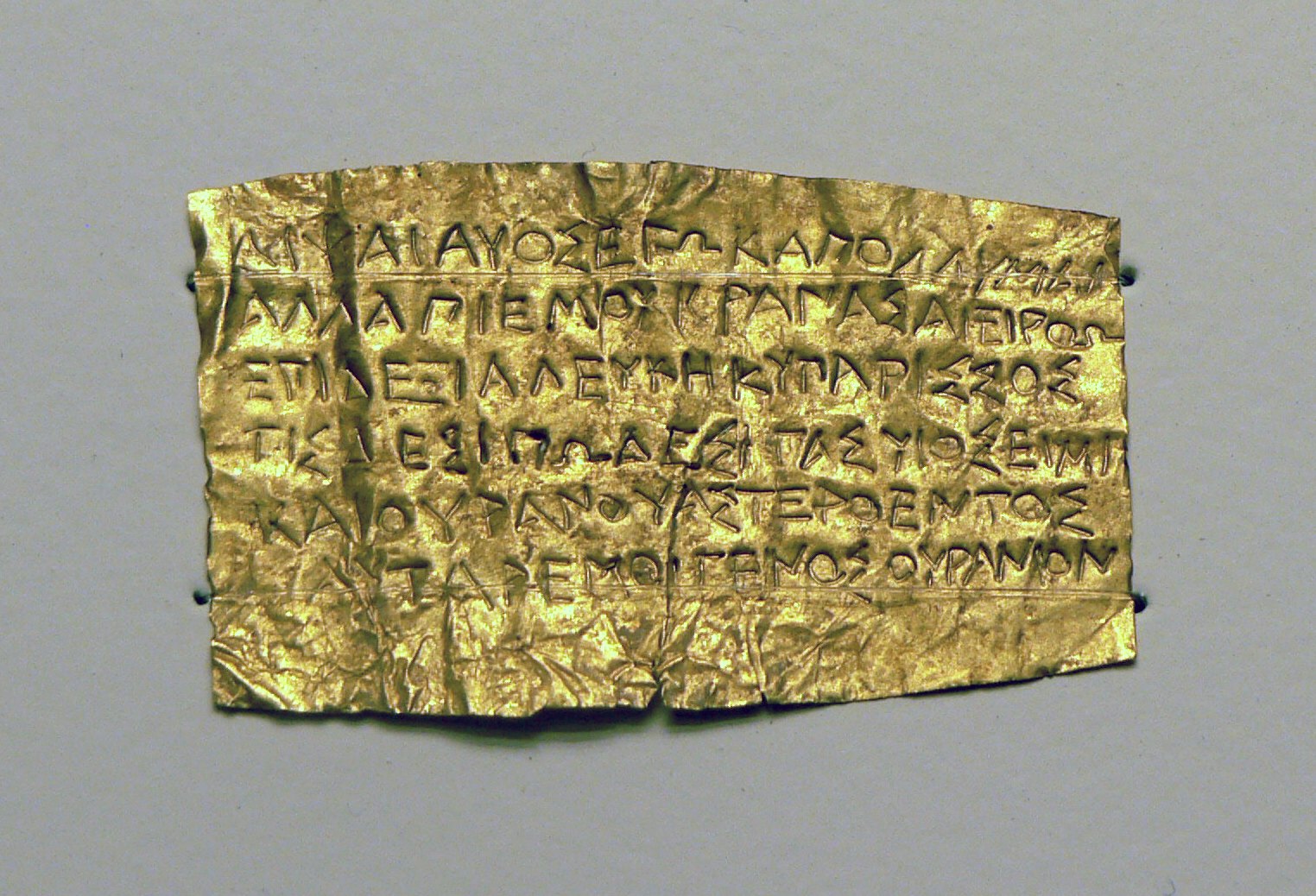
The Funeral is the rite of the final gold. The Temple describes it in a sentence: "The dead are sanctified, the soul empowered, and its way to the Elysian Fields blessed," and the funeral rite closes with a Genesia, a memorial kept over 40 days.14 The Greek initiates carried the same hope into their graves on thin sheets of gold. A tablet from Thurii in southern Italy, of the 4th century BC, greets the initiated dead:
Gold tablet from Thurii, 4th century BC 37
χαῖρε παθὼν τὸ πάθημα τὸ δ᾽ οὔπω πρόσθε ἐπεπόνθεις· θεὸς ἐγένου ἐξ ἀνθρώπου· ἔριφος ἐς γάλα ἔπετες.
"Rejoice, you who have suffered the suffering you had never suffered before: you have become a God from a man. A kid, you have fallen into milk."
"You have suffered the suffering," and "you have become a God": the blackening and the gold, joined in 2 short lines and written in gold. The tablet is the end of the Work in its oldest Greek words.
A Daily Order of the Work
The festivals come 8 times a year and the rites of life a few times in a lifetime. The Work is daily, and the Temple's liturgy can carry it daily with texts that the Ancients themselves prayed. The order below joins them to the Temple's own practice:
- At morning: the prayer of Socrates. Before the day begins, the prayer by the Ilissus, said in Greek or in English: ὦ φίλε Πάν τε καὶ ἄλλοι ὅσοι τῇδε θεοί, δοίητέ μοι καλῷ γενέσθαι τἄνδοθεν· ἔξωθεν δὲ ὅσα ἔχω, τοῖς ἐντὸς εἶναί μοι φίλια, "grant that I become beautiful within, and that whatever I have outside be friendly to what is within."6 It asks for the inner and the outer gold together, and sets the measure of the day.
- Before the day's work: the line to Hephaestus. Before any work on oneself or in the world: ἀλλ᾽ ἵληθ᾽, Ἥφαιστε· δίδου δ᾽ ἀρετήν τε καὶ ὄλβον, "be gracious, Hephaestus, and grant excellence and prosperity."39 The craftsman God who led men out of caves into houses is asked to bless the chisel.
- At the altar: water, oil and fire. The 3 elements of the Baptism, renewed in miniature: a touch of clean water to the brow for the washing, a drop of oil for the seal, and the candle for the light of Zeus.36 The Zevist who does this each day repeats the whole Work in a minute, and keeps its order in the body as well as in the mind.
- In meditation: the programme of the stage. The Temple's meditations as set out in this teaching: cleansing in the blackening, construction in the whitening, ascent in the gold.29
- At night: the review. The Pythagorean examination of the day, from the Golden Verses: "Where did I transgress? What did I do? What duty did I leave undone?" Then, the verses continue, rebuke yourself for what was base and "rejoice in what was good," χρηστὰ δὲ τέρπευ.40 The day is rubbed on the touchstone before sleep.
Ἡ λειτουργία ἐστὶ τὸ ἔσω ἔργον ἔξω τελούμενον.
Liturgy is the inner Work performed outwardly.
When the Gold Is False: The Negative Outcomes
The alchemists' greatest danger at the end of the Work was false gold, and the forgers of their age gave them plenty of examples. The third stage has its counterfeits too, and they're more dangerous than the failures of the earlier stages, because they look like success:
- Gilding without gold. The outer marks of refinement without the inner state: the right vocabulary, the calm voice, the Greek quotations, the photographs at the altar, and underneath an unformed soul. Theognis warned that counterfeit metal is easy to detect but a counterfeit mind is "the most counterfeit thing the God made for mortals."4 The touchstone of life reveals it in time.
- Gold kept in the dark. The opposite error: a real inner experience that never reaches the life. The meditator who sees light and keeps a disordered house, the mystic who speaks of the Gods and treats people badly. Socrates asked for the inside and the outside together;6 Plato's just man acts "then at last" in money, body, public life and private dealings.2 Gold that never circulates fails half of the prayer.
- Inflation. The person who has tasted the light declares himself finished, or above others, or a God already. Jung warned that "inflation magnifies the blind spot in the eye," and that an inflated consciousness "is always egocentric and conscious of nothing but its own existence."41, 8 The page on hubris and Izfet shows the same error at the scale of the cosmos: the breach of measure, and the blindness that follows it.42
- Hoarding. The stone that won't be projected. The alchemists' stone proved itself by turning other metal into gold; a refined soul that gives nothing, teaches no one and helps no one has kept the form of the gold and lost its virtue. Charity, as the Temple teaches it, is the remedy.26
- Stopping. The belief that the Work is done. The Temple's teaching on the Great Work holds that it runs across more than 1 lifetime, and the wheel of the year returns every autumn to the descent.28, 14 A soul that stops climbing begins to tarnish, because it keeps its bloom only by renewing the Work.
- Mortal gold mixed with divine. Plato forbade his guardians to mix the possession of divine gold with the possession of mortal gold.2 The danger is old and simple: spiritual achievement turned into a source of money, status or control over others. The gold of the soul is spent for the Gods and for others, and the person who sells it has stopped making it.
When the Gold Is True: The Positive Outcomes
The true gold is known by its fruits. Plato's unified man is "temperate and harmonised" and acts justly in everything he touches.2 Plotinus' purified soul is "wholly of the divine."15 Theognis' gold "always keeps its bloom pure."4 The Hermetic initiate sees "the universe, and myself in Mind."16 The refined Zevist knows the third stage by these marks:
- Unity. The inner parts no longer quarrel. The person wants what he chooses and does what he wants, and his days have one direction.
- A light that feeds itself. The practice continues, and it no longer has to be forced; the virtues come of themselves, as Plato's spark, once caught, "nourishes itself."17
- Stability under testing. The touchstone holds no fear. Losses and trials still come, and they show the gold's colour instead of the base metal underneath.5
- A life friendly to the soul. Work, home, body, speech and relationships are in harmony with the inner state, and they feed it in turn.2
- Power for others. The gold multiplies. The refined person raises a family well, works well, teaches, heals and strengthens the Temple, and the people around him become better for his presence.
- The bond with the Gods as a lived reality. The Temple's teaching on ἔρως describes the true Initiate, for whom the Gods are a reality within, as close as family.43 The gold of the third stage is that closeness made permanent.
- Readiness for the Godhead. The third stage of the alchemy is the threshold of Theosis, the Great Work of becoming a God, which the Temple teaches as the ultimate imperative of the Zevist path.28 The tablets of the initiates gave its last words: "you have become a God from a man."37
Ὁ ἀληθινὸς χρυσὸς τὸ ἄνθος ἀεὶ καθαρὸν ἔχει.
True gold always keeps its bloom pure.
Objections and Replies
Objection I: "Spiritual alchemy is a modern psychological reading of an old chemistry."
The spiritual reading is as old as the art. Zosimos, around 300 AD, wrote of the Work in the language of altars, priests, dismemberment and spirit;44 a modern study of him is titled The Spiritual Alchemy of Zosimos of Panopolis;45 and the Hermetic treatises of the same Greco-Egyptian world describe the rebirth of the soul in the same terms.16 Jung renewed in the 20th century a reading as old as the art.8
Objection II: "Gold is the symbol of greed."
Socrates prayed for "as much gold as only a temperate man could carry."6 Plato distinguished the divine gold in the soul from the mortal gold of coins and forbade mixing them.2 The lines that editors give to Pindar call gold the child of Zeus because neither moth nor weevil can devour it.11 The gold of the Work stands for what can't be corrupted, and greed is its corruption.
Objection III: "If the Gods complete the gold, why practise the rites?"
Because the rites are how the Gods complete it. Iamblichus taught that theurgic union comes through "the perfect accomplishment of ineffable acts" and the power of symbols "understood by the Gods alone."31 The liturgy is the place where the human hand prepares and the divine hand finishes, and the Temple's rites were made for exactly that meeting.
Conclusion: The Gold That Shines in the Night
The Great Work ends where Pindar's 1st Olympian begins: gold, "like a blazing fire in the night," shining out above every other wealth.12 The night is the first stage, the blackening, in which the old order dissolved and the soul learned that confusion is the door to the search. The long labour between is the second stage, the whitening, in which the person washed his matter and cut his statue with habit and trial. The fire and the gold are the third stage: the divine gold that the Gods placed in the soul "always," tinctured now through the whole person, so that the inner unity shines outwardly in speech, conduct, work, family and service.
The Temple celebrates the Work in its Initiation, in the water, oil, fire and Name of its Baptism, in the wheel of its 8 festivals, in the passage of its Funeral, and in the daily prayer of a Zevist who asks, as Socrates asked, to become beautiful within and to have the things outside be friends to what is within. The road up and the road down are one, and the gold within and the gold without are one gold.
Plato, Phaedrus 279b to c 6
δοίητέ μοι καλῷ γενέσθαι τἄνδοθεν· ἔξωθεν δὲ ὅσα ἔχω, τοῖς ἐντὸς εἶναί μοι φίλια.
"Grant that I become beautiful within, and that whatever I have outside be friendly to what is within."
Ἡ ψυχὴ χρυσῆ γενομένη Διὸς τέκνον.
The soul that has become gold is the child of Zeus.
High Priest Zevios Metathronos
Temple of Zeus Foundation
Sources & References
- Splendor Solis, British Library, Harley MS 3469, dated 1582, 22 full-page miniatures: plate 18, f. 29, the young red king on the crescent moon in the last flask of the planetary series; plate 19, f. 30v, the black sun; plate 22, f. 33v, the red sun. The earliest copy is Berlin, Kupferstichkabinett, 78 D 3, dated 1531 to 1532.
- Plato, Republic 415a (ὁ θεὸς πλάττων, ὅσοι μὲν ὑμῶν ἱκανοὶ ἄρχειν, χρυσὸν ἐν τῇ γενέσει συνέμειξεν αὐτοῖς), 416e to 417a (χρυσίον δὲ καὶ ἀργύριον εἰπεῖν αὐτοῖς ὅτι θεῖον παρὰ θεῶν ἀεὶ ἐν τῇ ψυχῇ ἔχουσι καὶ οὐδὲν προσδέονται τοῦ ἀνθρωπείου, οὐδὲ ὅσια τὴν ἐκείνου κτῆσιν τῇ τοῦ θνητοῦ χρυσοῦ κτήσει συμμειγνύντας μιαίνειν), 443c to e (παντάπασιν ἕνα γενόμενον ἐκ πολλῶν, σώφρονα καὶ ἡρμοσμένον, οὕτω δὴ πράττειν ἤδη …). Greek, J. Burnet, Platonis Opera 4, Oxford, 1905; trans. P. Shorey, Loeb Classical Library 237, 1930.
- Plato, Symposium 210e (ἐξαίφνης κατόψεταί τι θαυμαστὸν τὴν φύσιν καλόν, τοῦτο ἐκεῖνο … οὗ δὴ ἕνεκεν καὶ οἱ ἔμπροσθεν πάντες πόνοι ἦσαν) and 216e to 217a (τὰ ἐντὸς ἀγάλματα … θεῖα καὶ χρυσᾶ). Greek, J. Burnet, Platonis Opera 2, Oxford, 1910.
- Theognis 119 to 128 (counterfeit gold and silver, and the counterfeit mind, τοῦτο θεὸς κιβδηλότατον ποίησε βροτοῖσιν; οὐ γὰρ ἂν εἰδείης ἀνδρὸς νόον οὐδὲ γυναικός, πρὶν πειρηθείης) and 449 to 452 (ὥσπερ ἄπεφθον χρυσόν, ἐρυθρὸν ἰδεῖν τριβόμενον βασάνῳ …). Greek, J. M. Edmonds, Elegy and Iambus 1, Loeb Classical Library 258, 1931; M. L. West, Iambi et Elegi Graeci 1, Oxford, 1989.
- Plato, Gorgias 486d: εἰ χρυσῆν ἔχων ἐτύγχανον τὴν ψυχήν, ὦ Καλλίκλεις … τῶν λίθων ᾗ βασανίζουσιν τὸν χρυσόν. Greek, J. Burnet, Platonis Opera 3, Oxford, 1903.
- Plato, Phaedrus 279b to c, the prayer to Pan: ὦ φίλε Πάν τε καὶ ἄλλοι ὅσοι τῇδε θεοί, δοίητέ μοι καλῷ γενέσθαι τἄνδοθεν· ἔξωθεν δὲ ὅσα ἔχω, τοῖς ἐντὸς εἶναί μοι φίλια. πλούσιον δὲ νομίζοιμι τὸν σοφόν· τὸ δὲ χρυσοῦ πλῆθος εἴη μοι ὅσον μήτε φέρειν μήτε ἄγειν δύναιτο ἄλλος ἢ ὁ σώφρων. Greek, J. Burnet, Platonis Opera 2, Oxford, 1910.
- H. G. Liddell, R. Scott and H. S. Jones, A Greek-English Lexicon, 9th ed., Oxford, 1940, s.vv. ἴωσις ("refinement" by oxidation, from ἰός; the making of a tincture; Olympiodorus, p. 94, and Zosimos, p. 145, in Berthelot and Ruelle) and ξάνθωσις (Pseudo-Democritus, p. 54 Berthelot).
- C. G. Jung, Psychology and Alchemy, Collected Works 12, trans. R. F. C. Hull, 2nd ed., Princeton, 1968: §333 (melanosis, leukosis, xanthosis and iosis; reduced to 3 colours "about the fifteenth or sixteenth century," the xanthosis or citrinitas falling into disuse); §563, on inflation ("An inflated consciousness is always egocentric and conscious of nothing but its own existence").
- Rosarium Philosophorum, printed at Frankfurt in 1550 as part 2 of De Alchimia opuscula complura veterum philosophorum, with 20 woodcuts; woodcut 10, the crowned and winged Rebis standing on the moon, closes the first series.
- C. G. Jung, "The Psychology of the Transference" (1946), Collected Works 16, from §353, illustrated with the first 10 woodcuts of the Rosarium Philosophorum.
- Pindar, fragment 222 Snell-Maehler: Διὸς παῖς ὁ χρυσός· κεῖνον οὐ σὴς οὐδὲ κὶς δάπτει, quoted in the scholia on Pythian 4 (on ἄφθιτον στρωμνάν, the golden fleece). A. B. Drachmann, Scholia vetera in Pindari carmina 2, Leipzig, Teubner, 1910; B. Snell and H. Maehler, Pindari carmina cum fragmentis 2, Leipzig, 1989. The scholion cites Sappho just before the lines, and their attribution has been discussed.
- Pindar, Olympian 1.1 to 2 (ἄριστον μὲν ὕδωρ, ὁ δὲ χρυσὸς αἰθόμενον πῦρ ἅτε διαπρέπει νυκτὶ μεγάνορος ἔξοχα πλούτου) and Pythian 2.72 (γένοι᾽ οἷος ἐσσὶ μαθών). Greek, J. Sandys, Loeb Classical Library 56, 1937.
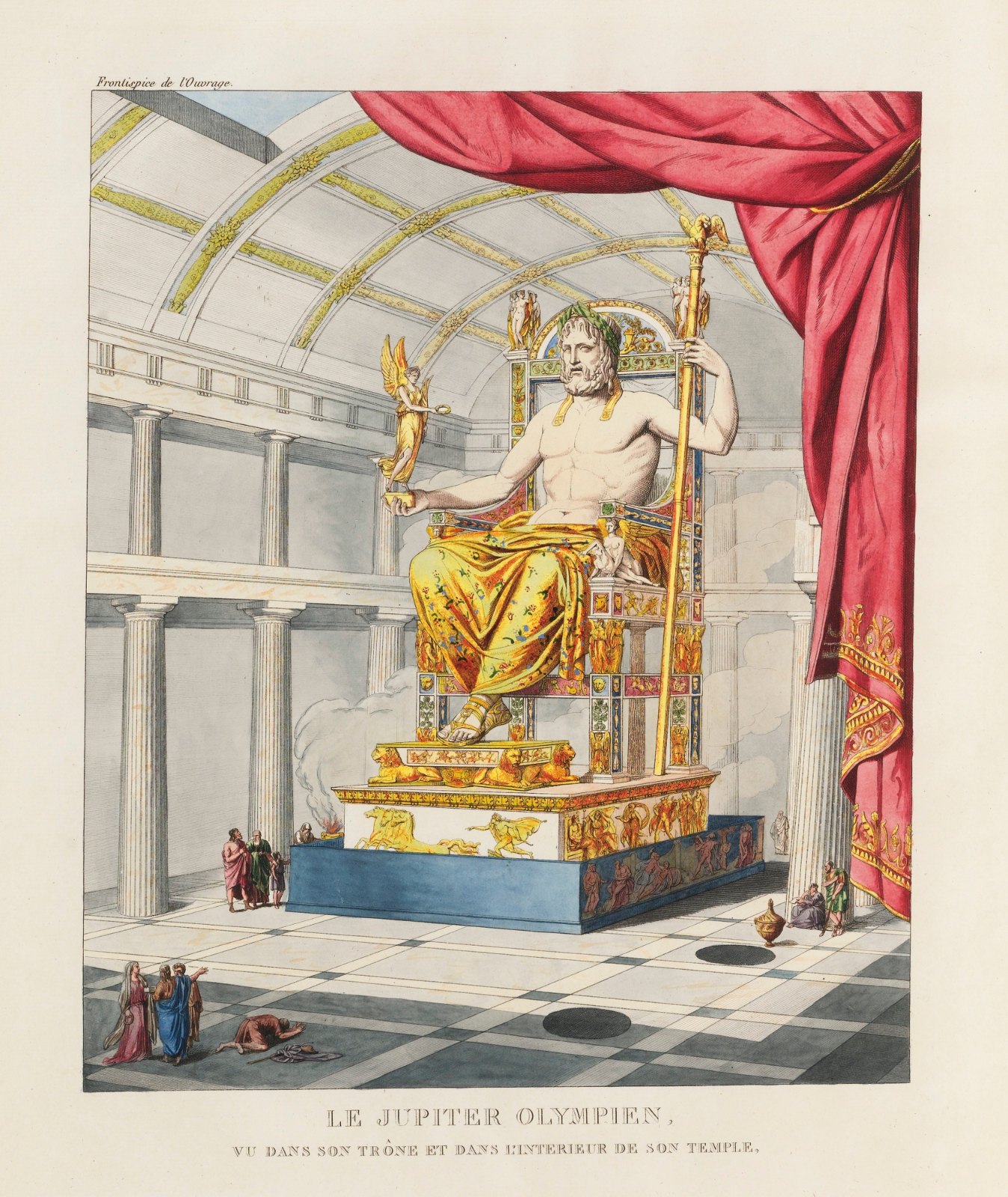
- The gold and ivory Zeus of Phidias at Olympia, about 435 BC; reconstruction in A.-C. Quatremère de Quincy, Le Jupiter olympien, Paris, 1815.
- Temple of Zeus, Zevist Rites and Holidays: the Rites of Life (Amphidromia, Baptism, Ephebeia, Wedding, Funeral with the 40-day Genesia memorial) and the 8 festivals with the Temple's own descriptions, as quoted in Table 2.
- Plotinus, Enneads 1.6.6: γίνεται οὖν ἡ ψυχὴ καθαρθεῖσα εἶδος καὶ λόγος καὶ πάντη ἀσώματος καὶ νοερὰ καὶ ὅλη τοῦ θείου, ὅθεν ἡ πηγὴ τοῦ καλοῦ. Greek, P. Henry and H.-R. Schwyzer, Plotini Opera 1, Oxford Classical Texts, 1964.
- Corpus Hermeticum 13 (On Rebirth): 13.3 (καί εἰμι νῦν οὐχ ὁ πρίν, ἀλλ᾽ ἐγεννήθην ἐν νῷ), 13.11 (ἐν οὐρανῷ εἰμι, ἐν γῇ, ἐν ὕδατι, ἐν ἀέρι· ἐν ζῴοις εἰμί, ἐν φυτοῖς· ἐν γαστρί, πρὸ γαστρός, μετὰ γαστέρα, πανταχοῦ), 13.13 (Πάτερ, τὸ πᾶν ὁρῶ καὶ ἐμαυτὸν ἐν τῷ νοΐ). Ed. A. D. Nock and A.-J. Festugière, Corpus Hermeticum II, Paris, Budé, 1945; trans. B. P. Copenhaver, Hermetica, Cambridge, 1992.
- Plato, Letters 7, 341c to d: ῥητὸν γὰρ οὐδαμῶς ἐστιν ὡς ἄλλα μαθήματα, ἀλλ᾽ ἐκ πολλῆς συνουσίας γιγνομένης περὶ τὸ πρᾶγμα αὐτὸ καὶ τοῦ συζῆν ἐξαίφνης, οἷον ἀπὸ πυρὸς πηδήσαντος ἐξαφθὲν φῶς, ἐν τῇ ψυχῇ γενόμενον αὐτὸ ἑαυτὸ ἤδη τρέφει. Greek, J. Burnet, Platonis Opera 5, Oxford, 1907.
- C. G. Jung, Two Essays on Analytical Psychology, Collected Works 7, trans. R. F. C. Hull, 2nd ed., Princeton, 1966, §266.
- Heraclitus, fr. 22 B60 Diels-Kranz: ὁδὸς ἄνω κάτω μία καὶ ὡυτή, from Hippolytus, Refutation of All Heresies 9.10.4. H. Diels and W. Kranz, Die Fragmente der Vorsokratiker 1, 6th ed., Berlin, 1951.
- Tabula Smaragdina (Emerald Tablet), first preserved as an appendix to the Arabic Kitāb Sirr al-khalīqa attributed to Balīnūs (late 8th or early 9th century); Latin vulgate of the 12th century; the wording quoted is that printed in De alchemia, Nuremberg, J. Petreius, 1541, p. 363. See J. Ruska, Tabula Smaragdina, Heidelberg, 1926.
- Heinrich Khunrath, Amphitheatrum Sapientiae Aeternae, 1st ed. 1595 with hand-coloured circular plates; 2nd ed., Hanau, 1609; plates designed by Hans Vredeman de Vries and engraved by Paullus van der Doort. The plate of the Oratorium and Laboratorium carries Dormiens vigila on the architrave and Disce bene mori below the table (Universitätsbibliothek Frankfurt am Main).
- Temple of Zeus, Noble Speech, Good Conduct, and Reverence to the Gods.
- Temple of Zeus, Good Manners, Kindness, and the Discipline of Courtesy.
- Temple of Zeus, Physical Exercise: Beginner, Intermediate and Advanced.
- Temple of Zeus, Zevist Parenting.
- Temple of Zeus, Charity in Zevism: a good heart, a clear mind, and help that lifts people up.
- Temple of Zeus, Most Workings Are Not Just a One Shot Deal.
- Temple of Zeus, Theosis: The Magnum Opus: the Great Work as the ultimate imperative of the Zevist path, across more than 1 lifetime if it must be so, each life reaching its full worth in the pursuit.
- Temple of Zeus, Meditation: the Ascend category (Meditation on Zeus, Mer Ka Ba, Meditation on the Spirit, Theosis (Magnum Opus)); Single Serpent Meditation, Twin Serpent Meditation, Freeing the Soul, Words of Power, Invoking the Elements, Invoking Quintessence.
- Temple of Zeus, Theosis (Magnum Opus), the meditation page: the full teaching "released in time," given "when its meaning can be understood"; the programmes, the Ethics, prayer and ritual, honest self-observation and a record; "The practices are its tools, and the life lived through them is the Work."
- Iamblichus, On the Mysteries 2.11, 96.13 to 97.2 Parthey. Ed. G. Parthey, Berlin, 1857; H. D. Saffrey and A.-Ph. Segonds, Paris, Budé, 2013; trans. E. C. Clarke, J. M. Dillon and J. P. Hershbell, Atlanta, 2003.
- Ovid, Metamorphoses 10.243 to 297, Pygmalion. Latin, H. Magnus, Gotha, 1892.
- Proclus, On the Hieratic Art according to the Greeks, ed. J. Bidez, Catalogue des manuscrits alchimiques grecs 6, Brussels, 1928, pp. 148 to 151; new critical edition and translation by E. Pachoumi, Leiden, Brill, 2024: "all things pray according to their own order," and the heliotrope's hymn to its king.
- Temple of Zeus, Magick and Theurgy, the Theurgy section (the Heavenly Powers): Banishing Ritual, Meditation for Protection, Magickal Squares, Healing, Drawing Down Energy From Stars and Luminaries.
- Temple of Zeus, Becoming an Initiate: the prayer written by hand, signed, recited aloud or in the mind, and burned; the renunciation of "the path of Izfet" for "the path of Ma'at"; "from Ignorance to Truth"; a permanent commitment that cannot be repeated; the gold tablet, "From a human, you have become a god."
- Temple of Zeus, The Zevist Baptism: water ("You are cleansed in the Name of Zeus"; washed "of falsehood, ignorance, and spiritual bondage"), oil ("The seal of Zeus is upon you"), the flame as "the light of Zeus," the 2 names of "the world of men" and "the world of the spirit," "Guard this name. It is sacred," the adult prayer ("I have left falsehood behind. I walk in Truth") and the response in praise of Zeus.
- Gold tablet from Thurii, Timpone Grande, 4th century BC (Zuntz A4): χαῖρε παθὼν τὸ πάθημα τὸ δ᾽ οὔπω πρόσθε ἐπεπόνθεις· θεὸς ἐγένου ἐξ ἀνθρώπου· ἔριφος ἐς γάλα ἔπετες. A. Bernabé, Orphicorum Fragmenta, fr. 487, 2005; F. Graf and S. I. Johnston, Ritual Texts for the Afterlife, London, 2007, no. 3.
- Orphic gold tablet from Thessaly, 4th century BC; J. Paul Getty Museum, 75.AM.19.
- Homeric Hymn 20, To Hephaestus, 8: ἀλλ᾽ ἵληθ᾽, Ἥφαιστε· δίδου δ᾽ ἀρετήν τε καὶ ὄλβον. Greek, H. G. Evelyn-White, Loeb Classical Library 57, 1914.
- Pythagorean Golden Verses 40 to 44, ending δειλὰ μὲν ἐκπρήξας ἐπιπλήσσεο, χρηστὰ δὲ τέρπευ. Ed. J. C. Thom, The Pythagorean Golden Verses, Leiden, Brill, 1995.
- C. G. Jung, Aion, Collected Works 9ii, trans. R. F. C. Hull, 2nd ed., Princeton, 1968, §44: "Inflation magnifies the blind spot in the eye."
- Temple of Zeus, Hubris and Izfet: The Breach in the Measure.
- Temple of Zeus, Ἐραστὴς καὶ Ἐρώμενος: Attraction, Love and True Initiation: the true Initiate, for whom the Gods are a lived reality within.
- Zosimos of Panopolis, Visions (Περὶ ἀρετῆς), Mémoires authentiques X to XII, ed. M. Mertens, Les alchimistes grecs IV.1, Paris, 1995; L. M. Principe, The Secrets of Alchemy, Chicago, 2012, pp. 15 to 24, on Zosimos' "language of altars, dismemberment, and sacrifice" as a reflection of late Greco-Egyptian temple practice (p. 19).
- K. A. Fraser, "Baptised in Gnôsis: The Spiritual Alchemy of Zosimos of Panopolis," Dionysius 25, 2007, pp. 33 to 54.