













52 min read
Μελάνωσις: Alchemical Chaos and the Dark Night of the Soul
author: High Priest Zevios Metathronos
Stage I · Nigredo
Every Great Work begins in the dark. The Greek alchemists of Egypt began it with a blackening, μελάνωσις in the list of stages that Jung drew from their books, and the Latin West called it nigredo; much later a Spanish poem gave the experience the name it still carries, the Dark Night of the Soul. Plato had described it long before, as a prisoner, unbound in a cave, whose eyes ache in a light he can't yet bear, and the Mysteries described it as wandering through darkness until a marvellous light breaks. This teaching sets out what happens when a new Zevist learns the Truth and the old picture of reality gives way: why old conflicts and old programming rise up, why confusion and resistance belong to the process and prove that it has begun, how the laboratory of the soul is cleared, what is lost when the Work is abandoned, and what the cleared laboratory yields, a soul made ready for the form and the gold that follow.
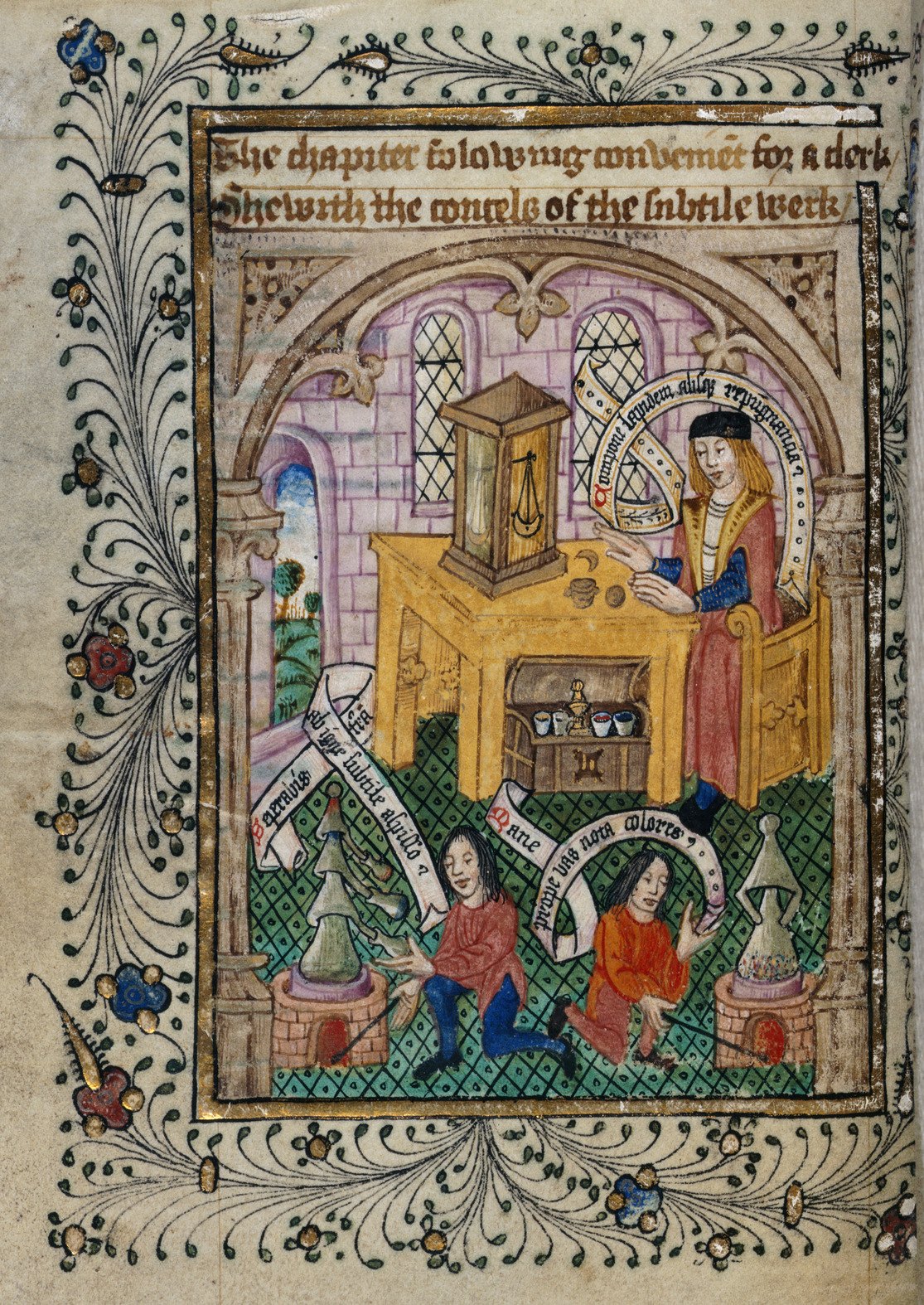
The Blackening in Plain Words
The teaching has 6 parts, and each answers a plain question.
What it is. The first stage of the Great Work in a human being: the loosening of the old order of a life, so that a truer order can be built in its place. The alchemists set it at the start of every operation, and Jung, who studied their books for decades, summed up their consensus in a single sentence: "The nigredo or blackness … is the initial state, either present from the beginning as a quality of the prima materia, the chaos or massa confusa, or else produced by the separation (solutio, separatio, divisio, putrefactio) of the elements."2
When it comes. After the awakening. A person meets the Gods, learns the Truth of the original religion, takes the Initiation and begins power meditation, and the structures that held the old life together start to move.3, 4
What it feels like. Confusion, grief, anger, doubt, fatigue, old memories, sometimes fear. The Temple's teaching for new people names the feelings without softening them: repressed emotions rise, "such as anger, hatred, rage, grief, and so forth," together with upsetting thoughts and feelings "and not knowing why these are occurring."4
Why it happens. The soul is being cleared, and nothing can be cleared that stays hidden. What was buried has to come up into the light before it can leave.
How long it lasts. For each person differently. The Temple says that these emotions "can last up to a year or even longer, depending on the intensity," and that "how long this process takes or whether one goes through this is individual."4
How it ends. In order and in freedom. "In time, suppressed emotions will be cleaned out, and the soul will be able to advance and be much freer."4 The blackening is followed by the whitening, the forming of the self, and the whitening by the gold.5
The Temple reads the sacred art as 1 Work in 3 stages, and this teaching is the first of the 3:
| Stage | Greek and Latin | Colour | In the Soul | In the Life | Teaching |
|---|---|---|---|---|---|
| I | μελάνωσις, nigredo | Black | The old order dissolves; buried contents rise; confusion and resistance. | Reassessment of beliefs, habits, bonds and time. | Μελάνωσις: Alchemical Chaos |
| II | λεύκωσις, albedo | White | The washing; the self is formed by deliberate work, habit and trial. | Discipline, measure, a structured day, a trained body. | Λεύκωσις: The Rough Stone and the Living Statue |
| III | ἴωσις, rubedo | Red and gold | The soul made one, illumined and stable. | A life that carries the inner order outward and improves what it touches. | Ἴωσις: The Alchemical Gold, Within and Without |
The Sacred Art: Where the Blackening Comes From
Alchemy is Greek and Egyptian at the root. Its oldest surviving writings are in Greek, composed in Roman Egypt, where the workshop crafts of dyers, metalworkers and glassmakers met Greek natural philosophy. Lawrence Principe, a leading historian of the subject, places the union of the 2 traditions "probably in the third century AD," and from it came "the independent discipline of alchemy."6
The first name in the line is the writer who published under the name of Democritus, active in the 1st century, most likely in the reign of Nero.7 His books are older than the discipline in its full form, and they preserve the oldest formula of the art, said to have been found when a column split open in a temple:
Pseudo-Democritus, Physika kai Mystika 7
Ἡ φύσις τῇ φύσει τέρπεται, καὶ ἡ φύσις τὴν φύσιν νικᾷ, καὶ ἡ φύσις τὴν φύσιν κρατεῖ.
"Nature delights in nature, and nature conquers nature, and nature masters nature."
The formula already holds the whole doctrine of this teaching. A nature meets a stronger nature, is overcome, and is mastered into a higher state. Around 300 AD Zosimos of Panopolis, the best known of the Greek alchemists, traced the art to the Egyptian temples and named it χημεία; later writers called it the divine and sacred art.6, 8
The Greek authors marked the stages of the Work by colour, and Jung lists them as μελάνωσις, the blackening; λεύκωσις, the whitening; ξάνθωσις, the yellowing; and ἴωσις, the final tincturing, which Jung matched with the Latin rubedo, the reddening.9, 2 Jung records what happened to the scheme in the West: "Later, about the fifteenth or sixteenth century, the colours were reduced to three, and the xanthosis, otherwise called the citrinitas, gradually fell into disuse or was but seldom mentioned."2 Black, white and red remained, and the Temple keeps that order: chaos, form and gold.
Zosimos left a dream that shows how the Greek alchemists saw the blackening from within. In the treatise his manuscripts call On Excellence, Περὶ ἀρετῆς, he sees a priest standing on a bowl-shaped altar of 15 steps. The priest names himself Ion, priest of the inner sanctuaries, and tells him what he suffers: a man came at dawn, cut him apart with a sword, and burned his flesh and bones in the fire of the art, until by the transformation of the body he became spirit, πνεῦμα. He calls it an unbearable punishment.10 Principe reads the altar and the dismemberment as an echo of the practice of the late Egyptian temples.6
The dream is severe, and its meaning is clear. What enters the vessel as body and habit comes out as spirit, and the passage between them is felt as a breaking. The Ancients kept the hardness of the first stage in plain view, and they kept its destination in view as well.
Ἡ φύσις νικηθεῖσα ὑπὸ κρείττονος φύσεως κρείττων γίγνεται.
A nature overcome by a stronger nature becomes stronger itself.
Chaos Before Cosmos: The Greek Order of Creation
The Greeks set darkness at the head of creation, and they set it there as a mother. Hesiod's Theogony begins its account of the world with the words "first of all Chaos came into being," and the poem then shows what comes out of the dark:11
Hesiod, Theogony 123 to 125 11
ἐκ Χάεος δ᾽ Ἔρεβός τε μέλαινά τε Νὺξ ἐγένοντο· Νυκτὸς δ᾽ αὖτ᾽ Αἰθήρ τε καὶ Ἡμέρη ἐξεγένοντο, οὓς τέκε κυσαμένη Ἐρέβει φιλότητι μιγεῖσα.
"From Chaos came Erebus and black Night; and from Night in turn were born Aether and Day, whom she conceived and bore after mingling in love with Erebus."
Day is the child of Night. The bright upper air, the αἰθήρ of the Gods, is born of the black. The Orphic hymn to Night opens on the same note: "Night, mother of Gods and of men, I shall sing," Νύκτα θεῶν γενέτειραν ἀείσομαι ἠδὲ καὶ ἀνδρῶν.12
Ovid, who gathered the Greek cosmogonies into Latin verse, gave the classic picture of what the world was before the God ordered it:
Ovid, Metamorphoses 1.5 to 9 13
Ante mare et terras et quod tegit omnia caelum unus erat toto naturae vultus in orbe, quem dixere chaos: rudis indigestaque moles nec quicquam nisi pondus iners congestaque eodem non bene iunctarum discordia semina rerum.
"Before the sea and the lands and the sky that covers all things, nature had a single face throughout the whole world, which they called chaos: a rough, unordered mass, nothing but inert weight, the warring seeds of things not well joined, heaped together in one place."
Then: "This strife a God, and a kindlier nature, settled," Hanc deus et melior litem natura diremit.13 Plato says the same in philosophical prose. The God of the Timaeus "took over all that was visible, which was not at rest but moving in discord and without order, and brought it into order out of disorder," εἰς τάξιν αὐτὸ ἤγαγεν ἐκ τῆς ἀταξίας.14
The soul repeats the cosmogony. Before the Work it is a rough and unordered mass, its seeds at war with each other, and the first thing the Work does is to show the mass for what it is. The ordering that follows is the second stage. Zeus, Sovereign of the Cosmos, rules over an order that was won from chaos, and the soul that wants to become like the Gods wins its order the same way.15
The Temple distinguishes 2 kinds of darkness here, and the distinction matters for everything that follows. The first is the dark of the beginning: unformed matter, unexplored ground, the material that waits for order. Walked into with light, it becomes light, which is knowledge and wisdom. The second is Izfet, dissolution that seeks no order and drags what it touches back towards formless ruin.16 The blackening of the Work belongs to the first kind: it loosens what it will rebuild, while Izfet loosens what it means to ruin.
Ἐκ νυκτὸς ἡμέρα, καὶ ἐκ χάους κόσμος.
From night, day; and from chaos, cosmos.
The Dark Night of the Soul: An Old Experience Under a New Name
The phrase is late. It comes from a Spanish Carmelite, Juan de la Cruz, whose poem Noche oscura was probably written between 1577 and 1579 and whose prose commentary on it followed in 1584 to 1586. An English version of 1864 was called The Obscure Night of the Soul; the title The Dark Night of the Soul belongs to its revision of 1908.17 The experience the phrase names is far older, and the Greeks described it 2,000 years before the poem.
Plutarch, priest of Apollo at Delphi, compared the soul's passage at death with initiation into the great Mysteries, and in doing so he left an exact ancient account of what an initiate lived through on the way to the light:18
Plutarch, fragment 178 Sandbach, from Stobaeus 4.52.49 18
πλάναι τὰ πρῶτα καὶ περιδρομαὶ κοπώδεις καὶ διὰ σκότους τινὲς ὕποπτοι πορεῖαι καὶ ἀτέλεστοι, εἶτα πρὸ τοῦ τέλους αὐτοῦ τὰ δεινὰ πάντα, φρίκη καὶ τρόμος καὶ ἱδρὼς καὶ θάμβος· ἐκ δὲ τούτου φῶς τι θαυμάσιον ἀπήντησεν καὶ τόποι καθαροὶ καὶ λειμῶνες ἐδέξαντο, φωνὰς καὶ χορείας καὶ σεμνότητας ἀκουσμάτων ἱερῶν καὶ φασμάτων ἁγίων ἔχοντες …
"First there are wanderings, wearisome runnings about, and fearful, unfinished journeys through the dark; then, just before the end, every terror: shuddering, trembling, sweat and amazement. After this a marvellous light meets you, and pure places and meadows receive you, with voices and dances and the solemnities of sacred sounds and holy sights …"
Every element of the Dark Night is in that sentence: the wandering without a map, the circling that seems to lead nowhere, the dread that grows strongest just before the end, and then the light, which comes to meet the wanderer. The terrors come "just before the end," πρὸ τοῦ τέλους αὐτοῦ, which means that their intensity is itself a sign of nearness.
A 2nd-century initiate of Isis, the hero of Apuleius' novel, reports his own night in Latin and in the fewest possible words:
Apuleius, Metamorphoses 11.23 19
Accessi confinium mortis et calcato Proserpinae limine per omnia vectus elementa remeavi; nocte media vidi solem candido coruscantem lumine; deos inferos et deos superos accessi coram et adoravi de proxumo.
"I approached the boundary of death and, having trodden the threshold of Proserpina, I was carried through all the elements and returned; at midnight I saw the sun shining with brilliant light; I came face to face with the Gods below and the Gods above, and worshipped them from near at hand."
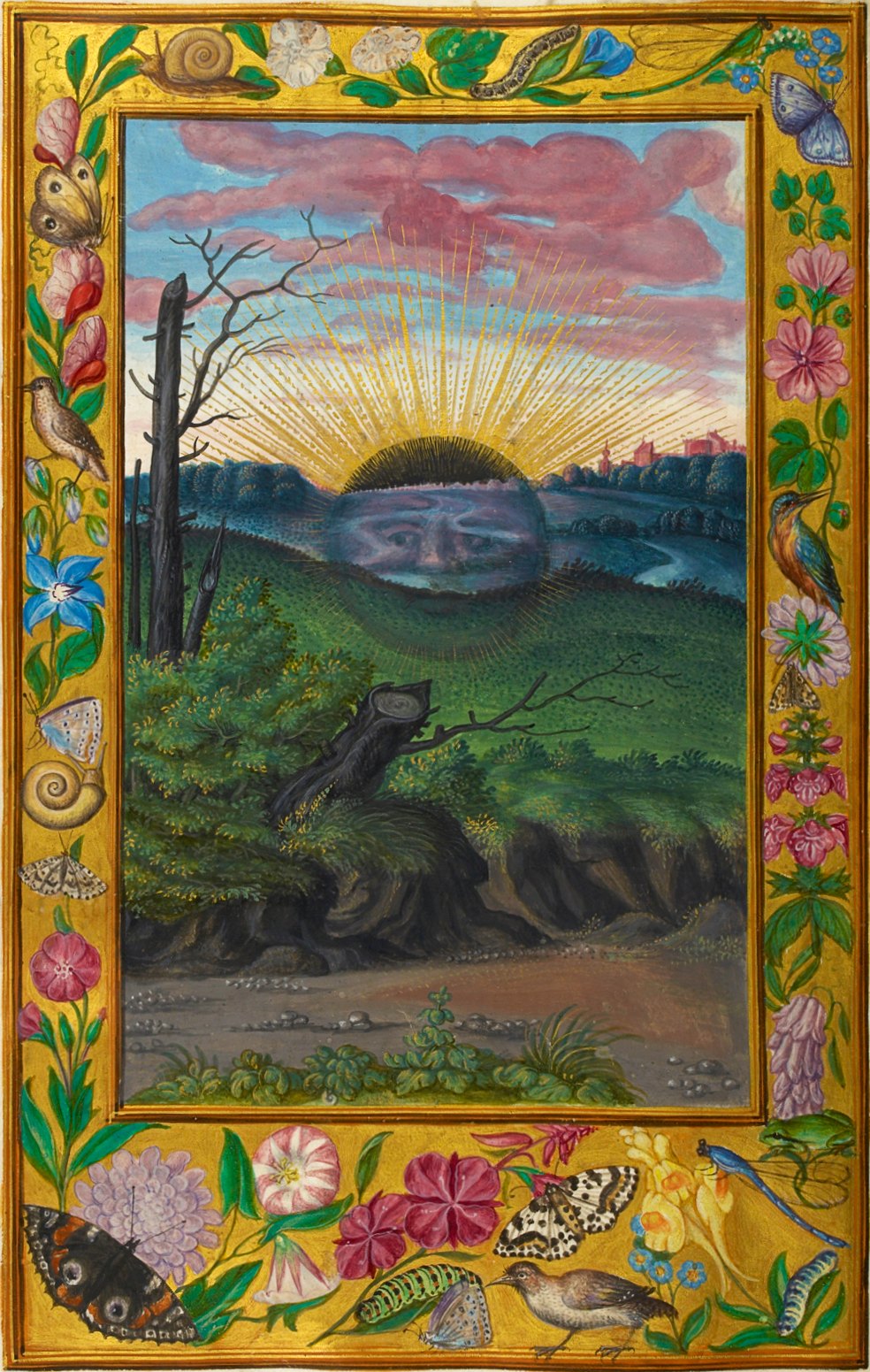
"At midnight I saw the sun." The alchemists painted the same paradox. The Splendor Solis, a German manuscript whose earliest copy is dated 1531 to 1532, gives a whole plate to a sun with a face, sinking black behind a landscape of felled trees, and closes the book 3 plates later with the same sun risen red and gold.20
Socrates, who called himself a midwife of souls, gave the night its most humane description. Those who keep company with him, he says in the Theaetetus, "are in labour and are filled with perplexity night and day," ὠδίνουσι γὰρ καὶ ἀπορίας ἐμπίμπλανται νύκτας τε καὶ ἡμέρας, "far more than women giving birth; and this labour my art can both arouse and bring to an end."21
Πρὸ τοῦ τέλους τὰ δεινά· μετὰ δὲ τὰ δεινὰ τὸ φῶς.
Before the end come the terrors; after the terrors, the light.
Plato's Cave: The Pain of the First Light
The most famous image in Greek philosophy is an image of the blackening. In the 7th book of the Republic, Plato describes prisoners chained since childhood in a cave, facing a wall on which shadows move; they take the shadows for the whole of reality. Then 1 of them is freed.22
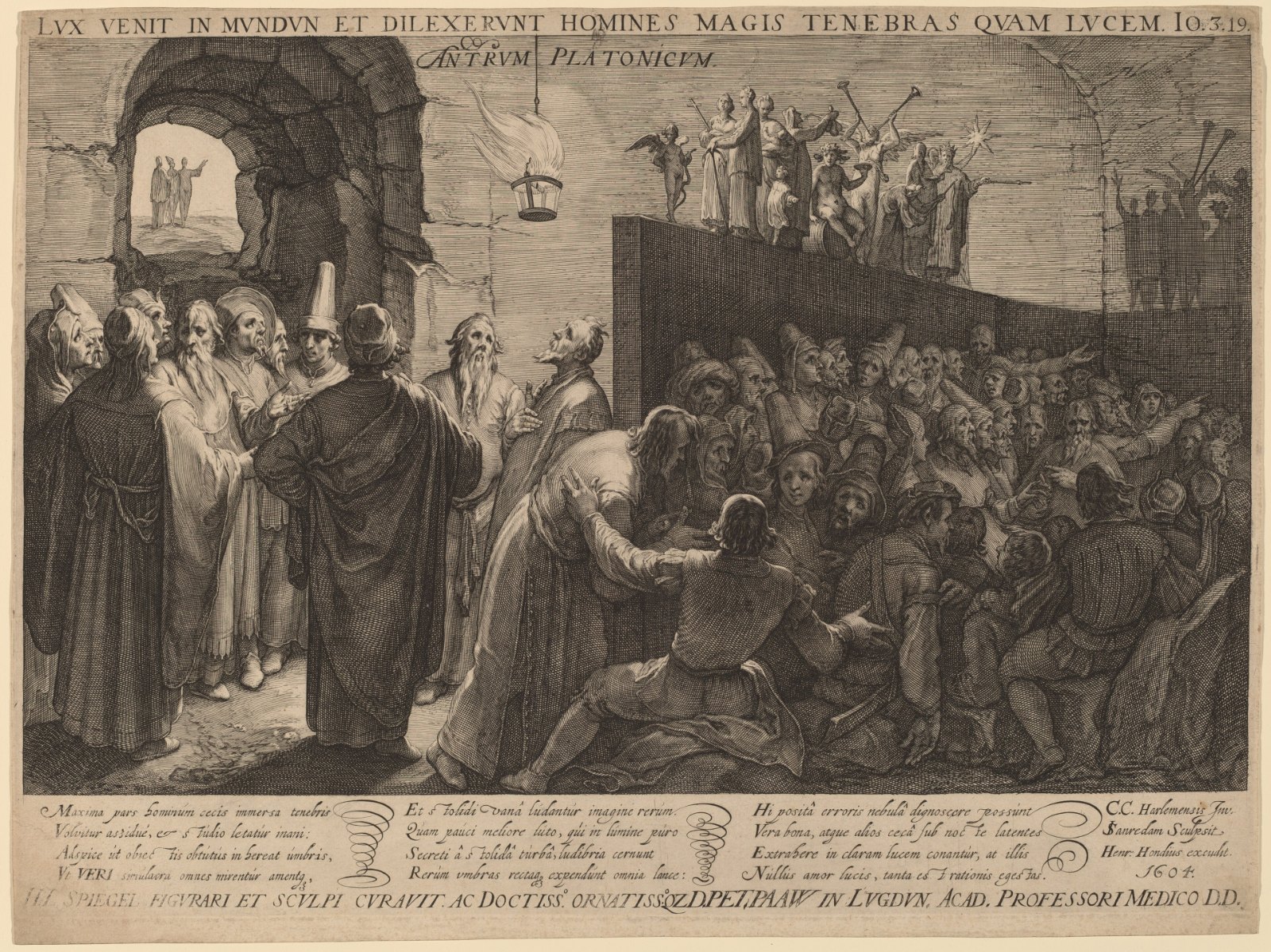
Plato, Republic 515c to d 22
ὁπότε τις λυθείη καὶ ἀναγκάζοιτο ἐξαίφνης ἀνίστασθαί τε καὶ περιάγειν τὸν αὐχένα καὶ βαδίζειν καὶ πρὸς τὸ φῶς ἀναβλέπειν, πάντα δὲ ταῦτα ποιῶν ἀλγοῖ τε καὶ διὰ τὰς μαρμαρυγὰς ἀδυνατοῖ καθορᾶν ἐκεῖνα ὧν τότε τὰς σκιὰς ἑώρα … οὐκ οἴει αὐτὸν ἀπορεῖν τε ἂν καὶ ἡγεῖσθαι τὰ τότε ὁρώμενα ἀληθέστερα ἢ τὰ νῦν δεικνύμενα;
"Whenever one of them was freed and suddenly compelled to stand up, turn his neck, walk and look up towards the light, and in doing all this felt pain, and because of the dazzle couldn't make out the things whose shadows he used to see … don't you think he would be at a loss, and would believe that the things he saw before were truer than those now being shown him?"
Plato's account of the blackening holds 4 facts, and every new Zevist will recognise them.
- The freeing hurts. The prisoner "felt pain," ἀλγοῖ. Release from a lifelong posture is painful in the body before it's joyful in the mind, and Plato doesn't pretend otherwise.
- The new light blinds before it shows. The μαρμαρυγαί, the flashing dazzle, make the newly freed man see less than he saw in the dark. The first effect of the Truth is often a confusion greater than the old certainty.
- The old shadows feel truer. He is "at a loss," ἀπορεῖν, and believes that what he saw before was more real. The pull of the old picture is strongest exactly when the new one appears.
- He wants to flee back. If forced to look at the light itself, he'd turn and run towards what he can make out, and think it clearer.22
Then Plato gives the remedy in a single word. Dragged up the "rough and steep ascent," pained and indignant, the man can't see anything at once; "then he would need habituation, I think, if he is going to see the things above," συνηθείας δὴ οἶμαι δέοιτ᾽ ἄν.22 Habituation means time and repetition. The eyes adjust, first to shadows and reflections, then to the things themselves, then to the stars by night, and "last of all, the sun itself, in its own place."22
Plato adds a rule of charity that the Temple holds to. "Anyone with sense would remember that disturbances of the eyes are of 2 kinds and come from 2 causes: when the eyes are moved from light into darkness, and from darkness into light." Whoever sees a soul confused and unable to make something out "wouldn't laugh unthinkingly," but would ask which way the soul is travelling, since a confused newcomer may be climbing.22
The turn involves the whole person. "Just as an eye couldn't be turned from the dark towards the bright except together with the whole body, so this must be turned around together with the whole soul, away from what comes to be," σὺν ὅλῃ τῇ ψυχῇ ἐκ τοῦ γιγνομένου περιακτέον εἶναι.22 This is why the blackening touches everything at once: beliefs, feelings, relationships, habits, the use of time.
Plato also knew how the cave treats the one who comes back to free the others: "if they could somehow get him into their hands and kill him, wouldn't they kill him?"22 The new Zevist often meets a smaller version of that hostility from family, friends or an old religious community.
Οἱ ὀφθαλμοὶ πρὸς τὸ φῶς ἐθίζονται, ἡ δὲ ψυχὴ πρὸς τὴν ἀλήθειαν.
The eyes grow used to the light, and the soul to the Truth.
The Reassessment of Reality: When a New Zevist Learns the Truth
To learn the Truth is to reread a life. The new Zevist learns that the Gods are real and near; that the original religion of mankind runs back through the Greek, Egyptian and Indian sources the Temple teaches from;24 and that the fear taught in childhood was, in the Temple's words, training meant to make "the perfect slave."25 Each of these discoveries reaches backwards. Childhood, family, history, morality and the picture of oneself are all read again in a new light, and some of what was loved has to be seen for what it was.
For some, the reassessment is a homecoming and passes almost without pain. The Temple speaks for them when it says that "for many, embracing Zevism is a first time of coming into one's own."4 For others it's a quake. The Temple's teaching on the old programming says the same plainly: some shed it easily, while for others it stands as "a huge wall," and the path can't be walked in earnest until the wall comes down.25 Both are starting positions in the same laboratory.
The reassessment runs through the whole person, in 4 fields that each need their own care:
- Spiritual. The Gods are known for the first time as kin rather than as distant judges. The bond is new, and a new bond is tender; the person may swing between elation and doubt about whether any of it is real. The Temple expects this: some doubt resolves with study, and irrational doubt can linger for a time.25
- Mental. Beliefs absorbed without examination come up for judgement: about sin, about the body, about power, about what a good person is. Many of them were never chosen, and it takes time to see which ones stay.
- Emotional. Grief for the years lost, anger at what was taught, sometimes shame at having believed it. The Temple prescribes these feelings as part of the cleansing: anger at the teachings received and grief over lost time, carried through meditation and practice.25
- Existential. What to do with time, work, friendships and habits now that the aim of life has changed. Plato named that aim: to become like God as far as is possible, ὁμοίωσις θεῷ κατὰ τὸ δυνατόν, and a life ordered to it can't keep every arrangement of the life that wasn't.21, 26
In 1960 the anthropologist Kalervo Oberg described what happens to people who move to a foreign country: a first period of fascination, then a crisis of confusion and hostility as the old cues stop working, then gradual recovery, and at last an adjustment in which the new place becomes home. He called the whole experience "culture shock," with the crisis as its 2nd stage.27 The new Zevist undergoes a culture shock of the soul. The country is the world of the Gods, and the cues that stop working are the habits of the old religion. The recovery comes the same way, by living in the new country until its language is native.
Ὁ τὴν ἀλήθειαν μαθὼν τὸν ἑαυτοῦ βίον αὖθις ἀναγιγνώσκει.
Whoever learns the Truth reads his own life again.
Why Old Conflicts Rise Again
The newcomer is often surprised by the timing. The Truth has been found, the Gods are near, the practice has begun, and just then old griefs return, quarrels long settled flare up, and memories that seemed forgotten arrive in the middle of a meditation. The Temple explains the mechanism directly. "Power meditation is a psychic cleaning house, so to speak," and starting a programme of it can cause "repressed emotions to manifest." The source of the material lies in the past: "Many of us can't even remember these experiences, but our subconscious minds do."4
The cleaning house brings up 2 kinds of material. The first is personal: the wounds, fears and angers of a single life, stored where they couldn't be dealt with at the time. The second is inherited: the programming of the old religion, which the Temple describes symptom by symptom in its teaching on freeing the mind from Christianity and Islam.25 These are the forms it takes when it rises:
- Fear of the Gods. The Gods are pictured as "angry judges who will punish you constantly," or even as evil. The fear was planted early and runs deeper than argument, so it can return after the mind has already rejected it.
- Persistent doubt. Distrust of one's own mind, and of whether the Gods or the path are real. Some doubt is a healthy part of study and resolves with it; the irrational kind lingers because it was installed and not reasoned.
- Guilt for existing. The doctrine of original sin teaches a person to feel bad for simply being alive, and to feel guilty for wanting power, success or happiness. It returns as a vague unease whenever life goes well.
- Resistance to meditation. A sense that quieting the mind is dangerous, which shows itself as panic, restlessness or sudden distraction just as the practice deepens.
- Feeling undeserving. The self-image of the sinner, which blocks healing and power by declaring the person unworthy of them in advance.
- Discomfort with life energy. Sex, passion and ambition were framed as sinful, and their return as natural powers can feel at first like transgression.
- Waiting for saviours. The belief that a person can't change himself and must be rescued from outside, which runs against the whole Zevist path of self-transformation with the Gods.25
The old self also defends itself by its own nature, apart from any religion. Every structure resists its dissolution; a habit fights for its life. The Hermetic treatise On Rebirth, written in Greek in Roman Egypt, names these defenders one by one. Hermes tells his son Tat to cleanse himself "of the irrational torments of matter," and the son is alarmed:
Corpus Hermeticum 13.7 28
Τιμωροὺς γὰρ ἐν ἐμαυτῷ ἔχω, ὦ πάτερ; Οὐκ ὀλίγους, ὦ τέκνον, ἀλλὰ καὶ φοβεροὺς καὶ πολλούς. Ἀγνοῶ, ὦ πάτερ. Μία αὕτη, ὦ τέκνον, τιμωρία ἡ ἄγνοια· δευτέρα λύπη· τρίτη ἀκρασία· τετάρτη ἐπιθυμία· πέμπτη ἀδικία· ἕκτη πλεονεξία· ἑβδόμη ἀπάτη· ὀγδόη φθόνος· ἐνάτη δόλος· δεκάτη ὀργή· ἑνδεκάτη προπέτεια· δωδεκάτη κακία.
"'Have I tormentors in myself, father?' 'Not a few, my child; they are fearsome and many.' 'I don't know them, father.' 'The first torment is ignorance; the second, grief; the third, incontinence; the fourth, lust; the fifth, injustice; the sixth, greed; the seventh, deceit; the eighth, envy; the ninth, treachery; the tenth, anger; the eleventh, recklessness; the twelfth, malice.'"
The treatise goes on to drive the tormentors out one by one as divine powers enter, until the remaining torments "flew off with a whir," and the reborn son can say: "Father, I see the universe, and myself in Mind."28 The table gives the exchange as the treatise sets it out.
| The Tormentor That Resists | Greek | The Power That Expels It | Greek |
|---|---|---|---|
| Ignorance | ἄγνοια | Knowledge of God | γνῶσις θεοῦ |
| Grief | λύπη | Knowledge of joy | γνῶσις χαρᾶς |
| Incontinence | ἀκρασία | Self-mastery | ἐγκράτεια |
| Lust | ἐπιθυμία | Endurance | καρτερία |
| Injustice | ἀδικία | Justice | δικαιοσύνη |
| Greed | πλεονεξία | Sharing | κοινωνία |
| Deceit | ἀπάτη | Truth | ἀλήθεια |
| Envy | φθόνος | The Good | τὸ ἀγαθόν |
| Treachery, anger, recklessness, malice | δόλος, ὀργή, προπέτεια, κακία | Life and Light | ζωή, φῶς |
Jung gave the same fact its modern name. The hidden side of the personality, which he called the shadow, "is a moral problem that challenges the whole ego-personality, for no one can become conscious of the shadow without considerable moral effort." Making it conscious "is the essential condition for any kind of self-knowledge, and it therefore, as a rule, meets with considerable resistance."29 The resistance is a rule of the process, and where none appears, nothing deep has yet been touched.
C. G. Jung, The Philosophical Tree, Collected Works 13, §335 30
"One does not become enlightened by imagining figures of light, but by making the darkness conscious. The latter procedure, however, is disagreeable and therefore not popular."
Plato described this disturbance as a sign of growth. When the soul begins to grow its wings again, the places where they sprout, long closed by hardness, begin to melt, and the soul suffers what children suffer when their teeth come through:
Plato, Phaedrus 251c 31
ζεῖ οὖν ἐν τούτῳ ὅλη καὶ ἀνακηκίει, καὶ ὅπερ τὸ τῶν ὀδοντοφυούντων πάθος περὶ τοὺς ὀδόντας γίγνεται ὅταν ἄρτι φύωσιν, κνῆσίς τε καὶ ἀγανάκτησις περὶ τὰ οὖλα, ταὐτὸν δὴ πέπονθεν ἡ τοῦ πτεροφυεῖν ἀρχομένου ψυχή· ζεῖ τε καὶ ἀγανακτεῖ καὶ γαργαλίζεται φύουσα τὰ πτερά.
"In this state the whole soul seethes and throbs; and just as those who are cutting teeth feel itching and irritation in the gums when the teeth are just coming through, so the soul that is beginning to grow wings feels the same: it seethes, it chafes and it tickles as it grows its wings."
A child cutting a tooth cries, and no one thinks the tooth is a disaster. The pain is the sign that something new is breaking through the gum. Plato asks the newcomer to read the chafing of the soul in the same way. Old conflicts rise because the soul has begun to move; in a soul at rest in its cave, nothing rises.
Ἡ ψυχὴ πτεροφυοῦσα ἀγανακτεῖ· ἀγανακτοῦσα δὲ πτεροφυεῖ.
The soul that grows wings chafes; and in its chafing it grows wings.
Confusion and Resistance Belong to Existence
The Greeks held that opposition is woven into the order of things. Heraclitus put it plainly: "War is father of all and king of all; some he has shown as Gods, others as men; some he has made slaves, others free."32 Aristotle preserves his principle that "what opposes unites, and the finest harmony comes from things that differ, and all things come about through strife."32
The harmony of the world, Heraclitus said, is "a back-turning harmony, as of the bow and the lyre," παλίντροπος ἁρμονίη ὅκωσπερ τόξου καὶ λύρης.32 The bow shoots because its 2 ends pull against each other, and the lyre sings because its strings are under tension; the soul in its blackening is strung the same way.
Heraclitus also taught why the hard comes before the sweet: "Disease makes health sweet and good, hunger satiety, weariness rest."32
Aristotle gave the alchemists their principle of dissolution. In On Generation and Corruption he asks whether change is unceasing "because the passing-away of this is the coming-to-be of something else, and the coming-to-be of this is the passing-away of something else," and states it outright a page later: "in the case of substances the coming-to-be of one thing is always the passing-away of another, and the passing-away of one is the coming-to-be of another."33
The Latin schools compressed it into a maxim, corruptio unius generatio alterius, and the alchemists built their putrefactio upon it. Something has to pass away for the new thing to come to be. The newcomer grieving the passing of an old self is watching that law at work.
Socrates defended confusion as a gift. In the Meno he leads a young slave through a problem in geometry until the boy, who had answered with confidence, realises that he doesn't know. Meno had complained that Socrates numbs people like the torpedo fish. Socrates turns the complaint into a doctrine:
Plato, Meno 84b 34
ἀπορεῖν οὖν αὐτὸν ποιήσαντες καὶ ναρκᾶν ὥσπερ ἡ νάρκη, μῶν τι ἐβλάψαμεν; οὐκ ἔμοιγε δοκεῖ. προὔργου γοῦν τι πεποιήκαμεν, ὡς ἔοικε, πρὸς τὸ ἐξευρεῖν ὅπῃ ἔχει· νῦν μὲν γὰρ καὶ ζητήσειεν ἂν ἡδέως οὐκ εἰδώς.
"'Then in making him perplexed and numb, as the torpedo fish does, did we do him any harm?' 'I don't think so.' 'We have at any rate done something useful, it seems, towards his finding out how the matter stands; for now, not knowing, he would gladly search.'"
Before the confusion, the boy would "easily have believed, before many people and many times," that he spoke well, and would never have searched.34 Confusion is the door to the search. Plato's Socrates puts the same truth at the very root of philosophy in the Theaetetus: "this experience, wondering, belongs very much to a philosopher; there is no other beginning of philosophy than this."21
The world teaches this law to anyone who trains, builds or learns. A body beginning a new exercise programme is sore for days afterwards; sports medicine calls it delayed onset muscle soreness, "a familiar experience for the elite or novice athlete," and it comes from the very work that will make the muscle stronger.35 A house under renovation looks worse than the old house for a season, with walls opened and dust in every room. A language learner reaches a stage where he knows enough to see how much he doesn't know. In each case the mess is the visible face of growth.
Jung found the law in the psyche and credited it to the Greek. "Old Heraclitus, who was indeed a very great sage, discovered the most marvellous of all psychological laws: the regulative function of opposites. He called it enantiodromia, a running contrariwise, by which he meant that sooner or later everything runs into its opposite."36
Ἀπορία θύρα ζητήσεως· ζήτησις δὲ ὁδὸς πρὸς τὸ φῶς.
Perplexity is the door to the search, and the search is the road to the light.
The Dark Attic of the Soul
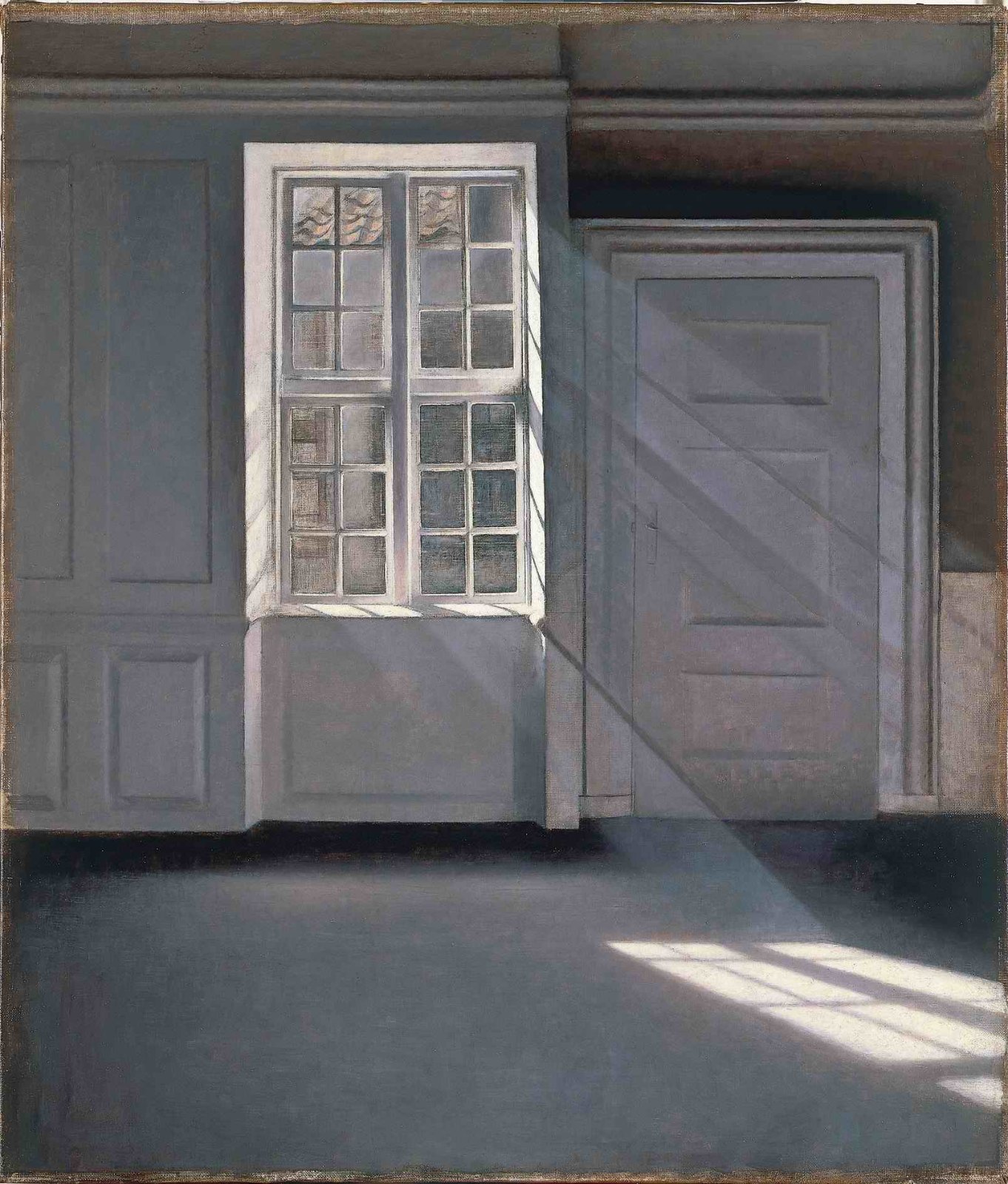
Every house has an attic. It's where things go that no one wants to look at and no one dares to throw away: trunks of inherited belief, letters never answered, the clothes of a former self, furniture that belonged to other people's opinions, a box of childhood fears with the lid tied down. For years the attic stays shut. The family lives downstairs and speaks of it rarely, and the ceiling holds.
The Work begins when someone climbs the ladder with a lamp. The first sight is worse than expected. The lamp shows more than anyone remembered putting there, and every box opened raises dust. The air gets thicker before it gets cleaner; the eyes water; the one who climbed is tempted to close the hatch and go back down to the warm rooms where nothing needs deciding. This is the hour of the blackening, and everyone who has cleared an attic knows it.
The work itself is simple and slow. A window is opened, and the dust begins to leave. Each object is lifted into the light and judged: this to keep, this to mend, this to give to the fire. Some things were treasures under the dust; some were never the family's at all and go back where they came from. The work is done in sessions, an evening at a time, because no one clears a lifetime's attic in a day, and the one who tries usually collapses on the stairs with half of it undone.
Then a day comes when the boards are swept and the window is clean, and the light falls across an empty floor. The room that held the family's fear becomes the highest and quietest room in the house, the one closest to the sky. It becomes the room where a person can sit and dream: plan the life ahead, receive the thought that comes from above, keep company with the Gods in silence.
The Masonic tradition built this image into its initiation, and kept the alchemical words in it. In the French and Scottish rites the candidate waits, before he receives the light, in a small dark room called the Chamber of Reflection. On its table lie a skull, bread and water, an hourglass, and 3 vessels of salt, sulphur and mercury, the 3 principles of the alchemists; a cockerel is painted on the wall with the words Vigilance and Perseverance; and on another wall stand the letters V.I.T.R.I.O.L. In that room the candidate writes his philosophical testament, as if he were about to die.38
The letters are an alchemical acrostic printed in the Occulta Philosophia at Frankfurt in 1613: Visita Interiora Terrae Rectificando Invenies Occultum Lapidem, "Visit the interior of the earth; by rectifying you will find the hidden stone."39 The interior of the earth and the attic under the roof are the same place, seen from 2 sides. Both are the inner rooms of the self, where the hidden stone waits under everything that was stored on top of it.
Τὸ σκοτεινὸν ὑπερῷον κρύπτει τὸ καθαρόν.
The dark attic hides the clean one.
The Jungian Reading: Shadow, Melancholia and Nigredo
No modern thinker took the alchemists as seriously as Carl Gustav Jung. Between Psychology and Alchemy in 1944 and Mysterium Coniunctionis a decade later, he argued that the operations the alchemists described in their vessels were also, and perhaps first, operations in the psyche of the operator.2, 40 He used the woodcuts of the Rosarium Philosophorum, printed at Frankfurt in 1550, to illustrate the stages of the transference in psychotherapy.41
For Jung the nigredo was the meeting with the shadow. Of an alchemist who prayed for his darkness to be purged, Jung writes that he "must have been undergoing the experience of the nigredo, the first stage of the work, which was felt as 'melancholia' in alchemy and corresponds to the encounter with the shadow in psychology."2 In Mysterium Coniunctionis he describes the state from within: confrontation with the shadow "produces at first a dead balance, a standstill that hampers moral decisions and makes convictions ineffective or even impossible," and he links that state with the alchemists' "nigredo, tenebrositas, chaos, melancholia."40
Jung lived the stage before he wrote about it. From the end of 1913 to about 1917 he went through what his memoirs call the confrontation with the unconscious, recording it in the notebooks that became The Red Book; he later called those years the most important of his life, the time in which everything essential was decided.42 The first stage of the Work was, for the man who mapped it, the source of everything that followed.
His name for the whole process was individuation: "Individuation means becoming a single, homogeneous being, and, in so far as 'individuality' embraces our innermost, last, and incomparable uniqueness, it also implies becoming one's own self."36
The Temple takes Jung's map and completes it. Jung was exact about the inner mechanics: the shadow, the resistance, the necessity of the dark. He was cautious about what lies beyond the psyche, and he left the Gods as contents of the human mind. Zevism holds that the soul is real and the Gods are real, and that the Work is done with them.
Iamblichus said it 17 centuries ago: "it's not thinking that links theurgists to the Gods," but the accomplishment of the sacred works and the power of the symbols "understood by the Gods alone."43 The psychological reading describes the vessel. The theurgic reading adds the fire that comes from above.
Ἡ σκιὰ γνωσθεῖσα φῶς γίγνεται.
The shadow, once known, becomes light.
Zevism and the Reordering of the Whole Person
Zevism asks for the whole person, and so the blackening it brings reaches the whole person. A religion that touched only the hours of worship would leave the rest of the house as it was. The path of the Gods touches the spirit, the mind, the feelings and the shape of a life, and it rearranges all 4 to face the same direction.44
- The spiritual order. At Initiation the Zevist asks to be moved "from Ignorance to Truth" and places himself under Ma'at and Satya.3 The relationship with the Divine changes its nature, from fear of a judge to kinship with a family of Gods, and that change has to settle into the body and the nerves, which learned the old fear long before the mind rejected it.
- The mental order. Beliefs are examined one by one, and the ones that were never chosen are either chosen now or discarded. Study is the tool here: the Temple's study programmes, the ancient sources, the teachings of the Advanced Philosophy section.
- The emotional order. The feelings released by practice are let out and let go. "Just let it out in a constructive way," the Temple counsels, and it calls the process "very normal and therapeutic."4
- The existential order. Time, work, food, sleep, friendships and habits are reordered to the aim of the path. The Temple's teaching on Συνάφεια explains why this matters to the Gods' help itself: when the vessel is chaotic, the Gods still try to help and their energy still comes, but its force scatters; an ordered vessel carries it.45
The 4 orders don't change at the same speed. The mind often agrees in a week to what the feelings will need a year to accept. Plato's habituation applies to each of them separately, and patience with the slower ones is part of the Work.
Ὅλῃ τῇ ψυχῇ στρέφεται ὁ στρεφόμενος.
The one who turns, turns with the whole soul.
Clearing the Laboratory: The Practice
The laboratory is cleared by daily work, and the Temple's Meditation and Theurgy sections already hold the tools. The practice of the blackening is a practice of cleansing, steadiness and patience:
- Begin the Basic Meditation Program and keep it every day. The Temple's programmes move from body to Spirit in stages, each mastered before the next.46, 47 Regularity matters more than length in this stage, because the soul in the blackening needs a single fixed point that doesn't move while everything else does.
- Clean the aura and release what doesn't belong. The Temple's aura cleaning, and its meditation for detaching unwanted people and energies, are the brooms of the laboratory.47 Much of what rises in the blackening never belonged to the person; it was put there.
- Free the mind from the old programming. The Temple calls this "a mandatory step." Its methods are catharsis, self-suggestion in trance with affirmations such as "I am worthy of power" and "The Gods are my allies," purposeful meditation, and the renunciation of the old allegiance: "That was then, this is now."25 Members can also use the deprogramming recordings of the Hall of Osiris.25
- Let it out in a constructive way. Anger and grief are let out through the body and the word: hard exercise, writing, honest speech with a trusted person, tears at the altar. The constructive way is any way that releases without harming.4
- Observe and record. The Self-Observation and Recollection meditations teach the newcomer to watch what rises without being swept away by it.47 The Temple's guidance on the Great Work adds a plain instruction: observe yourself honestly and keep a record.46 A journal kept through the blackening becomes, a year later, the clearest proof that the night moved.
- Keep the body as the floor of the laboratory. Sleep, food and exercise hold the vessel steady while its contents are stirred. The Temple's Diet and Sleep and Physical Exercise pages begin at the beginner's level for exactly this reason.48
- Keep the bond with the Gods. Prayer, ritual and the Rites stay in place through the night. The Initiation teaching reassures the newcomer: "Do not worry if the ritual does not go perfectly as planned."3
- Go slowly. Augustus, Suetonius says, repeated the Greek maxim σπεῦδε βραδέως, "make haste slowly."49 The alchemists warned against too strong a fire, which cracks the vessel; Plato's habituation asks for the same patience.22
- Stay in company. The Temple's forums, clergy and community exist so that no one climbs the attic ladder entirely alone.
The signs of the blackening can be read like the colours in a flask. The table gathers them:
| Sign | What It Is | What to Do | Witness |
|---|---|---|---|
| Old memories and emotions surface in meditation | The cleaning house at work: buried material rising to leave | Let it out constructively; keep the daily practice | Temple of Zeus, Zevism and Power Meditation4 |
| Fear of the Gods returns after it was rejected | Programming planted early, deeper than argument | Free the mind; affirmations in trance; the altar kept daily | Temple of Zeus, Freeing the Mind25 |
| The new truth seems less real than the old picture | The dazzle of the first light | Habituation: time and repetition | Plato, Republic 515c to 516a22 |
| Restlessness or panic when the mind grows quiet | Resistance of the old self to the practice | Shorter sessions, kept daily; the Void and Foundation meditations | Temple of Zeus, Meditation section47 |
| Confusion and loss of old certainties | Aporia, the door to the search | Study; ask; keep searching | Plato, Meno 84a to c34 |
| Irritation, chafing, impatience | The soul growing its wings | Read it as growth and persist | Plato, Phaedrus 251c31 |
| Hostility from the old surroundings | The cave's reaction to the freed prisoner | Hold the path quietly; seek the community | Plato, Republic 517a22 |
| Grief for the lost years | The passing-away that makes room for the new | Let it be grieved, then let it go | Aristotle, On Generation and Corruption 319a33 |
In the Liturgy: The Black Vessel
Zevism enacts the blackening in its rites, and the newcomer has usually lived it there before understanding it. The Initiation is the black vessel of the Work. The prayer is written by hand and signed; the candidate renounces his former allegiances and "the path of Izfet" for "the path of Ma'at"; he asks to be admitted to the Mysteries and moved "from Ignorance to Truth"; and the signed page is folded and burned in the candle flame.3 The old self is given to the fire in a literal act, and what remains is ash, the residue the alchemists called the caput mortuum, the dead head out of which the new work begins.
The Greek initiates knew the rite as a death followed by a birth. A gold tablet laid in a grave at Pelinna in Thessaly greets the initiate: "Now you have died and now you have come into being, thrice-blessed one, on this very day," νῦν ἔθανες καὶ νῦν ἐγένου, τρισόλβιε, ἄματι τῶιδε.50 Death and birth on the same day: the Greeks put the first stage into a single line of verse.
The Temple's year carries the blackening as well. The Genesia, on 31 October, is the festival of "communion with the dead and the confrontation with mortality," and the Winter Solstice, the Cheimerinai Tropai of 22 to 23 December, celebrates "the rebirth of the light out of the longest darkness."51 Between the 2 festivals the year itself passes through its nigredo, and the Zevist who keeps them walks the same road outwardly that the soul walks inwardly.
The page on freeing the mind adds a private rite of the blackening: a formal renunciation of the old religion's gods and rules, to mark a clean break.25 The words are short, and they carry the whole stage: "That was then, this is now."
Ὁ παλαιὸς ἐν πυρί, ὁ νέος ἐν φωτί.
The old self in the fire, the new in the light.
When the Night Does Not Lift: The Negative Outcomes
The blackening is the beginning of the Work, and a beginning can be wasted. The alchemists knew that a vessel left in the fire too long, or taken out too soon, or abandoned with its contents half dissolved, yields ruin. The Ancients named the failures of this stage, and the Temple names them too, so that they can be recognised in time.
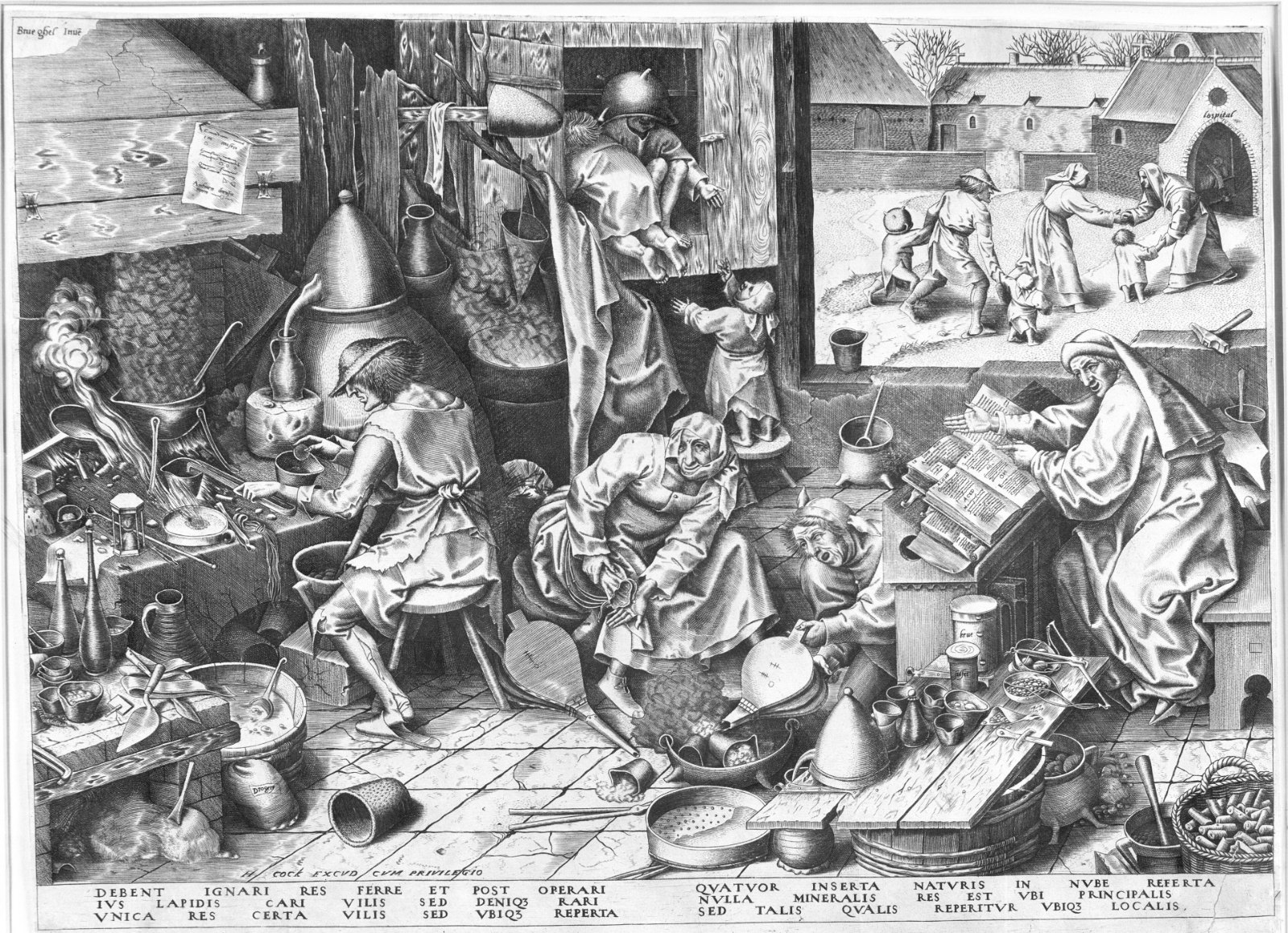
- Abandoning the Work midway. Plato quotes the saying of the Mysteries: "many carry the fennel wand, but few are Bacchoi," ναρθηκοφόροι μὲν πολλοί, βάκχοι δέ τε παῦροι.53 Many begin; few finish the night. The Temple's account of the striver describes the pattern in modern form: the one who comes for a season and then takes a "timeout," which the true Initiate never does.54 A blackening abandoned halfway leaves the house worse than it was, its walls opened and its old structure gone, with nothing yet built in its place.
- Returning to the cave. Plato's freed prisoner, forced to face the light, wants to "flee, turning away towards the things he can make out," believing them clearer.22 The old programming can win a battle: guilt returns, fear returns, and the person goes back to the old religion or to a vague indifference. The return is rarely peaceful, because a soul that has seen the light can't fully believe the shadows again.
- Making the darkness a home. Some never leave the stage of anger and grief. The anger at what was taught becomes an identity, complaint becomes a way of life, and the person lives among the ruins of the old religion without building anything new. The Temple prescribes anger and grief as passages to be walked through; a person who settles in them has exchanged one cave for another.
- Carrying human wounds to the Gods. Ψυχῆς Ἰατρεῖον, the Temple's page on the healing of the soul, warns that problems not rectified at the human level carry over into the practice: hatred of the parents becomes hatred of the Gods, and the habit of expecting everything to be done by others becomes the expectation that the Gods will do everything.55 The blackening brings such wounds up, and they need their own healing at their own level.
- Mistaking the first light for the gold. A few weeks of intense experience can persuade a newcomer that the Work is finished and that he stands above others. Jung called this inflation: "An inflated consciousness is always egocentric and conscious of nothing but its own existence. It is incapable of learning from the past."2 Its cosmological side is set out in the Temple's page on hubris and Izfet.16 Bruegel's alchemist, throwing the family's last coin into the crucible, is the picture of the Work done without order or measure.52
- Mistaking illness for the Work. The blackening moves. It comes in waves, it responds to practice, and over months it lightens. A darkness that doesn't move, that takes sleep, appetite and work for weeks on end and doesn't answer to practice, has left the laboratory for the infirmary. The Temple's own teaching draws that line: spirituality heals and grows the soul, but it can't replace the treatment of traumatic conditions, and the Temple promotes diagnosis and the solving of each problem at its proper level, with the physician as well as at the altar.55
- Forcing the fire. Meditating 10 hours a day in the first month, fasting, losing sleep and abandoning every duty make the vessel crack. The art of the blackening is a steady, moderate heat kept for a long time.
When the Laboratory Is Cleared: The Positive Outcomes
The night ends, and the Ancients described its ending with joy. Plutarch's initiate, after the terrors, is met by "a marvellous light," and "pure places and meadows receive" him.18 Plato's freed prisoner, once his eyes have grown used to the day, can look at "the sun itself, in its own place," and understands that the sun governs the seasons and the years and everything in the visible world.22
Hermes' son, his tormentors driven out, says: "Father, I see the universe, and myself in Mind."28 The Temple's promise is the same in plain modern words: "In time, suppressed emotions will be cleaned out, and the soul will be able to advance and be much freer. One will find inner balance and peace."4
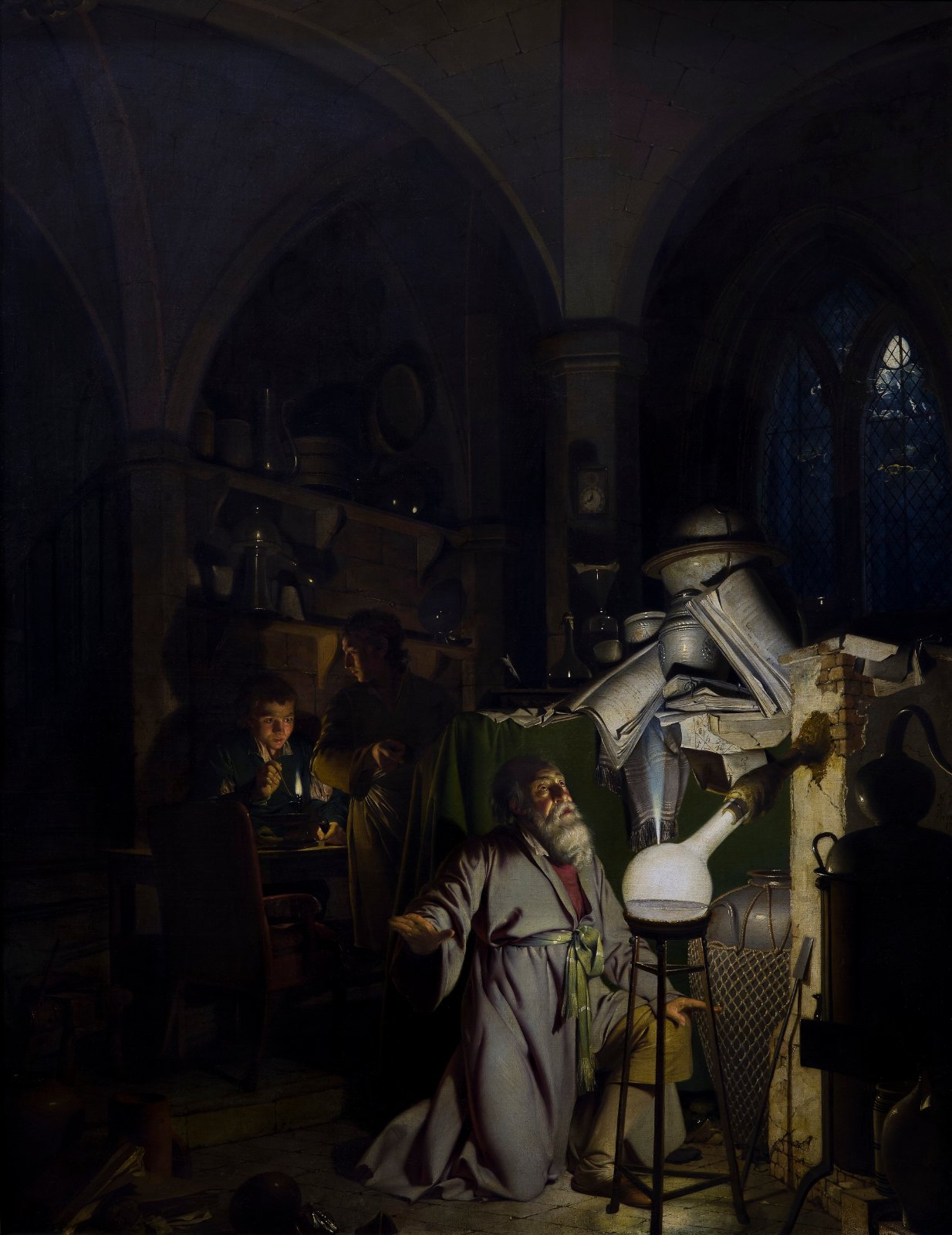
The cleared laboratory yields concrete goods, and the person who has passed through the blackening knows them in daily life:
- Freedom from the old fear. The Gods are known as kin, and prayer comes without dread. The fear that once returned unbidden stops returning.
- Energy returned. Much of a person's strength was spent holding the attic shut. Once the contents have been cleared, that strength comes back for living, working and practising.
- Clarity. Beliefs have been examined, and the ones that remain are chosen. The mind is quieter because it's no longer arguing with itself.
- A truthful self-knowledge. The shadow has been seen and named, and what is known can be governed. Heraclitus said "I searched myself," ἐδιζησάμην ἐμεωυτόν, and the cleared laboratory is the fruit of that search.32
- A bond with the Gods that can carry weight. The vessel is steady, and the energy of the Gods that once scattered now gathers and flows.45
- Readiness for the form. The laboratory is clean, and the material is ready to be shaped. The second stage of the Work, the forming of the self, can begin on ground that will hold it.5
Καθαρθέντος τοῦ ἐργαστηρίου ἄρχεται ἡ μόρφωσις.
Once the laboratory is cleared, the forming begins.
Objections and Replies
Objection I: "The Dark Night of the Soul is a Christian idea."
The phrase is Christian and Spanish, from the 1570s and 1580s.17 The experience was described in Greek by Plato around 375 BC, in his account of the freed prisoner; by the Mysteries, as Plutarch reports them; and by Zosimos of Panopolis around 300 AD; and in Latin by Apuleius' initiate of Isis in the 2nd century.22, 18, 10, 19 The Temple uses the familiar phrase as a name for the older fact, as it uses the word Theosis for Plato's ὁμοίωσις θεῷ.
Objection II: "If Zevism were true, it would bring peace at once."
Medicine, cleaning and training all disturb before they heal, and nobody concludes that they're false. Socrates' numbing of the young slave did him no harm and set him searching.34 The Temple promises peace at the end of the process, and it's honest about the passage that leads there.4
Objection III: "This is only psychology."
Jung's psychology describes the mechanics of the vessel with great precision, and the Temple uses it. The Ancients, from the Mysteries to Iamblichus, held that the Work is completed by the Gods through sacred acts and symbols that go beyond thought.43 Psychology explains why the attic is full; theurgy brings the light that fills the room once it's clear.
Conclusion: The Night Before the Work
The Greeks put darkness at the head of creation and made Day its child. Their alchemists put the blackening at the head of the Work, their Mysteries led the initiate through a dark journey to a marvellous light, and their greatest philosopher showed a freed prisoner in pain, at a loss, longing for his shadows, and then, with time, looking at the sun. The new Zevist who finds old conflicts rising, old programming stirring and old certainties falling is standing in that same tradition. The confusion proves that the soul has turned, and the resistance proves that something deep has been touched.
The laboratory has to be cleared before anything can be made in it. That clearing is slow, it raises dust, and it ends. When the attic is swept and the window is clean, the person stands in the highest room of the house with the light falling across the floor, free to dream, to build and to keep company with the Gods. The form of the self comes next, and then the gold.
Plato, Republic 516a to b 22
συνηθείας δὴ οἶμαι δέοιτ᾽ ἄν, εἰ μέλλοι τὰ ἄνω ὄψεσθαι … τελευταῖον δὴ οἶμαι τὸν ἥλιον … αὐτὸν καθ᾽ αὑτὸν ἐν τῇ αὑτοῦ χώρᾳ δύναιτ᾽ ἂν κατιδεῖν καὶ θεάσασθαι οἷός ἐστιν.
"He would need habituation, I think, if he is going to see the things above … and last of all, I think, he would be able to look at the sun itself, in its own place, and contemplate it as it is."
Μέσῃ νυκτὶ ὁ ἥλιος.
At midnight, the sun.
High Priest Zevios Metathronos
Temple of Zeus Foundation
Sources & References
- Thomas Norton, The Ordinal of Alchemy, composed 1477; British Library, Add MS 10302, the earliest surviving manuscript, 4th quarter of the 15th century, with 5 full-page miniatures (ff. 1r, 6v, 32v, 37v, 67v); f. 37v shows furnace tenders and a robed scholar with alembics and a balance enclosed in glass. British Library catalogue, Add MS 10302.
- C. G. Jung, Psychology and Alchemy, Collected Works 12, trans. R. F. C. Hull, 2nd ed., Princeton, 1968: §41 (the nigredo "felt as 'melancholia' in alchemy and corresponds to the encounter with the shadow in psychology"); §333 (the 4 stages melanosis, leukosis, xanthosis and iosis, reduced to 3 "about the fifteenth or sixteenth century"); §334 ("The nigredo or blackness is the initial state …"); §563, Epilogue, on inflation ("An inflated consciousness is always egocentric and conscious of nothing but its own existence. It is incapable of learning from the past …").
- Temple of Zeus, Becoming an Initiate: the Initiation prayer written by hand, signed and burned in the candle flame; the renunciation of "the path of Izfet" for "the path of Ma'at"; the petition to be moved "from Ignorance to Truth"; "Do not worry if the ritual does not go perfectly as planned"; "Allow your transformation to develop in its own time."
- High Priest Zevios Metathronos and Pythia, Zevism and Power Meditation, Temple of Zeus: "Power meditation is a psychic cleaning house, so to speak"; repressed emotions "such as anger, hatred, rage, grief"; "These emotions can last up to a year or even longer, depending on the intensity"; "Just let it out in a constructive way"; "In time, suppressed emotions will be cleaned out, and the soul will be able to advance and be much freer"; "for many, embracing Zevism is a first time of coming into one's own."
- Temple of Zeus, Ἡ Ἱερὰ Τέχνη: The Alchemy of the Soul, the index of this teaching, with Λεύκωσις: The Rough Stone and the Living Statue and Ἴωσις: The Alchemical Gold, Within and Without.
- L. M. Principe, The Secrets of Alchemy, Chicago, University of Chicago Press, 2012 (dated 2013), ch. 1, "Origins: Greco-Egyptian Chemeia": the merger of craft and philosophical traditions "probably in the third century AD" gave rise to "the independent discipline of alchemy"; "Zosimos was active around 300 AD"; on Zosimos' language of altars and dismemberment as an echo of late Greco-Egyptian temple practice, pp. 15 to 24.
- M. Martelli, The Four Books of Pseudo-Democritus, Sources of Alchemy and Chemistry 1, Leeds, Maney, 2013, pp. 11, 29 to 31, 78 to 121: the formula Ἡ φύσις τῇ φύσει τέρπεται, καὶ ἡ φύσις τὴν φύσιν νικᾷ, καὶ ἡ φύσις τὴν φύσιν κρατεῖ, found on a column that split open in a temple; the author active in the 2nd half of the 1st century AD, "most likely c. 54 to 68." Older text in M. Berthelot and C.-É. Ruelle, Collection des anciens alchimistes grecs II, Paris, 1888.
- K. A. Fraser, "Baptised in Gnôsis: The Spiritual Alchemy of Zosimos of Panopolis," Dionysius 25, 2007, pp. 33 to 54: Zosimos traces the origins of the sacred art to the Egyptian temples and names it χημεία; a later treatise is titled "Comarius the Philosopher and High Priest Instructs Cleopatra in the Divine and Sacred Art of the Philosopher's Stone."
- H. G. Liddell, R. Scott and H. S. Jones, A Greek-English Lexicon, 9th ed., Oxford, 1940, s.vv. λεύκωσις (Olympiodorus, p. 91 Berthelot), ξάνθωσις (Pseudo-Democritus, p. 54 Berthelot), ἴωσις (Olympiodorus, p. 94; Zosimos, p. 145 Berthelot; "refinement" by oxidation, and the making of a tincture). The Greek colour terms run through the corpus from Pseudo-Democritus to Olympiodorus in the 6th century.
- Zosimos of Panopolis, Visions (Περὶ ἀρετῆς), Mémoires authentiques X to XII, ed. and trans. M. Mertens, Les alchimistes grecs IV.1, Paris, Les Belles Lettres, 1995; English in F. Sherwood Taylor, "The Visions of Zosimos," Ambix 1, 1937. On Zosimos' date, "active about the year 300 A.D.," M. Mertens, "Graeco-Egyptian Alchemy in Byzantium," 2006, p. 210.
- Hesiod, Theogony 116 (ἦ τοι μὲν πρώτιστα Χάος γένετ᾽) and 123 to 125. Greek, H. G. Evelyn-White, Loeb Classical Library 57, 1914; M. L. West, Hesiod: Theogony, Oxford, 1966.
- Orphic Hymns 3, To Night, 1: Νύκτα θεῶν γενέτειραν ἀείσομαι ἠδὲ καὶ ἀνδρῶν. Ed. W. Quandt, Orphei Hymni, 3rd ed., Berlin, 1962; G. Ricciardelli, Inni orfici, Milan, Fondazione Lorenzo Valla, 2000.
- Ovid, Metamorphoses 1.5 to 9 (chaos, rudis indigestaque moles) and 1.21 (Hanc deus et melior litem natura diremit). Latin, H. Magnus, Gotha, 1892; R. J. Tarrant, Oxford Classical Texts, 2004.
- Plato, Timaeus 30a: βουληθεὶς γὰρ ὁ θεὸς ἀγαθὰ μὲν πάντα … πᾶν ὅσον ἦν ὁρατὸν παραλαβὼν οὐχ ἡσυχίαν ἄγον ἀλλὰ κινούμενον πλημμελῶς καὶ ἀτάκτως, εἰς τάξιν αὐτὸ ἤγαγεν ἐκ τῆς ἀταξίας. Greek, J. Burnet, Platonis Opera 4, Oxford, 1905.
- Temple of Zeus, Satya, Ma'at and Arete: The Cosmos Around the Throne of Zeus: Zeus as Sovereign of the Cosmos; Ma'at as the order of existence.
- Temple of Zeus, Hubris and Izfet: The Breach in the Measure: Izfet as dissolution and the collapse of order; hubris and its blindness.
- Juan de la Cruz, Noche oscura, poem probably written between 1577 and 1579; the prose commentary (Declaración) 1584 to 1586, left incomplete; first printed Alcalá, 1618. English: D. Lewis, The Obscure Night of the Soul, in The Complete Works of Saint John of the Cross, London, 1864; revised by B. Zimmerman as The Dark Night of the Soul, London, 1908.
- Plutarch, fragment 178 Sandbach (On the Soul), preserved in Stobaeus, Anthology 4.52.49, comparing death with initiation into the great Mysteries. Ed. F. H. Sandbach, Plutarchi Moralia VII, Leipzig, Teubner, 1967, and Loeb Classical Library 429 (Moralia XV), 1969.
- Apuleius, Metamorphoses 11.23: Accessi confinium mortis … nocte media vidi solem candido coruscantem lumine; deos inferos et deos superos accessi coram et adoravi de proxumo. Latin, S. Gaselee, Loeb Classical Library 44, 1915.
- Splendor Solis, British Library, Harley MS 3469, dated 1582, 22 full-page miniatures: plate 19, f. 30v, the black sun; plate 22, f. 33v, the red sun. The earliest copy is Berlin, Kupferstichkabinett, 78 D 3, dated 1531 to 1532. British Library catalogue, Harley MS 3469.
- Plato, Theaetetus 151a (πάσχουσι δὲ δὴ οἱ ἐμοὶ συγγιγνόμενοι καὶ τοῦτο ταὐτὸν ταῖς τικτούσαις· ὠδίνουσι γὰρ καὶ ἀπορίας ἐμπίμπλανται νύκτας τε καὶ ἡμέρας πολὺ μᾶλλον ἢ ᾽κεῖναι· ταύτην δὲ τὴν ὠδῖνα ἐγείρειν τε καὶ ἀποπαύειν ἡ ἐμὴ τέχνη δύναται), 155d (οὐ γὰρ ἄλλη ἀρχὴ φιλοσοφίας ἢ αὕτη), 176b (φυγὴ δὲ ὁμοίωσις θεῷ κατὰ τὸ δυνατόν). Greek, J. Burnet, Platonis Opera 1, Oxford, 1905.
- Plato, Republic 515c to 516c (the freed prisoner: pain, dazzle, ἀπορεῖν, ἀληθέστερα; the rough ascent; συνηθείας δὴ οἶμαι δέοιτ᾽ ἄν; last of all the sun itself, which governs the seasons and the years), 517a (they would kill the one who frees them), 518a to b (2 kinds of disturbance of the eyes), 518c to d (σὺν ὅλῃ τῇ ψυχῇ ἐκ τοῦ γιγνομένου περιακτέον εἶναι). Greek, J. Burnet, Platonis Opera 4, Oxford, 1905; trans. P. Shorey, Loeb Classical Library 276, 1935.
- Jan Pietersz. Saenredam after Cornelis Cornelisz. van Haarlem, Antrum Platonicum (Plato's Cave), engraving, 1604; National Gallery of Art, Washington.
- Temple of Zeus, The Synthesis: what works and what is true within the original religion of mankind; and Theosis: The Magnum Opus, on the Work as Greece, Egypt and India name it.
- High Priest Zevios Metathronos, Freeing the Mind from Christianity and Islam: A Mandatory Step, Temple of Zeus: the religions' aim of making "the perfect slave"; fear of the Gods as "angry judges who will punish you constantly"; doubt; guilt and original sin; resistance to meditation; feeling undeserving; discomfort with life energy; waiting for saviours; for some "a huge wall"; catharsis, self-suggestion ("I am worthy of power," "My will is strong," "The Gods are my allies"), the Hall of Osiris deprogramming recordings, the renunciation rite ("That was then, this is now"), and purposeful meditation.
- Temple of Zeus, ὁμοίωσις θεῷ: Becoming a God, on Plato, Theaetetus 176b and the original aim of the ancient path.
- K. Oberg, "Cultural Shock: Adjustment to New Cultural Environments," Practical Anthropology 7, 1960, pp. 177 to 182.
- Corpus Hermeticum 13 (On Rebirth): 13.3 (καί εἰμι νῦν οὐχ ὁ πρίν, ἀλλ᾽ ἐγεννήθην ἐν νῷ), 13.7 (κάθαραι σεαυτὸν ἀπὸ τῶν ἀλόγων τῆς ὕλης τιμωριῶν; the 12 tormentors), 13.8 to 9 (the powers that drive them out: γνῶσις θεοῦ, γνῶσις χαρᾶς, ἐγκράτεια, καρτερία, δικαιοσύνη, κοινωνία, ἀλήθεια, τὸ ἀγαθόν, ζωή, φῶς; the last torments ἐξέπτησαν νικηθεῖσαι ῥοίζῳ). Ed. A. D. Nock and A.-J. Festugière, Corpus Hermeticum II, Paris, Budé, 1945; trans. B. P. Copenhaver, Hermetica, Cambridge, 1992.
- C. G. Jung, Aion, Collected Works 9ii, trans. R. F. C. Hull, 2nd ed., Princeton, 1968, ch. II, "The Shadow," §14, p. 8.
- C. G. Jung, "The Philosophical Tree" (1945; rev. 1954), in Alchemical Studies, Collected Works 13, trans. R. F. C. Hull, Princeton, 1967, §335.
- Plato, Phaedrus 251a to c: the regrowth of the soul's wings; ζεῖ τε καὶ ἀγανακτεῖ καὶ γαργαλίζεται φύουσα τὰ πτερά. Greek, J. Burnet, Platonis Opera 2, Oxford, 1910.
- Heraclitus, frs. 22 B8 (from Aristotle, Nicomachean Ethics 8.1, 1155b4 to 6), B51 (παλίντροπος ἁρμονίη ὅκωσπερ τόξου καὶ λύρης, from Hippolytus, Refutation 9.9.2), B53 (Πόλεμος πάντων μὲν πατήρ ἐστι, πάντων δὲ βασιλεύς, from Hippolytus 9.9.4), B101 (ἐδιζησάμην ἐμεωυτόν, from Plutarch, Against Colotes 1118c), B111 (νοῦσος ὑγιείην ἐποίησεν ἡδὺ καὶ ἀγαθόν, λιμὸς κόρον, κάματος ἀνάπαυσιν, from Stobaeus 3.1.177). H. Diels and W. Kranz, Die Fragmente der Vorsokratiker 1, 6th ed., Berlin, 1951.
- Aristotle, On Generation and Corruption 1.3, 318a23 to 25 (διὰ τὸ τὴν τοῦδε φθορὰν ἄλλου εἶναι γένεσιν καὶ τὴν τοῦδε γένεσιν ἄλλου εἶναι φθοράν) and 319a20 to 22 (ἡ θατέρου γένεσις ἀεὶ ἐπὶ τῶν οὐσιῶν ἄλλου φθορὰ καὶ ἡ ἄλλου φθορὰ ἄλλου γένεσις). Greek, E. S. Forster, Loeb Classical Library 400, 1955.
- Plato, Meno 80a to b (the torpedo fish) and 84a to c (ἀπορεῖν οὖν αὐτὸν ποιήσαντες καὶ ναρκᾶν ὥσπερ ἡ νάρκη, μῶν τι ἐβλάψαμεν;). Greek, J. Burnet, Platonis Opera 3, Oxford, 1903.
- K. Cheung, P. Hume and L. Maxwell, "Delayed Onset Muscle Soreness: Treatment Strategies and Performance Factors," Sports Medicine 33, 2003, pp. 145 to 164.
- C. G. Jung, Two Essays on Analytical Psychology, Collected Works 7, trans. R. F. C. Hull, 2nd ed., Princeton, 1966: §111 (Heraclitus and enantiodromia, "the regulative function of opposites"); §266 ("Individuation means becoming a single, homogeneous being …").
- Vilhelm Hammershøi, Støvkornenes dans i solstrålerne (Dust Motes Dancing in the Sunbeams), 1900, oil on canvas; Ordrupgaard, Charlottenlund, acquired 1989.
- The Chamber of Reflection (cabinet de réflexion) of the French and Scottish rites: skull, bread, water, hourglass, vessels of salt, sulphur and mercury, the cockerel with Vigilance and Persévérance, the letters V.I.T.R.I.O.L., and the candidate's philosophical testament (J.-M. Ragon, 1860: he must "make and sign his will"). A dark room before initiation appears in the exposures of 1737, 1742, 1762 and 1766.
- Occulta Philosophia, Frankfurt am Main, Johann Bringer, 1613, the earliest securely dated printing of the acrostic, a dialogue drawing on Hermes and Basilius Valentinus: woodcut with the acrostic Visita Interiora Terrae Rectificando Invenies Occultum Lapidem; the emblem was reprinted under Basilius Valentinus in the French Azoth, Paris, 1624 and 1659.
- C. G. Jung, Mysterium Coniunctionis, Collected Works 14, trans. R. F. C. Hull, London, 1963, p. 497: confrontation with the shadow "produces at first a dead balance, a standstill …," the state the alchemists called "nigredo, tenebrositas, chaos, melancholia."
- C. G. Jung, "The Psychology of the Transference" (1946), Collected Works 16, from §353, using 10 of the 20 woodcuts of the Rosarium Philosophorum (Frankfurt, 1550) to illustrate the stages of the transference.
- C. G. Jung, Memories, Dreams, Reflections, recorded and edited by A. Jaffé, trans. R. and C. Winston, New York, Pantheon, 1963, ch. VI, "Confrontation with the Unconscious"; on the Black Books (from 12 November 1913 to 1917) and Liber Novus, S. Shamdasani, introduction to C. G. Jung, The Red Book, New York, 2009.
- Iamblichus, On the Mysteries 2.11, 96.13 to 97.2 Parthey: οὐδὲ γὰρ ἡ ἔννοια συνάπτει τοῖς θεοῖς τοὺς θεουργούς … ἀλλ᾽ ἡ τῶν ἔργων τῶν ἀρρήτων καὶ ὑπὲρ πᾶσαν νόησιν θεοπρεπῶς ἐνεργουμένων τελεσιουργία ἥ τε τῶν νοουμένων τοῖς θεοῖς μόνοις συμβόλων ἀφθέγκτων δύναμις ἐντίθησι τὴν θεουργικὴν ἕνωσιν. Ed. G. Parthey, Berlin, 1857; H. D. Saffrey and A.-Ph. Segonds, Paris, Budé, 2013.
- Temple of Zeus, The Four Levels of Evolution: body, emotion, reason and spirit as a ladder of the soul.
- Temple of Zeus, Συνάφεια: Vibrational Energetic Matching: when the vessel is chaotic the Gods still help and the energy comes, but its force scatters.
- Temple of Zeus, Theosis (Magnum Opus), the meditation page: the Basic Meditation Program in 3 programmes from body to Spirit, each mastered before the next; observe yourself honestly and keep a record; the high meditations "released in time." See also Theosis: The Magnum Opus.
- Temple of Zeus, Meditation, the index of the power and awareness meditations by level: Basic Meditation Program, Most Important Foundation Meditation, How to Clean Your Aura, How to Detach Unwanted People and Energies from Your Aura, The Self Observation Meditation, Recollection Meditation, Void Meditation.
- Temple of Zeus, Diet and Sleep: Beginner and Physical Exercise: Beginner.
- Suetonius, Divus Augustus 25.4: crebro itaque illa iactabat: σπεῦδε βραδέως; cf. Aulus Gellius, Attic Nights 10.11.5. Latin, M. Ihm, Leipzig, Teubner, 1908.
- Gold tablets from Pelinna, Thessaly (late 4th century BC): νῦν ἔθανες καὶ νῦν ἐγένου, τρισόλβιε, ἄματι τῶιδε. A. Bernabé, Poetae Epici Graeci II.2, Orphicorum Fragmenta, frs. 485 to 486, 2005; F. Graf and S. I. Johnston, Ritual Texts for the Afterlife, London, 2007, nos. 26a to b.
- Temple of Zeus, Zevist Rites and Holidays: the Genesia, 31 October, "Communion with the dead and the confrontation with mortality"; the Cheimerinai Tropai, 22 to 23 December, "The rebirth of the light out of the longest darkness."
- Philips Galle after Pieter Bruegel the Elder, The Alchemist, engraving published by Hieronymus Cock, after 1558; The Metropolitan Museum of Art, 26.72.29. The open book reads "Alghe mist," a pun on alchemist read as "all is mixed up" or "all is rubbish"; the vignette at upper right shows the family led to the poorhouse ("lospital").
- Plato, Phaedo 69c to d: ναρθηκοφόροι μὲν πολλοί, βάκχοι δέ τε παῦροι. Greek, J. Burnet, Platonis Opera 1, Oxford, 1905.
- Temple of Zeus, Ἐραστὴς καὶ Ἐρώμενος: Attraction, Love and True Initiation: the striver, and the true Initiate who never takes a "timeout."
- Temple of Zeus, Ψυχῆς Ἰατρεῖον: The Healing of the Soul and Its Limits: spirituality heals and grows the soul but cannot replace treatment; problems not rectified psychologically carry over into the practice; diagnosis and the solving of each problem at its proper level.
- Joseph Wright of Derby, The Alchymist, In Search of the Philosopher's Stone, Discovers Phosphorus, and prays for the successful Conclusion of his operation …, exhibited 1771, reworked 1795; Derby Museum and Art Gallery.