













48 min read
Ἐραστὴς καὶ Ἐρώμενος: Attraction, Love and True Initiation
author: High Priest Zevios Metathronos
The Platonic Theory of Ἔρως and the Bond with the Gods
People commonly believe that they choose their allegiance to the Gods, and because they believe the matter is theirs to choose, many choose badly. For the soul that has truly evolved, in past lives and in this one, the choice was made earlier: before it came here, before the logical mind rationalised it, and in many cases before birth. Greek named the 2 partners in love ἐραστής, the lover who pursues what he lacks, and ἐρώμενος, the beloved who is courted, and called the force between them ἔρως. Plato turned all 3 words towards the soul and the Gods, and built on them a theory of the soul's ascent.
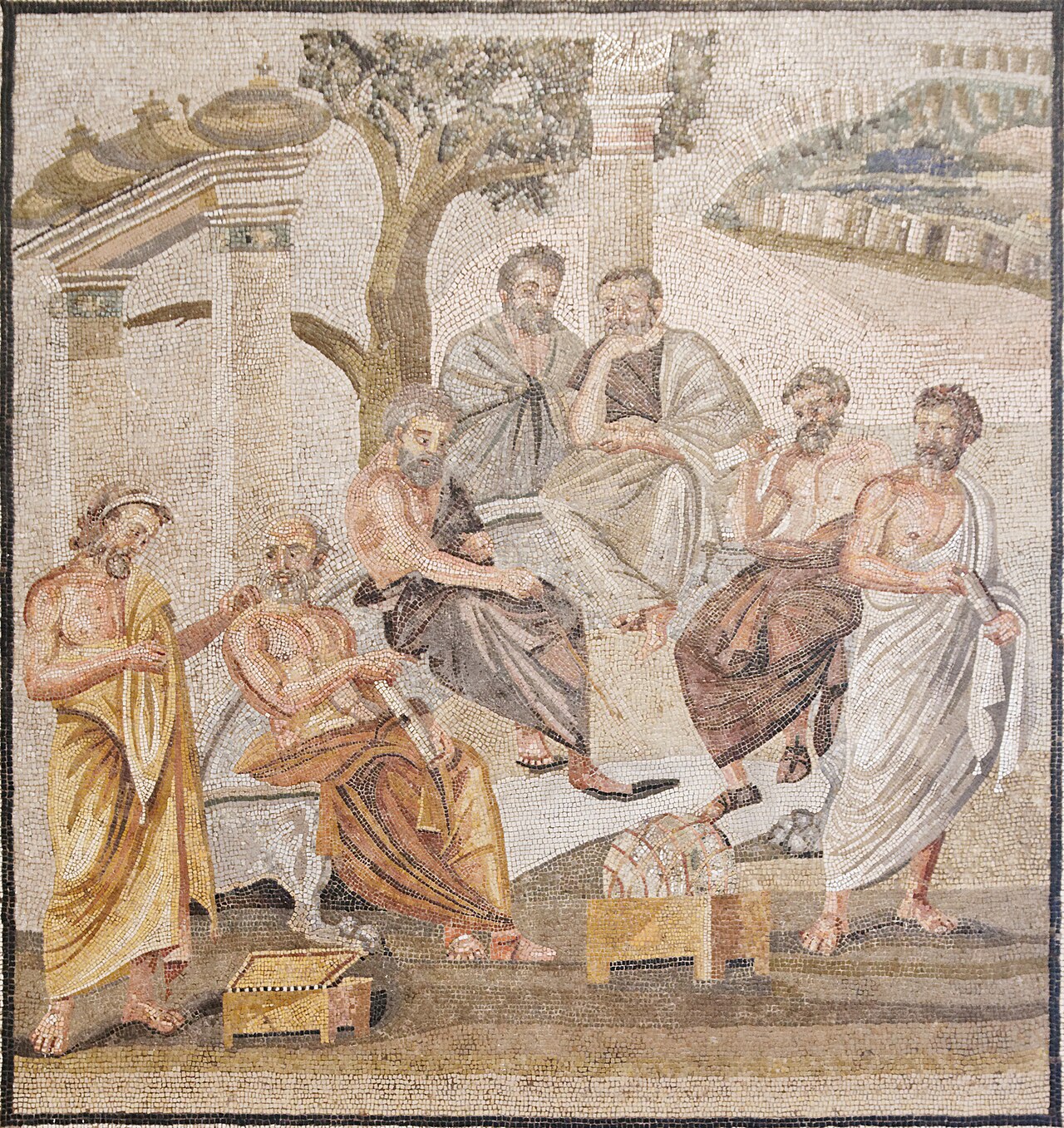
Mosaic from the Villa of T. Siminius Stephanus near Pompeii, 1st century BCE to 1st century CE; Naples, Museo Archeologico Nazionale, inv. 124545. Photograph: Marie-Lan Nguyen, public domain.

This teaching follows that theory from the choice made before birth to the striver who courts the Gods, and from him to the Initiate, for whom the Gods have become family and a lived reality within.
Ἐραστὴς καὶ Ἐρώμενος in Plain Words
The teaching has 6 parts.
The choice. Most people treat their allegiance to the Gods as a decision of the reasoning mind, and since they think it's theirs to make, they make poor ones. For those the Gods have touched in the soul, the decision was settled earlier, and its arrival in this life can come in childhood or all at once, as revelation. Such a person can then be led to the Temple, where the revelation continues. Plato set the soul's allegiance before birth, in the procession of heaven where each soul followed its God.1
The binary. Potentially the bond exists in everyone. Practically it's binary: it's in a person, or it isn't there. Knowledge and rites can't manufacture it; they express what exists in a person, or show that it doesn't. Whoever has it knows it, since it was there before he understood it consciously.
The striver. The 1st type carries the bond as something within him that hasn't manifested. On the way towards it he can falter, stall for years or lose the way. He relates to the Gods as a lover in pursuit, and he also expects them to court him as a beloved is courted. Attraction moves him.
The Initiate. The 2nd type has known true divine epiphany. He can't stray from the Path and wouldn't want to, because he is this; asking him to leave would be asking a fish to walk on the shore. He relates to the Gods as a married person relates to family, and before he asks what something means for him, he asks how it could affect the Gods, or what the Gods value.
The confusion. Strivers are often taken for Initiates, by others and by themselves. Many pass the gate of the Initiation, and few reach its core.
The way across. To strive is noble. Striving builds towards the 2nd state, and it can succeed or fail.
| Aspect | The Striver | The Initiate | Sources |
|---|---|---|---|
| Greek figure | An ἐραστής in lack, who also waits to be courted like an ἐρώμενος. | An οἰκεῖος, one of the household of the Gods. | Plato, Symposium 203c to d; Aristotle, Nicomachean Ethics 1157a, 1162a |
| What moves him | Attraction: desire led towards pleasure. | Love that has become union. | Plato, Phaedrus 238b to c; Plotinus, Enneads 6.9.9 |
| His question | "What does this mean for me?" | "How could this affect the Gods, or what the Gods value?" | Aristotle, Nicomachean Ethics 1156b: the perfect friend wishes good for the friend's sake |
| His requests | Run one way, from him to the Gods. | Run both ways: the Gods have a say in his life. | Plato, Phaedrus 255c to e |
| His constancy | Flourishes and dies on the same day. | Remains through life, fused with what lasts. | Plato, Symposium 203d to e, 183e |
| Under trial | Recoils, sulks, leaves, takes a timeout. | Is delayed at most, and overcomes the delay. | Plato, Phaedrus 248c; Republic 620d to e |
| Rank in the Mysteries | Wand-bearer, ναρθηκοφόρος: one of the crowd in the procession. | Bacchos, βάκχος: one filled with the God. | Plato, Phaedo 69c to d |
The Words: Ἐραστής, Ἐρώμενος, Ἔρως
The verb ἔραμαι, ἐράω means to love with desire, to long for. Its agent noun ἐραστής is the lover, the one who desires and pursues. Its passive participle ἐρώμενος is the one loved, the beloved; Greek also called him τὰ παιδικά. The abstract noun is ἔρως, love as desire, and the same word is the name of the God.2
In classical Athens the 2 words named the partners of a regulated bond between an adult man and a youth. The ἐραστής pursued, and the ἐρώμενος was pursued, courted with attention and gifts, and free to grant or withhold his favour.3 Plato carried the vocabulary of that custom over to the soul's love of the divine, and this teaching uses it in his sense.
Pausanias, a speaker in Plato's Symposium, explains the logic of the custom. It bids the lover pursue and the beloved flee, so that the contest tests which kind each is, lover and beloved, and it counts being caught quickly as shameful, "so that time may come in between, which is thought to test most things well," ἵνα χρόνος ἐγγένηται, ὃς δὴ δοκεῖ τὰ πολλὰ καλῶς βασανίζειν.4
Aristotle names the weakness built into the pair: lover and beloved take pleasure in different things.
Aristotle, Nicomachean Ethics 8.4, 1157a6 to 10 5
καὶ μὴ ὡς ἐραστῇ καὶ ἐρωμένῳ. οὐ γὰρ ἐπὶ τοῖς αὐτοῖς ἥδονται οὗτοι, ἀλλ᾽ ὃ μὲν ὁρῶν ἐκεῖνον, ὃ δὲ θεραπευόμενος ὑπὸ τοῦ ἐραστοῦ· ληγούσης δὲ τῆς ὥρας ἐνίοτε καὶ ἡ φιλία λήγει (τῷ μὲν γὰρ οὐκ ἔστιν ἡδεῖα ἡ ὄψις, τῷ δ᾽ οὐ γίνεται ἡ θεραπεία).
"And not as with a lover and a beloved. For these don't take pleasure in the same things: the one in seeing the other, the other in being attended to by the lover. And when the bloom of youth ends, sometimes the friendship ends too, since the sight no longer pleases the one, and the attention no longer comes to the other."
The beloved's pleasure is θεραπεία: being attended to, served, courted. When it stops coming, his friendship can stop with it.
Diotima of Mantinea, the wise woman who taught Socrates the things of love, corrected him on this point. Socrates had thought Eros beautiful, and she showed him the source of his mistake: "You thought that the beloved was Eros, and not the one who loves." Then she drew the line between the 2:
Plato, Symposium 204c 4
καὶ γὰρ ἔστι τὸ ἐραστὸν τὸ τῷ ὄντι καλὸν καὶ ἁβρὸν καὶ τέλεον καὶ μακαριστόν· τὸ δέ γε ἐρῶν ἄλλην ἰδέαν τοιαύτην ἔχον, οἵαν ἐγὼ διῆλθον.
"For it's the lovable that is truly beautiful and delicate and perfect and blessed; the one who loves has another form, the kind I have described."
The form she had described is poverty and need. In the strict Platonic order, then, the Gods stand in the place of the beloved: beautiful, perfect, blessed, lacking nothing. The human being stands in the place of the lover. Plotinus, the Platonist of the 3rd century AD, puts the true beloved in the world above: "yonder is the true beloved," ἐκεῖ δὲ τὸ ἀληθινὸν ἐρώμενον.6
The striver confuses the places. He pursues the Gods for what he lacks, as a lover does, and at the same time he waits for them to court him, as a beloved waits. The Initiate has left the lover's lack and the beloved's waiting behind for a 3rd word, οἰκεῖος: of the house, kin, one's own. Aristophanes, another speaker in the Symposium, names οἰκειότης, belonging, among the things that seize those who find their other half, and the Neoplatonist Proclus named the 2nd stage of perfect prayer οἰκείωσις, the soul's becoming akin to the Gods.4, 7, 8
Ὁ ἐραστὴς αἰτεῖ, ὁ δ᾽ οἰκεῖος δίδωσιν.
The lover asks; the kinsman gives.
The Choice Before the Choice
Most people treat allegiance to the Gods as a decision they reach by reasoning: they compare, weigh, sample and choose. Because they believe the choice is theirs to make at any moment, they also believe they can unmake it, and they choose badly.
For those who have truly evolved, in past lives and in this one, and who have been touched in the soul by the Divine hand of the Gods, it happens another way. It can start early, in childhood, or come suddenly; it's powerful, and it's revelation. Such a person can then be led to the Temple, so that the revelation continues. The choice was made before all of this: before he came here, before his logical mind rationalised anything, and in many cases before he was born. If you're in this category, you know it.
In the great myth of the Phaedrus, Plato places the soul's allegiance in heaven, before birth. The souls travel in the procession of the Gods around the vault of heaven, each in the train of its own God:
Plato, Phaedrus 246e to 247a 1
ὁ μὲν δὴ μέγας ἡγεμὼν ἐν οὐρανῷ Ζεύς, ἐλαύνων πτηνὸν ἅρμα, πρῶτος πορεύεται, διακοσμῶν πάντα καὶ ἐπιμελούμενος … ἕπεται δὲ ὁ ἀεὶ ἐθέλων τε καὶ δυνάμενος· φθόνος γὰρ ἔξω θείου χοροῦ ἵσταται.
"Zeus, the great leader in heaven, driving a winged chariot, goes first, ordering all things and caring for them … and whoever is always willing and able follows, for envy stands outside the divine chorus."
With its God, each soul beheld the realities beyond heaven. Socrates recalls it in the 1st person: "we following with Zeus, others with another of the Gods," ἑπόμενοι μετὰ μὲν Διὸς ἡμεῖς, ἄλλοι δὲ μετ᾽ ἄλλου θεῶν, and in that procession the souls were initiated into "the most blessed of initiations."1
On earth the soul keeps the allegiance it had in heaven:
Plato, Phaedrus 252d 1
καὶ οὕτω καθ᾽ ἕκαστον θεόν, οὗ ἕκαστος ἦν χορευτής, ἐκεῖνον τιμῶν τε καὶ μιμούμενος εἰς τὸ δυνατὸν ζῇ.
"And so, according to each God whose chorus-member each one was, he lives honouring that God and imitating him as far as he can."
The followers of Zeus, Plato adds, seek a soul like Zeus, δῖόν τινα, one that's by nature a lover of wisdom and fit to lead.1 And the recognition comes at once. Plato describes the man "who beheld much of what was there then," ὁ τῶν τότε πολυθεάμων: when he meets on earth a likeness of the divine beauty he once saw, he first shudders, "and something of the terrors of that time steals over him; then, gazing, he reveres it as a God."1 The response comes before any argument, because the soul is remembering.
The Republic gives the choice itself. In the Myth of Er, the souls about to be born stand before Lachesis, the Fate who allots, daughter of Necessity, and her prophet proclaims:
Plato, Republic 10, 617d to e 9
Ψυχαὶ ἐφήμεροι … οὐχ ὑμᾶς δαίμων λήξεται, ἀλλ᾽ ὑμεῖς δαίμονα αἱρήσεσθε … ἀρετὴ δὲ ἀδέσποτον, ἣν τιμῶν καὶ ἀτιμάζων πλέον καὶ ἔλαττον αὐτῆς ἕκαστος ἕξει. αἰτία ἑλομένου· θεὸς ἀναίτιος.
"Souls of a day … No daimon will be allotted to you; you will choose your daimon … Virtue has no master: each will have more or less of her as he honours or dishonours her. The responsibility is the chooser's; God is blameless."
The daimon is the guardian spirit of a life. When every soul has chosen, Lachesis sends with each the daimon it chose, "as guardian of its life and fulfiller of what it chose," φύλακα … τοῦ βίου καὶ ἀποπληρωτὴν τῶν αἱρεθέντων.9 The choice made before birth walks with the person through life and guards him. For the one who is truly in the Path, this is the shape of the Gods' care: the closer he is to them, the more surely they intervene so that he doesn't lose his way.
The same myth shows that depth decides the choice, in heaven as on earth. The man who drew the 1st lot seized the greatest tyranny at once, without examining it, and found too late that it held the eating of his own children. He blamed fortune, daimones and everything except himself. He had come from heaven, Plato says, and had lived his former life in a well-ordered city, having "partaken of virtue by habit, without philosophy," ἔθει ἄνευ φιλοσοφίας ἀρετῆς μετειληφότα.9
Virtue held by habit and never made his own failed him at the moment of choosing. The person who treats the Gods as one option among others, and believes he chooses them by preference, repeats his error in this life: he chooses by preference, and preference changes.
Πρὶν γενέσθαι ᾕρηται ἡ ψυχή.
Before it is born, the soul has already chosen.
Potential in All, Binary in Fact
Plato holds that every human soul once saw the truth, since that's the condition of being human at all. Potentially, then, the bond is there in everyone. In the same passage he measures the distance between the potential and the fact:
Plato, Phaedrus 249e to 250a 1
πᾶσα μὲν ἀνθρώπου ψυχὴ φύσει τεθέαται τὰ ὄντα, ἢ οὐκ ἂν ἦλθεν εἰς τόδε τὸ ζῷον· ἀναμιμνῄσκεσθαι δὲ ἐκ τῶνδε ἐκεῖνα οὐ ῥᾴδιον ἁπάσῃ, οὔτε ὅσαι βραχέως εἶδον τότε τἀκεῖ, οὔθ᾽ αἳ δεῦρο πεσοῦσαι ἐδυστύχησαν, ὥστε ὑπό τινων ὁμιλιῶν ἐπὶ τὸ ἄδικον τραπόμεναι λήθην ὧν τότε εἶδον ἱερῶν ἔχειν. ὀλίγαι δὴ λείπονται αἷς τὸ τῆς μνήμης ἱκανῶς πάρεστιν·
"Every human soul has by nature beheld the things that are, or it wouldn't have come into this living being. But to recollect those things from the things here isn't easy for every soul: neither for those that saw what was there only briefly, nor for those that fell here and met misfortune, so that, turned towards injustice by some company they kept, they forgot the holy things they saw then. Few are left in whom memory is sufficiently present."
The few in whom memory is present are those who were close to the Gods before. Plato's ordinance of Adrasteia, the Inescapable, governs such souls: "whatever soul has become a companion of a God and caught sight of something of the truth is to be free from harm until the next circuit, and if it can always do this, it is always to be unharmed."1 Such a soul doesn't begin from nothing in each life.
The Bhagavad Gītā speaks of the soul's age in the voice of the God:
Bhagavad Gītā 7.19 10
bahūnāṃ janmanām ante jñānavān māṃ prapadyate | vāsudevaḥ sarvam iti sa mahātmā sudurlabhaḥ ||
"At the end of many births the one who has knowledge comes to me for refuge, knowing that Vāsudeva is all. Such a great soul is very hard to find."
So the reality works in binary terms: the bond is in a person, or it isn't there. Within those who carry it, manifestation draws the 2nd line, between the striver, in whom the bond is still latent, and the Initiate, in whom it's lived.
Knowledge, rites and all the outer forms of the religion exist to express what exists in a person, or to show that it doesn't exist. Aristotle described initiation the same way: the initiates "must not learn something, but undergo something and be put into a certain state, having evidently become fit," οὐ μαθεῖν τι δεῖν, ἀλλὰ παθεῖν καὶ διατεθῆναι, δηλονότι γενομένους ἐπιτηδείους.11 The rite meets a fitness already formed in the soul and gives it form.
Where a person has been under the Gods before, or was their Initiate in a former life, the passion is undying, powerful and unyielding, and external or negative circumstances can't restrain it. Such a person can't escape it, because he would never think of escaping or of taking a "timeout." When divine love and grace have fallen on a person, nothing in this world could ever replace them.
Ἔρως, Child of Poverty: The Striver
There are 2 types of people in this, and the 1st is the one who strives. He strives because the bond is within him and hasn't manifested yet. Striving means walking towards it, and a walker can falter, forget, be sidetracked for a very long time and lose the way. For him the bond is still a need to strive for something, and not yet an objective and solid reality of being. He builds towards that level, and he can succeed or fail.
In the Symposium, Socrates first gets Agathon, the host of the banquet, to agree that whatever desires, desires what it lacks, and doesn't desire what it has. He then sums up: "what he doesn't have, and what he himself is not, and what he lacks: aren't these the things that desire and love are for?" ὃ μὴ ἔχει καὶ ὃ μὴ ἔστιν αὐτὸς καὶ οὗ ἐνδεής ἐστι, τοιαῦτ᾽ ἄττα ἐστὶν ὧν ἡ ἐπιθυμία τε καὶ ὁ ἔρως ἐστίν;4 Love, as Socrates defines it here, is the mark of an absence.
Diotima then tells the birth of Eros. On the day Aphrodite was born, the Gods feasted, and among them was Poros, Resource, son of Metis. Penia, Poverty, came to the door to beg. Poros, drunk on nectar, went into the garden of Zeus and fell asleep, and Penia, scheming because of her own lack, lay beside him and conceived Eros.4
The child carries both natures. From his mother he is "always poor," hard, barefoot and homeless, sleeping in doorways and on the road, "always dwelling with want," ἀεὶ ἐνδείᾳ σύνοικος. From his father he is a schemer after the beautiful and the good, bold, intense, a formidable hunter, "loving wisdom all his life."4 And his life has this shape:
Plato, Symposium 203d to e 4
καὶ οὔτε ὡς ἀθάνατος πέφυκεν οὔτε ὡς θνητός, ἀλλὰ τοτὲ μὲν τῆς αὐτῆς ἡμέρας θάλλει τε καὶ ζῇ, ὅταν εὐπορήσῃ, τοτὲ δὲ ἀποθνῄσκει, πάλιν δὲ ἀναβιώσκεται διὰ τὴν τοῦ πατρὸς φύσιν, τὸ δὲ ποριζόμενον ἀεὶ ὑπεκρεῖ.
"He is by nature neither immortal nor mortal: on the same day he now flourishes and lives, when things go well for him, and now dies, and comes back to life again through his father's nature; and what he gains always slips away."
The account fits the striver. He flourishes after a strong meditation and dies after a hard week; a new book or a new teacher revives him, and whatever he gains slips away, because nothing in him holds it yet. Between wisdom and ignorance, between the Gods and the world, he hasn't settled anywhere.
Diotima then states the law that separates him from the Initiate:
Plato, Symposium 204a 4
θεῶν οὐδεὶς φιλοσοφεῖ οὐδ᾽ ἐπιθυμεῖ σοφὸς γενέσθαι (ἔστι γάρ), οὐδ᾽ εἴ τις ἄλλος σοφός, οὐ φιλοσοφεῖ.
"None of the Gods loves wisdom or desires to become wise, for he is wise; nor does anyone else who is wise love wisdom."
The Initiate doesn't strive for the bond in the way of lack, because he is the bond. For the same reason he can't stray: failure there isn't an option, since what he would have to abandon is himself.
Striving remains noble. Diotima calls Eros a great daimon, a spirit standing between Gods and human beings and binding the whole together: "through this comes all the intercourse and conversation of the Gods with human beings," διὰ τούτου πᾶσά ἐστιν ἡ ὁμιλία καὶ ἡ διάλεκτος θεοῖς πρὸς ἀνθρώπους.4 The striver is on that road, and his temptation is to take the road for the arrival.
Οὐδεὶς ἐπιθυμεῖ γενέσθαι ὅπερ ἐστίν.
No one longs to become what he already is.
The Striver as Ἐρώμενος: Waiting to Be Courted
The striving person resembles someone in love with another person. He's after them and wants to be with them, and they aren't together. The lover makes requests, and every one of them revolves around him:
- How the Gods should be. He carries a picture of the Gods drawn from his own wishes, and he measures the Gods against it.
- What he should receive. He expects experiences, signs, powers and quick answers, and he counts the relationship by what it pays.
- What they should be to him. He wants a comforter, a provider and an audience, someone who is there when he needs it.
- How they should make him feel. When the practice brings excitement, he stays. When it brings dryness, effort or correction, he decides the Gods have failed him.
When the Gods don't behave precisely as he expected, he recoils, sulks, leaves, gets angry or abandons the chase. It's sometimes said afterwards that he abandoned something real, though it wasn't yet truly there: he stood around the subject and never entered it. Everyone and everything has to satisfy his need of striving and connect with him on his own terms, or for him there's nothing there.
These are the people who jump in for 2 months, take an interest, leave, meditate sporadically, speak the grandiose words of being sons and daughters of this God and that God, and vanish like the countless others who came before them and will come after them. They're enticed: attraction moves them, and love has no part in it.
The same striver also plays the other part. In the courtship Pausanias describes, the lover pursues and the beloved flees, makes himself hard to catch and waits to be won.4 Towards the Gods, the striver takes the beloved's side: he expects to be chased, courted and begged to take part, and he swings back and forth. He stays inside the courtship, on the side that waits to be won, and courtship is still outside the family.
Aristotle's beloved wanted θεραπεία, and his friendship could end with the bloom of youth.5 The striver's bloom is the novelty of the 1st months. While new experiences keep arriving, he's devoted, and when the attention stops coming, so does he. Greek used the same word, θεραπεία, for the service human beings render to the Gods: Plato calls "every service of the Gods," συμπάσῃ θεραπείᾳ θεῶν, the best and most effective thing in the good man's life.12 The striver expects to receive the θεραπεία he owes.
Aristotle also gives the rhythm of such love. Young people love by feeling and for pleasure, he writes, "so they love and quickly stop, often changing within the same day," πολλάκις τῆς αὐτῆς ἡμέρας μεταπίπτοντες.5 Pausanias had already named the type and its end:
Plato, Symposium 183d to e 4
πονηρὸς δ᾽ ἐστὶν ἐκεῖνος ὁ ἐραστὴς ὁ πάνδημος, ὁ τοῦ σώματος μᾶλλον ἢ τῆς ψυχῆς ἐρῶν· καὶ γὰρ οὐδὲ μόνιμός ἐστιν, ἅτε οὐδὲ μονίμου ἐρῶν πράγματος. ἅμα γὰρ τῷ τοῦ σώματος ἄνθει λήγοντι, οὗπερ ἤρα, "οἴχεται ἀποπτάμενος," πολλοὺς λόγους καὶ ὑποσχέσεις καταισχύνας· ὁ δὲ τοῦ ἤθους χρηστοῦ ὄντος ἐραστὴς διὰ βίου μένει, ἅτε μονίμῳ συντακείς.
"Base is that lover, the common one, who loves the body more than the soul; he isn't constant either, since what he loves isn't constant. As soon as the bloom of the body he loved fades, 'he is gone, flown away,' putting his many words and promises to shame. The lover of a good character remains through life, since he has been fused with what lasts."
In the striver, the many words and promises are the grandiose titles, and the flight is the vanishing after 2 months.
The Case of Alcibiades
Alcibiades was the most courted young man in Athens, rich, brilliant and beautiful. In the Symposium he tells how he set out to win Socrates, certain that Socrates was in love with his beauty and would court him for it, and how Socrates refused the part. Before he tells that story, he confesses what Socrates does to him:
Plato, Symposium 216a to b 4
ἀναγκάζει γάρ με ὁμολογεῖν ὅτι πολλοῦ ἐνδεὴς ὢν αὐτὸς ἔτι ἐμαυτοῦ μὲν ἀμελῶ, τὰ δ᾽ Ἀθηναίων πράττω … σύνοιδα γὰρ ἐμαυτῷ ἀντιλέγειν μὲν οὐ δυναμένῳ ὡς οὐ δεῖ ποιεῖν ἃ οὗτος κελεύει, ἐπειδὰν δὲ ἀπέλθω, ἡττημένῳ τῆς τιμῆς τῆς ὑπὸ τῶν πολλῶν. δραπετεύω οὖν αὐτὸν καὶ φεύγω, καὶ ὅταν ἴδω, αἰσχύνομαι τὰ ὡμολογημένα.
"He forces me to admit that, still lacking much myself, I neglect myself and tend to the affairs of the Athenians … I know in myself that I can't argue against doing what he bids, yet whenever I go away, I'm overcome by the honour the crowd gives. So I run away from him like a runaway slave, and whenever I see him, I'm ashamed of what I agreed."
When Socrates speaks, Alcibiades says, his heart leaps more than the heart of a Corybant, a frenzied dancer of the Mother's rites, and tears pour from him; then he stops his ears as against the Sirens and runs. He has often wished Socrates gone from among men, knowing he would grieve far more if it happened.4 He closes with a warning: Socrates deceives the young "as a lover, and then becomes the beloved himself instead of the lover."4 The beauty who expected to be courted ended as the one who pursued, and never reached the man he pursued.
His life kept the same shape. He deserted Athens for Sparta in 415 BC, left Sparta for the Persian satrap Tissaphernes, returned to Athens in triumph in 407, went into exile again a year later, and was killed in Phrygia in 404.13
Ὁ μὲν ἐρώμενος θεραπεύεσθαι ζητεῖ, ὁ δὲ τελεσθεὶς θεραπεύει.
The beloved seeks to be served; the Initiated serves.
The 2 Loves: Attraction and Divine Madness
Plato never despised the lover. In the Symposium Phaedrus says the lover is "more divine than the beloved, for he has the God within him," θειότερον γὰρ ἐραστὴς παιδικῶν· ἔνθεος γάρ ἐστι.4 Pausanias divides love in 2, following the 2 Aphrodites: the Heavenly, Οὐρανία, and the Common, Πάνδημος.4 Plotinus carries the division into the soul itself: "when she is there, she has the heavenly Eros, and here she becomes common."6 The line runs through ἔρως itself, and the Temple draws it where Plato drew it.
Socrates' 1st speech in the Phaedrus, which argues that a boy should favour the man who doesn't love him, defines the lower love. Ἔρως there is a desire that has overpowered right opinion:
Plato, Phaedrus 238b to c 1
ἡ γὰρ ἄνευ λόγου δόξης ἐπὶ τὸ ὀρθὸν ὁρμώσης κρατήσασα ἐπιθυμία πρὸς ἡδονὴν ἀχθεῖσα κάλλους … ἀπ᾽ αὐτῆς τῆς ῥώμης ἐπωνυμίαν λαβοῦσα, ἔρως ἐκλήθη.
"For the desire that, without reason, has overpowered the opinion striving towards what is right, and has been led towards the pleasure of beauty … took its name from that very strength, ῥώμη, and was called ἔρως."
Such desire is attraction: it wants pleasure, and it wants it for itself. The same speech gives its verdict on such a lover's friendship: it "doesn't come with goodwill, but in the manner of food, for the sake of being filled: as wolves love lambs, so lovers cherish a boy," ὡς λύκοι ἄρνας ἀγαπῶσιν, ὣς παῖδα φιλοῦσιν ἐρασταί.1 In Plato's image of the soul as a charioteer driving 2 winged horses, attraction is the black horse, "companion of hubris and boasting, shaggy about the ears, deaf, barely yielding to whip and goads together."1
The palinode, Socrates' 2nd speech, praises the other love. "The greatest of goods come to us through madness, provided it's given by divine gift," τὰ μέγιστα τῶν ἀγαθῶν ἡμῖν γίγνεται διὰ μανίας, θείᾳ μέντοι δόσει διδομένης.1 The 4th and highest madness is ἔρως: the one who sees beauty here and recollects the true beauty grows wings, longs to fly upward, gazes up like a bird and neglects what lies below. Of all forms of divine possession it's the best, and "the one who loves the beautiful, partaking of this madness, is called a lover."1
Diotima gives this love its road. Rightly guided, the lover begins with the beauty of 1 body and learns that the beauty of all bodies is one. He comes to prize the beauty of souls above the beauty of bodies, then sees beauty in practices and laws, then in the branches of knowledge, until, turned towards "the wide sea of beauty," he nears the end of the ascent.4
Whoever has been led this far, "beholding beautiful things in due order and rightly," θεώμενος ἐφεξῆς τε καὶ ὀρθῶς τὰ καλά, "will suddenly behold something wondrous, beautiful in its nature," ἐξαίφνης κατόψεταί τι θαυμαστὸν τὴν φύσιν καλόν: Beauty itself, always being, neither coming to be nor passing away.4 That summit is the union the Initiate lives.
The table sets the 2 loves side by side:
| Aspect | Attraction: Ἔρως Πάνδημος | Divine Love: Ἔρως Οὐράνιος | Sources |
|---|---|---|---|
| Its source | Desire led towards pleasure, without reason. | Recollection of the beauty the soul saw with the Gods; a divine gift. | Plato, Phaedrus 238b to c, 244a, 249d to e |
| What it seeks | What it can take for itself. | The Gods and the good for their own sake. | Plato, Phaedrus 241c to d; Aristotle, Nicomachean Ethics 1156b |
| What drives it | The black horse, deaf and boastful, dragging the chariot. | The charioteer, recollecting Beauty, with the white horse obedient to him. | Plato, Phaedrus 253d to 254e |
| Its path | Circles 1 object and drops it when the bloom fades. | Climbs from 1 beautiful body to souls, laws, knowledge and Beauty itself. | Plato, Symposium 183e, 210a to 211c |
| Its duration | Ends with the bloom, often changing within the same day. | Lasts as long as the good stay good, since virtue is lasting. | Aristotle, Nicomachean Ethics 1156b, 1157a |
| Its end | Flight, with its words and promises put to shame. | Wings, and victory in 1 of the 3 truly Olympic contests. | Plato, Symposium 183e; Phaedrus 256a to b |
The striver lives under the 1st love, with the 2nd still latent in him. The Initiate is the one in whom the 2nd love has done its work and reached its end.
Ἐπιθυμία μὲν τρέφεται, θεῖος δ᾽ ἔρως πτεροῖ.
Desire feeds itself; divine love gives wings.
The Stream of Beauty and the Love That Returns: Ἀντέρως
Diotima set the Gods in the place of the beloved, since they're perfect and lack nothing. The Phaedrus shows what flows from the beloved's place. The beauty of the beloved pours a stream towards the lover who gazes at it; the stream fills him, overflows, and returns to its source. With the Gods in the beloved's place, the order of the whole relationship comes into view: their beauty reaches the soul first, and what the soul gives back to them is that beauty, returned as love.
The lover who belongs to Zeus shows how the gaze is trained. Such lovers seek a beloved with a soul like Zeus, and when they find him, "they do everything so that he will be such."1 To do it, they must first find the God in themselves:
Plato, Phaedrus 252e to 253a 1
ἰχνεύοντες δὲ παρ᾽ ἑαυτῶν ἀνευρίσκειν τὴν τοῦ σφετέρου θεοῦ φύσιν εὐποροῦσι διὰ τὸ συντόνως ἠναγκάσθαι πρὸς τὸν θεὸν βλέπειν, καὶ ἐφαπτόμενοι αὐτοῦ τῇ μνήμῃ ἐνθουσιῶντες ἐξ ἐκείνου λαμβάνουσι τὰ ἔθη καὶ τὰ ἐπιτηδεύματα, καθ᾽ ὅσον δυνατὸν θεοῦ ἀνθρώπῳ μετασχεῖν.
"Tracking from within themselves to find the nature of their own God, they succeed, because they have been compelled to gaze intently at the God; and laying hold of him by memory, possessed by him, they take from him his ways and pursuits, as far as a human being can share in a God."
The stream itself carries a divine name:
Plato, Phaedrus 255c to d 1
τότ᾽ ἤδη ἡ τοῦ ῥεύματος ἐκείνου πηγή, ὃν ἵμερον Ζεὺς Γανυμήδους ἐρῶν ὠνόμασε, πολλὴ φερομένη πρὸς τὸν ἐραστήν, ἡ μὲν εἰς αὐτὸν ἔδυ, ἡ δ᾽ ἀπομεστουμένου ἔξω ἀπορρεῖ· καὶ οἷον πνεῦμα ἤ τις ἠχὼ ἀπὸ λείων τε καὶ στερεῶν ἁλλομένη πάλιν ὅθεν ὡρμήθη φέρεται, οὕτω τὸ τοῦ κάλλους ῥεῦμα πάλιν εἰς τὸν καλὸν διὰ τῶν ὀμμάτων ἰόν … τὴν τοῦ ἐρωμένου αὖ ψυχὴν ἔρωτος ἐνέπλησεν.
"Then the spring of that stream which Zeus, when he loved Ganymede, named ἵμερος, longing, flows in abundance towards the lover. Part of it sinks into him, and part, when he's filled, runs off outside; and as a breath or an echo, rebounding from smooth and solid surfaces, is carried back to where it started, so the stream of beauty goes back into the beautiful one through the eyes … and fills the soul of the beloved, in turn, with love."
The beloved, into whom his own beauty has flowed back, loves in return, and at first he doesn't know what has happened to him:
Plato, Phaedrus 255d to e 1
ἐρᾷ μὲν οὖν, ὅτου δὲ ἀπορεῖ· καὶ οὔθ᾽ ὅτι πέπονθεν οἶδεν οὐδ᾽ ἔχει φράσαι … ὥσπερ δὲ ἐν κατόπτρῳ ἐν τῷ ἐρῶντι ἑαυτὸν ὁρῶν λέληθεν … εἴδωλον ἔρωτος ἀντέρωτα ἔχων· καλεῖ δὲ αὐτὸν καὶ οἴεται οὐκ ἔρωτα ἀλλὰ φιλίαν εἶναι.
"So he loves, and he's at a loss to say what he loves. He doesn't know what he has felt and can't put it into words … he doesn't notice that he's seeing himself in his lover as in a mirror … holding a counter-love, ἀντέρως, an image of love. He calls it, and believes it to be, friendship, φιλία, rather than love."
Plato's word for what forms in the beloved is ἀντέρως, counter-love; the beloved himself calls it φιλία, the love of friends and of kin. The love has become mutual. Carried over to the Gods, the image gives the whole bond: the soul that keeps its eyes on the Gods receives the stream of their beauty, gives back what overflows as worship, and is loved in return. The striver who waits to be courted claims the beloved's place for himself, and that place belongs to the Gods.
The Neoplatonists named both directions. Proclus teaches that the Gods love what is below them providentially, προνοητικῶς, and what is below loves the Gods by turning back to them, ἐπιστρεπτικῶς.14 The divine lover on earth imitates the Gods' side:
Proclus, Commentary on the First Alcibiades 53 14
ὁ θεῖος ἐραστὴς μιμούμενος τὸν ἑαυτοῦ θεόν, ᾧ κάτοχός ἐστιν, ἀποσπᾷ καὶ ἀνάγει τοὺς εὖ πεφυκότας, τελειοῖ τοὺς ἀτελεῖς, ἐπιτυχεῖς ποιεῖ τοὺς σωθῆναι δεομένους.
"The divine lover, imitating his own God, by whom he's possessed, draws away and leads upward those of good nature, perfects the imperfect, and brings to their goal those who need to be saved."
Plotinus describes the soul's side: "the soul, receiving into itself the outflow from there, is moved, rises in Bacchic frenzy, is filled with goads, and becomes love," καὶ ἔρως γίνεται.15 The soul's love for the Gods begins as their outflow.
The name of the stream points to the Gods' own love. Zeus named it ἵμερος when he loved Ganymede, a prince of Troy and 1 of the 3 sons of Tros:
Homer, Iliad 20.232 to 235 16
Ἶλός τ᾽ Ἀσσάρακός τε καὶ ἀντίθεος Γανυμήδης, ὃς δὴ κάλλιστος γένετο θνητῶν ἀνθρώπων· τὸν καὶ ἀνηρείψαντο θεοὶ Διὶ οἰνοχοεύειν κάλλεος εἵνεκα οἷο ἵν᾽ ἀθανάτοισι μετείη.
"Ilus and Assaracus and godlike Ganymede, who was born the most beautiful of mortal men; the Gods snatched him up to pour wine for Zeus, for the sake of his beauty, so that he might dwell among the immortals."
Xenophon's Socrates reads the myth for the soul. Zeus, he says, let the mortal women he loved for their form remain mortal, "but those whose good souls he admired, he made immortal; among them are Heracles and the Dioscuri." Ganymede, too, "was carried up to Olympus by Zeus for the sake of his soul, and not of his body," and his name means one who delights in wise counsel.17 The soul Zeus loves, he takes up and makes immortal: Theosis, the soul's becoming divine, in a single image.18
Ῥεῖ τὸ κάλλος τῶν θεῶν, καὶ πληροῦται ὁ βλέπων.
The beauty of the Gods flows, and whoever gazes is filled.
Ναρθηκοφόροι and Βάκχοι: The Gate and the Core
The 1st type is often mistaken for the 2nd, by others and by himself. The Mysteries had a saying for the difference, and Plato's Socrates quotes it on the last day of his life:
Plato, Phaedo 69c to d 19
ὃς ἂν ἀμύητος καὶ ἀτέλεστος εἰς Ἅιδου ἀφίκηται ἐν βορβόρῳ κείσεται, ὁ δὲ κεκαθαρμένος τε καὶ τετελεσμένος ἐκεῖσε ἀφικόμενος μετὰ θεῶν οἰκήσει. εἰσὶν γὰρ δή, ὥς φασιν οἱ περὶ τὰς τελετάς, "ναρθηκοφόροι μὲν πολλοί, βάκχοι δέ τε παῦροι"· οὗτοι δ᾽ εἰσὶν κατὰ τὴν ἐμὴν δόξαν οὐκ ἄλλοι ἢ οἱ πεφιλοσοφηκότες ὀρθῶς.
"Whoever arrives in Hades uninitiated and unperfected will lie in the mire, but whoever arrives there purified and perfected will dwell with the Gods. For there are, as those concerned with the rites say, 'many wand-bearers, but few Bacchoi'; and these, in my opinion, are none other than those who have practised philosophy rightly."
The νάρθηξ was the fennel stalk carried as a wand in the rites of Dionysos, and a great crowd carried it in procession. A βάκχος was the worshipper in whom the God himself was present, so that he bore the God's own name.20 Every Bacchos carried the wand, and only a few of those carrying it were Bacchoi. The 1st type has passed the gate, perhaps, and hasn't yet found himself at the core of the Initiation. The 2nd type is the truly Initiated. The perfected, Socrates says, "will dwell with the Gods," μετὰ θεῶν οἰκήσει: the verb is built on οἶκος, the house.
Diotima draws the same line inside the teaching of love itself:
Plato, Symposium 209e to 210a 4
ταῦτα μὲν οὖν τὰ ἐρωτικὰ ἴσως, ὦ Σώκρατες, κἂν σὺ μυηθείης· τὰ δὲ τέλεα καὶ ἐποπτικά, ὧν ἕνεκα καὶ ταῦτα ἔστιν, ἐάν τις ὀρθῶς μετίῃ, οὐκ οἶδ᾽ εἰ οἷός τ᾽ ἂν εἴης.
"Into these matters of love, Socrates, perhaps even you could be initiated; but the final and highest mysteries, for whose sake these exist too, if one pursues them rightly, I don't know whether you'd be able."
Her words come from Eleusis, where the μύστης, the newly initiated, could return in a later year to become an ἐπόπτης, a beholder of the highest rite.20 Plato uses them for the soul's whole path, and in the Phaedrus he names its end. The man who uses rightly the reminders of what he once saw, "being always initiated into perfect initiations, alone becomes truly perfect," τελέους ἀεὶ τελετὰς τελούμενος, τέλεος ὄντως μόνος γίγνεται. He stands apart from human concerns and close to the divine, and the many rebuke him as deranged; "that he's possessed by a God escapes the many," ἐνθουσιάζων δὲ λέληθεν τοὺς πολλούς.1
Ἡ πύλη πολλῶν, τὸ δ᾽ ἄδυτον ὀλίγων.
The gate belongs to many; the sanctuary to few.
The Initiate: From Lover to Family
The 2nd type of person is like a married person who already has a manifested bond and love with the Gods. He imagines no other life without them, and he feels no need to. He has already accepted the other: between them there's interconnection, and every request runs both ways, where the striver has only requests. The self integrates with the Gods and their existence automatically and naturally, and so the Gods have a say in his choices and in his life.
He cares about the Gods' concerns as one cares for the needs of family: their Work in the world, their order, their worship, their Temple and their people. When he weighs a decision, the Initiate doesn't stop at "if I leave here, what does it mean for me?" He asks, "Yes, but how could this affect the Gods, or what the Gods value?"
People behave one way towards lovers and another towards a trusted family. A lover is courted, tested, kept or dropped; a family member is simply one's own. Whoever behaves towards the Gods as a lover waiting to be courted, swinging back and forth, isn't yet a member of the family. He's a lover, and not yet a person who holds the Being of the Gods within.
Aristotle placed the bond with the Gods among the bonds of family:
Aristotle, Nicomachean Ethics 8.12, 1162a4 to 7 5
ἔστι δ᾽ ἡ μὲν πρὸς γονεῖς φιλία τέκνοις, καὶ ἀνθρώποις πρὸς θεούς, ὡς πρὸς ἀγαθὸν καὶ ὑπερέχον· εὖ γὰρ πεποιήκασι τὰ μέγιστα· τοῦ γὰρ εἶναι καὶ τραφῆναι αἴτιοι, καὶ γενομένοις τοῦ παιδευθῆναι.
"The friendship of children towards parents, and of human beings towards the Gods, is a friendship towards something good and superior; for they have done the greatest good: they are the causes of being and of being nourished, and, once born, of being educated."
The friendship of the good, he writes elsewhere, "lasts as long as they are good, and virtue is a lasting thing," ἡ δ᾽ ἀρετὴ μόνιμον.5 Pausanias said the same of the lover of a good character: he "remains through life, since he has been fused with what lasts," μονίμῳ συντακείς.4
Aristophanes, in the same dialogue, tells the myth of the halves. Human beings were once whole and were cut in 2, and "each of us is a tally of a human being," ἕκαστος οὖν ἡμῶν ἐστιν ἀνθρώπου σύμβολον, always seeking the matching half.4 When the halves meet:
Plato, Symposium 192b to c 4
τότε καὶ θαυμαστὰ ἐκπλήττονται φιλίᾳ τε καὶ οἰκειότητι καὶ ἔρωτι, οὐκ ἐθέλοντες ὡς ἔπος εἰπεῖν χωρίζεσθαι ἀλλήλων οὐδὲ σμικρὸν χρόνον.
"Then they are wondrously struck with friendship, belonging and love, unwilling, so to speak, to be separated from one another for even a short time."
Their souls, he adds, plainly want something else, "which they can't say, and divine what they want, and speak in riddles."4 Hephaestus names it for them: "I am willing to melt you together and fuse you into one, so that the 2 of you become 1," συντῆξαι καὶ συμφυσῆσαι εἰς τὸ αὐτό, ὥστε δύ᾽ ὄντας ἕνα γεγονέναι. And Aristophanes concludes: "to the desire and pursuit of the whole, the name is ἔρως," τοῦ ὅλου οὖν τῇ ἐπιθυμίᾳ καὶ διώξει ἔρως ὄνομα.4 Pausanias' συντακείς and Hephaestus' συντῆξαι come from the same verb, συντήκω, to melt together: in both speeches lasting love is a fusion.
The Initiate lives in that οἰκειότης, that belonging. The house of the Gods has a hearth that never leaves it: when the Gods ride out in procession, "Hestia remains alone in the house of the Gods," μένει γὰρ Ἑστία ἐν θεῶν οἴκῳ μόνη.1 The Initiate belongs to that house. He lives in it and keeps its fire.
Τῷ τελεσθέντι οἰκεῖοι οἱ θεοί.
To the Initiated, the Gods are kin.
Union: The Gods as a Lived Reality Within
In simple words, the Gods have become a part of the Initiate's self, his soul and his existence. They're no longer an object of attraction or of external affection. They're a lived reality within the person. Plotinus reached that union 4 times in the 6 years his pupil Porphyry spent with him,21 and he wrote its history in the soul:
Plotinus, Enneads 6.9.9 6
ἐρᾷ οὖν κατὰ φύσιν ἔχουσα ψυχὴ θεοῦ ἑνωθῆναι θέλουσα, ὥσπερ παρθένος καλοῦ πατρὸς καλὸν ἔρωτα. ὅταν δὲ εἰς γένεσιν ἐλθοῦσα οἷον μνηστείαις ἀπατηθῇ, ἄλλον ἀλλαξαμένη θνητὸν ἔρωτα ἐρημίᾳ πατρὸς ὑβρίζεται· μισήσασα δὲ πάλιν τὰς ἐνταῦθα ὕβρεις ἁγνεύσασα τῶν τῇδε πρὸς τὸν πατέρα αὖθις στελλομένη εὐπαθεῖ.
"The soul in its natural state loves God and wishes to be united with him, as a maiden loves a noble father with a noble love. But when she comes into birth and is deceived, as it were, by wooings, she exchanges him for another, mortal love, and in her father's absence she is outraged. Then, coming to hate the outrages here, and purifying herself of the things of this world, she sets out again towards the father and is happy."
The wooings are the attractions of the world, and the soul that follows them changes lovers as the striver does. The return ends in the father's house, in family. Plotinus then says what the soul finds there:
Plotinus, Enneads 6.9.9 6
ἐκεῖ δὲ τὸ ἀληθινὸν ἐρώμενον, ᾧ ἔστι καὶ συνεῖναι μεταλαβόντα αὐτοῦ καὶ ὄντως ἔχοντα, οὐ περιπτυσσόμενον σαρξὶν ἔξωθεν.
"Yonder is the true beloved, with whom one can be united, sharing in him and truly possessing him, without embracing him from outside with flesh."
The loves of this world, he writes just before, are mortal and harmful, loves of images, and they change, "because that wasn't the truly beloved, nor our good, nor what we seek."6 Diotima gave the same end as the definition of love: "love is, in sum, of the good being one's own forever," ὁ ἔρως τοῦ τὸ ἀγαθὸν αὑτῷ εἶναι ἀεί.4 Her ladder ends there, at Beauty itself, and its fruit follows:
Plato, Symposium 212a 4
ἢ οὐκ ἐνθυμῇ, ἔφη, ὅτι ἐνταῦθα αὐτῷ μοναχοῦ γενήσεται, ὁρῶντι ᾧ ὁρατὸν τὸ καλόν, τίκτειν οὐκ εἴδωλα ἀρετῆς, ἅτε οὐκ εἰδώλου ἐφαπτομένῳ, ἀλλὰ ἀληθῆ, ἅτε τοῦ ἀληθοῦς ἐφαπτομένῳ· τεκόντι δὲ ἀρετὴν ἀληθῆ καὶ θρεψαμένῳ ὑπάρχει θεοφιλεῖ γενέσθαι, καὶ εἴπέρ τῳ ἄλλῳ ἀνθρώπων ἀθανάτῳ καὶ ἐκείνῳ;
"Or don't you realise, she said, that there alone, seeing beauty with that by which it can be seen, he'll beget true virtue and no images of virtue, since he's laying hold of the true and of no image; and that to the one who has begotten true virtue and nurtured it, it belongs to become dear to the Gods, and, if any human being can, to become immortal himself?"
The Bhagavad Gītā names the same person among the worshippers of the God. 4 kinds worship him: the afflicted, the seeker of knowledge, the seeker of gain and the one who knows. "Of these the one who knows, ever yoked, devoted to one alone, excels; for I am exceedingly dear to him, and he is dear to me," priyo hi jñānino 'tyartham ahaṃ sa ca mama priyaḥ. All 4 are noble, the God says, "but the one who knows I hold to be my very self," jñānī tv ātmaiva me matam.10 The afflicted and the seeker of gain come with requests. The one who knows has become the God's own.
Such people can be older souls on this path, and no external stimulus that appears in life, from the most positive to the most negative, impresses them or moves them away. They are simply there, because their essence is more strongly related to the Gods. For them no other life makes sense, and there's no other way. If anything delays them, they overcome it. Plato's verdict on the lover and beloved whose better part prevails fits them: "having become winged and light, they have won 1 of the 3 truly Olympic contests."1
Ἐν αὐτῷ οἱ θεοί, καὶ αὐτὸς ἐν τοῖς θεοῖς.
The Gods are in him, and he is in the Gods.
Signs of the 2 States
The striver and the Initiate can say the same words and keep the same rites for a time. Their difference shows under pressure, and in what each does when nothing is pressing at all.
| Situation | The Striver | The Initiate |
|---|---|---|
| The practice brings nothing he can feel | Concludes it doesn't work, and drifts. | Keeps it, because it's part of who he is. |
| Trouble comes | Demands rescue, and blames the Gods when it's slow. | Turns to the Gods, acts, and endures. |
| Success comes | Forgets the Gods while things go well. | Gives thanks and stays the same. |
| Another path promises more | Samples it. | Isn't moved. |
| The Temple asks for work | Asks what he'll get. | Asks what's needed. |
| A delay comes | Takes 6 months of a timeout. | Overcomes it. |
| He speaks of himself | Claims grand titles: son or daughter of this God or that. | Speaks of the Gods and their Work. |
Grand titles taken before the work are what the Temple's teaching on hubris calls the claim without the climb.22 The Initiate rarely announces himself; the God's presence in him is something the many don't see.1
For the Striver: Turning Striving into Being
Nothing in this teaching closes the road. The striver can cross into the 2nd state, and the Ancients left the way marked.
- Let time test you. Greek custom held it shameful to be caught quickly, "so that time may come in between, which is thought to test most things well."4 Stay through the 2nd month and through the 6th, and count as real only what remains after the bloom has gone.
- Gaze at your God. The followers of Zeus succeeded in "tracking from within themselves to find the nature of their own God," because they had been "compelled to gaze intently at the God."1 Study the God you belong to, meditate on him daily, and keep his image before you. The Temple's Meditation on Zeus is the place to begin.
- Imitate before you ask. Each follower of a God "lives honouring that God and imitating him as far as he can."1 Imitating the Gods in conduct is what the Temple's Ethics teach, and it builds the likeness through which their help arrives.8
- Turn requests into service. The beloved of the custom waited for θεραπεία. Give it instead: worship, gratitude, work for the Temple. Every offering made without a request attached moves you from the courtship towards the household.
- Climb in order. Diotima's ascent goes "in due order and rightly," ἐφεξῆς τε καὶ ὀρθῶς, 1 rung at a time, until the end comes into view "suddenly."4 Wanting the summit in the 1st month is asking to be an ἐπόπτης before becoming a μύστης.
- Act as family before you feel like family. Ask the Initiate's question now: "Yes, but how could this affect the Gods, or what the Gods value?" Asked daily, it trains the soul to answer from within.
The expectation that the Gods will do everything while the person does nothing is among the patterns that the Temple's teaching on the healing of the soul traces as they carry over into the practice.23
Objections and Replies
Objection I: "If the Choice Was Made Before Birth, Why Strive at All?"
Because the bond is potential in everyone, and potential grows by work. Lachesis' proclamation joins the 2 truths in a single breath: the soul chooses its daimon, and "virtue has no master: each will have more or less of her as he honours or dishonours her."9 The age of the soul that the Bhagavad Gītā speaks of, "at the end of many births," is built by births spent striving.10
Objection II: "Plato Ranks the Lover Above the Beloved, So Isn't the Striver Higher Than the Initiate?"
Plato's higher lover is ἔνθεος, possessed by the God, and the Initiate keeps that divine ἔρως in full; what he has left behind is the lack and the waiting to be courted. Diotima defines love as the desire for "the good being one's own forever," so union is the goal love was aiming at from the start.4 The striver who swings between pursuit and waiting to be courted lives under the common love, with the divine one still latent in him.
Objection III: "Can the Initiate Fall?"
No. Things can delay him, and he overcomes them, and the closer a person is to the Gods, the more surely they intervene so that he doesn't lose his way. Plato's ordinance of Adrasteia promises it to the soul that keeps company with its God: "if it can always do this, it is always to be unharmed." And the daimon chosen before birth goes with each soul "as guardian of its life."1, 9
Objection IV: "Who Decides Which Type a Person Is?"
His own life decides, over time. A striver can mistake himself for an Initiate, and Table 3 is the test he can apply honestly to himself. Whoever lives the bond knows it, as this teaching began by saying, and whoever is still striving learns from the same signs which way to walk.
Conclusion: The House of the Gods
The soul's choice of the Gods comes before the choosing mind. Potentially the bond is in everyone, and practically it's binary: it's in a person, or it isn't there. Rites and knowledge express it and can't manufacture it.
The striver walks towards it as Plato's Eros walks, poor, eager, flourishing and dying on the same day, while what he gains slips away. He pursues the Gods as a lover pursues, and he waits for them to court him as a beloved waits; while attraction rules him, he leaves when the bloom ends. He has passed the gate. To strive is noble, and the road he's on can bring him through.
The Initiate has received the stream of the Gods' beauty and returned it as love. He's one of the household, kin to the Gods as children are kin to the parents who gave them being, nourishment and education. He asks what the Gods value before he asks what he gets. The Gods have a say in his life, and no stimulus from the world, good or bad, moves him from them. They're a lived reality within him, the true beloved held from within, and he's become what the Mysteries call a Bacchos and Plato calls a soul "dear to the Gods."4
Ὁ μὲν ἐραστὴς διώκει, ὁ δ᾽ οἰκεῖος οἰκεῖ.
The lover pursues; the kinsman dwells.
High Priest Zevios Metathronos
Temple of Zeus Foundation
Sources & References
- Plato, Phaedrus: 238b to c, the definition in Socrates' 1st speech, ἐπιθυμία πρὸς ἡδονὴν ἀχθεῖσα κάλλους … ἔρως ἐκλήθη; 241c to d, ὡς λύκοι ἄρνας ἀγαπῶσιν, ὣς παῖδα φιλοῦσιν ἐρασταί; 244a, τὰ μέγιστα τῶν ἀγαθῶν ἡμῖν γίγνεται διὰ μανίας, θείᾳ μέντοι δόσει διδομένης; 246e to 247a, Zeus leads the procession, μένει γὰρ Ἑστία ἐν θεῶν οἴκῳ μόνη, ἕπεται δὲ ὁ ἀεὶ ἐθέλων τε καὶ δυνάμενος; 248c, θεσμός τε Ἀδραστείας; 249b to 250c, recollection, the 4th madness, τελέους ἀεὶ τελετὰς τελούμενος, ὀλίγαι δὴ λείπονται αἷς τὸ τῆς μνήμης ἱκανῶς πάρεστιν, ἑπόμενοι μετὰ μὲν Διὸς ἡμεῖς; 250e to 251a, ὁ δὲ ἀρτιτελής, ὁ τῶν τότε πολυθεάμων; 252c to 253a, each lives honouring and imitating his God, Διὸς δῖόν τινα εἶναι ζητοῦσι τὴν ψυχήν, ἐφαπτόμενοι αὐτοῦ τῇ μνήμῃ; 253d to 254e, the charioteer, the white horse and the black; 255b to e, ὃν ἵμερον Ζεὺς Γανυμήδους ἐρῶν ὠνόμασε and εἴδωλον ἔρωτος ἀντέρωτα ἔχων; 256a to b, ὑπόπτεροι καὶ ἐλαφροὶ γεγονότες. Greek, J. Burnet, Platonis Opera 2, Oxford, 1901; translations compared: H. N. Fowler, Loeb Classical Library 36, 1914; R. Hackforth, Cambridge, 1952; A. Nehamas and P. Woodruff, Indianapolis, 1995.
- H. G. Liddell, R. Scott and H. S. Jones, A Greek-English Lexicon, 9th ed., Oxford, 1940: ἔραμαι and ἐράω, "love, be in love with, desire passionately"; ἐραστής, "lover"; ἐρώμενος, the beloved; τὰ παιδικά, "darling, favourite"; οἰκεῖος, "in or of the house," "of the same family, kin," "one's own"; οἰκειότης, "kindred, relationship," "intimacy"; θεραπεία, "service, attendance," and "service paid to the Gods, worship"; νάρθηξ, "giant fennel," the wand of the Bacchic rites; ἐπόπτης, one admitted to the highest grade of the Mysteries.
- On the ἐραστής and the ἐρώμενος in classical Athens, the courtship of the beloved and his freedom to grant favour, χαρίζεσθαι: K. J. Dover, Greek Homosexuality, London, 1978, updated ed., Cambridge, Mass., 1989.
- Plato, Symposium: 180b, Phaedrus, θειότερον γὰρ ἐραστὴς παιδικῶν· ἔνθεος γάρ ἐστι; 180d to 181c, Pausanias on the 2 Aphrodites, Οὐρανία and Πάνδημος; 183d to 184a, the common lover, "οἴχεται ἀποπτάμενος," the lover of good character μονίμῳ συντακείς, and the custom of pursuit and flight, ἵνα χρόνος ἐγγένηται, ὃς δὴ δοκεῖ τὰ πολλὰ καλῶς βασανίζειν; 191d to 193a, Aristophanes, ἀνθρώπου σύμβολον, φιλίᾳ τε καὶ οἰκειότητι καὶ ἔρωτι, συντῆξαι καὶ συμφυσῆσαι, τοῦ ὅλου οὖν τῇ ἐπιθυμίᾳ καὶ διώξει ἔρως ὄνομα; 200a to e, desire is of what one lacks; 201d, Diotima of Mantinea; 202e to 204c, the daimonic, the birth of Eros from Πόρος and Πενία, θεῶν οὐδεὶς φιλοσοφεῖ, and τὸ ἐρώμενον ἔρωτα εἶναι, οὐ τὸ ἐρῶν; 206a, ὁ ἔρως τοῦ τὸ ἀγαθὸν αὑτῷ εἶναι ἀεί; 209e to 212a, τὰ δὲ τέλεα καὶ ἐποπτικά, the ascent from 1 beautiful body to souls, practices and laws, the branches of knowledge and "the wide sea of beauty" (210a to d), ἐφεξῆς τε καὶ ὀρθῶς, ἐξαίφνης, Beauty itself (210e to 211c), θεοφιλεῖ γενέσθαι; 215d to 216c, 217a to 219e and 222b, Alcibiades. Greek, J. Burnet, Platonis Opera 2, Oxford, 1901; translations compared: W. R. M. Lamb, Loeb Classical Library 166, 1925; A. Nehamas and P. Woodruff, Indianapolis, 1989.
- Aristotle, Nicomachean Ethics 8.3, 1156a31 to b6, ἐρωτικοὶ δ᾽ οἱ νέοι … διόπερ φιλοῦσι καὶ ταχέως παύονται, πολλάκις τῆς αὐτῆς ἡμέρας μεταπίπτοντες; 1156b7 to 12, the perfect friendship of the good, διαμένει οὖν ἡ τούτων φιλία ἕως ἂν ἀγαθοὶ ὦσιν, ἡ δ᾽ ἀρετὴ μόνιμον; 8.4, 1157a6 to 10, lover and beloved; 8.12, 1162a4 to 7, the friendship of children towards parents and of human beings towards the Gods. Greek, I. Bywater, Aristotelis Ethica Nicomachea, Oxford, 1894, who prints ὃ μὲν … ὃ δὲ at 1157a8; translations compared: H. Rackham, Loeb Classical Library 73, 1926; W. D. Ross, revised by J. O. Urmson, in The Complete Works of Aristotle, ed. J. Barnes, Princeton, 1984.
- Plotinus, Enneads 6.9.9: καὶ οὖσα ἐκεῖ τὸν οὐράνιον Ἔρωτα ἔχει, ἐνταῦθα δὲ πάνδημος γίγνεται; ἐρᾷ οὖν κατὰ φύσιν ἔχουσα ψυχὴ θεοῦ ἑνωθῆναι θέλουσα …; ταῦτα μὲν τὰ ἐρώμενα θνητὰ καὶ βλαβερὰ καὶ εἰδώλων ἔρωτες καὶ μεταπίπτει, ὅτι οὐκ ἦν τὸ ὄντως ἐρώμενον οὐδὲ τὸ ἀγαθὸν ἡμῶν οὐδ᾽ ὃ ζητοῦμεν; ἐκεῖ δὲ τὸ ἀληθινὸν ἐρώμενον, ᾧ ἔστι καὶ συνεῖναι μεταλαβόντα αὐτοῦ καὶ ὄντως ἔχοντα, οὐ περιπτυσσόμενον σαρξὶν ἔξωθεν. Greek, P. Henry and H.-R. Schwyzer, Plotini Opera 3, Oxford, 1982, compared with R. Volkmann, Plotini Enneades 2, Leipzig, 1884, who prints [καὶ] before ἁγνεύσασα; trans. A. H. Armstrong, Loeb Classical Library 468, 1988.
- Proclus, Commentary on Plato's Timaeus 1.211.8 to 212.1 (ed. E. Diehl, Leipzig, 1903): the 5 stages of perfect prayer, γνῶσις, then οἰκείωσις κατὰ τὴν πρὸς τὸ θεῖον ὁμοίωσιν ἡμῶν τῆς συμπάσης καθαρότητος, ἁγνείας, παιδείας, τάξεως, then συναφή, ἐμπέλασις and ἕνωσις. Trans. D. T. Runia and M. Share, Proclus: Commentary on Plato's Timaeus 2, Cambridge, 2008.
- Temple of Zeus, Συνάφεια: Vibrational Energetic Matching: likeness to the Gods as the channel of their help; οἰκείωσις, the 2nd stage of prayer.
- Plato, Republic 10.614b to 621d, the Myth of Er: 617d to e, the proclamation of Lachesis, Ψυχαὶ ἐφήμεροι … οὐχ ὑμᾶς δαίμων λήξεται, ἀλλ᾽ ὑμεῖς δαίμονα αἱρήσεσθε … ἀρετὴ δὲ ἀδέσποτον … αἰτία ἑλομένου· θεὸς ἀναίτιος; 619b to d, the soul that chose tyranny, ἔθει ἄνευ φιλοσοφίας ἀρετῆς μετειληφότα; 620d to e, ἐκείνην δ᾽ ἑκάστῳ ὃν εἵλετο δαίμονα, τοῦτον φύλακα συμπέμπειν τοῦ βίου καὶ ἀποπληρωτὴν τῶν αἱρεθέντων. Greek, J. Burnet, Platonis Opera 4, Oxford, 1902; trans. P. Shorey, Loeb Classical Library 276, 1935.
- Bhagavad Gītā 7.16 to 19 (Mahābhārata 6.29.16 to 19 in the Poona critical edition): caturvidhā bhajante māṃ janāḥ sukṛtino 'rjuna | ārto jijñāsur arthārthī jñānī ca bharatarṣabha (16); teṣāṃ jñānī nityayukta ekabhaktir viśiṣyate | priyo hi jñānino 'tyartham ahaṃ sa ca mama priyaḥ (17); udārāḥ sarva evaite jñānī tv ātmaiva me matam (18a); bahūnāṃ janmanām ante jñānavān māṃ prapadyate | vāsudevaḥ sarvam iti sa mahātmā sudurlabhaḥ (19). Translations compared: F. Edgerton, Cambridge, Mass., 1944; W. J. Johnson, Oxford, 1994.
- Aristotle, On Philosophy, fr. 15 Rose (V. Rose, Aristotelis qui ferebantur librorum fragmenta, Leipzig, 1886), preserved in Synesius, Dion 8 (ed. N. Terzaghi, Synesii Cyrenensis Opuscula, Rome, 1944; ch. 10 in J. G. Krabinger's edition, 1850): καθάπερ Ἀριστοτέλης ἀξιοῖ τοὺς τελουμένους οὐ μαθεῖν τι δεῖν, ἀλλὰ παθεῖν καὶ διατεθῆναι, δηλονότι γενομένους ἐπιτηδείους. The reading τι is the form usually quoted; Terzaghi's edition accents τί, "what one must," which keeps the contrast between learning and undergoing.
- Plato, Laws 716d to e: τῷ μὲν ἀγαθῷ θύειν καὶ προσομιλεῖν ἀεὶ τοῖς θεοῖς εὐχαῖς καὶ ἀναθήμασιν καὶ συμπάσῃ θεραπείᾳ θεῶν κάλλιστον καὶ ἄριστον καὶ ἀνυσιμώτατον πρὸς τὸν εὐδαίμονα βίον. Greek, J. Burnet, Platonis Opera 5, Oxford, 1907; trans. R. G. Bury, Loeb Classical Library 187, 1926.
- Plutarch, Life of Alcibiades 4 to 6, the many lovers who courted him and his bond with Socrates; 22 to 23, his escape at Thurii and flight to Sparta; 24 to 25, Tissaphernes; 32 to 34, the return to Athens in 407 BC; 36, the 2nd exile after Notium; 38 to 39, his death in Phrygia; trans. B. Perrin, Loeb Classical Library 80, 1916. Thucydides 6.61, 6.88 to 93, 8.45 to 47; Xenophon, Hellenica 1.4.12 to 20, 1.5.16 to 17.
- Proclus, Commentary on the First Alcibiades of Plato 53 (ed. L. G. Westerink, Amsterdam, 1954; ed. A.-Ph. Segonds, Paris, 1985 to 1986): ὁ θεῖος ἐραστὴς μιμούμενος τὸν ἑαυτοῦ θεόν, ᾧ κάτοχός ἐστιν, ἀποσπᾷ καὶ ἀνάγει τοὺς εὖ πεφυκότας, τελειοῖ τοὺς ἀτελεῖς, ἐπιτυχεῖς ποιεῖ τοὺς σωθῆναι δεομένους; 55 to 56, the Gods love their inferiors προνοητικῶς and the inferior love their superiors ἐπιστρεπτικῶς. Trans. W. O'Neill, Proclus: Alcibiades I, The Hague, 1965 ("the divine lover, imitating the particular god by whom he is inspired, detaches and leads upwards those of noble nature, perfects the imperfect and causes those in need of salvation to find the mark"); C. Terezis and M. Tsakoymaki, "Divine Eros and Divine Providence in Proclus' Educational System," Peitho 5 (2014), 163 to 176.
- Plotinus, Enneads 6.7.22: καὶ τοίνυν ψυχὴ λαβοῦσα εἰς αὑτὴν τὴν ἐκεῖθεν ἀπορροὴν κινεῖται καὶ ἀναβακχεύεται καὶ οἴστρων πίμπλαται καὶ ἔρως γίνεται (Henry and Schwyzer print Ἔρως); later in the chapter the soul rises ὑπὸ τοῦ δόντος τὸν ἔρωτα, "lifted by the giver of love." Greek, R. Volkmann, Leipzig, 1884; P. Henry and H.-R. Schwyzer, Oxford, 1982; trans. A. H. Armstrong, Loeb Classical Library 468, 1988.
- Homer, Iliad 20.230 to 235: the 3 sons of Tros, Ἶλός τ᾽ Ἀσσάρακός τε καὶ ἀντίθεος Γανυμήδης; τὸν καὶ ἀνηρείψαντο θεοὶ Διὶ οἰνοχοεύειν κάλλεος εἵνεκα οἷο ἵν᾽ ἀθανάτοισι μετείη. Greek, D. B. Monro and T. W. Allen, Homeri Opera, Oxford, 1920; trans. A. T. Murray, revised by W. F. Wyatt, Loeb Classical Library 171, 1999.
- Xenophon, Symposium 8.28 to 31: ὅσων δὲ ψυχαῖς ἀγαθαῖς ἀγασθείη, ἀθανάτους τούτους ἐποίει· ὧν Ἡρακλῆς μὲν καὶ Διόσκουροί εἰσι; καὶ Γανυμήδην οὐ σώματος ἀλλὰ ψυχῆς ἕνεκα ὑπὸ Διὸς εἰς Ὄλυμπον ἀνενεχθῆναι; the name read from γάνυται and μήδεα, so that Ganymede is honoured among the Gods as ἡδυγνώμων, "delighting in counsel." Greek, E. C. Marchant, Xenophontis Opera Omnia 2, Oxford, 1921; trans. O. J. Todd, Loeb Classical Library 168, 1923.
- Temple of Zeus, Theosis: The Magnum Opus: ὁμοίωσις θεῷ κατὰ τὸ δυνατόν (Plato, Theaetetus 176b); Heracles' ascent as the image of the Work.
- Plato, Phaedo 69c to d: ὃς ἂν ἀμύητος καὶ ἀτέλεστος εἰς Ἅιδου ἀφίκηται ἐν βορβόρῳ κείσεται, ὁ δὲ κεκαθαρμένος τε καὶ τετελεσμένος ἐκεῖσε ἀφικόμενος μετὰ θεῶν οἰκήσει; ναρθηκοφόροι μὲν πολλοί, βάκχοι δέ τε παῦροι. Greek, J. Burnet, Platonis Opera 1, Oxford, 1900; trans. H. N. Fowler, Loeb Classical Library 36, 1914.
- On the νάρθηξ and the Bacchic procession, and on Βάκχος as the name both of the God and of the worshipper possessed by him: W. Burkert, Greek Religion, trans. J. Raffan, Oxford, 1985, 161 to 167 and 290 to 295; on the grades of μύστης and ἐπόπτης at Eleusis, the ἐποπτεία attained in a later year: W. Burkert, Ancient Mystery Cults, Cambridge, Mass., 1987; G. E. Mylonas, Eleusis and the Eleusinian Mysteries, Princeton, 1961; Plutarch, Life of Demetrius 26.
- Porphyry, Life of Plotinus 23: while Porphyry was with him, Plotinus 4 times attained the goal of union with the God above all things; on Porphyry's 6 years with Plotinus, 263 to 268, chapters 4 to 6. Ed. P. Henry and H.-R. Schwyzer, Plotini Opera 1, Oxford, 1964; trans. A. H. Armstrong, Loeb Classical Library 440, 1966.
- Temple of Zeus, Hubris and Izfet: The Breach in the Measure: the claim without the climb.
- Temple of Zeus, Ψυχῆς Ἰατρεῖον: The Healing of the Soul and Its Limits: patterns carried over into the practice, among them the expectation that others will do everything, and the line between spiritual work and professional care.