




15 min read
The Boar of Artemis
author: High Priest Zevios Metathronos
κάπρος (kápros)
Artemis's trial, Demeter's sow, Freyr's golden boar and Vishnu as Varaha: the force of the deep earth.
Byrdyak · CC BY-SA 4.0 · Wikimedia Commons

The boar is the earth's own weapon: a beast that ploughs the soil with its snout and lays waste the fields of those who forget the Gods. Artemis loosed it on Calydon, Heracles carried it alive from Erymanthos, and Vishnu took its form to lift the drowned Earth on His tusks.
| Realm | Beasts of the Earth |
|---|---|
| Greek | κάπρος (kápros); σῦς (sŷs), the swine |
| Latin | aper; sus; porca (the sow) |
| Other Names | Sanskrit varāha; Old Norse göltr |
| Species | Sus scrofa (wild boar) |
| Gods | Artemis, Ares, Adonis, Demeter and Persephone (the sow), Freyr and Freyja, Vishnu (Varaha) |
| Material Capacity | A smell-led rooting snout, upturned tusks and a range on every continent but Antarctica |
| Spiritual Capacity | The raw force of the base chakra: the trial of the hero and, consecrated, the power that lifts the world |
| Element and Sphere | Earth; the forest floor, the furrow and the depths beneath the waters |
The Living Animal
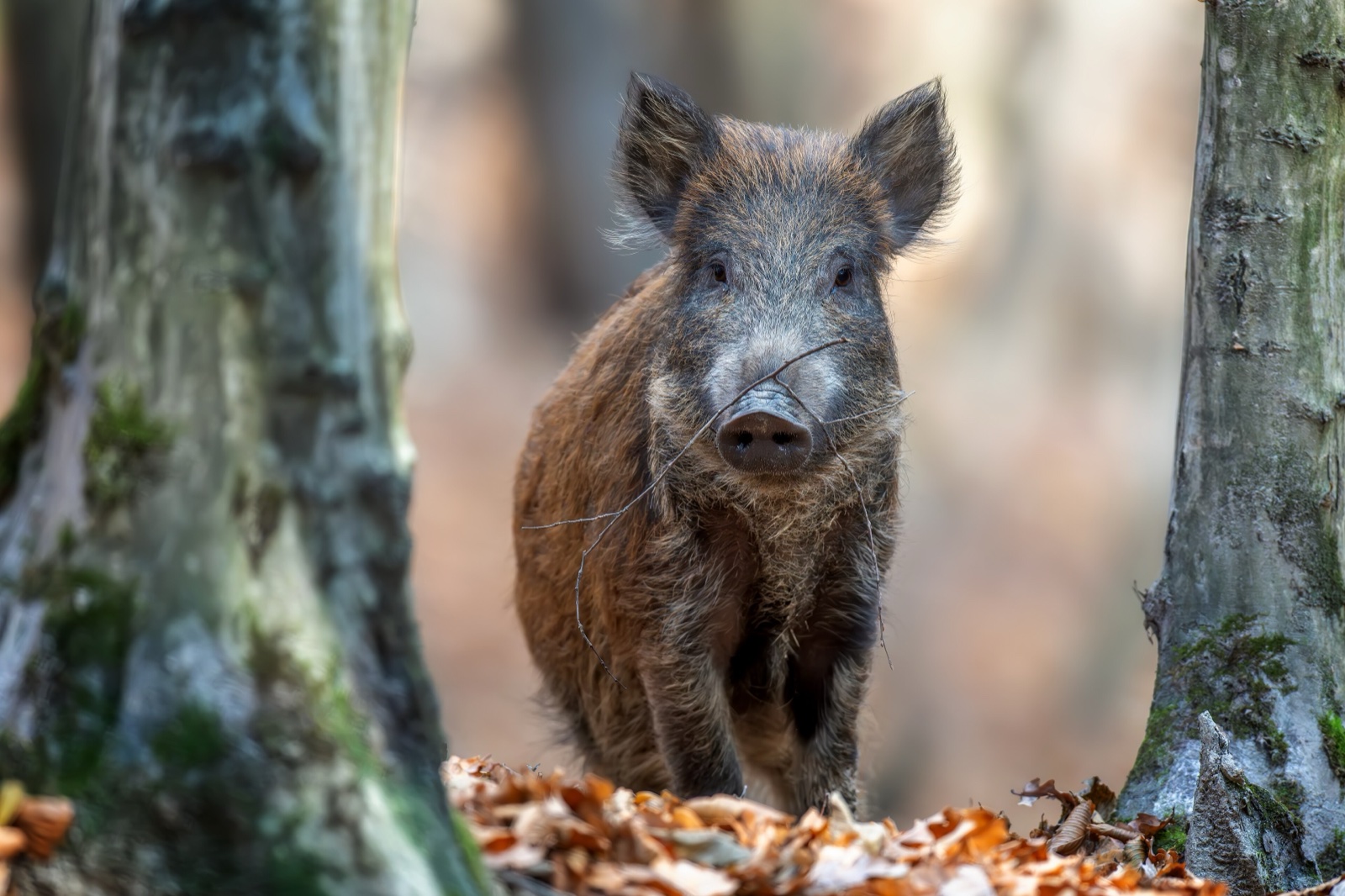
The wild boar, Sus scrofa, is the most widespread member of the Artiodactyla, the order of even-toed hoofed mammals[1]. Its native range ran from the British Isles in the far west across Eurasia to Korea, Japan and Southeast Asia, and introduced herds now roam Australia, New Zealand and the Americas[2]. With those herds the species lives on every continent except Antarctica[3].
Adults measure 153 to 240 cm in total length and weigh 66 to 272 kg[3]. The upper canines grow 5 to 10 cm long and stay visible even when the mouth is shut[3]; they curve outward and upward to form the tusks[2].
The long, flattened snout gives the boar a heightened sense of smell[3]. It forages with that snout close to the ground and, grubbing for food, throws aside soil and small undergrowth[3]. The animal is omnivorous, though most of what it eats is plant matter: crops, fruit, nuts and mast, roots and green shoots[3].
The sows are social. They live in groups called sounders, several females with their young[3], and these maternal families average about 20 animals, while adult males keep apart outside the breeding season[2]. The longest known lifespan in the wild is 9 to 10 years, yet most boars die in their 1st or 2nd year[3].
The boar's tame kin, the domestic pig, has been studied closely for its mind. A 2015 review concluded that pigs are cognitively complex and share many traits with the animals humans count as intelligent[4]. The IUCN lists the wild species as Least Concern[2].
The Spiritual Capacity: The Force of the Earth
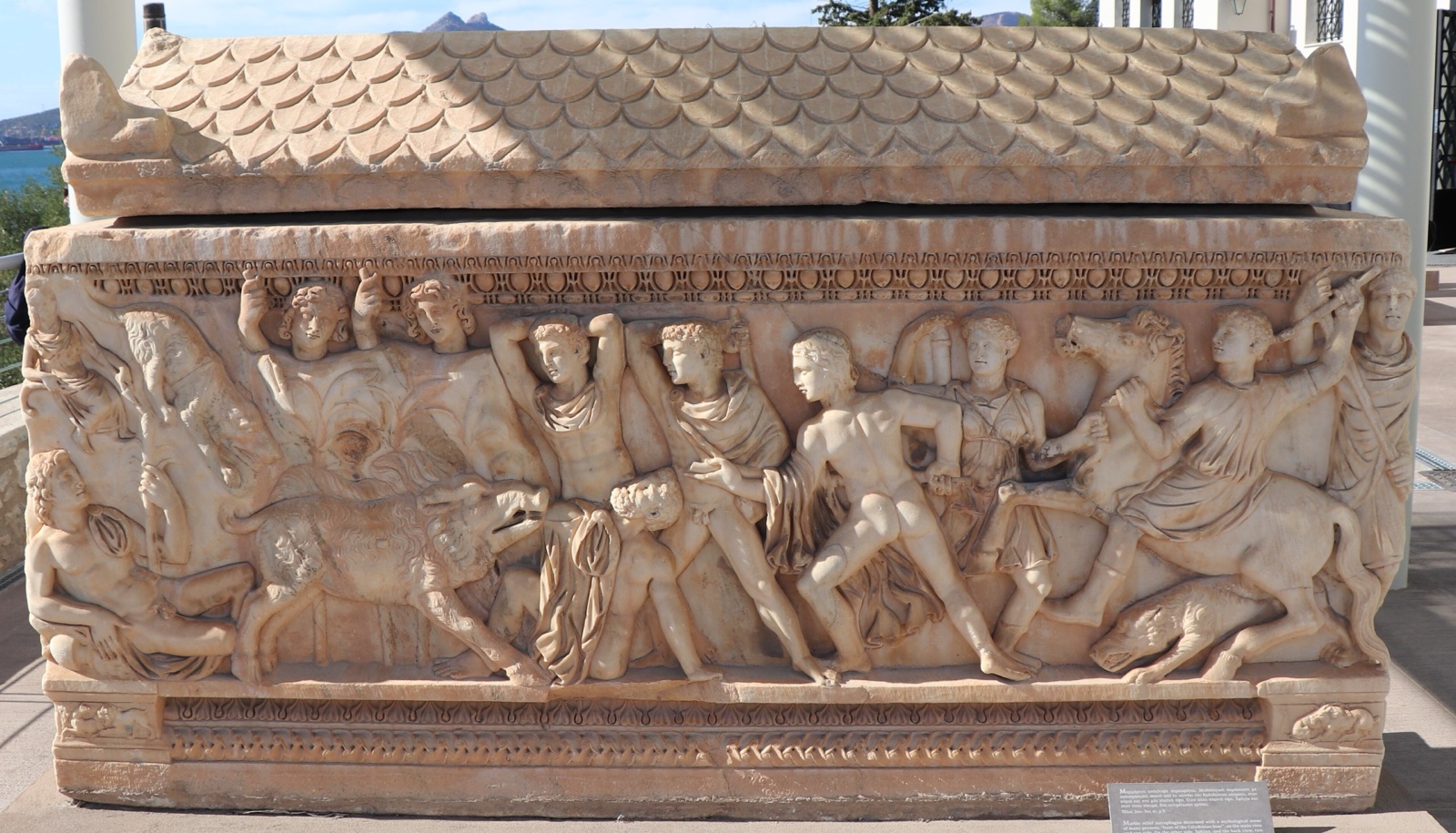
In Zevism the boar is the force of the earth in its raw state. It is the power that lives at the base chakra: dense, hot, driving straight ahead, not yet given a direction. The ancient witnesses never number it among the gentle beasts. When Oeneus of Calydon forgot Artemis alone among the Gods at the offering of first fruits, She sent a boar of great size and strength that kept the land from being sown[5].
The boar is the trial of Arete. At Calydon the best men of Hellas gathered against it; on Erymanthos it fell to Heracles, son of Zeus, as his 4th labour. He did not kill it: he drove it out of a thicket into deep snow, snared it and carried it alive to Mycenae[6]. The Temple reads the deed as the right relation to the base force: it is mastered and carried, never destroyed.
The same force kills the one who meets it unready. Adonis, beloved of Aphrodite, died of a boar's wound while hunting, and Apollodorus says the blow came through the wrath of Artemis[7]. Other traditions say that Ares Himself took the shape of a boar to kill Him: Servius on Virgil's Eclogues 10.18 and Ptolemy Hephaestion record it[8], and Nonnus has Ares, in the shape of a wild boar with jagged tusk, weave the fate of Adonis[9]. The Temple names Adonis with Tammuz[10]: the beautiful one who descends and is mourned.
The sow turns the same power toward birth. At the Thesmophoria of Demeter and Persephone, piglets went down into pits; the Bailers brought up the rotten remains, and whoever scattered them with the seed was promised a good crop[11]. The ancient commentator calls the piglets' many offspring a sign of the generation of fruits and of humans[11]. What descends into the earth returns as harvest: this is the rhythm of Kore, and the sow carries it in her body (read beside it The Wheat of Demeter).
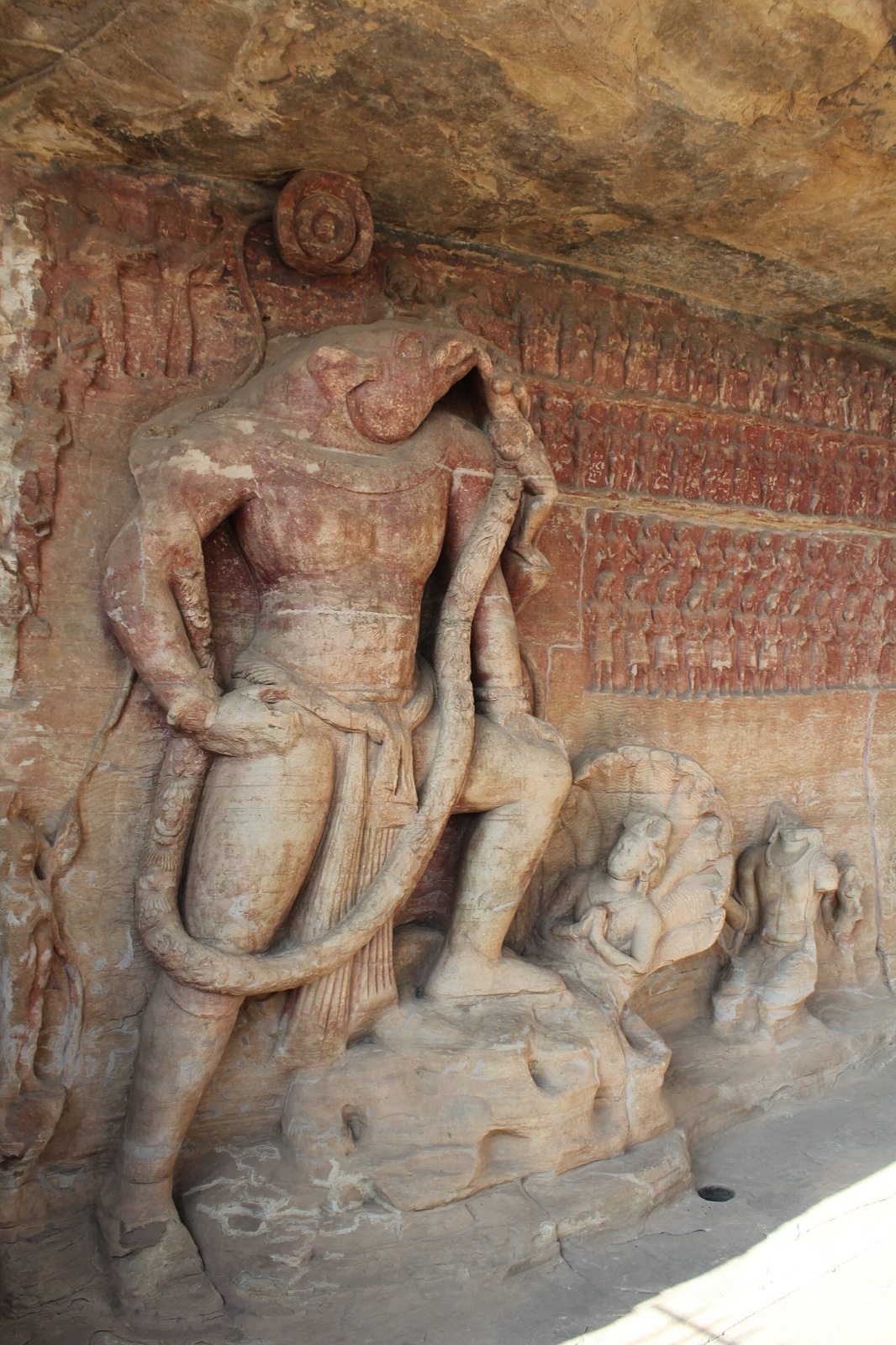
At its summit the boar becomes cosmic. Vishnu, in the Temple's teaching one of the 3 faces of the power that Zeus embodies as one[12], took the boar's form when a demon dragged the Earth to the bottom of the sea, and raised her out of the water on His tusks[13]. Here the base force, consecrated, lifts the world out of the abyss: Ma'at restored against the dissolution of Izfet. In the North the same image burns with light, for the golden bristles of Freyr's boar shone in the darkest night[14].
Furius · CC0 · Wikimedia Commons
_-_the_hunt.jpg)
Where Matter and Spirit Meet
The boar's body and the boar's meaning are the same reality seen from opposite sides. Each capacity of the living animal shows a power of the soul.
- The rooting snout. The boar finds its food by smell and opens the ground to reach it. The soul does the same work at the base chakra: it does not flee the dense powers of the body but goes down into them, to the root. Varaha dives to the floor of the waters for the Earth; the Zevist descends into the base to find the strength buried there.
- The upturned tusks. The weapon grows from the jaw and curves upward, toward the sky. This is the base force bent into ascent, the image of the current that rises from the root of the spine through the chakras (Kundalini). On those tusks Varaha lifts the Earth: raw strength made into the instrument of order.
- The widest range. No member of its order spreads farther, and the boar now lives on every continent but Antarctica. So too the base force lives in every soul and every people: Greek, Roman, Gaul, Norse and Indian all knew the boar because all carry its power. Unmastered, it kills Adonis; mastered, as Heracles masters it in the snow, it serves the hero.
- The sounder and the lone male. Sows keep maternal families; grown males walk alone. The force of the earth wears both faces: the fertile mother that Demeter keeps and the solitary fighter of the hunt. The Zevist holds both in the base chakra, abundance and courage from the same root.
- A mind inside the beast. Science finds the pig cognitively complex. The base force is not blind matter: it carries its own intelligence, which wakes when the current rises and the lower powers come under the rule of the higher.
The Gods and Their Many Names
The boar recurs around 2 divine powers in every land: the Mistress of the wild, who sends it as trial or punishment, and the Lord who masters it or takes its form. In Hellas the sender is Artemis and the warrior force is Ares; in Rome the sow belongs to Ceres, whom the Temple knows as Demeter; in India the boar is Vishnu Himself, a face of Zeus. The Norse peoples gave the golden boar to Freyr and to Freyja, and the Gauls and early Romans carried it into battle as a standard.
| Civilization | God (and the Temple's identity) | The Bond with the Animal | Witness |
|---|---|---|---|
| Hellas (Aetolia) | Artemis (Diana) | Sends the Calydonian boar against the orchard of Oeneus for a forgotten offering | Homer, Iliad 9.533-549[15] |
| Hellas (Arcadia) | Heracles, son of Zeus | Takes the Erymanthian boar alive as his 4th labour | Apollodorus, Library 2.5.4[6] |
| Cyprus and Syria | Adonis (Tammuz); Ares (Mars) | Adonis killed by a boar; in some traditions the boar is Ares Himself | Servius on Eclogues 10.18; Nonnus, Dionysiaca 42[8][9] |
| Attica | Demeter (Ceres, Isis) and Persephone | Piglets lowered into the pits of the Thesmophoria; their remains sown with the seed | Scholion on Lucian, ed. Rabe 275-276[11] |
| Rome | Ceres (Demeter) | The sow, 1st victim of Ceres, for rooting up the young corn | Ovid, Fasti 1.349-352[16] |
| Scandinavia and Iceland | Freyr; Freyja | Freyr's boar Gold-Mane, whose bristles light the dark; Freyja's Hildisvíni, "Battle-Swine", made by the dwarfs Dáinn and Nabbi | Gylfaginning 49; Hyndluljóð 7[17][18] |
| India | Prajāpati; Vishnu as Varaha (a face of Zeus) | The boar raises the Earth from the waters | Śatapatha Brāhmaṇa 14.1.2.11; Udayagiri Cave 5[19][20] |
| Gaul and Rome | The war standard | The Gaulish boar standard; the boar among Rome's 5 legionary standards before Marius | Arch of Orange; Pliny, Natural History 10.16[21][22] |
The thread is the power of the earth under divine rule. Where the Goddess of the wild is offended, the boar breaks out of the forest and lays the fields waste; where the hero or the God governs it, the same beast feeds the furrow, carries the warrior's courage and lifts the drowned world. Ares in the boar and Vishnu in the boar are the 2 ends of 1 force: fury loosed and fury consecrated.
The Śatapatha Brāhmaṇa names the boar Emūṣa and calls Him the Earth's lord, Prajāpati[19]; Britannica traces the later avatar of Vishnu to this earlier legend of Prajāpati in boar shape[13]. The Temple reads the chronology plainly: the boar who raises the Earth is older than any 1 name given to Him, and the power behind every name is the Sovereign of the Cosmos.
Arian Zwegers from Brussels, Belgium · CC BY 2.0 · Wikimedia Commons
.jpg)
Ancient Witnesses
The witnesses speak in 4 tongues. Homer gives the boar that Artemis loosed on Calydon, Ovid the sow of Ceres and her rooting snout, the Brāhmaṇa the boar who raised the Earth, and Snorri the shining bristles of Freyr's boar.
ἣ δὲ χολωσαμένη δῖον γένος ἰοχέαιρα
ὦρσεν ἔπι χλούνην σῦν ἄγριον ἀργιόδοντα,
ὃς κακὰ πόλλʼ ἕρδεσκεν ἔθων Οἰνῆος ἀλωήν·
πολλὰ δʼ ὅ γε προθέλυμνα χαμαὶ βάλε δένδρεα μακρὰBut She, the archer, the divine child, in Her wrath
roused against him a fierce wild boar with white tusks,
which wrought much harm, ravaging the orchard of Oeneus;
many tall trees it threw to the ground, uprooted.Homeri Opera, ed. D. B. Monro and T. W. Allen (Oxford, 1920) · Translation: Temple of Zeus. Verified against the Perseus Digital Library TEI file of the Oxford text (Perseus Hopper: Perseus:text:1999.01.0133, book 9).
prima Ceres avidae gavisa est sanguine porcae
ulta suas merita caede nocentis opes;
nam sata vere novo teneris lactentia sulcis
eruta saetigerae comperit ore suis.Ceres first delighted in the blood of the greedy sow,
avenging Her own wealth by the guilty one's deserved death;
for in early spring She found the seed, milky in the soft furrows,
dug up by the snout of the bristly swine.Ovid, Fasti, ed. J. G. Frazer · Translation: Temple of Zeus. Verified against the Perseus Digital Library TEI file.
Śatapatha Brāhmaṇa 14.1.2.11 [19]
इयती ह वा इयमग्रे पृथिव्यास प्रादेशमात्री तामेमूष इति वराह उज्जघान सोऽस्याः पतिः
iyatī ha vā iyamagre pṛthivyāsa prādeśamātrī tāmemūṣa iti varāha ujjaghāna so'syāḥ patiḥ
So large only was this Earth in the beginning, a span in measure. A boar named Emūṣa raised her up; He is her lord.
Śatapatha Brāhmaṇa, Mādhyandina recension, GRETIL e-text · Translation: Temple of Zeus, compared with J. Eggeling, SBE 44 (1900). The sentence continues: He is Prajāpati.
Snorri Sturluson, Skáldskaparmál 43 [14]
En Frey gaf hann göltinn ok sagði, at hann mátti renna loft ok lög nótt ok dag meira en hverr hestr
ok aldri varð svá myrkt af nótt eða í myrkheimum, at eigi væri ærit ljós, þar er hann fór;
svá lýsti af burstinni.And to Freyr he gave the boar, and said that it could run through air and over sea, night and day, faster than any horse,
and never was night so dark, nor the worlds of darkness, that there was not light enough where it went;
so brightly shone its bristles.Snorra Edda, Heimskringla.no text (chapter 35 in older translations) · Translation: Temple of Zeus. The speaker is the dwarf Brokkr, presenting the gifts of his brother Sindri.
Universal Significance
The boar marched with armies long before it entered heraldry. The triumphal arch at Orange, built under Augustus, shows among the captured arms of the Gauls the boar standard they carried into battle[21]. The Deskford carnyx from north-east Scotland, a war trumpet of about AD 80 to 250, ends in a head shaped like a wild boar with upturned snout[23]. Pliny records that Rome itself once marched under 5 standards, the wolf, the minotaur, the horse and the boar beside the eagle, until Marius in his 2nd consulship gave the legions the eagle alone[22]; the eagle's story belongs to The Eagle.
The Germanic warrior kept the boar on his head. The Benty Grange helmet, Anglo-Saxon work of the 7th century found in Derbyshire in 1848, carries a free-standing boar at its apex, and the poem Beowulf mentions boar-adorned helmets 5 times[24]. In the 15th century the white boar was the badge of Richard III of England, and a silver-gilt example was found in 2009 on or near the battlefield of Bosworth[25].
The Hellenistic boar survived as a public companion. In Florence, Pietro Tacca cast a bronze boar fountain shortly before 1634 after a Roman marble copy of a Hellenistic original now in the Uffizi; visitors rub its snout to ensure their return to the city, a custom already recorded in 1766[26].
In India the colossal Varaha of Udayagiri Cave 5 remains the iconographic centrepiece of a site consecrated in 401 CE, the 82nd year of the Gupta calendar, in the presence of Chandragupta II[20][27]. The relief shows the God as a colossal giant with a boar's head and the Earth as a woman dangling at His side, with sages and Gods in ranks around Him[27].
In Zevist Contemplation
The Zevist uses the boar's image to work with the base of the soul: to meet its strength without fear and to bring it under the rule of the higher chakras. The practices below require no priest and promise nothing beyond what the soul itself achieves.
- Grounding at the root. Sit with the spine straight and place the attention at the base of the spine. See the boar there, rooting in dark soil, and breathe slowly into that place until it feels warm and heavy. The aim is presence in the body, the foundation every later ascent needs.
- The tusks turned upward. After grounding, follow the line of the tusks: let the warmth gathered at the base rise along the spine toward the solar chakra. This is the image of Varaha lifting the Earth, raw force raised into order.
- The labour of Heracles. When anger or appetite charges, recall the Erymanthian boar driven into the snow and carried alive. Do not kill the force and do not obey it: slow it, hold it, carry it where it serves. This is Arete practised in the hour of trial.
- The gift of the sow. At the sowing or the harvest, give thanks to Demeter for the earth's return. Reflect that every descent, of seed, of mood, of the soul into hardship, can come back as fruit when Ma'at governs it.
The boar has no older symbol page on the site; its kin are the powers of the earth. Read with it The Chakras for the base and its ascent, and Artemis, who sends the boar and stands guardian of the wild.
Continue exploring
Related Pages
- The Gods: Artemis
- The Gods: Ares
- The Gods: Adonis
- The Gods: Heracles
- Sacred Animal: The Bear of Artemis
- Sacred Animal: The Wolf of Apollo
- Previous: The Fawn of Artemis
- Next: The Bear of Artemis
- All 32 Sacred Animals
- All symbols