




14 min read
The Cow of Hathor
author: High Priest Zevios Metathronos
βοῦς (boûs)
Hathor, Isis, Hera and Kamadhenu: the nourishing power of the Gods and the soul that gives.
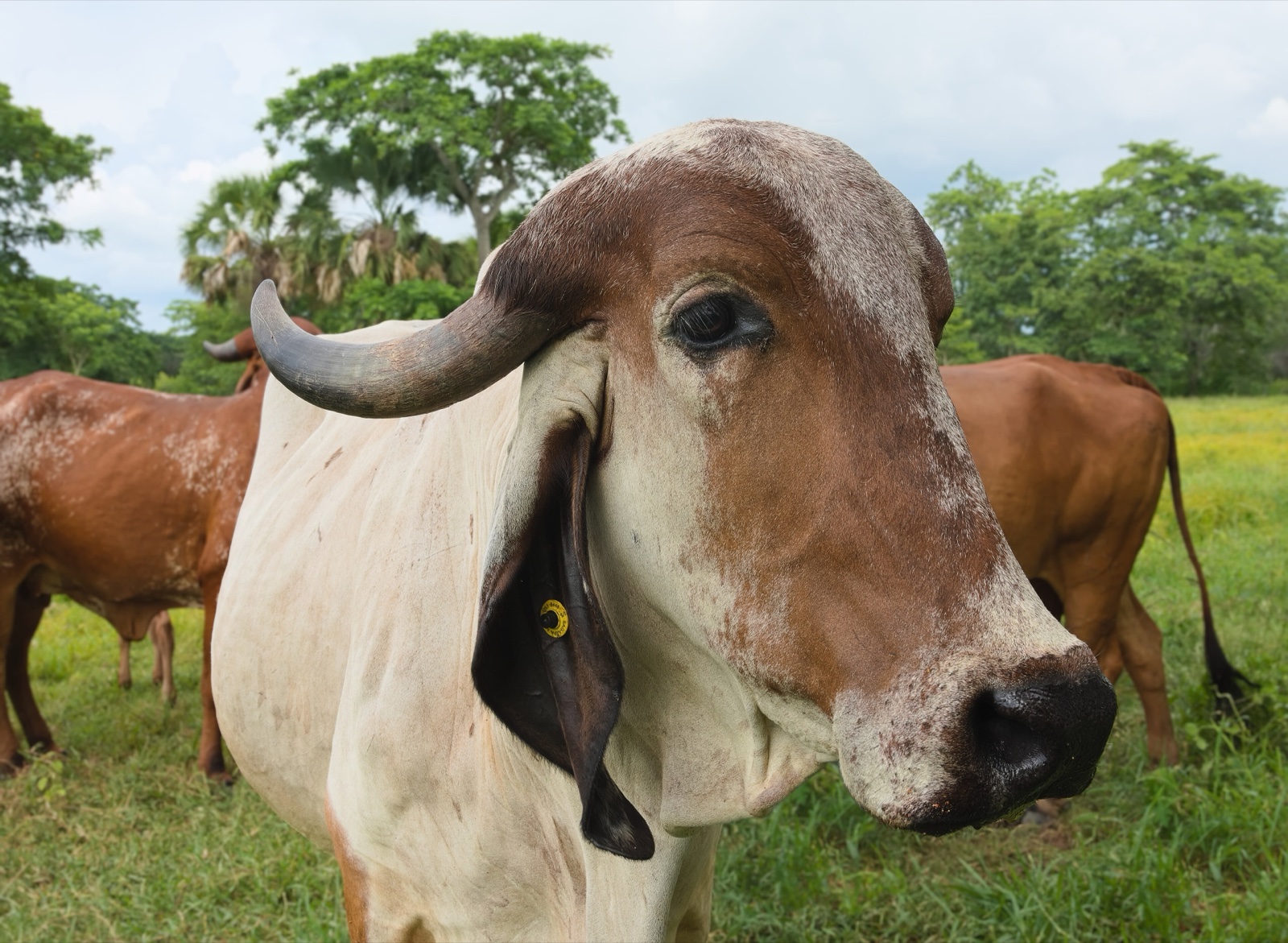
Cvmontuy · CC BY-SA 4.0 · Wikimedia Commons

The cow is the nourishing power of the Gods made flesh: Hathor of the sky in Her cow form, Hera of the wide ox-eyes, Io wandering horned across the world, the wish-granting cow of the sages, Auðhumla feeding the first being with 4 rivers of milk. In Zevism the cow is the giving and receptive soul, the Grail that is filled and that fills.
| Realm | Beasts of the Earth |
|---|---|
| Greek | βοῦς (boûs) |
| Latin | vacca, bos |
| Other Names | Kāmadhenu and Nandinī in India; Auðhumla in the North |
| Species | Bos taurus and the zebu Bos indicus |
| Gods | Hathor, Isis, Hera, Io, Aditi, Helios, Hermes |
| Material Capacity | A 4-chambered stomach that turns grass into milk; wide panoramic sight |
| Spiritual Capacity | Nourishing and receptive power; the Grail that is filled and gives |
| Element and Sphere | Earth and the sky; the heart and the solar chakra |
The Living Animal
The domestic cow, Bos taurus, was won from the aurochs by a small company of early farmers. Ancient DNA from Iranian sites and computer simulations show that all taurine cattle descend from as few as 80 wild oxen domesticated in the Near East some 10,500 years ago[1]. The earliest signs of that domestication are restricted to a small region between southeast Anatolia and Syria[2].
The humped zebu, Bos indicus, comes from India. A study of 844 zebu mitochondrial DNA sequences from 19 Asian countries found the diversity of both maternal lineages highest in the north of the Indian subcontinent, and named the Indus Valley the most likely centre of origin for the lineage called I1[3].
The Gir, the cow of the hero picture, is one of the principal zebu breeds of India, raised in Gujarat for milk and beef[4]. It has a rounded, domed forehead, long pendulous ears and horns that sweep back and spiral up; cows average 385 kilograms and 130 centimetres, and give on average 1,590 kilograms of milk per lactation, with a record of 3,182 kilograms[4].
The cow lives by patience. Like most ruminants it has a 4-chambered stomach of rumen, reticulum, omasum and abomasum; plant food softens in the rumen, returns to the mouth as cud to be chewed again, and is digested with the help of microorganisms, because the animal's own body makes no enzymes that break down cellulose[5].
Her eyes keep a wide watch: cattle see across more than 300 degrees, with a blind spot only directly behind them[6]. From her udder comes the food of nations. World milk production rose from 524 million tonnes in 1992 to 930 million tonnes in 2022, India is the largest producer with 22 percent of the world's milk, and about 150 million households take part in milk production[7].
The Spiritual Capacity
In Zevism the cow reveals the nourishing face of the Divine: the power that receives, carries, feeds and gives without being emptied. Egypt saw the sky itself in this form. Hathor, Goddess of the sky, of women, of fertility and love, took the cow as Her principal animal form and was bound to motherhood[8].
In the soul the cow governs the heart and the solar chakra, which the Temple names the Grail. Milk is the image of what the Grail receives from the Gods and pours out again: warmth, steadiness and life given to others. A soul that holds this power feeds those around it without loss, as the cow of the sages yields whatever is asked of her[9].
The cow also teaches receptivity of sight. Homer gives Hera the epithet βοῶπις, "ox-eyed"[10]: the large, calm eye that takes in the whole field before it acts. For the Zevist this is the gaze of the Queen of the Gods, wide and unhurried, the opposite of the narrow stare of appetite.
Finally the cow is the sacred possession that may not be consumed. The herds of Helios on Thrinakia were 7 herds of 50 cows that were never born and never died[11]; when the companions of Odysseus killed them for food, Zeus struck the ship with His thunderbolt and the God took away their homecoming[11]. In the Temple's teaching this is Ma'at guarding what belongs to the Gods: what is holy in the soul is kept, not eaten by hunger.
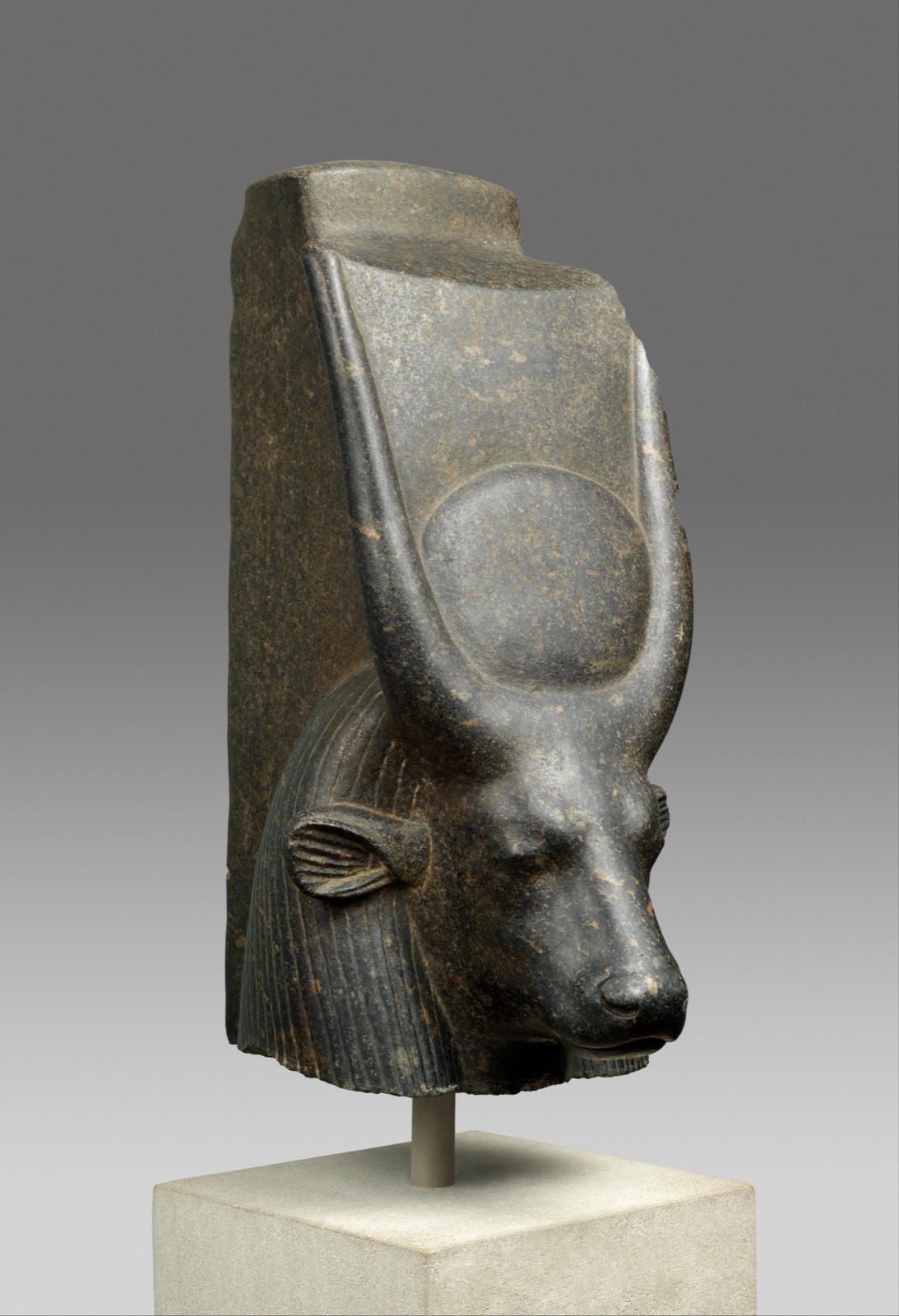
The Metropolitan Museum of Art · CC0 · Wikimedia Commons
_MET_DP317925.jpg)
Where Matter and Spirit Meet
The body of the cow and the teaching of the cow answer each other point by point.
- The 4 chambers and the cud. The ruminant stomach softens food, returns it as cud and digests it again with its living microorganisms[5]. The soul digests wisdom the same way: a teaching is taken in, brought back, chewed again in meditation and only then becomes strength. In Gylfaginning 4 rivers of milk run from Auðhumla[12]; 4 chambers and 4 rivers mark the same law of slow, complete nourishment.
- Milk for the many. 930 million tonnes of milk were produced in 2022 and some 150 million households live from it[7]. Generosity is the spiritual capacity behind this fact: the Grail that gives from fullness and is refilled, the wish-granting cow whose gifts never run out.
- The wide eye. Cattle watch more than 300 degrees of the horizon[6]. This is the eye of βοῶπις Hera: receptive awareness that sees the whole before it chooses, the calm that precedes right action.
- The covenant of domestication. About 80 wild oxen became the ancestors of every taurine cow 10,500 years ago[1], and the Indus Valley gave the zebu[3]. The partnership between humankind and the herd is ancient, and the sanctity of the cow is its spiritual recognition: the creature that feeds a people is placed under the protection of the Gods.
The Gods and Their Many Names
The cow belongs to the great Goddess under Her many names and to the herds of the Sun. In the Temple's teaching Aphrodite is Astarte, Inanna and Isis; Demeter is also Isis; Hera is Juno; Apollo is Helios; Hermes is Thoth; and Zeus is Odin of the North. The Greeks themselves identified Hathor with Aphrodite[8], and Herodotus saw that the statue of Isis was a woman with cow's horns, as the Greeks paint Io[13].
| Civilization | God (and the Temple's Identity) | The Bond with the Animal | Witness |
|---|---|---|---|
| Egypt | Hathor (identified by the Greeks with Aphrodite) | Her principal animal form is the cow; She is Goddess of the sky and, at Deir el-Bahari, Lady of the West. | Britannica, "Hathor"[8]; Met 19.2.5[14] |
| Egypt | Isis (Aphrodite, Demeter) | Cows are sacred to Isis and may not be sacrificed; Her statue is a woman with cow's horns. | Herodotus 2.41.1-2[13] |
| Hellas | Hera (Juno) | Bears the Homeric epithet βοῶπις, "ox-eyed". | Homer, Iliad 1.551[10] |
| Hellas and Egypt | Io, beloved of Zeus (Jupiter) | Changed into a heifer by Jupiter, driven horned across the earth, then worshipped in Egypt by the linen-clad throng. | Ovid, Met. 1.610-611, 1.747[15]; Aeschylus, Prometheus Bound 673-674[16] |
| India, Vedic | Aditi, mother of the Gods | The cow is called Aditi, "mother of the Rudras, daughter of the Vasus, sister of the Ādityas", and must not be killed. | Ṛgveda 8.101.15[17] |
| India, epic | The cow of Vasiṣṭha | Nandinī yields whatever is sought and raises armies from her body against the king who tries to seize her. | Mahābhārata 1, Section CLXXVII[9] |
| The North | Auðhumla, nurse of the forefathers of Odin (Zeus) | Feeds Ymir with 4 rivers of milk and licks Búri, grandfather of Odin, out of the salty rime. | Snorri, Gylfaginning 6[12] |
| Hellas | Helios (Apollo) | Owns 7 herds of 50 immortal cows on Thrinakia, tended by Goddesses. | Homer, Odyssey 12.127-136[11] |
| Hellas | Hermes (Thoth) | On the evening of the day He is born drives off 50 of the immortal cattle of Apollo, reversing their tracks. | Homeric Hymn to Hermes 17-19, 68-76[18] |
The thread is plain. The Goddess who nourishes takes the cow's form in Egypt, lends Her eyes to the Queen of Olympus, appears in Io as the beloved of Zeus who becomes a Goddess on the Nile, and stands in the Veda as Aditi, the boundless mother. The same image returns because the same nourishing power is worshipped under every name.
The herds of the Sun complete the picture. Helios grazes immortal cows, Hermes on His first day steals cattle of the Gods, and the bull-calf Apis of Memphis is born of a cow touched by light from heaven, as told on the page of the bull. The cow is wealth that belongs to heaven first, and human herds are its reflection. Indian painters give the wish-granting cow the name Kāmadhenu and set her beside the sage and the Parijata tree, as in the painting of about 1820 shown here; the Mahābhārata calls the cow of Vasiṣṭha Nandinī and says that she always yielded what was sought[9].
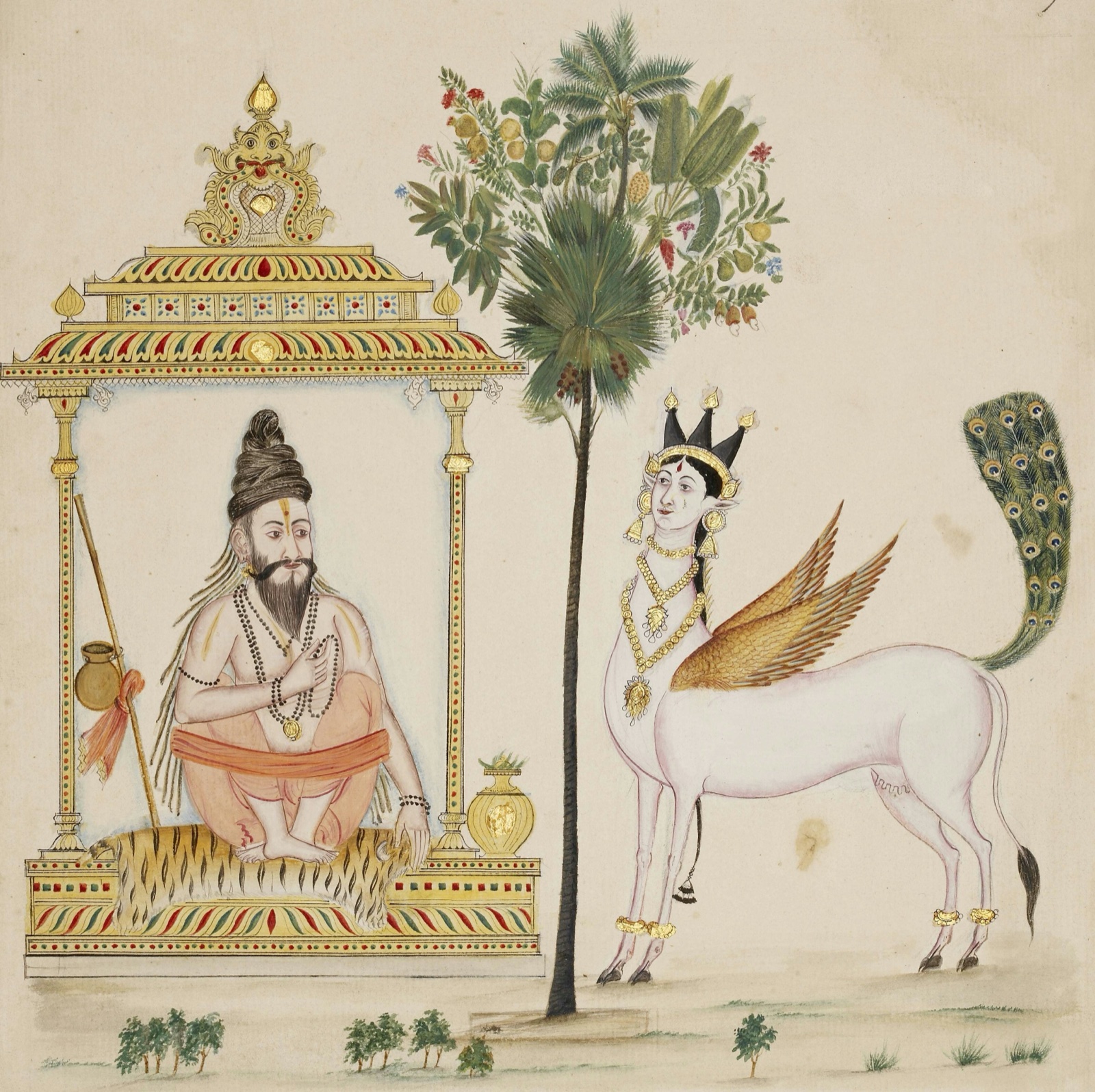
Unknown artist · Public domain · Wikimedia Commons

Ancient Witnesses
The 5 witnesses below come from 4 traditions and speak of the cow as sacred: Homer on the deathless herds of Helios, Herodotus on the cow-horned Isis, Ovid on Io made a Goddess, the Ṛgveda on the inviolable cow, and Snorri on the first cow of the world.
Homer, Odyssey 12.128-131 [11]
βόσκοντʼ Ἠελίοιο βόες καὶ ἴφια μῆλα,
ἑπτὰ βοῶν ἀγέλαι, τόσα δʼ οἰῶν πώεα καλά,
πεντήκοντα δʼ ἕκαστα. γόνος δʼ οὐ γίγνεται αὐτῶν,
οὐδέ ποτε φθινύθουσι. θεαὶ δʼ ἐπιποιμένες εἰσίν,There graze the cattle and the fat sheep of Helios, 7 herds of cattle and as many fair flocks of sheep, 50 in each. No offspring is born to them, and they never perish; Goddesses are their shepherds.
Homer, The Odyssey, ed. A. T. Murray (Loeb Classical Library, 1919) · Translation: Temple of Zeus. Circe instructs Odysseus.
Herodotus, Histories 2.41.2 [13]
τὸ γὰρ τῆς Ἴσιος ἄγαλμα ἐὸν γυναικήιον βούκερων ἐστὶ κατά περ Ἕλληνες τὴν Ἰοῦν γράφουσι, καὶ τὰς βοῦς τὰς θηλέας Αἰγύπτιοι πάντες ὁμοίως σέβονται προβάτων πάντων μάλιστα μακρῷ.
For the statue of Isis is a woman with the horns of a cow, as the Greeks paint Io, and all Egyptians alike revere cows far more than any other beasts.
Herodotus, ed. A. D. Godley (Loeb Classical Library, 1920-1925) · Translation: Temple of Zeus.
Ovid, Metamorphoses 1.747 [15]
Nunc dea linigera colitur celeberrima turba,
Now, most renowned, She is worshipped as a Goddess by the linen-clad throng.
Die Metamorphosen des P. Ovidius Naso, ed. Hugo Magnus (Gotha, 1892) · Translation: Temple of Zeus. Io, restored to human form in Egypt.
माता रुद्राणां दुहिता वसूनां स्वसादित्यानाम् अमृतस्य नाभिः ।
प्र नु वोचं चिकितुषे जनाय मा गाम् अनागाम् अदितिं वधिष्ट ॥mātā rudrāṇāṃ duhitā vasūnāṃ svasādityānām amṛtasya nābhiḥ |
pra nu vocaṃ cikituṣe janāya mā gām anāgām aditiṃ vadhiṣṭa ||Mother of the Rudras, daughter of the Vasus, sister of the Ādityas, navel of immortality: to the discerning man have I proclaimed it. Do not slay the guiltless cow, Aditi.
Ṛgveda Saṃhitā, Wikisource (Sanskrit); accents omitted, words separated · Translation: Temple of Zeus. Text checked against the accented Devanagari of Wikisource; the unaccented IAST also agrees with Vedapath.
Snorri Sturluson, Gylfaginning 6 [12]
þá er hrímit draup, at þar varð af kýr sú, er Auðhumla hét,
en fjórar mjólkár runnu ór spenum hennar, ok fæddi hon Ymi.When the rime dripped, there came of it the cow called Auðhumla, and 4 rivers of milk ran from her teats, and she fed Ymir.
Edda Snorra Sturlusonar, ed. Guðni Jónsson · Translation: Temple of Zeus.
Universal Significance
The cow Goddess was carved in hard stone for millennia. At el-Tod, parts of 2 bovine statues of the Twelfth Dynasty were found reused in the foundations of the temple of Montu, and may show Montu or Hathor, a cow Goddess prominent in the Middle Kingdom[19]. The Metropolitan Museum keeps a head of a cow Goddess in porphyritic diorite, 53.6 centimetres high, with the sun disk between Her horns; it bears no inscription, and Hathor is its most likely subject[14].
A strait still carries the name of the wandering cow. In Aeschylus Prometheus tells Io that mortals will forever speak of her passage, and the strait she crosses will be named after it: Βόσπορος δʼ ἐπώνυμος κεκλήσεται, "and it shall be named Bosporus"[16]. The strait of Aeschylus is the Cimmerian channel by Lake Maeotis, and the prophecy sends Io from the plain of Europe to the Asian mainland[16]: the boundary of 2 continents carries the name of the cow.
In India the sanctity of the cow entered the law of the modern state. Article 48 of the Constitution, among the Directive Principles of State Policy, calls for measures "prohibiting the slaughter, of cows and calves and other milch and draught cattle"; the draft article was debated on 24 November 1948 and settled on 14 November 1949[20]. The Vedic verse that calls the cow guiltless and forbids her killing[17] stands at the far end of the same line.
The Indian cow has also crossed the oceans. The Gir was one of the breeds used to develop the Brahman cattle of North America[4], and the hero photograph shows a Gir cow in Mexico. India itself is now the world's largest milk producer[7], so that the land which made the cow holy also gives the most milk on earth.
In Zevist Contemplation
The Zevist turns to the cow to train the receptive and giving powers of the soul. The practices below work through the heart, the solar chakra and patient attention.
- The milk into the Grail. Sit upright and breathe into the solar plexus. Visualise white light like milk pouring from above into the solar chakra until it is full, then let it overflow through the heart toward the people of the household.
- The ox-eyed gaze. Soften the eyes and widen the field of vision until the edges of the room are present at once, as the eye of the herd watches the whole horizon. Hold this wide, calm sight for some minutes before study or decision.
- Rumination. Read a short sacred text once, then return to it 3 more times across the day, each time recalling it without looking. Like the cud returned to the mouth, the teaching is chewed until it is fully taken into the soul.
- The herds of Helios. In conduct, name what in the life of the soul is not to be spent: vows, rest, the hour of worship. Guard these as the herds of the Sun were guarded, knowing that the companions lost their homecoming by eating what belonged to the God.
The cow stands beside the bull among the Beasts of the Earth. Read it with the pages of Hera and Aphrodite, Goddesses of the nourishing and loving power.
Continue exploring
Related Pages
- The Gods: Hera
- The Gods: Aphrodite
- The Gods: Apollo
- The Gods: Hermes
- Sacred Animal: The Bull of Zeus
- Sacred Animal: The Ram of Zeus Ammon
- Previous: The Bull of Zeus
- Next: The Ram of Zeus Ammon
- All 32 Sacred Animals
- All symbols