




15 min read
The Tortoise of Hermes
author: High Priest Zevios Metathronos
χελώνη (chelṓnē)
Hermes, Aphrodite Ourania, Pan and Vishnu as Kurma: the shell that guards, sings and bears the world.
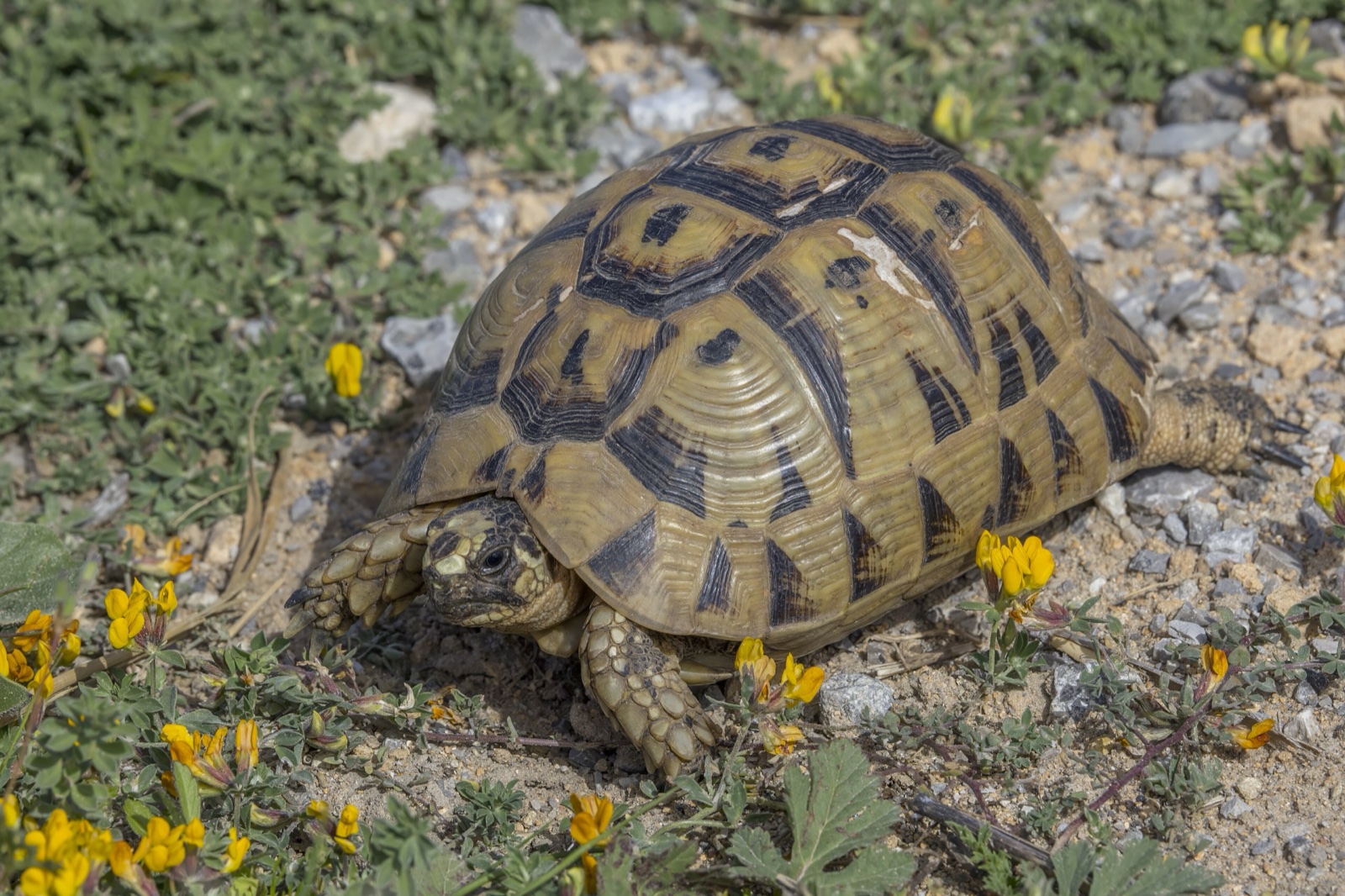
Charles J. Sharp · CC BY-SA 4.0 · Wikimedia Commons
_male_Cap_Bon_2.jpg)
The tortoise is the creature the Gods build upon. Hermes made the first lyre from its shell, Pheidias set Aphrodite Ourania's foot upon it, and in India Vishnu became a tortoise to bear the mountain of the churning. The living animal carries its spine as armour, rests through whole seasons and ages more slowly than almost any other creature.
| Realm | Creatures of the Waters and the Depths |
|---|---|
| Greek | χελώνη (chelṓnē); χέλυς (chélys), tortoise and lyre |
| Latin | testudo |
| Other Names | Sanskrit kūrma (कूर्म), kacchapa (कच्छप) |
| Species | Testudo graeca (spur-thighed tortoise) and kin |
| Gods | Hermes, Aphrodite Ourania, Pan, Vishnu (Kurma), Indra, Prajapati |
| Material Capacity | A shell grown from ribs and spine, long seasonal stillness, slow or negligible ageing |
| Spiritual Capacity | Protection, the withdrawn mind, the foundation that bears the axis of the worlds |
| Element and Sphere | Earth and water; the base of the cosmos; the threshold |
The Living Animal
The tortoise of this page is the spur-thighed tortoise, Testudo graeca, whose western subspecies live in North Africa and southern Spain. It is marked by 2 spurs on its thighs, present in every subspecies, though missing in 23% of animals of the subspecies T. g. graeca[1]. In Tunisia only T. g. nabeulensis occurs, across most of the country; its adults usually stay below 18 cm, with males averaging 13.0 cm and females 12.1 cm[1]. The species is a herbivore: in Doñana, in southern Spain, 81 species of plants were recorded in the diet of T. g. whitei[1].
The shell is the skeleton turned outward. The carapace above and the plastron below are bony structures that join along each side of the body into a rigid skeletal box[2]. The shell formed through the fusion of modified ribs, vertebrae and shoulder girdle bones; the fossil Odontochelys is about 220 million years old, and Eunotosaurus, about 40 million years older, fills a gap of 30 to 55 million years in the turtle record[3].
The tortoise lives by the seasons. In Doñana the spur-thighed tortoise has a period of very low activity from November to March and another of very low or no activity from July to September, while in Tunisia T. g. nabeulensis winters discontinuously[1]. Its giant kin, the Aldabra tortoise, can go without food or water for long periods, and giant tortoises sleep an average of 18 hours in 24[4].
The tortoise ages slowly, and in some species barely at all. In 2022 Rita da Silva and colleagues studied 52 species of turtles and tortoises in zoos and aquariums: about 75% showed slow or negligible senescence, and about 80% aged more slowly than modern humans[5][6]. Testudo graeca was one of 2 species whose estimated rate of ageing in females lay below zero, which the authors read as possible evidence of negligible senescence[5]. A companion study of 77 cold-blooded species from 107 wild populations found little evidence of ageing in several chelonians and pointed to bony shells and a relatively slow pace of life[7].
The oldest known living land animal is a tortoise. Jonathan, a Seychelles giant tortoise, Aldabrachelys gigantea hololissa, was already fully mature when he arrived on St Helena in 1882; he is believed to have hatched about 1832, which makes him 194 years old in 2026[8]. He lives in the gardens of Plantation House, the residence of the island's governor[9]. In the wild, lives are shorter and harder: one studied population of T. g. nabeulensis had an average age of 13.8 years and a maximum of 24[1].
The Spiritual Capacity: The Shell That Guards, Sings and Bears
The Temple's page on the Lyre teaches the instrument as the soul brought into harmony. This page stands one step earlier, with the living creature, and asks what the Gods saw in it before it became an instrument. In the Homeric Hymn to Hermes the newborn God, son of Zeus and Maia, steps over the threshold of His cave and meets a tortoise grazing at the courtyard gate[10]. He laughs and greets it as a σύμβολον, a sign of great profit[10].
Then Hermes names the 2 capacities of the creature in a single couplet: alive, the tortoise will be a defence, ἔχμα, against harmful witchcraft; dead, it will sing most beautifully[10]. The shell that guards the living body becomes the sounding body of the song. In Zevism these are the 2 works of the soul's outer form: it shields the soul in life, as the protective aura taught under the Aegis does, and when the lower self is hollowed out by discipline, the same form resounds to the Gods. The hymn compares the speed of Hermes's work to a thought flashing through a man's breast: word and deed planned at once[10].
At Elis, Pheidias made Aphrodite Ourania in gold and ivory, standing with one foot on a tortoise; Pausanias declined to explain it and left the meaning "to those who wish to guess"[11]. Plutarch read the tortoise as a lesson in keeping at home and keeping silence[12]. The Temple reads it at the scale of the cosmos. Ourania is heavenly love, and the tortoise beneath Her foot is the world itself: in the Śatapatha Brāhmaṇa the lower shell is this earth, the upper shell the sky, and the space between them the air[13].
In India the tortoise bears the axis of creation. When the Gods and the Asuras churned the ocean, Vishnu took "the wondrous, vast body of a tortoise", entered the water and raised Mount Mandara, then bore it on a back that spread over 100,000 yojanas, "like a second great island"[14]. In the Mahābhārata it is Indra who sets the mountain on the back of the Tortoise-king[15]. In the Temple's teaching Indra is Zeus, and Vishnu is one of the 3 faces of the cosmic power that Zeus embodies as one.
In Zevism the churning is the work of meditation: the mountain is the spine, Sushumna, turned between opposing forces, and the rope is the serpent, whose image the Temple's page on the Serpent holds. The tortoise is the base that keeps the axis from sinking: the base chakra, stability, patience. Its virtue is steadfastness, the strength that holds still while everything above it turns.
Where Matter and Spirit Meet
Each capacity of the living tortoise is the visible form of a spiritual one. 4 of them show the bond clearly.
- A shell grown from the spine and the protected soul. The tortoise's armour grew from its own ribs and vertebrae[3]. In Zevism the soul's protection grows the same way, from the strength of the inner axis and the chakras along it, and the hymn's ἔχμα against harm is the outward sign of an inward order[10].
- Drawing in the limbs and the withdrawal of the senses. The Bhagavad Gītā compares the wise man who draws back his senses to the tortoise drawing its feet under its shield[16]. The rigid box of the shell is the body of that teaching[2]: the Zevist withdraws attention from the outer world before turning it to the Third Eye.
- Long seasons of stillness and the conservation of force. The spur-thighed tortoise passes whole seasons in very low activity[1]. The soul also has seasons: times to act and times to withdraw and gather power. The tortoise teaches the Zevist to spend vital force with measure and to keep a reserve.
- Negligible senescence and Theosis. In many tortoises the risk of death rises little or not at all with age, and Testudo graeca may be among those with negligible senescence[5]. The aim of the Zevist path is ὁμοίωσις θεῷ, likeness to the deathless Gods, as the Temple teaches in Becoming as the Gods; the tortoise shows in matter that decline is not a fixed law of every living body.
The Gods and Their Many Names
In the Temple's teaching Hermes is Thoth, Anubis and Mercury; Aphrodite is Astarte, Inanna, Isis and Venus; Indra is Zeus; and Brahma, Vishnu and Shiva are 3 faces of the cosmic power that Zeus embodies as one. The tortoise gathers around the powers that make and that found: the God who makes the first instrument, the creator who takes the tortoise's shape, the God who bears the world's axis on His back.
| Civilization | God | The Bond with the Animal | Witness |
|---|---|---|---|
| Hellas: Kyllene in Arcadia | Hermes (Thoth, Mercury) | Finds the tortoise at the threshold and makes it the first lyre | Homeric Hymn to Hermes 24-51[10] |
| Arcadia: Mount Parthenion | Pan | The tortoises of the mountain, the best for lyres, are held sacred to Pan; the people neither take them nor let strangers take them | Pausanias 8.54.7[11] |
| Elis | Aphrodite Ourania (Astarte, Venus) | Pheidias's gold and ivory statue stands with one foot on a tortoise | Pausanias 6.25.1[11]; Plutarch, Moralia 142[12] |
| Rome | Mercury (Hermes) | The lyre is called testudo, "skilled to resound on 7 strings"; Mercury is "parent of the curved lyre" | Horace, Odes 1.10.6 and 3.11.1-4[17] |
| Vedic India | Prajapati, Lord of Creatures (the Vedic counterpart of Brahma) | Takes the tortoise's form and creates living beings; the tortoise is the 3 worlds | Śatapatha Brāhmaṇa 7.5.1.1-5[13] |
| Epic India | Indra (Zeus) | Sets Mount Mandara on the back of the Tortoise-king for the churning of the ocean | Mahābhārata, Ādi Parva 18[15] |
| Puranic India | Vishnu as Kurma (a face of Zeus) | Takes the body of a tortoise, raises Mandara from the water and bears it on His back | Bhāgavata Purāṇa 8.7.9-10[14] |
The table shows one bond in many lands: the tortoise is the foundation on which something higher is set. Hermes sets strings on its shell, Aphrodite sets Her foot on it, Indra sets the mountain on it, and the Śatapatha Brāhmaṇa makes the 3 worlds of its body[13]. The Greek and the Indian witnesses speak in different tongues and agree, because they describe the same order of foundation.
The foundation belongs to the Head God. In the Temple's teaching the order that holds the world in place is Ma'at, kept by Zeus as Sovereign of the Cosmos, and the tortoise is its living image: the stable ground beneath the turning of the worlds, the base that keeps creation from sinking into the waters of dissolution.
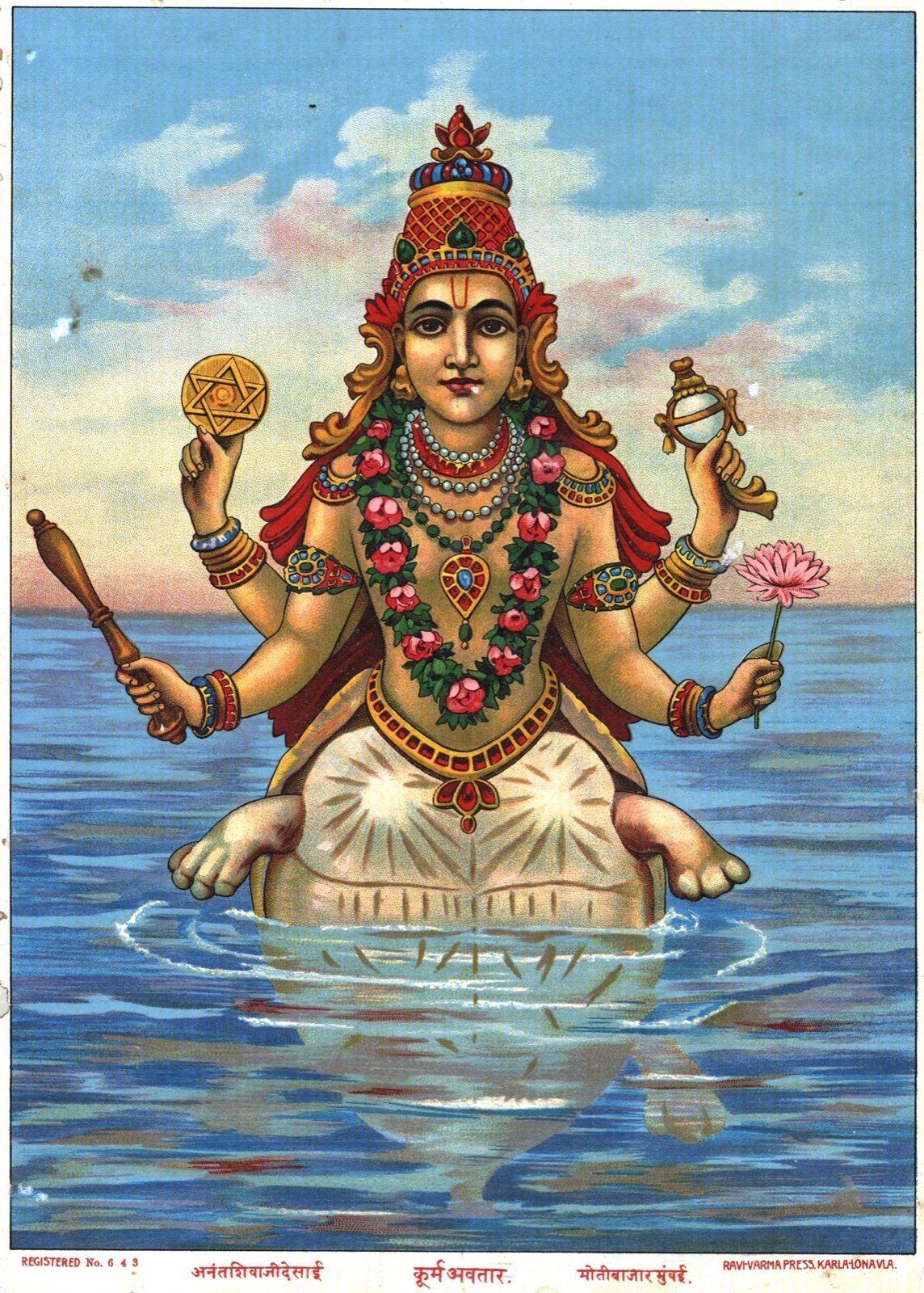
Raja Ravi Varma · Public domain · Wikimedia Commons

Ancient Witnesses
5 witnesses follow: the Homeric Hymn to Hermes twice, Pausanias at Elis, Horace's hymn to Mercury and the Bhāgavata Purāṇa. Together they show the tortoise as the creature the Gods turn into song, set Their feet upon and take as Their own body.
Homeric Hymn to Hermes 24-25 [10]
ἔνθα χέλυν εὑρὼν ἐκτήσατο μυρίον ὄλβον·
Ἑρμῆς τοι πρώτιστα χέλυν τεκτήνατʼ ἀοιδόν·There He found a tortoise and won endless wealth; for Hermes was the very first to make the tortoise a singer.
Hesiod, the Homeric Hymns and Homerica, ed. H. G. Evelyn-White (London and New York, 1914) · Translation: Temple of Zeus.
Homeric Hymn to Hermes 37-38 [10]
ἦ γὰρ ἐπηλυσίης πολυπήμονος ἔσσεαι ἔχμα
ζώουσʼ· ἢν δὲ θάνῃς, τότε κεν μάλα καλὸν ἀείδοις.For alive you shall be a defence against harmful witchcraft; but if you die, then you would sing most beautifully.
Hesiod, the Homeric Hymns and Homerica, ed. H. G. Evelyn-White (London and New York, 1914) · Translation: Temple of Zeus.
Pausanias, Description of Greece 6.25.1 [11]
καὶ τὴν μὲν ἐν τῷ ναῷ καλοῦσιν Οὐρανίαν, ἐλέφαντος δέ ἐστι καὶ χρυσοῦ, τέχνη Φειδίου, τῷ δὲ ἑτέρῳ ποδὶ ἐπὶ χελώνης βέβηκε·
The one in the temple they call Ourania; She is of ivory and gold, the work of Pheidias, and She stands with one foot upon a tortoise.
Pausaniae Graeciae Descriptio, ed. F. Spiro (Leipzig: Teubner, 1903) · Translation: Temple of Zeus.
Mercuri, nam te docilis magistro
movit Amphion lapides canendo,
tuque testudo resonare septem
callida nervis,Mercury, since under your teaching Amphion, an apt pupil, moved stones by his singing; and you, tortoise-shell, skilled to resound on 7 strings,
Horace, Odes and Epodes, ed. P. Shorey and G. J. Laing (Chicago) · Translation: Temple of Zeus. The sentence continues in the next stanza.
Bhāgavata Purāṇa 8.7.9-10 [14]
विलोक्य विघ्नेशविधिं तदेश्वरो दुरन्तवीर्यो ऽवितथाभिसन्धिः
कृत्वा वपुः कच्छपमद्भुतं महत् प्रविश्य तोयं गिरिमुज्जहार
तमुत्थितं वीक्ष्य कुलाचलं पुनः समुद्यता निर्मथितुं सुरासुराः
दधार पृष्ठेन स लक्षयोजन प्रस्तारिणा द्वीप इवापरो महान्vilokya vighneśavidhiṃ tadeśvaro durantavīryo 'vitathābhisandhiḥ
kṛtvā vapuḥ kacchapamadbhutaṃ mahat praviśya toyaṃ girimujjahāra
tamutthitaṃ vīkṣya kulācalaṃ punaḥ samudyatā nirmathituṃ surāsurāḥ
dadhāra pṛṣṭhena sa lakṣayojana prastāriṇā dvīpa ivāparo mahānSeeing the work of the Lord of Obstacles, the Lord, of boundless power and unfailing purpose, took the wondrous, vast body of a tortoise, entered the water and raised the mountain. When the Gods and Asuras saw the great mountain raised again, they rose to churn once more; and He bore it on His back, which spread over 100,000 yojanas, like a second great island.
GRETIL e-text of the Bhāgavata Purāṇa, Book 8 · Translation: Temple of Zeus. The Devanagari is a direct transliteration of the GRETIL IAST.
Universal Significance
The tortoise stands on some of the first coins of Europe. Aegina, an island 27 km off Athens, was the first Greek state to adopt coinage, after the mints of Asia Minor and the Ionian islands, striking its first coins around 600 BC with a sea turtle[18]. Aegina is often considered the town that introduced coined money to the western world, and its turtles were widely used and popular[19].
In the course of the 5th century BC the sea turtle gave way to a land tortoise with clearly defined legs and a segmented shell, a change often linked to the Athenian occupation of the island[18]. A land tortoise still marked Aeginetan staters of about 370 BC[19]. The emblem moved from the sea to the land and kept its place in the market for more than 2 centuries.
The tortoise gave its name to music. The hymn calls the first lyre simply χέλυς, tortoise[10], and Horace addresses the lyre as testudo, the Latin word for the animal, in his hymn to Mercury[17]. Pheidias set a tortoise beneath the foot of his Aphrodite at Elis, and Pausanias saw it there[11]. In India the tortoise entered the ritual of the fire altar and the cosmology of the Brahmanas[13], and Kurma took His place among the forms of Vishnu[14].
The modern world measures the tortoise's endurance and its danger. Testudo graeca is listed as Vulnerable on the IUCN Red List (assessed 1996) and on Appendix II of CITES; more than 300,000 animals a year were exported from northern Africa in the 1950s and 1960s, and collection for the pet trade remains a main threat with habitat loss[1]. In 2022 the tortoise entered the science of ageing as a challenge to its theories[5], and in 2026 Guinness World Records named Jonathan of St Helena an icon at 194 years[9].
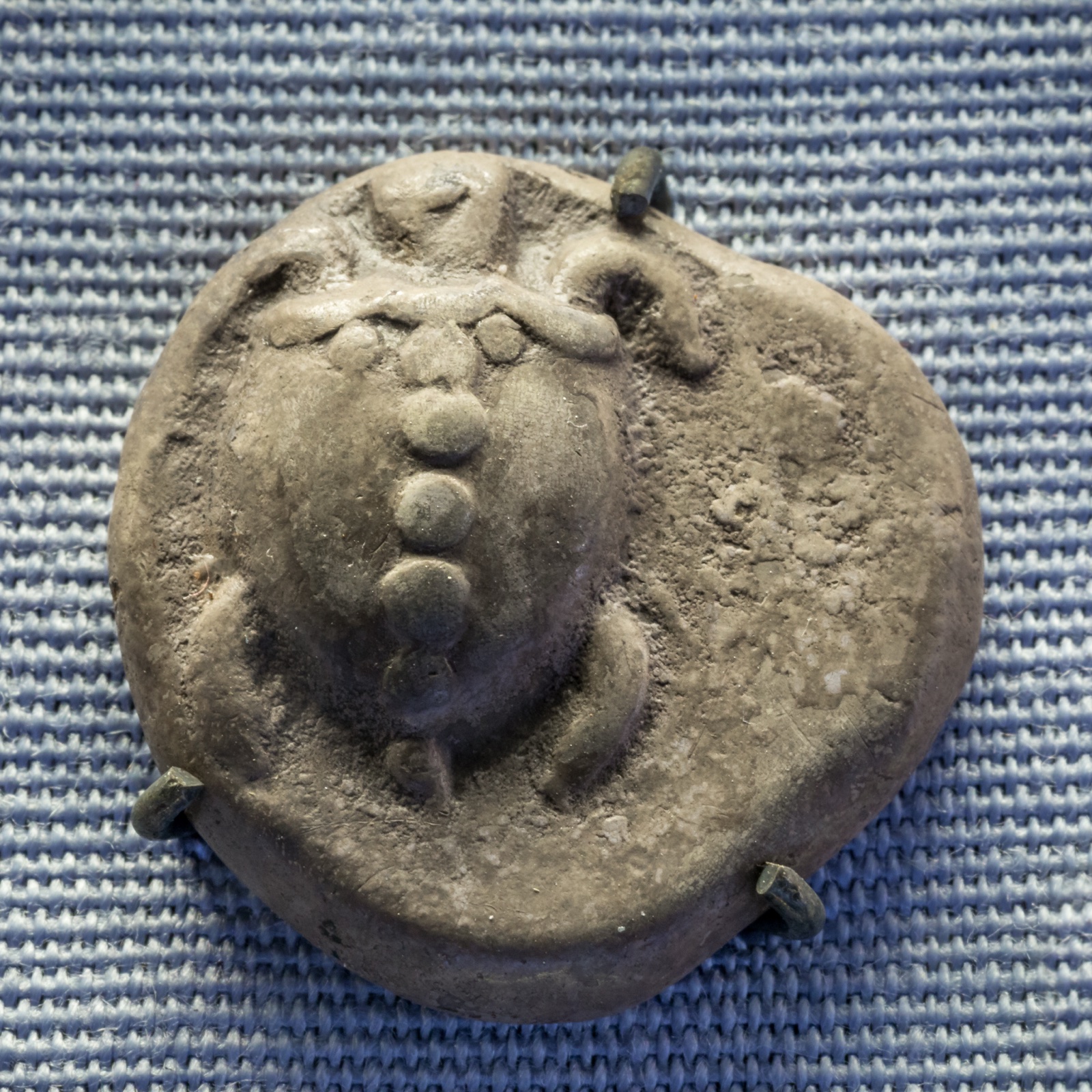
ArchaiOptix · CC BY-SA 4.0 · Wikimedia Commons

In Zevist Contemplation
The Zevist takes the tortoise into practice as the image of the foundation, the withdrawn mind and the body that sings. These points serve meditation, study and conduct; none needs a priest, and none promises more than steady practice gives.
- The threshold. Hermes met the tortoise as He crossed the threshold of His cave. Begin each practice at a threshold, the moment between the outer day and the inner work, and receive what meets you there as a σύμβολον, a sign.
- Drawing in the limbs. Seated, draw attention back from the eyes, ears, tongue, nose and skin, as the tortoise draws its feet under its shield. When the senses are gathered in, turn the attention to the Third Eye.
- The base that bears the mountain. Sit with the spine upright as Mount Mandara and feel the base of the body as the tortoise beneath it. Breathe into the base chakra until the seat feels as steady as the back that bore the churning; then let the breath rise along the spine, as the chakra teaching describes.
- The shell that sings. Hum a long vowel and feel the chest and skull resound, as the emptied shell resounded under Hermes's hand. What is hollowed of fear and noise becomes an instrument for the Gods.
- The long life. In conduct, move with measure. The tortoise lives within its seasons and ages slowly; the Zevist keeps vital force by refusing waste, and holds Theosis as the aim of a long and ordered life.
The Temple's page on the Lyre carries the teaching of harmony and of the lyre that passed from Hermes to Apollo. Read it beside this page, which keeps to the living tortoise and the world it bears.
Continue exploring
Related Pages
- Symbol: The Lyre
- The Gods: Hermes
- The Gods: Aphrodite
- Symbol: Pan: Sacred Nature and the Breath of Life
- Sacred Animal: The Serpent
- Sacred Animal: The Goat of Zeus
- Sacred Animal: The Crocodile of Sobek
- Previous: The Crocodile of Sobek
- Next: The Bee of Zeus
- All 32 Sacred Animals
- All symbols