














| Language / Culture | Name of Aphrodite | Attestation |
|---|---|---|
| Classical Greek | Ἀφροδίτη (Aphrodite) | Homer, Hesiod, inscriptions (8th century BCE onward) |
| Cypriot Greek | 𐠲𐠙𐠨 / 𐠀𐠡𐠦𐠭𐠃𐠂 (a-po-ro-ta-o-i/wa-na-sa) | Cypriot inscriptions (6th to 4th centuries BCE) |
25 min read
APHRODITE
author: High Priest Zevios Metathronos
co-author: Novice Priest Karnonnos
I. The Name of Aphrodite
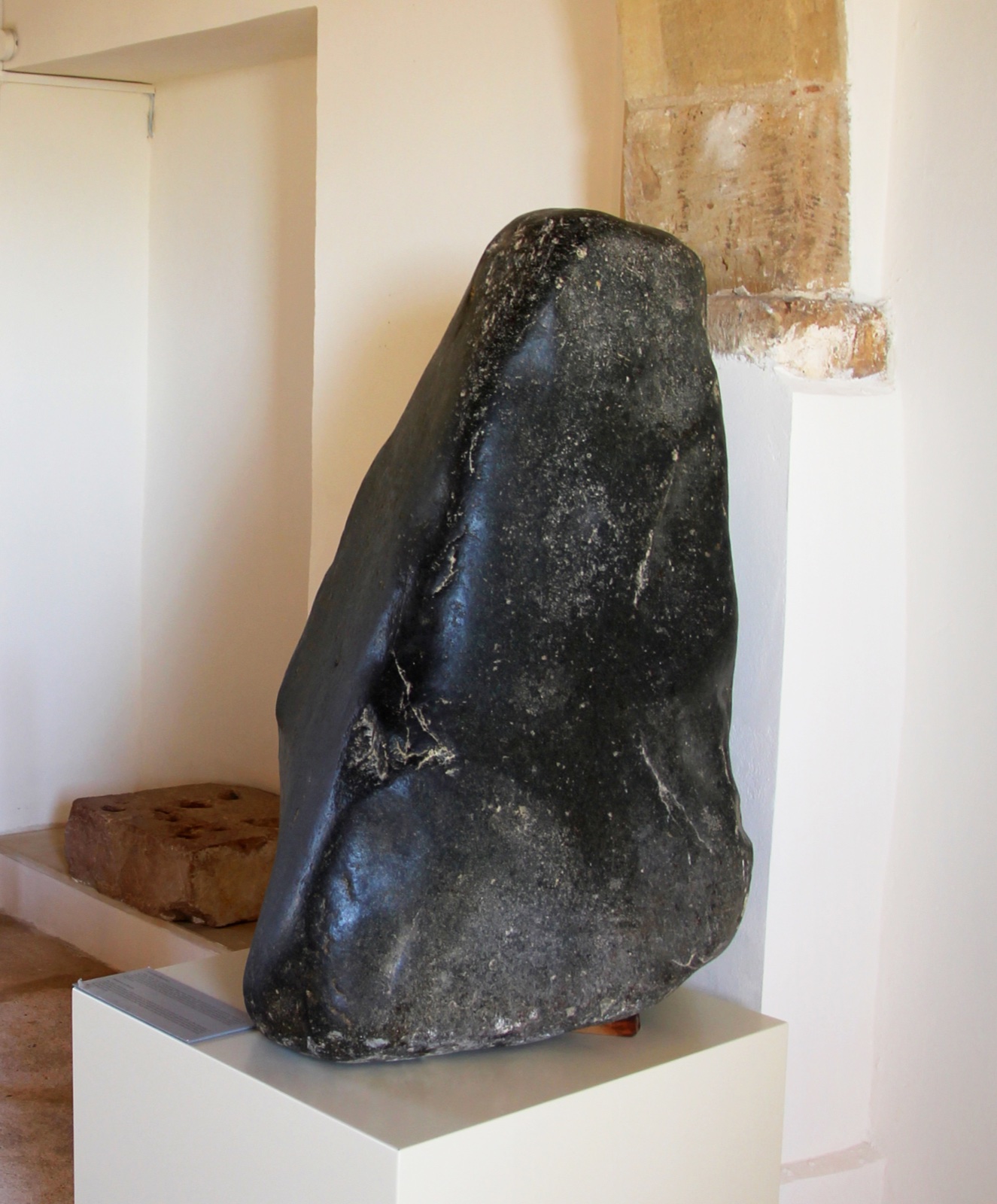
Conical stone which served as the cult idol in the sanctuary of Aphrodite at Palaepaphos, Cyprus.
Photo: Wojciech Biegun, CC BY-SA 3.0 · Source and licence
Photo: Wojciech Biegun, CC BY-SA 3.0 · Source and licence
The name of Aphrodite is explained by Hesiod to mean born of sea foam in alignment with her myth, something Homer connects her to. Socrates does not even attempt to contradict this in the Cratylus. The genitive noun ἀφροῦ means of the sea foam. It is never explained clearly in Antiquity, however, what -δίτη means and how it could mean born from is confusing. One medieval explanation claimed it comes from αβροδίαιτος, 'one who lives delicately'.1,2,3
Modern etymologists have offered no definitive explanation for what the name could mean either. Some connect it to *dita, a hypothesized stem meaning 'bright'. There are numerous hypotheses drawing from the so-called Middle Eastern origin of the goddess especially from postulated adjectives in Phoenician, but nothing definitive has been established lexically.4,5
Generally, the earliest attestation of her name is dated to the Iliad and Odyssey, the Homeric corpus. There is no particular Linear B source for Aphrodite that is convincing. The Greeks themselves sometimes contended Aphrodite's rites were alien to the mainland, but other than Herodotus, they did not attribute them linearly to a direct Phoenician influence on Greece. Plato states it is befitting the planet Venus (Aphrodite in Greek) was named after an equivalent goddess by the Mesopotamians.2,6,7,8
The Cypriot script dating back to the 11th century BCE renders her as 𐠀𐠡𐠦𐠭𐠃𐠂 (a-po-ro-ta-o-i) around the 4th century BCE and the month Aphroditias ICS 299.A.5 a century earlier, but prior to that it simply calls her the Mistress (𐠲𐠙𐠨, wa-na-sa), the Goddess and so on. Some historians believe Aphrodite was a native Cypriot goddess. That has some rooting in Antiquity, too; Pausanias contended the Assyrians were the first to worship her, the Cypriots of Paphos second, the Phoenicians third, and the Cythareans learned it from the Phoenicians in line with Herodotus' account.9,10
The earliest attestation of her name in regular Greek is also quite old. The British Museum 1888,0601.456 object from Naukratis in Egypt, a large bowl of Chian manufacture with a graffito naming the goddess, is dated back to the 620s BCE.11
ΣΩΣΤΡΑΤΟΣ ΜΕ ΑΝΕΘΗΚΕΝ ΤΗΦΡΟΔΙΤΗΙ[
Sostratus dedicated me to Aphrodite.
Sources: Homer, Iliad; van Beek, The Reflexes of Syllabic Liquids in Ancient Greek: Linguistic Prehistory of the Greek Dialects and Homeric Kunstsprache, 2022; Egetmeyer, Markus. Le dialecte grec ancien de Chypre., 2010 2,5,9
II. Aphrodite in the Hellenic World
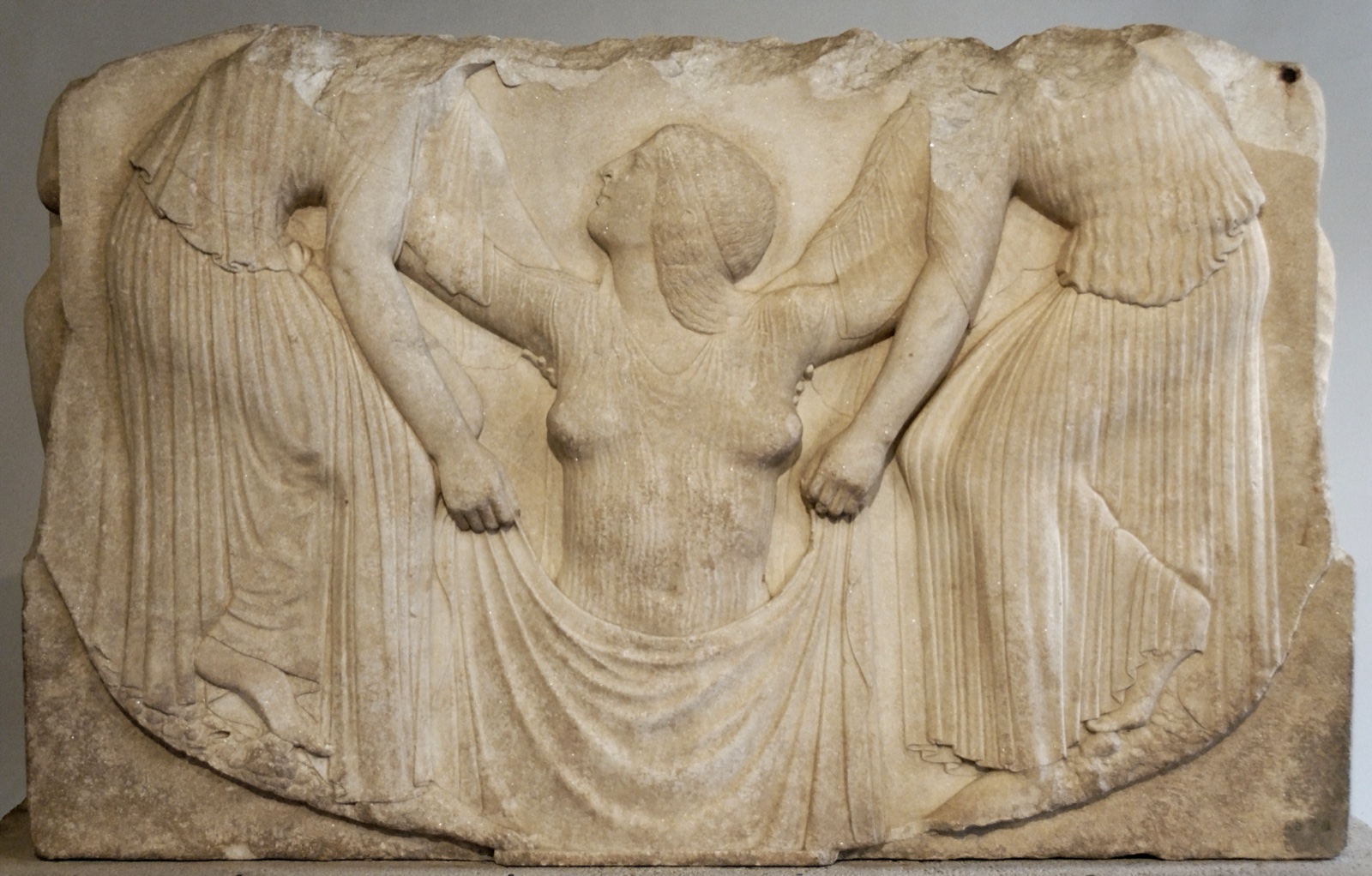
The so-called Ludovisi Throne, main panel: Aphrodite attended by two handmaidens as she rises out of the surf. Thasos marble, Greek work, c. 460 BC (authenticity disputed). Found in 1887 in the Villa Ludovisi. Palazzo Altemps, Rome.
Public domain · Source and licence
Public domain · Source and licence

The Iliad and Post-Iliad
Aphrodite's main role in the Iliad is explained briefly at the end of the story in an oblique way referencing her being chosen and the other goddesses being reviled. Later literature explains the Trojan War's direct outbreak proceeds from that contest she had won: the contest of the Apple of Discord or Judgement of Paris (24.25–30). When not invited to a banquet of the wedding of Peleus and Thetis, the enraged Eris either provokes a quarrel among the goddesses, or in Hyginus account throws a fruit between them, which Lucian further claimed was inscribed "to the fairest one".
The contest is a fulfillment of what Zeus had already ordained with Themis, namely that Greece and Troy would go to war, but as it happens, Hera, Athena and the goddess of love engaged further and further into their dispute, providing the active agent. The goddesses plead to the highest Lord who refused to judge and tasked Hermes with taking them to Mount Ida near Troy where the latter would arbitrate. In any case, the final judgment went to the Trojan prince, Paris.
In Euripides' account, Hera offers the prize of being the magnificent king of Eurasia, while Athena offers glory in battle and command of the Phyrgians. Aphrodite, enhanced with all the graces and perfumes the Charities and Seasons give her, suggests the prize of the most beautiful woman on earth: Helen, the semi-divine wife of Menelaus of Sparta. Because Alexander was rapt by physical beauty like most humans, he chose the prize of Cypris, provoking the Trojans and Greeks to war when Aphrodite uses all her powers to push Helen towards him, and pushing both Hera and Athena to grim retribution towards Troy.
The Iliad itself only mentions the insult paid to Athena and Hera due to the lust of Paris. The direct characterization of Aphrodite begins with her recovering Paris from the battlefield after Menelaus catches him by his chin-strap, dragging him into her mists. She then fetches Helen.
The temperament of the goddess waxes between humorous and light (her Homeric title is φιλομμειδὴς, 'laughter-loving' or 'fond of laughing'), frustrated and at one point, deathly fearsome when Helen desires to disobey her.
The battle commences, and Aphrodite shields her son Aeneas with her body. Diomedes attacks her, wounding her above the wrist. Ichor falls from her, while Apollo catches her son in a dark cloud. She flees to Olympus in distress to be with her mother Dione. Smiling, Zeus gently rebukes her for being involved in the sphere of Ares and Athena, telling her to keep herself to the realm of marriage and the erotic.
To her [Hera] again spoke in answer laughter-loving Aphrodite: “It cannot be, nor is it right, that I should refuse your words; for you sleep in the arms of mightiest Zeus.”
Homer, Iliad, trans. Murray
Aphrodite is later convinced by good grace to hand over her ultimate girdle of persuasion to Hera. When the gods take the field, she again engages to lead Ares off the field, leading Athena to strike them down.
At the end of the Iliad, Aphrodite carefully anoints Hector's body with rose oil, preserving it from the dogs who would consume it and any of the friction of Achilles' chariot.2
The Odyssey introduces the fact that Hephaestus is her true and rightful husband, though he contains many oppositional aspects to her in his creative faculty, and this leads to the infamous episode of the net.
The Homeric Hymn
Love of mortals is the primary theme the first Homeric Hymn to Aphrodite, making it highly unusual. She can subdue humans, birds, animals and the entire natural world with desire, even the divine themselves cannot escape her, with three exceptions: the virgin goddesses Athena, Artemis and Hestia.
τάων οὐ δύναται πεπιθεῖν φρένας οὐδ᾿ ἀπατῆσαι·
τῶν δ᾿ ἄλλων οὔ πέρ τι πεφυγμένον ἔστ᾿ Ἀφροδίτην
οὔτε θεῶν μακάρων οὔτε θνητῶν ἀνθρώπων.
Those are the goddesses whose minds she cannot persuade or outwit. But for the rest, nothing has escaped Aphrodite, either of the blessed gods or of mortal men.
Homeric Hymn to Aphrodite [Hymn #5], trans. West
Ironically, Zeus with his resources more inexhaustible than hers puts desire straight into the heart of the goddess of love herself after he hears her brag of this, and so Aphrodite is made to love Anchises, a herdsman of Mount Ida outside of Troy. When she appears to him, the beauty of her face, her figure and her clothes representing the universe as a microcosm lead Anchises to be filled with desire to be great, proclaiming that whichever of the goddesses are before him, he wishes for a golden lineage that lasts forever, provided he does the necesssary rites.
Aphrodite, realizing his fear of the divine, says she is a mere mortal woman, and they lie together. But when Anchises looks in her eyes, he realizes fully she is a goddess and shudders with fear. The goddess tells him he should have no shame, as the most glorious of mortals has sired a demigod, Aeneas. The stigma is hers; no longer can Aphrodite compel the divine, she fears, after lying with a mortal man, and the secret must never be told to anyone.
νίκην τῶιδε φέρεσθαι, ἐμὴν δ᾿ ἔντυνον ἀοιδήν.
αὐτὰρ ἐγὼ καὶ σεῖο καὶ ἄλλης μνήσομ᾿ ἀοιδῆς.
I salute you, sweet-and-gentle one of curling lashes: grant me victory in this competition, and order my singing. And I will take heed both for you and for other singing.
Second Homeric Hymn to Aphrodite [Hymn #6], trans. West
There are two more Hymns to her. One focuses on the celestial beauty of Aphrodite that charmed even the gods, while the other praises her as ever laughing and smiling. Both hymns, the Sixth and the Tenth in the sequence, end by asking for help in singing.12
The Hesiodic Aphrodite
It is notable that Hesiod explains Aphrodite not as the daughter of Zeus and Dione, but as the byproduct of the castrated member of Ouranos washed at sea, from the foam surrounding it. The foamy residue washed to the shores of Cyprus, where Aphrodite arose from the sea with great fame, grasses all growing beneath her feet as she stepped around the shore and the balmy spray adorned her ankles.1
And when at first he had cut off the genitals with the adamant and thrown them from the land into the strongly surging sea, they were borne along the water for a long time, and a white foam rose up around them from the immortal flesh; and inside this grew a maiden.
Hesiod, Theogony, 188–192
Aphrodite is crowned on Cyprus as its queen. Despite departing from the Iliad's geneaology and also not aligning with other accounts crediting Kythera as where she emerged, Hesiod refers to the episode with Anchises and other themes, meaning her standard definitive story as a goddess had become concrete at this point regardless of her parentage.
Hesiod, instead of committing the Homeric epithet to his description, uses the closely related pun φιλομμηδής (the fond-one of genitals), emphasizing her mastery over all forms of love, generation and intercourse, the one who compels nature and the world to propagate. The foamy aphro- element of her name is linked to seminal fluid itself.
The Orphic Aphrodite
The Orphic Hymn to Aphrodite has numerous codes that relate to her universality as a goddess. At first, the Hymn seems like a summary of her Homeric and Hesiodic characteristics. Οὐρανίη (Ouranie, 'heavenly'), πολύυμνε (Polyhymne, 'many-hymned'), φιλομμειδὴς Ἀφροδίτη (Filoppeides, 'laughter-loving', the Homeric epithet) and ποντογενής (pontogenes, 'seaborn') are all used to describe her in the first lines.
To the keen eye, the placement of the four-fold epithets is layered and very deliberate. The Ourania Aphrodite, as Plato explained, has no link to earthly generation and things like sensual romance; she is heavenly. Polyhymnia describes her creativity in endless forms. Filoppeides, on the other hand, is close to the Hesiodic pun and is, in any event, always tied to the amorous nature of Aphrodite. The seaborn adjective loops her back to the sexless conception of Ourania, but also points to the sea as the origin of all life and generation, tying her together.
Everything comes from you; you have yoked the world,
and you control all three realms. You give birth to all,
to everything in heaven, upon the fruitful earth
and in the depths of the sea
Orphic Hymn to Aphrodite, trans. Athanassakis and Wolkow
Another epithet, ζεύκτειρα (zeukteira), is used, meaning "she who yokes". This had a sexual meaning in Ancient Greek to describe sex, but the way the Orphic Hymn uses this is to point out that Aphrodite yokes matter to spirit, the world to the divine. The mechanisms of the goddess in uniting things go far beyond intercourse or conception.
The most difficult part occurs at the tenth line. Aphrodite is φαινομένη τ' ἀφανής τ' (manifest and unmanifest). Nothing is more obvious or blatant than the earthly things she rules over, but the causes of her magnetism are never seen. Her secrets remain hers. The reasons of love, of union, of the yoke of the universe remain unknown, all of a cause nocturnal, balmy and under the horizon.13
III. The Epithets of Aphrodite
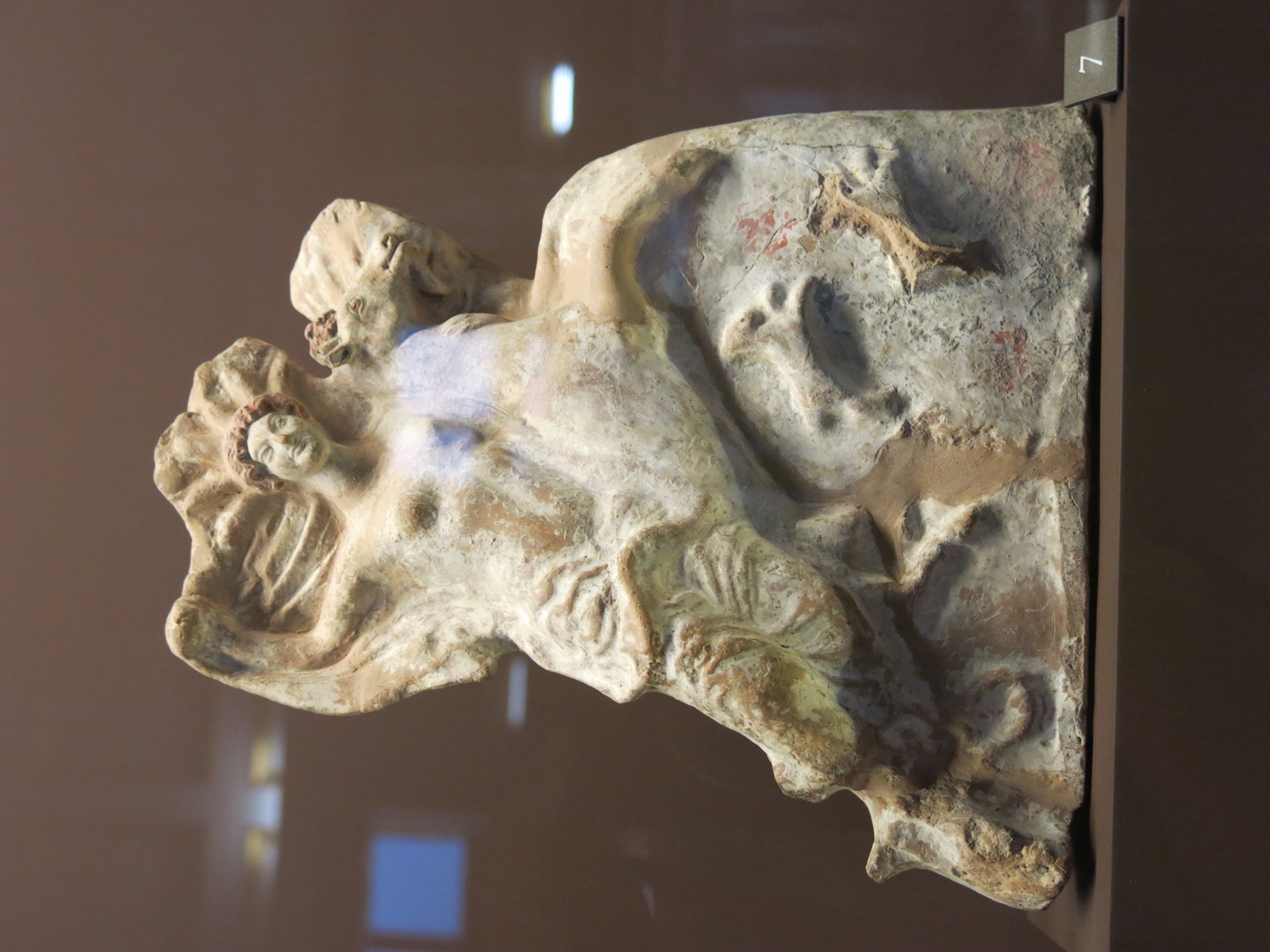
Aphrodite Pandemos ('belonging to the people') or Epitragia ('riding a billy goat'). Boeotian terracotta figurine, c. 350 BC, Boeotia, Greece. Louvre Museum, Paris, CA 1324.
Public domain · Source and licence
Public domain · Source and licence

| Epithet | Meaning | Domain |
|---|---|---|
| Aphrodite Ourania (Ἀφροδίτη Οὐρανία) | The Heavenly | Celestial, sacred union |
| Aphrodite Pandemos (Πάνδημος) | Of the People | Generation, sexuality |
| Aphrodite Apostrophia (Ἀποστροφία) | The Averter | Natural law, limitations |
| Aphrodite Philommeides (Φιλομμειδής) | Laughter-loving | Lightness, union |
| Aphrodite Kythereia (Κυθέρεια) | Of Kythera | The sea-birth's first landfall |
| Aphrodite Kypris (Κύπρις) | The Cyprian | Cyprus, her ancient seat |
| Aphrodite Areia (Ἀρεία) | The Warlike | The armed goddess |
| Aphrodite Melainis (Μελαινίς) | The Black | Secrecy, the night |
| Aphrodite Morpho (Μορφώ) | The Fair-Shaped | The veiled, fettered goddess of Sparta |
| Aphrodite Euploia (Εὔπλοια) | Of Fair Voyage | Seafaring, pleasant conditions |
| Aphrodite Hetaira (Ἑταίρα) | The Companion | Patroness of companions and courtesans |
| Aphrodite Chryse (Χρυσῆ) | The Golden | Divine beauty |
| Aphrodite Aphrogeneia (Ἀφρογένεια) | Foam-born | Generation, mystery |
| Aphrodite en Kepois (ἐν κήποις) | of the Gardens | Generation, growth and beauty |
| Aphrodite Anadyomene (Ἀναδυομένη) | Rising from the Sea | Heaven and earth |
| Aphrodite Genetyllis (Γενετυλλίς) | Protector of Births | Generation, motherhood |
| Aphrodite Paphia (Παφία) | Of Paphos | Ancient altar, stone |
| Aphrodite Knidia (Κνιδία) | Of Knidos | The cult of Praxiteles' famed statue |
| Aphrodite Zeukteira (ζεύκτειρα) | She who Yokes | Mating, union of universe |
| Aphrodite Automata (Ἀὐτόμᾰτᾰ) | Self-Generating | Sea birth, mystery of love |
Sources: Hesiod, Theogony; Homer, Iliad, trans. Murray; Homer, Odyssey, trans. Murray; erodotus, Histories, trans. Godley; Pausanias, Description of Greece, trans. Jones; HPlato, Symposium, trans. Lamb; Thucydides, History of the Peloponnesian War, trans. Smith; Theocritus, Idylls, trans. Hopkinson; Athenaeus, Deipnosophistae, trans. Gulick; Pliny, Natural History, trans. Rackham; Farnell, The Cults of the Greek States, 1896; Burkert, Greek Religion, 1985; Pirenne-Delforge, L'Aphrodite grecque, 1994; Smith, Dictionary of Greek and Roman Biography and Mythology, 1873.1,2,6,7,14,15,16,17,18,19,20,21,22,23
IV. The Temples and Sacred Sites of Aphrodite
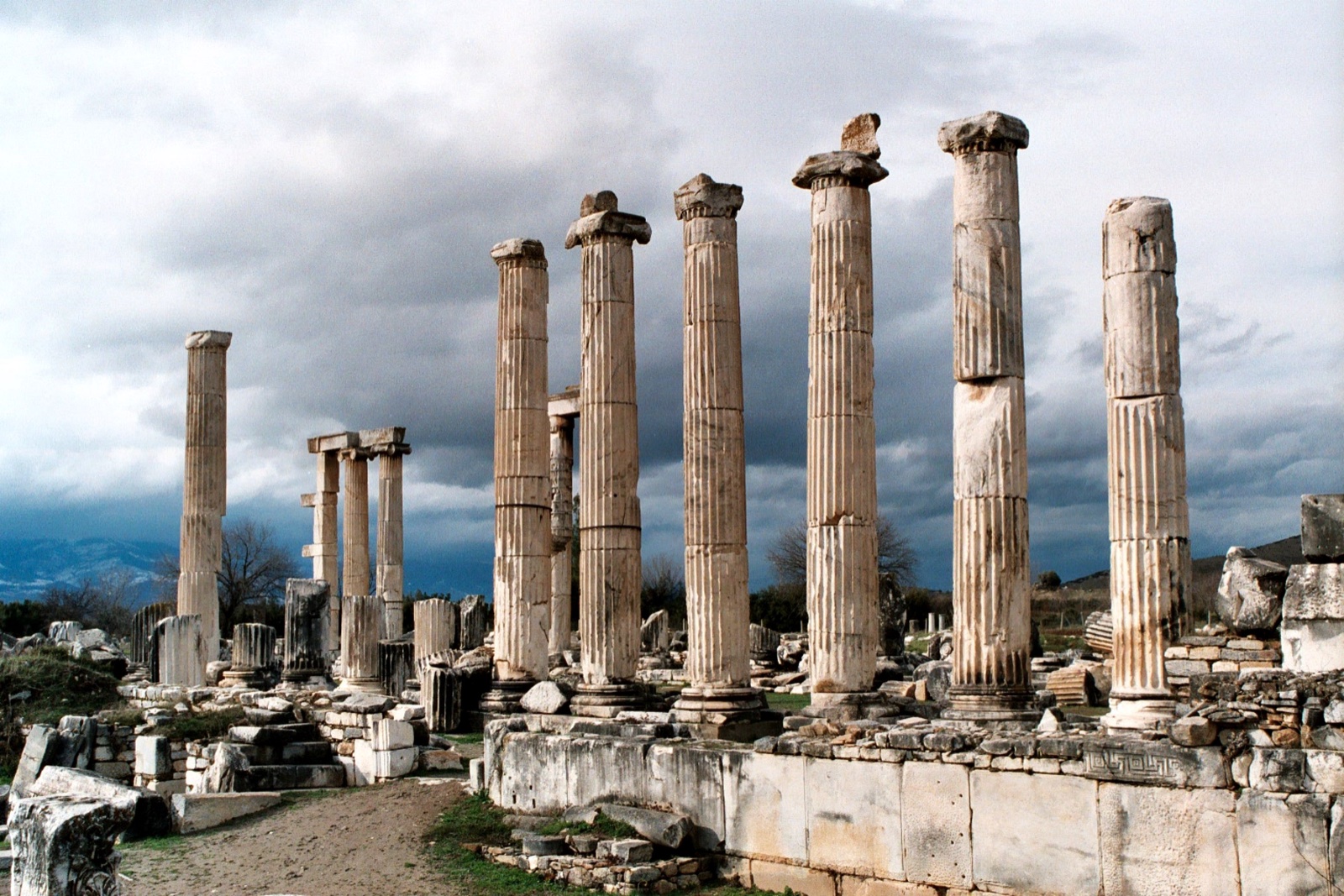
Aphrodisias, the Temple of Aphrodite.
Photo: Dguendel, CC BY 3.0 · Source and licence
Photo: Dguendel, CC BY 3.0 · Source and licence

Cyprus
Palaipaphos (Old Paphos) was the site most sacred to Aphrodite on Cyprus. The sanctuary, that both by archeological evidence and classical allusion dated back to the eleventh century BCE, originally celebrated the Wanassa, the primeval goddess that evolved into Aphrodite. Cypris (of Cyprus) was one of Aphrodite's most famous epithets, because according to Hesiod she emerged there.
Due to its antiquity and native Cypriot origin stemming from the Greeks who created a Kingdom of Paphos after the Trojan War, Old Paphos was highly unlike other Greek temples, a model that was maintained even when the Romans rebuilt it in the 1st century CE. Its layout was of legendary import: Homer himself mentions its open altar in the Odyssey, confirming findings from archeology that date it back to an arcane point in the mists of time.5,24,25,28
The site was highly important to the priest-kings of Cyprus. When Paphos moved to the nearby port of Nea Paphos (New Paphos) by king Nicocles in the fourth century BCE, the site itself was not moved an inch by sacred decree. Sacred pilgrimages of men and women would emerge from the new city to walk 11km to the old site.25
simulacrum deae non effigie humana ... metae modo exurgens.
The image of the goddess is not in human form ... but rises in the manner of a cone. Tacitus, Histories
Aphrodite's official sacred image at the sanctuary of Old Paphos was a conical greenish stone, otherwise known as a baetyl. This holy stone was held to be as ancient as the site. Other sacred images of a human Aphrodite existed in copious amounts, but the stone due to its proportion and geometric symbolism was considered to be the holiest representation of her essence.26,27
Amathous on Cyprus was another important cult center to Aphrodite which dated back to the eighth century BCE. The sanctuary was built on the city's acropolis. Unlike its sibling, a large Hellenistic and then Roman-style temple was constructed.28
Acrocorinth
Being the most important site to her on mainland Greece, the summit of the Acropolis of Corinth was dedicated to Aphrodite. Strabo described the environment before the sack of the kingdom and Old Corinth by Rome as being one of the most illustrious in Greece, with 1,000 women consecrated to the goddess. The temple itself, however, was small and modest, at maximum measuring 10 x 6 meters.
ἀνελθοῦσι δὲ ἐς τὸν Ἀκροκόρινθον ναός ἐστιν Ἀφροδίτης·
ἀγάλματα δὲ αὐτή τε ὡπλισμένη καὶ Ἥλιος καὶ Ἔρως ἔχων τόξον.
On ascending Acrocorinth there is a temple of Aphrodite.
The images are Aphrodite herself armed, Helios, and Eros holding a bow.
Pausanias, Description of Greece
Writers beyond Strabo like Pausanias mention that the most pivotal sight was a statue of an armed Aphrodite carrying a shield, probably the shield of Ares from the Iliad. The synchronicity between the great goddesses and other goddesses described on this page seems to have been important for Corinth. She was also flanked by her son, Eros, and the sun god who founded Corinth, Helios.14,29,30,31
The Upper Peirene spring lay behind the temple, and here Aphrodite's tie to Athena, the other great goddess of Corinth, was seemingly emphasized.32
Kythera
Not much is known about Kythera's temple, but the Aegean island gave Aphrodite her most enduring epithet in literature, Cytharaea, because she first went toward it. Herodotus maintained that Kythira was expressly important because the cult of Aphrodite Ourania had been brought from the Phoenician city of Ascalon to the site in ancient times. The sea-snail that produced the luxurious purple dyes of Tyre was also found on the island, though archeological evidence shows their production from 1750BCE long before Tyrian dominance.
The temple to Aphrodite Ourania was probably on its acropolis, the Palaeocastron. The maritime nature of the island played deeply on the sea-borne character of the goddess as it formed an important link between the mainland and Crete.
The epithet became synonymous with the goddess, extending far beyond its original context. For many centuries, Cytharaean was used as a euphemism for the things of the planet Venus, as the adjective venereal developed a negative connotation increasingly tied to disease and sin in some European languages, including English.6,33,34,35,36
Miletus
Miletus in Asia Minor, the wealthiest city of pre-Alexandrian and pre-Roman Antiquity, formed a maritime cult that placed a high emphasis on the nature of the goddess. A hill outside the city, now known as Zeytintepe, shows a high level of devotional worship and large scale archeological findings.37,38
Other Major Sites
There were numerous other temples to Aphrodite of great importance, including at the site of Naukratis in Egypt, where as stated above the first attestation of her name is found. The city of Aphrodisias in Asia Minor developed around the sanctuary of a local Carian goddess who became identified with Aphrodite.39
X. Love
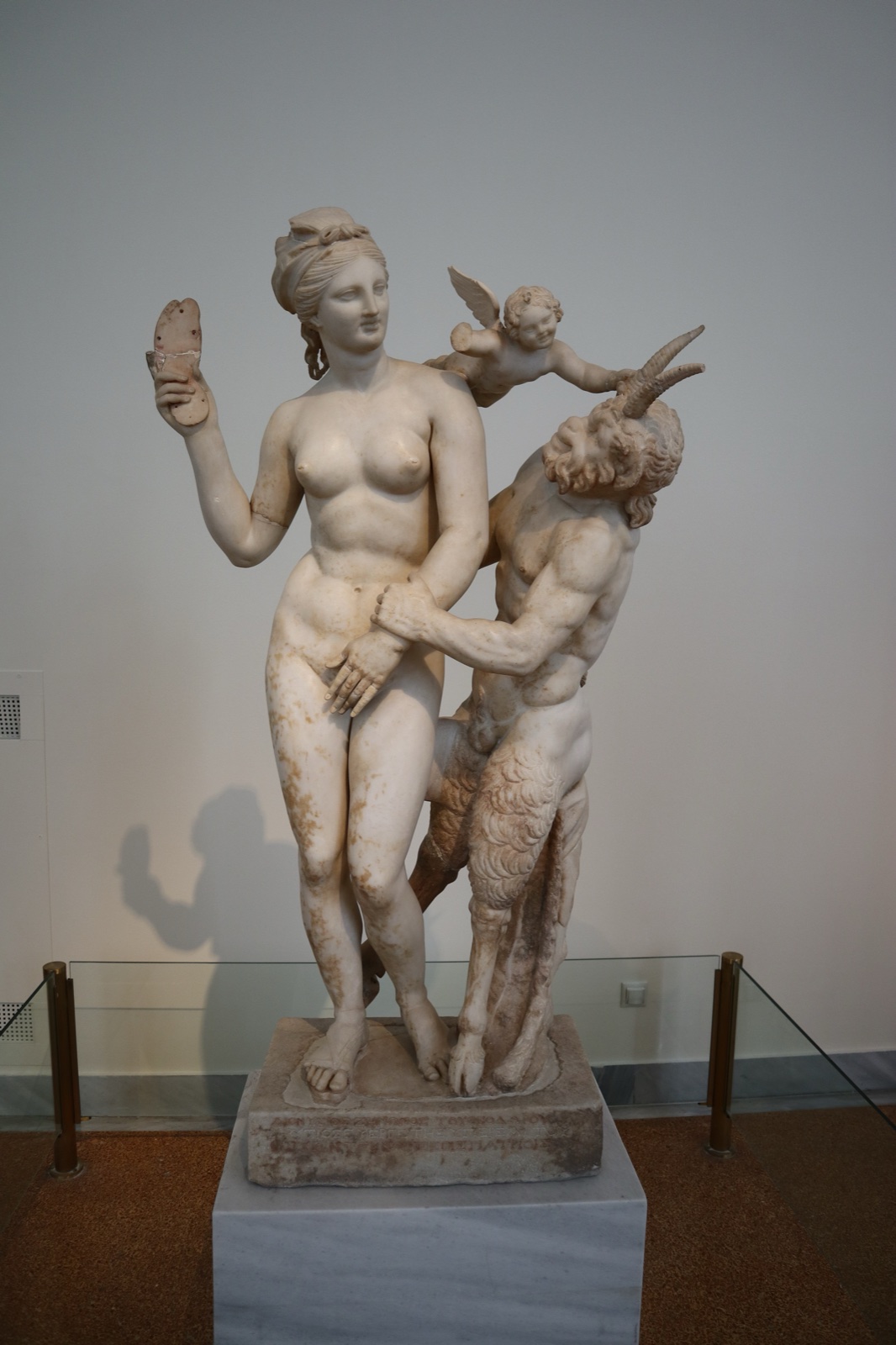
Marble group of Aphrodite with Pan and Eros, about 100 BC. Eros grasps Pan's horn while Aphrodite raises her sandal to fend him off. From Delos, House of the Poseidoniasts of Beirut. National Archaeological Museum, Athens, inv. 3335.
Public domain (CC0) · Source and licence
Public domain (CC0) · Source and licence

Aphrodite is often a misunderstood goddess. Some philosophers in Antiquity despaired of her erotic realm. Her role in the Iliad sparks the war and, for example, she gets involved in things she has no remit to do. Her philosophical functions are complicated because she had two aspects.40, 41
Plato separates Aphrodite into two: Ourania, the seaborn, and Pandemos, daughter of Zeus and Dione. Numerous philosophers speculated on Ourania's characteristics. The Platonist interpretation makes Ourania the child of the sea foam, the one who rises beauty to its ultimate form, the power that lifts ugliness into beauty and points towards the love of the philosophers, separating from earthly generation.41, 42
Pandemos Aphrodite and the many powers beneath her rules the lower rank of generation and becoming. She keeps the world fertile, generating, existing, sensible, peaceful and yet warring through union of different things; her love is rooted in material and sensual impulse, but it is still necessary.41
In regards to nature, both forms ultimately unite in the sense of binding together (sundein, sunagein): she is the connective power that joins distinct and opposed things into communion on different levels. Her love reconciles contrary essences and presides over blending (krasis), pairing, marriage, and the generative mixture of the world, including on the lower levels male and female, angry and calm, watery and fiery. Unlike Apollo, the point of her unity is to reconcile opposites, not to make multiple things one. Ourania does so on a higher level.41, 43
The binding of Paris and Helen paradoxically causes war, the ultimate separation. Even in the Trojan story, the goddess presides over uniting things of absolute necessity to keep the world turning, for Proclus bringing the weaker term into harmony with the stronger and aggressive force, which is why she is associated with peace. Her desire to save and preserve, along with her pity, is still shown: she tries to save Paris and Aeneas by engaging in an alien activity (war), she anoints Hector's body with the balm of the delicate rose, she attempts to shield Troy from the worst disasters, and cares for Ares.40, 41
Beauty is one of the things that yokes, and it is Helen who represents that. Part of Aphrodite's necessity is to lead mortals downward and upward. Paris chooses the aspect of Beauty that is moored in the bodily, generative existence.41, 44
For Proclus, the image of Helen is warred over by the rational Greeks and irrational Trojans. What is made of her is not due to the dual nature of Aphrodite but due to what each side epitomizes and makes of her. An oppositional tradition emerged about Helen from Stesichorus, down to Plato who comments on this as a possibility, and then Euripides. For them, the phantom of Helen was fought over at Troy, while the true Helen was kept in Egypt.41, 44, 45, 46, 47, 48
Proclus also explained that her marriage and the affair of the net with Hephaestus shows how Aphrodite's powers participate on a different level, the hypercosmic one, than with those of Ares, which is situated lower. Hephaestus also mitigates the opposition and tension between the two by catching them in the net.
A third type of Aphrodite emerged in Thebes and possibly Megalopolis, the Apostrophia. This type was a moral form to turn away evil, warning of desire's limitations in regard to relatives, the helpless and other forbidden zones. But its faint philosophical relation lies in her epithet Epistrophia.
As far as the Zevist is concerned, all of the above means Aphrodite produces the conditions in the soul to unite what is opposite on an occult level, like making the two Chakras of different essences work together. This is in many ways the first step on the ladder to ascent. She also unites the occult soul with what is biological and material; the symbolism of Demeter, Artemis and the other goddesses tie into this, as is explained above.
XI. Festivals of Aphrodite
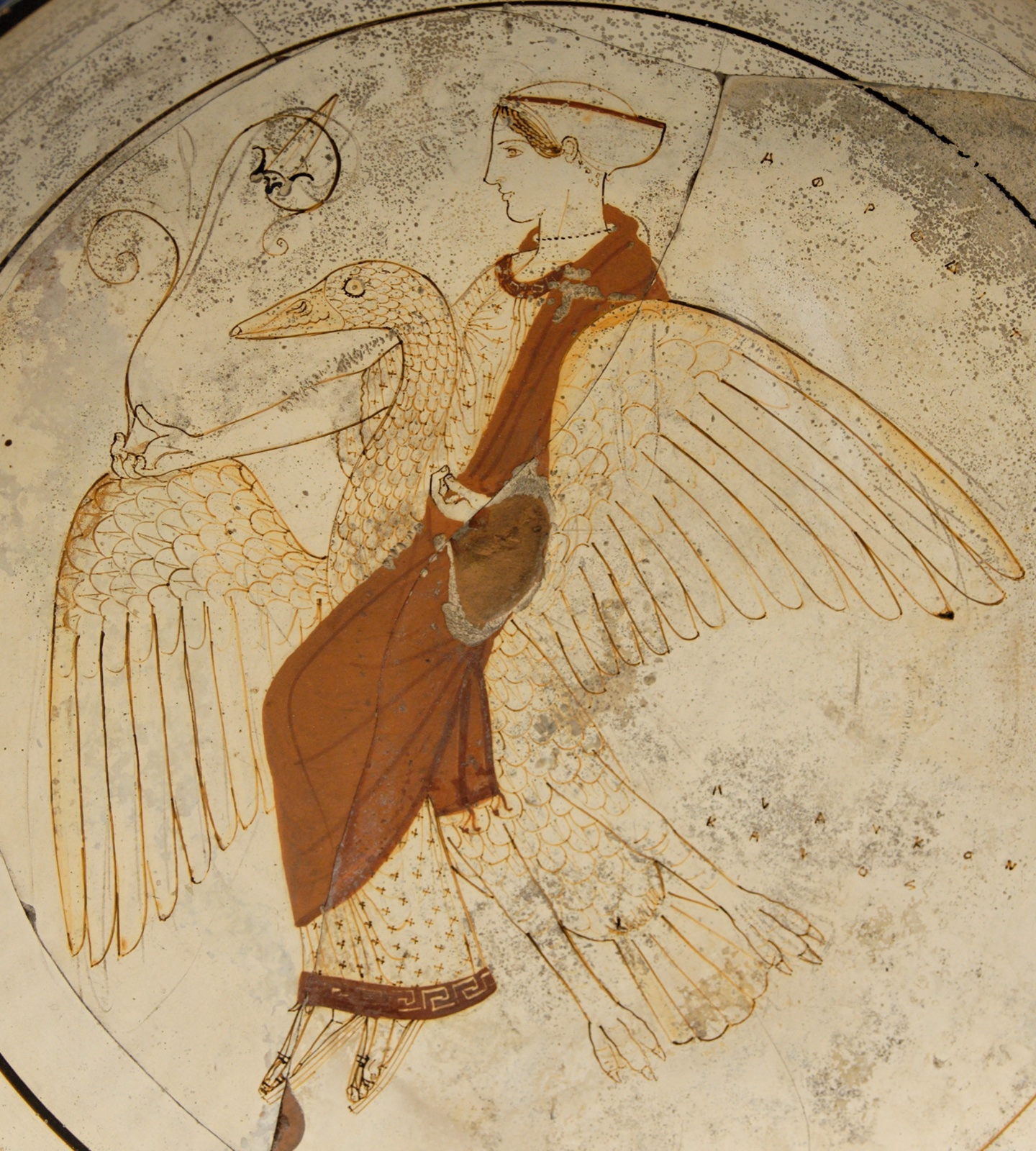
Aphrodite on a swan. Tondo of an Attic white-ground red-figure kylix attributed to the Pistoxenos Painter, c. 460 BC, from tomb F43 at Kameiros, Rhodes. British Museum GR 1869.10-7.77 (Cat. Vases D 2).
Photo: Marie-Lan Nguyen, CC BY 2.5 · Source and licence
Photo: Marie-Lan Nguyen, CC BY 2.5 · Source and licence

| Aphrodite Ritual Days | Place | Description | Importance | Date Recorded |
|---|---|---|---|---|
| Aphrodisia at Paphos | Paphos, Cyprus | Feast of the Paphian goddess | Pilgrimage procession, aniconic stone, bloodless altars | Strabo (early 1st century CE) |
| Aphrodite Pandemos | Athens | Aphrodite of All the People | Temple purified with a dove, statues washed, procession | Pausanias (2nd century CE) |
| Anagogia & Katagogia | Eryx, Sicily | Departure and return of the goddess | Sacred doves fly to Libya nine days, then return | Aelian (early 3rd century CE) |
| Acrocorinth | Corinth | Aphrodite of the hetairai | Public supplication, temple servants | Strabo (early 1st century CE) |
| Aphrodite Ourania | Cythera | The Heavenly; oldest Greek sanctuary | Armed cult image, Phoenician-derived rite | Herodotus (5th century BCE) |
| Aphrodisia at Aphrodisias | Aphrodisias, Caria | Festival of the Carian sanctuary | Sacred games, civic honors | Inscriptions (2nd–3rd century CE) |
| Adonia | Athens & Alexandria | Mourning of Adonis | Gardens of Adonis, rooftop laments, night revelry | Theocritus (3rd century BCE) |
Sources: Theocritus, Idylls (2015); Strabo, Geography (1927–1929); Pausanias, Description of Greece (1918); Aelian, Historical Miscellany (1997); Herodotus, Histories (1920); Reynolds, Aphrodisias and Rome (1982).51,52,53,54,55,56
Sources and Bibliography
- Hesiod. Theogony. 188–206, names 195–200 (Aphrogeneia and Kythereia, the birth from the foam; Philommeides). Trans. Hugh G. Evelyn-White (adapted). Loeb Classical Library, 1914.
- Homer. Iliad. 3.64 (Chryse, the golden); 3.424 (Philommeides, laughter-loving); 5.330 (Kypris, the Cyprian). Trans. Murray, A.T. & Wyatt, William F. Cambridge, MA, Harvard University Press, 1999.
- Plato. Cratylus. In Plato: Cratylus, Parmenides, Greater Hippias, Lesser Hippias. Greek text. Loeb Classical Library 167. Cambridge, MA: Harvard University Press, 1926. Section cited: 406c, on Aphrodite and Hesiodic continuity.
- Liddell, Henry George, Robert Scott, Henry Stuart Jones, and Roderick McKenzie. A Greek-English Lexicon. 9th ed., with revised supplement. Oxford: Clarendon Press, 1996. S.v. “Ἀφροδίτη.”
- van Beek, Lucien. The Reflexes of Syllabic Liquids in Ancient Greek: Linguistic Prehistory of the Greek Dialects and Homeric Kunstsprache. Leiden: Brill, 2022, especially chap. 7, §7.2.8, “Ἀφροδίτη,” 291–354. Van Beek discusses *-dītā- ~ *dih₂-, the Homeric evidence, competing Indo-European and Semitic explanations, and tentatively reconstructs *Aphr̥-dītā.
- Homer. Odyssey. 8.288 (Kythereia); 8.362–363 (Paphia, her precinct at Paphos). Trans. A.T. Murray. Loeb Classical Library, 1919.
- Herodotus, Histories 1.105 2-3. ed. C. Hude, Oxford Classical Texts, 3rd ed., 1927; trans. A.D. Godley, Loeb Classical Library, 1920
- Plato. Epinomis. In Plato, Volume XII: Charmides, Alcibiades I and II, Hipparchus, The Lovers, Theages, Minos, Epinomis.
- Egetmeyer, Markus. Le dialecte grec ancien de Chypre. 2 vols. Berlin and New York: Walter de Gruyter, 2010, on wanasa and aporotaoi.
- Budin, Stephanie L. A Reconsideration of the Aphrodite-Ashtart Syncretism. Numen 51, no. 2 (2004): 95–145.
- Lemos, Anna A. Archaic Pottery of Chios: The Decorated Styles. Oxford Monographs on Classical Archaeology. Oxford: Clarendon Press, 1991, 73–74, 243, no. 252.
- Homeric Hymn to Aphrodite, #5, #6 and #10. Trans. M.L. West. Loeb Classical Library, 2003.
- Orpheus. “Hymn 55: to Aphrodite.” In The Orphic Hymns, translated by Apostolos N. Athanassakis and Benjamin M. Wolkow. Baltimore: Johns Hopkins University Press, 2013.
- Pausanias. Description of Greece. 1.1.3 (Euploia and Knidia, Knidos); 1.14.7 (Ourania, the oldest at Athens); 1.22.3 (Pandemos, Athens); 2.2.4 (Melainis, Corinth); 3.15.11 (Morpho, Sparta); 3.17.5 (Areia, Sparta); 8.53.7 (Paphia); 9.16.3 (Apostrophia, Thebes). Trans. W.H.S. Jones. Loeb Classical Library, 1918.
- Plato. Symposium. 180d–181c (Ourania and Pandemos, the two loves). Trans. W.R.M. Lamb. Loeb Classical Library, 1925.
- Thucydides. History of the Peloponnesian War. 6.46.3 (the treasures of Aphrodite at Eryx, Erykine). Trans. C.F. Smith. Loeb Classical Library, 1921.
- Theocritus. Idylls. 15.100 (Golgi and Idalium, the Cypriot cult-seats). Trans. Neil Hopkinson. Loeb Classical Library, 2015.
- Athenaeus. Deipnosophistae. 13.571c (Aphrodite Hetaira). Trans. Charles Burton Gulick. Loeb Classical Library, 1937.
- Pliny the Elder. Natural History. 35.91 (the Anadyomene of Apelles); 36.20 (the Knidian Aphrodite of Praxiteles). Trans. H. Rackham. Loeb Classical Library, 1952–1962.
- Farnell, Lewis Richard. The Cults of the Greek States. Vol. 2. Clarendon Press, 1896.
- Burkert, Walter. Greek Religion. Trans. John Raffan. Harvard University Press, 1985.
- Pirenne-Delforge, Vinciane. L'Aphrodite grecque. Kernos Supplément 4. Centre International d'Étude de la Religion Grecque Antique, 1994.
- Smith, William, ed. Dictionary of Greek and Roman Biography and Mythology. 3 vols. John Murray, 1844–1849.
- Iacovou, Maria. Palaepaphos: Unlocking the Landscape Context of the Sanctuary of the Cypriot Goddess. Open Archaeology 5, no. 1 (2019): 204–34. https://doi.org/10.1515/opar-2019-0015
- Mayer, Franz Georg. Priest Kings in Cyprus. In Early Society in Cyprus, edited by Edgar Peltenburg, 376–391. Edinburgh: Edinburgh University Press, 1989.
- Tacitus. Histories. Translated by Clifford H. Moore. Loeb Classical Library. Cambridge, MA: Harvard University Press, 1925.
- Maier, Franz Georg, and Vassos Karageorghis. Paphos: History and Archaeology. Nicosia: A. G. Leventis Foundation, 1984.
- Karageorghis, Jacqueline. Kypris: The Aphrodite of Cyprus: Ancient Sources and Archaeological Evidence. Nicosia: A. G. Leventis Foundation, 2005.
- Strabo. Geography, 8.6.20, 14.6.3. (Corinth; Paphos) Translated by Horace Leonard Jones. Loeb Classical Library 196, 223. Cambridge, MA: Harvard University Press, 1927–1929.
- Blegen, Carl W., Richard Stillwell, Oscar Broneer, and Alfred Raymond Bellinger. Acrocorinth: Excavations in 1926. Corinth 3.1. Cambridge, MA: Harvard University Press for the American School of Classical Studies at Athens, 1930.
- Williams, Charles K., II. Corinth and the Cult of Aphrodite. In Corinthiaca: Studies in Honor of Darrell A. Amyx, edited by Mario A. Del Chiaro and William R. Biers, 12–24. Columbia: University of Missouri Press, 1986.
- Lee L. Brice and Angela Ziskowski, Athena, Peirene and Pegasi: Myth and Identity in Corinthian Numismatics, Numismatic Chronicle 181 (2021): 1–16, esp. 8–10.
- Coldstream, J. N., and G. L. Huxley, eds. Kythera: Excavations and Studies Conducted by the University of Pennsylvania Museum and the British School at Athens. London: Faber and Faber, 1972.
- Robert R. Stieglitz, The Minoan Origin of Tyrian Purple, Biblical Archaeologist 57, no. 1 (1994): 46–54, esp. 49–51.
- Agnes M. Clerke, A Popular History of Astronomy during the Nineteenth Century, 4th ed. (London: Adam and Charles Black, 1902), 314; see also Chambers’s Twentieth Century Dictionary, s.v. “Cytherean,” which defines the adjective simply as “pertaining to Venus.”
- Lewis D. Kaplan, “Development of the Atmosphere of Venus,” Icarus 9 (1968): 221–230, esp. 221, using “Cytherean atmosphere”; Jukka Nikander and Charles Boyer, “Displacement of the Clouds of Venus,” Nature 227 (1970): 477
- Greaves, Alan M. The Cult of Aphrodite in Miletos and Its Colonies. Anatolian Studies 54 (2004): 27–33.
- Panteleon, Ioannis A., and Reinhard Senff. Die Grabung im Aphroditeheiligtum auf dem Zeytintepe bei Milet in den Jahren 2003–2005. Archäologischer Anzeiger 2008, no. 2 (2008): 33–46. https://doi.org/10.34780/7fpv-8va6.
- Brody, Lisa R. The Aphrodite of Aphrodisias. Aphrodisias III. Mainz: Philipp von Zabern, 2007. See also: “The Cult of Aphrodite at Aphrodisias in Caria.” Kernos 14 (2001): 93–109. https://doi.org/10.4000/kernos.772.
- Homer. The Iliad. Translated by A. T. Murray. Revised by William F. Wyatt. 2 vols. Loeb Classical Library 170–171. Cambridge, MA: Harvard University Press, 1999.
- Lankila, Tuomo. "Aphrodite in Proclus' Theology." Journal for Late Antique Religion and Culture 3 (2009): 21–43. https://doi.org/10.18573/j.2009.10299.
- Plato. Lysis. Symposium. Gorgias. Translated by W. R. M. Lamb. Loeb Classical Library 166. Cambridge, MA: Harvard University Press, 1925.
- Duvick, Brian, trans. Proclus: On Plato Cratylus. Ancient Commentators on Aristotle. London: Duckworth, 2007. Reprint, London: Bloomsbury Academic, 2014.
- Baltzly, Dirk, John F. Finamore, and Graeme Miles, eds. and trans. Proclus: Commentary on Plato's Republic. Vol. 1, Essays 1–6. Cambridge: Cambridge University Press, 2018.
- Plato. Euthyphro. Apology. Crito. Phaedo. Phaedrus. Translated by Harold North Fowler. Loeb Classical Library 36. Cambridge, MA: Harvard University Press, 1914.
- Euripides. Helen. In The Complete Greek Drama, edited by Whitney J. Oates and Eugene O'Neill Jr., translated by E. P. Coleridge. New York: Random House, 1938.
- Plato. Republic. Translated by Paul Shorey. 2 vols. Loeb Classical Library 237 and 276. Cambridge, MA: Harvard University Press, 1930–1935.
- Herodotus. The Persian Wars. Translated by A. D. Godley. Loeb Classical Library. Cambridge, MA: Harvard University Press, 1920–1925.
- Pausanias. Description of Greece. Translated by W. H. S. Jones and H. A. Ormerod. Loeb Classical Library. Cambridge, MA: Harvard University Press, 1918–1935.
- Berg, Robbert M. van den. Proclus' Hymns: Essays, Translations, Commentary. Philosophia Antiqua 90. Leiden: Brill, 2001.
- Theocritus. Idylls, 15. (Adonia) Edited and translated by Neil Hopkinson. Loeb Classical Library 28. Cambridge, MA: Harvard University Press, 2015.
- Strabo. Geography, 8.6.20, 14.6.3. (Corinth; Paphos) Translated by Horace Leonard Jones. Loeb Classical Library 196, 223. Cambridge, MA: Harvard University Press, 1927–1929.
- Pausanias. Description of Greece, 1.22.3. (Aphrodite Pandemos) Translated by W. H. S. Jones. Loeb Classical Library 93. Cambridge, MA: Harvard University Press, 1918.
- Aelian. Historical Miscellany, 1.15. (Eryx) Translated by Nigel G. Wilson. Loeb Classical Library 486. Cambridge, MA: Harvard University Press, 1997.
- Herodotus. Histories, 1.105. (Cythera) Translated by A. D. Godley. Loeb Classical Library 117. Cambridge, MA: Harvard University Press, 1920.
- Reynolds, Joyce, ed. Aphrodisias and Rome: Documents from the Excavation of the Theatre at Aphrodisias Conducted by Professor Kenan T. Erim, Together with Some Related Texts. Journal of Roman Studies Monographs 1. London: Society for the Promotion of Roman Studies, 1982. Section cited: the festival and agonistic inscriptions of the Carian Aphrodisia.