













| Language / Culture | Name of Inanna | Attestation |
|---|---|---|
| Sumerian | 𒀭𒈹 (Inanna) | Uruk IV Cuneiform CDLI P001238 (c. 3350-3200BCE) |
| Akkadian | 𒀭𒈹 (Ashtar) | Prisoner Plaque P453401 (c. 2500-2350 BCE) |
38 min read
INANNA
author: High Priest Zevios Metathronos
co-author: Novice Priest Karnonnos
Hieratic Information about Inanna
| Divine Names | |
|---|---|
| |
| These hieratic names carry strong spiritual resonance and are recommended for summoning and invocation practices. | |
| Divine Symbols | |
| |
| Divine Numbers and Attributes | |
| Sacred Numbers | 40, 50, 60 |
| Runes | Thurisaz, Tiwaz, Sowilo (in order of importance) |
| Zodiac Sign of Power | Aries |
| Sacred Animals | The Great Eagle, the Bull, the Hawk, the Serpent |
| Element | Fire, Aether |
| Divine Forces | |
| |
| Important Titles | |
| |
| Names Across Civilizations | |
| Sumerian | Inanna (𒀭𒈹) |
| Akkadian | Ishtar (𒀭𒈹) |
I. The Name of Inanna
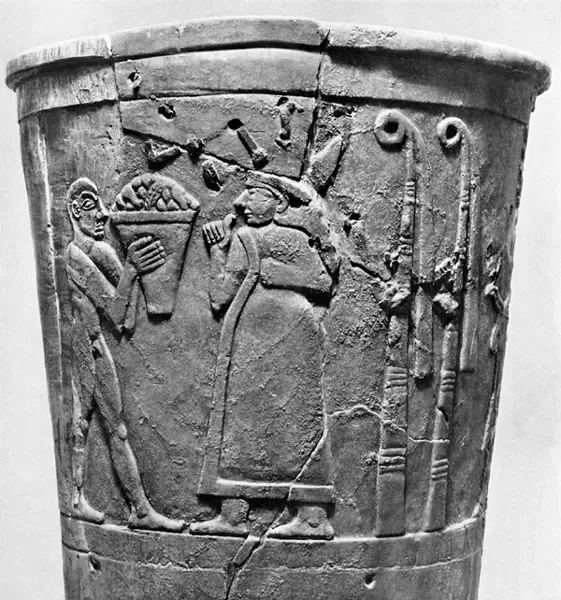
The Warka Vase, Uruk, the procession of offerings to Inanna
Inanna is the oldest known deity ever documented, with the first mention of her going all the way back to 3350-3200BCE in the cuneiform of Uruk IV. Scholars interpret the AN.MUŠ₃ → later ᵈINANA as conclusive evidence for her existence in these materials. A minority viewpoint interprets this as the moon god Nanna, but the consistency of AN.MUŠ₃ in slightly later materials and the fact Uruk was her city points to Inanna, opposed to the similarly ancient URI₃ sign that seems to demonstrate the presence of Nanna.1,2,3
Herodotus claimed the Mesopotamians were the first to worship the goddess, with the Cypriots and then Phoenicians coming after. The Akkadian form, Ashtar or Ishtar, appears to originate in the Prisoner Plaque (P453401) as mar:Aš-dar from 2900-2700BCE where it is used as a toponym. An inscribed seal at Kish two centuries later is more certain as her name unquestionably occurs in a divine naming formula on the Seal IM 2514 at Palace A.4,5,6
The most widely accepted modern etymology of Inanna is Sumerian: NIN “lady, mistress” + AN “heaven, sky” + -AK genitive, meaning Lady of Heaven. That name would seem to correlate with the title of perhaps all the goddesses in adjacent cultures equivalent to her. However, Inanna was never written with the NIN-AN-AK signs, only the MUŠ₃ logogram (𒈹), which poses a difficulty in understanding how it could have come about. Selz cites an Old Sumerian votive inscription from Lagash regardless in which the goddess appears as NIN-AN-A, supporting the general hypothesis.1,7,8
Unlike the isolated Sumerian, Akkadian is an eastern Semitic language; her name in it came later. The etymological meaning of Ishtar is unknown, but it is connected to the same Semitic root as *Attar, Attart, Ashtart (Ἀστάρτη, Astarte) and many other subsequent goddesses in Western Semitic languages. Manfred Krebernik proposed *'tr (to be rich, abundant). In Semitic languages from Ethiopia such as Ge'ez (astar), Tigritic (astär) and Amharic (astär), the root means star, something that is hypothesized to have died out in other Semitic languages. Her name is also probably connected to ʿaṯtarī (irrigated land), particularly as her southern Arabian counterpart 'Attar was associated with rainfall and fertile land.6,7,9
Ishtar's name is highly unusual in Semitic languages for not possessing a final -t to indicate a feminine deity. It may be connected to Egyptian Rushat or Aset, the name of Isis. Some scholars propose a link with Proto-Indo-European *ster (star).6
The deity Ishara among the Hurrians is similar, but the two are represented as separate deities, though theophoric names like Ishara-ki-Ishtar (Ishara is like Ishtar) and an association with the western Semitic Ashtart show their considerable overlap.10
Sources: Selz, The Uruk Phenomenon, 2020; Englund, Archaic Administrative Texts from Uruk, 1994; Cuneiform Digital Library Initiative (P453401); Roberts, The Earliest Semitic Pantheon, 1972; Heffron, Inana/Ištar (goddess) (Oracc), 2019.1,2,5,6,7
II. Inanna of Mesopotamia
The Earliest Myths
Around 2600BCE, the first myth of Inanna appeared. Inanna and Ama’ushumgal, also known as SF31, is a story about a cyclical journey in the netherworld involving her and her lover. Jana Matuszak, reviewing the earliest Sumerian evidence, consequently described SF 31 as the earliest attestation of the motif by which the deity disappears into the netherworld and subsequently returns. From the beginning, Inanna is defined by the element of descent and romance.11,12,13
Other fragments appear to show the relationship. NTSŠ 82 apparently reflects their romantic relationship, while SF 31 apparently concerns the periodic abduction and return of Ama’ushumgal. Another fragment called Inanna SF 78 may preserve a tradition in which Ama’ushumgal is “looking at all the women,” after which Enlil imposes a disastrous fate upon him.14,15
The Core Inanna Myths of the Sumerian Cycle
In the Sargonic period (c. 24th–23rd century BCE), a tutelary tablet for students often called "the Places of Inanna", probably from the city of Umma, was in circulation. This school exercise lists places at which specific mythological events involving Inanna occurred. The tablet indicates that a much larger corpus of her mythology was extant than what we know of, showing her supreme primacy as a goddess at the time.12,16
During the rise of Sargon and his successors, the syncretization of Inanna and Ishtar into a singular deity probably occurred. Inanna continued to have specific myths written in Sumerian. The most famous is Inanna and Enki, where Inanna takes the me of the drunken great god after visiting his palace and bestows it to Uruk. The Shu-Kale-Tuda story shows her dark side: he violates her when she sleeps, making her pelt the entire land with catastrophic events until he is punished.17,18,19
The Gudam story is a story where Inanna shows her ability to relegate appropriate roles. The eponymous antihero violently rages, destroying large parts of Uruk, until a fisherman dedicated to the goddess stops him. While Inanna is angry at her city being defiled, she is pleased enough by her follower to show Gudam mercy and a place outside the confines of society.17,20
Anu is the original owner of her great temple, the Eana. Inanna, however, rapaciously swears to conquer it for herself, which she somehow manages to achieve in a narrative of fragments that is unclear. Another genre concerning Uruk is the great contest: Enmerkar of Uruk and the ruler of Aratta compete in a political contest heavily structured around gaining Inanna's allegiance. Enmerkar attempts to secure Aratta's submission and resources for Inanna and Uruk.17,21,22
The Ishtar Myths
The Agushaya, likely composed during the reign of Hammurabi (ca. 1792–1750 BCE), is the main fragmentary narrative involving Ishtar in the Akkadian language. The poem itself emphasizes her invincible powers in superlative terms as she dances around the world: she is hailed as the one who can make things come forth and the most impetuous of the gods, showing her might. The middle of the poem consists of rhetorical questions about Ishtar.23,24
Her dancing becomes so overwhelming that Ea creates a rival to her from his fingernails, Shaltum (Discord), whose dancing overwhelms Ishtar and causes her to demand that Ea put her back into her cave. In a later story Ishtar tells Enlil about the infant Ishum: the child is abandoned, but Ishtar finds and fosters him. The strange episode apparently functions as an aetiology for Ishum's nature and name.23,25,26
Gilgamesh
The prologue to Inanna's descent is usually found in the Gilgamesh myths. When he either refuses her gifts on the advice of his divine mother, Inanna causes the Bull of Heaven to descend from heaven to confront Gilgamesh. The hero and Enkidu kill it. This is the Sumerian predecessor.27,28
13th century BCE retellings of the story from the VAT 12890 make Ishtar confront him again, but this time it is due to Gilgamesh directly refusing both the immense gifts she gives and her romantic advances. The final Epic of Gilgamesh from the Babylonian corpus makes Gilgamesh rehearse the fates of her former lovers as a reason why he cannot be with her. The eleventh tablet of the epic shows Ishtar lamenting for humanity and claims the other gods had no role when Enlil flooded the earth.29,30
In the Sumerian corpus, Inanna transplants the ḫuluppu tree to her garden at Uruk. After creatures occupy it, Gilgamesh clears the tree for her; its wood eventually becomes the pukku and mikku, whose loss leads into the netherworld story.17,31
The Descent and Dumuzid Myths
Fragments from ED IIIa, ca. 2600–2500 BCE indicate that stories of the relationship, disappearance, punishment, and return of the goddess were possibly circulating as a recognizable body of mythology but no deity was named. CUSAS 23, 205 for example shows Ama’ušumgal being killed and returning. The IM 205093 from the Sargonic period around the same time (ca. 2300BCE) labels Inanna as doing "slave work" in the underworld.12,32
The core Sumerian myth is elaborate. Inanna dresses elaborately for the visit; she wears a turban, wig, lapis lazuli necklace, beads upon her breast, the 'pala dress' (the ladyship garment), mascara, a pectoral, and golden ring, and holds a lapis lazuli measuring rod. Before leaving, Inanna ordered her Minister and Servant Ninshubur to ask the gods Enlil, Nanna, An, and Enki to help her if she did not return within three days.17,33
The Laws of the Underworld state that no one may depart from it once they have entered unless an appointed messenger is present. The goddess beat upon the gates, asking that they be opened so that she could pass into the land of death. Neti asked her why she wanted to enter the Underworld. Inanna claims "I want to take part in the funeral rites of Gugalanna, husband of my older sister Ereshkigal."17,33,34
When Ereshkigal hears, she says: "Close all seven gates of the underworld. Open each gate slightly, and allow Inanna to enter. Remove her royal attire as she passes into the land of Death." It is possible that Ereshkigal became suspicious of Inanna's intentions due to
At each of the seven gates, Neti informs Inanna she might go through the first gate of the Underworld provided she removes one item, to which the goddess complies and passes through. Inanna went through seven gates. At each gate she surrenders some type of clothing or jewelry she was wearing when she started her trip but also she removes herself of her power. By the time she arrived before her sister Ereshkigal, Inanna is naked.17,33
The seven judges, the Anunna, look at the goddess and make a decision, looking at her with death's glare, speaking to her with anger, and shouting of her guilt, and Inanna is turned into a corpse hung on a hook. Ninshubur, frightened at her mistress's predicament, goes to the temples of Nanna, Enki, Anu and Enlil, but only Enki agrees to help, the others considering it the fault of Inanna. Much like in the Agushaya myth, he creates two sexless figures named gala-tura and the kur-jara from the dirt of his fingernails, instructing them to appease Ereshkigal and sprinkle Inanna with the food and water of life.17,33,34
Escape requires a substitute and the galla spirits seize upon her intimates. Inanna spares Ninshubur, her beautician Shara and Lulal because they mourned her. Dumuzid, by contrast, is magnificently dressed on his throne and has forgotten her. She gives him the “look of death” and lets the galla seize him. After pursuit and escape episodes, she herself later laments and searches for him. Finally, Dumuzi and Ĝeshtinanna are assigned alternating periods of being above the earth.33,35,36
In the Ershemma, Inanna has not caused Dumuzi's death. She mourns him, leaves her temples, searches for him and negotiates with the Fly to locate him. Inanna’s Descent to the Netherworld is the first full Sumerian myth. Inanna abandons heaven and earth for Ereshkigal's netherworld. At seven gates she is stripped of her regalia, killed and hung up on a hook; Enki engineers her revival.33,35
The myths vary strongly in their conclusion. In some cases, Dumuzid or Tammuz is not chosen at all. In other cases, Inanna or Ishtar refuses to let him be resurrected. The Akkadian variant from the 7th century BCE removes Dumuzid's role altogether other than showing him as a mourner at the end. The most curious is the BM 33541 from Hellenistic Babylonia (287BCE), where Ishtar-type city goddesses appear primarily as bereaved divine women, while the lamentation is compared to the suffering of cities under warfare.37,38,39
What Inanna gives up in the descent sequence or the structure of her correspondence with her sister Ereshkigal is also distinct from each iteration to the other, but in every iteration she must go through seven gates and give up an item. The remarkable consistency of this number is a clue to the story being about the Chakras and how they function.35,37
III. The Epithets of Inanna and Ishtar
| Name / Epithet | Meaning | Explanation |
|---|---|---|
| 𒎏𒀭𒈾 (nin-an-na) | Queen of Heaven | Her supreme title; Akkadian Šarrat-šamê |
| 𒎏𒂍𒀭𒈾 (nin-é-an-na) | Lady of the Eanna | Uruk, “House of Heaven” |
| 𒎏𒂍𒃲 (nin-é-gal) | Lady of the Palace | Ninegal; Akk. Bēlet-ekalli, also an independent goddess |
| nu-gig | Hierodule of Heaven | Sacred woman of An; |
| nin-me-shara | Lady of All the ME | Queen of the Powers |
| Ninsianna | Radiant Queen of Heaven | Venus, the skies |
| Sharrat-Ninua | Queen of Nineveh | Nineveh |
| Sharrat-Arbaʾil | Queen of Arbela | Oracles, Arbela cult |
| Nin-Zabalam | Lady of Zabala | One of her oldest cult centers |
| Anunītum | The Martial One | Warlike Ishtar of Akkad; later a distinct goddess |
| Ulmashītum | She of the Ulmash | Ishtar of Akkad |
| Telītum | The Capable One | Resourcefulness, military |
| Labbatu | The Lioness | Warlike ferocity |
| Agushaya | The Whirling Dancer | Central point, power |
| Irnina | Victory | Victoriousness |
| qarittu | The Heroine | The valiant warrior-goddess |
Sources: Heffron, Inana/Ištar (goddess) (Oracc), 2019; Asher-Greve and Westenholz, Goddesses in Context, 2013; Wilcke, Inanna/Ištar A. Philologisch (RlA), 1980; Beaulieu, The Pantheon of Uruk, 2003; Beckman, Ištar of Nineveh Reconsidered, 1998; Zgoll, Inana als nugig, 1997; Foster, Before the Muses, 2005; Black and Green, Gods, Demons and Symbols of Ancient Mesopotamia, 1992.7,8,24,40,41,42,43,44
IV. The Temples and Sacred Sites of Inanna
Uruk
Uruk was Inanna's divine city in ancient Sumer. The Eanna or 'House of Heaven' (𒂍𒀭) there was in constant use from the late 4th millennium onward, being the major site of Inanna that was consequential enough to form a most important title of hers (Belet-Eanna), though the earliest Uruk IV elements cannot be attested to her. Under the Neo-Babylonian and early Achaemenid administration, its considerable archive alone comprised of more than 8,000 Akkadian tablets, possibly one of the greatest divine collections ever unearthed.41,45,46
Eanna itself became a major hub of administration and trade in its own right beyond the metropolis of Uruk. Scribes, artisans and a network of rural productive elements served the temple. At the Eanna, high ranking priests and priestesses served the goddess. A particular class known as gala-priests enacted laments to Inanna in a feminine register of Sumerian, and additionally, the king of Uruk at one point in the year would ritually marry the priestess of Inanna (the Entu).Although Enheduanna served the moon god Nanna in Ur, she composed a famous panegyric to the temple at Uruk.41,47,48
The temple at Uruk, having three millennia of continuous worship, lasted until the Parthian Empire's increasingly precarious rule over Mesopotamia caused Uruk to be abandoned from the second to fifth centuries CE.41,49
Nineveh
The northern Ishtar temple called the Emashmash occupied a commanding position on Kuyunjik and Julian Reade, a notable Assyriologist, describes it as dominating the enormous mound at the great city from the earliest times. Its long building history was remembered by Assyrian kings and the tie to Ishtar was a central part of their regal legitimacy. The goddess enjoyed enormous prestige there for millennia. Consequently, her ties in the north became more centrally focused on war, victory and regal protection.40,50
Nineveh was the capital of the Neo-Assyrian Empire (from 705–612 BCE, replacing the original capital in Assur) and was further elevated as Ishtar's most famous northern site due to Ashurnasirpal II and his successors' promotion of the goddess, eventually merging with the western Semitic and Syrian worship of Ashtart in time. Along with Rome and Pergamon, it is one of the most reviled cities in the Bible for that reason.50,51
Akkad
Much of the roots of how Ishtar's worship spread appears to have come from the Sargonian dynasties of Akkad promoting her and causing her synthesis with the Inanna of Sumer. Sargon and his successors elevated her enormously, and the Eulmash was her great sanctuary in the imperial capital. Much later kings even two millennia later still considered its restoration politically and religiously significant; Nabonidus in particular investigated its ancient foundations. Akkad itself, however, has never been located.46,52
Arbela
Arbelans worshipped Ishtar at the Egashankalamma (House of the Queen of the Land). Historians have generally noted this was one of the foremost temples of the Neo-Assyrian Empire and rivalled Nineveh in its grandiose nature and opulence. The Arbela cult of the goddess seemed to revolve around prophecy and divination. Prophets delivered divine messages from her directly to Assyrian kings.51,53
The cult at modern Erbil became especially prominent from the 14th–7th centuries BCE, reaching its zenith under Neo-Assyrian rule. Iconography retrieved from the site shows that there is a consistency between the Ishtar of the city and Nineveh.53,54
Other Major Sites
There were many sites across Mesopotamia that worshipped Inanna or Ishtar in a notable sense. She often formed a sub-cult within cities, such as her ancient cult at Lagash, where her secondary nature to its patron god Ningirsu still produced a splendorous amount of historical artefacts and cult objects.45,55
V. Inanna, Symbolism and the Arts
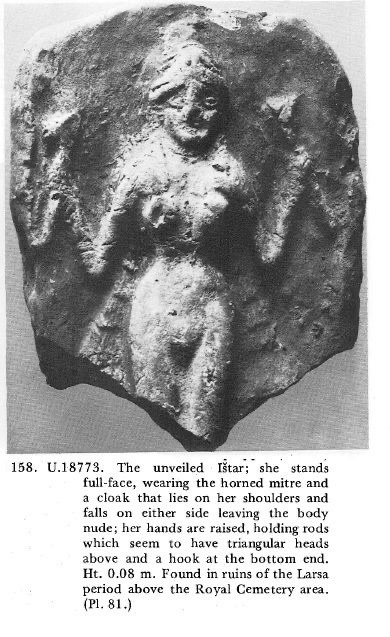
The unveiled Ishtar, terracotta plaque from Ur, found in ruins of the Larsa period above the Royal Cemetery area (U.18775)
Inanna is the first deity in the world to be shown in narrative art. The Warka Vase, an alabaster vessel carved at Uruk around 3200–3000 BCE, presents in ascending registers the plants, animals and naked bearers of offerings who process toward the goddess, or her priestess, standing before the paired reed-bundle gateposts that were her earliest sign, the very MUŠ₃ standard by which her name was written. The vase is at once the earliest surviving image of a cult and the first statement of a theme that would govern her iconography for three thousand years: the goddess as the one to whom the abundance of the land is brought.44,45,56
The eight-pointed star became the standard sign of Ishtar as the planet Venus; the lion, upon which she stands or which she holds by a leash, expressed her mastery of violent power; and Akkadian cylinder seals created the enduring image of the armed goddess, frontal, winged, with maces and scimitars rising from her shoulders. The lions of the Ishtar Gate of Babylon carried that presence into the monumental architecture of the Neo-Babylonian capital, while the celebrated terracotta “Queen of the Night” relief in the British Museum, a winged and taloned goddess flanked by owls and lions, has been claimed for Ishtar and Ereshkigal alike and remains the most debated image in her iconography.57,58,59,60
In literature, she has no rival among Mesopotamian deities. Enheduanna, daughter of Sargon and high priestess of Nanna at Ur, is the first author in human history whose name is attached to her work, and her greatest poem, the Exaltation of Inanna, is a sustained and personal address to the goddess in which theology and autobiography meet. The Sumerian hymns to Inanna outnumber those to any other god, and the Dumuzi–Inanna courtship songs form the fountainhead of the love lyric of the ancient Near East.61,62,63
Music and performance belonged to her sphere as a general right. Among the me she carried from Eridu were the arts of song and of the instruments. Her cult was served by the gala, the lamentation-singers who chanted to her in the Emesal register of Sumerian and whose laments survived into the first millennium as a fixed liturgy. The sacred-marriage hymns of the Ur III and Isin kings, composed for recitation and song, made the union of king and goddess itself a work of poetry and performance.47,64,65
VI. Venus Goddess
One thing historians such as Jeffrey Cooley have agreed on is that the nature of Inanna's myth goes far beyond describing a tempestuous goddess. The movement and visible characteristics of the planet Venus itself, informed by the astronomical expertise of the Mesopotamians, is in-built into her corpus of stories and attributes.40,66,67
As you rise in the morning sky … and at your bright appearance in the evening sky… Hymn to Inanna as Ninegala (Inanna D)
An example occurs in the hymns celebrating her ascension magnificently and attracting the gaze of all lands at night. Her movement through the heavens, brilliance and sovereignty over the horizon correspond well to nocturnal Venus. Its last appearance in the evening is likened to her descent into Irkalla. As Venus always trails or is in front of the Sun, it cannot traverse the heavens without its accompanying anchor. The link of Inanna to boundaries between light and dark, return, sudden brilliance and drawing on masculine powers is a profound theme accordingly.68,69,70
This also what underlines Inanna's strong connection in cult to her solar brother, Utu. Both deities are held with distributing earthly justice. It is Utu who steadfastly often helps Inanna out of dire situations and lends the proper assistance to help her.7,63
From here, the points become more complex. Venus remains an eastern predawn object for many months. Inanna's movements around the eastern horizon in Shu-kale-tuda tale have been interpreted in precisely this way. Direct-motion Venus also passes behind the Sun in superior conjunction which likely explains myths in which Inanna withdraws to a non-celestial location before returning on the opposite horizon. Most importantly, even days before any retrograding Venus makes an inferior conjunction with the Sun, it disappears from view, creating the foundation of the myth.66,71,72
The Sumerians knew also that the diurnal and nocturnal Venus were in fact the same planet, a piece of wisdom that was not understood much elsewhere until either Pythagoras or Parmenides clarified this matter later. Inanna as the Anunītu was also associated with Pisces, while Dumuzid was associated with Aries; technically she was also associated with the ingress of Aries.73,74,75
VII. Inanna and War
Inanna is often described as an impetuous goddess. This is rooted in the most ancient mythological corpus when she becomes enraged at the mountain Ebih refusing to show submission and subsequently destroys it. In Inanna and Enki, her resolve permits her to steal the Me from Enki and to drive his cosmic boat. The Agushaya poem in Akkadian takes this to another level: Ishtar dances around the world ferociously, absorbing everything into herself at an alarming rate, making the gods despair of her belligerence. It is only when Ea produces Shaltum whose dance is overwhelming that Ishtar stops.17,23
To some extent, her acts tend to overlap with some of Aphrodite's characterization in the Iliad as risk-taking and transgressing her role on the Trojan field, the military command of Athena, the impetuous lover-taking of Eos, the episode of the descending humanity-destroying goddess of Hathor-Sekhmet among the Egyptians, the later behaviors of Anat and Artemis in myth and the all-consuming powers of Kali in the Indian corpus, a cosmic deity also depicted dancing and twirling to the point of making the world quake.76
It is clear that royal dynasties also used the imagery of Inanna and Ishtar in war-like contexts. Sargon of Akkad styled himself “bailiff of Inanna” immediately before titles asserting universal kingship. The same inscription then recounted his victories over Uruk, Ur, Umma and other southern cities and the capture of Lugalzagesi. To control Uruk itself appears to have been a sign of great military prowess. Court literature associated with his daughter Enheduanna turned Inanna into an overwhelmingly powerful goddess whose authority extends over peoples, mountains, cities and rebellious territories. In Shulgi of Ur's testimony, she even declares: "In battle, I will be the one who goes before you."61,77,78,79
Material from Hammurabi's reign four hundred years later describes Ishtar as the Lady of War and Conflict, and the Tiglath-pileser I six hundred years after that near the close of the second millennium BCE describes her as the foremost one among the gods, the Lady of Tumult who adorns battles.80,81
The Neo-Assyrian Empire used Ishtar's symbolism similarly as a permanent member of the divine machinery of Assyrian conquest. Temples are restored from booty and successive kings described her as a divine warrior who produces royal victory. It was especially during Ashurbanipal's reign that her divine attributes of war were hailed the most: the Arbela is described in a royal dream with quivers, bow and an unsheathed sword. Remarkably, she tells the king to remain safe while she goes out and accomplishes the military task. The lions and lion-hunt of the ruler also became associated with her.58,82,83
War-like characteristics are one of the most consistent attributes of Inanna that inform how she was portrayed throughout Mesopotamian history.58,84
VIII. Love and Sexuality
Desirability and arousal … are yours, Inana.
A hymn to Inana (Inana C), trans.
Of all the series, the frankness of how Inanna was portrayed in conditioning the natural impulses of sexuality was stark. Old Akkadian incantations such as MAD V 8 label love-charms as the sons of Ishtar herself. It was even said in her oldest myths that when she descended to the netherworld, the bull would not mount the cow, the ass stopped giving the jenny offspring, and every facet of reproduction stopped.10,37,85,86
Again and again, literature connects her to attraction, joy, sensuality and imagery of what is ripe, beautiful and in full bloom. The King Ammi-ditana hymn to Ishtar published by François Thureau-Dangin in 1925 says87,88:
shāt mēleshim ruāmam labshat
zaʾnat inbī mīqiam u kuzbam
She who exults, clothed in allure,
adorned with fruit, charm and attractiveness.
The Ishtar-Louvre also connected her to intercourse, generation and then childbirth through "the opening of the womb" and "the gift of the baby" quite directly. Layering of this text shows that each element of initial desire is linked to some sort of creative faculty, ultimately progressing towards childbirth. On the other hand, to claim Ishtar is a mother goddess is to overstate the case; she was not associated ordinarily with motherhood in the same way as Isis or Demeter were.9,89,90
The goddess is also associated with a coterie of beloved men who experienced varying paths as a result, as explained above. However, there were limits to what Inanna could achieve. In Sumerian myth, the hero Bilgames is warned not to bring Inanna's gifts into his house by his divine mother Ninsun. In the more advanced Assyrian myth, after Ishtar promises Gilgamesh endless rewards should he become her beloved, he goes further and expresses his fear of ending up like them and refuses to take up her advances, causing her to feel insulted and send the heavenly Bull to attack him. The sage Enkidu also throws an animal pelt in her face.27,29,30
With all the above in mind, the commonly held assumption in older literature that Inanna's sacred personnel were sex workers is generally considered unviable. Julia Assante and Stephanie Budin in particular argued that there is no adequate evidence for an institutional Mesopotamian system in which temple personnel regularly sold intercourse as a religious rite. Modern scholarship has moved substantially away from the old “cult brothel” reconstruction, which emerged from later Assyrian descriptions of associated workers, the description of Babylon the Great as a harlot in the Book of Revelation and Strabo's description of the Corinthian hetaira, and were applied to Inanna by association.91,92,93,94,95
IX. Women and Inanna's Worship
Evidence from Nippur (ca. 2600–2500 BCE) shows that women dedicated inscribed bowls and vessels in their own names or identified themselves as wife or daughter of another person. One known donor was a midwife, showing Inanna's connection to births. Women participated personally in votive worship, although most people able to commission inscribed stone objects were probably relatively prosperous. The underlying act of Mesopotamian piety was to give food to the deity.96,97
Prayer literature shows that Inanna was treated as a deity capable of intervening in an individual's circumstances and altering the course of fate. People sought her favor in problems involving health, danger, enemies, divine anger, sexuality, love or fortune. Many of these petitions bear feminine hallmarks.9,48
Beads, ornaments and precious jewelry were given to the temple or attached to the divine image. The eight-pointed star also featured on a variety of jewelled artefacts from Nippur and Uruk, often given in sacred contexts. Parents gave girls names invoking the goddess, names meaning roughly “Who is like my Ishtar?”, “How long, O Ishtar?” or formulations expressing reliance upon her. Women often worshipped her by cakes baked in ashes called kamān tumri. Several cake molds of clay discovered at Mari were shaped like naked women.44,48,98
Music was another important avenue of female cult participation. At Old Babylonian Mari, Princess Bēltum arranged musicians for a ceremony at Ištar's sanctuary. Centuries later, a Late Babylonian ritual text from the Eturkalamma, temple of Bēlet-Bābili (“Lady of Babylon,” an Ištar), describes a highly structured rite involving prayers, recitations and music. Particularly noteworthy is a nigûtu performed by a nadītu priestess, while another ritual involved a woman called sakkikuddītu.48,99
Nonetheless, the en or high priest of Inanna was likely male, while it is conversely known that the en of her divine father, the moon god Nanna, was typically female, with Enheduanna being one such example. Women were, nonetheless, sacred personnel at the sanctuary of Inanna at Uruk: during the reign of Shu-Sin, the king gave valuable gold-and-agate jewelry to two nadītu women.48,100
X. Inanna and the Neo-Assyrian Kings
Two thousand years after the Sargonic kings spread her rites, Ashurbanipal claimed an unusually close relationship with the great goddess. In his account of the Elamite crisis, he addressed the Ishtar of Arbela as the goddess whose hands had created him, while another text describes the Ishtar of Nineveh as one who had raised him like his own birth-mother. RINAP 5/2, Ashurbanipal 185 indicates that the king even made the sacred Egashankalamma shine like daylight with gold, silver and copper in obeisance to her.51,82,101
The groundwork had been laid by Esarhaddon, whose principal inscription declares that from his childhood Aššur, Šamaš, Bēl, Nabû, Ištar of Nineveh and Ištar of Arbela had designated him for kingship, a claim that mattered greatly for a ruler whose succession followed the murder of Sennacherib and strife within the royal house. He restored Emašmaš at Nineveh, Egašankalamma at Arbela with its akītu facilities, and even Eanna at Uruk, and asked the goddess in return for length of days, the welfare of his descendants and the overthrow of his enemies. The relationship was not confined to the king: prophetesses of Arbela spoke to him in the goddess's own voice, telling him that when he was small she had taken him to her, and that he should not fear.53,102,103
Under Ashurbanipal, the bond became a closed circuit of patronage and victory. Sargon II had built and Sennacherib had perfected the rites of Ishtar's sanctuaries at Nineveh; Tiglath-pileser III had installed her very image in the provincial city of Ḫadattu beneath guardian bulls named for the capture of enemies. Ashurbanipal rebuilt her akītu-house around 645 BCE, enlarged the courtyard of Emashmash with inscriptions that passed directly from Elamite victory to temple construction, and had her processional boat made of cedar and silver; after his conquests he harnessed the defeated kings Tammarītu and Ummanaldashu to his carriage during an akītu procession and rode above them before humbling himself to the goddess. Even Sîn-šarra-iškun, on the eve of Assyria's fall, still claimed that the two Ištars had chosen him for the throne.82,104,105,106
XI. Festivals of Inanna
| Inanna/Ishtar Ritual Days | Place | Description | Importance | Date Recorded |
|---|---|---|---|---|
| Feasts of the Morning and Evening Inanna | Uruk | Archaic offering-feasts | Earliest recorded feasts of the goddess; deliveries of sheep, dates, and beer | Archaic Uruk texts (c. 3200 BCE) |
| The Sacred Marriage (Hieros Gamos) | Uruk / Isin | New Year fertility rite | King weds Inanna in the role of Dumuzi; a good fate decreed for the land | Šulgi X hymn, Third Dynasty of Ur (c. 2050 BCE) |
| Mourning for Dumuzi (Tammuz) | Uruk and across Mesopotamia | Midsummer lament for the dying god | Wailing and laments for the dead god; still practiced at Ezekiel 8:14 | Sumerian laments, Ur III–Old Babylonian (c. 2000 BCE) |
| Festival of Ishtar of Dēr (Dērītum) | Mari | Royal state festival | Procession attended by the royal family and foreign envoys | Mari archives, reign of Zimri-Lim (18th century BCE) |
| Akītu of the Ishtars of Nineveh and Arbela | Nineveh / Arbela | Neo-Assyrian New Year | The armed goddess processes; royal oracles delivered | Neo-Assyrian royal texts, reign of Assurbanipal (7th century BCE) |
| Akītu of Ishtar and Anu at Uruk | Uruk | Late Babylonian New Year | Statues of Anu and Ištar carried in procession to the akitu-house | Late Babylonian ritual texts, BRM 4 7 (3rd–2nd century BCE) |
Sources: Szarzyńska, Offerings for the Goddess Inana in Archaic Uruk, for the archaic feasts of the morning and evening Inanna; Lapinkivi, The Sumerian Sacred Marriage, for the Sacred Marriage rite and the hymn Šulgi X; Jacobsen, The Treasures of Darkness, for the ritual mourning of Dumuzi; Hoskisson, Dīrītum at Mari, for the festival of Ishtar of Dēr; Beckman, Ištar of Nineveh Reconsidered, for the Ninevite cult; Krul, The Revival of the Anu Cult, for the New Year akītu of Ištar and Anu at Uruk; and Cohen, Festivals and Calendars of the Ancient Near East, for the akītu and the cultic calendar throughout.42,47,49,107,108,109,110
Sources and Bibliography
- Selz, Gebhard J. “The Uruk Phenomenon.” In The Oxford History of the Ancient Near East. Volume I: From the Beginnings to Old Kingdom Egypt and the Dynasty of Akkad, edited by Karen Radner, Nadine Moeller, and D. T. Potts, 163–244. New York: Oxford University Press, 2020.
- Englund, Robert K. Archaic Administrative Texts from Uruk: The Early Campaigns. Archaische Texte aus Uruk 5. Berlin: Gebr. Mann, 1994. See pl. 59, W 9578,f (VAT 14663; CDLI P001238).
- Black, Jeremy, et al. “Nanna/Suen/Sin (god).” Ancient Mesopotamian Gods and Goddesses. Open Richly Annotated Cuneiform Corpus, University of Pennsylvania.
- Herodotus. The Persian Wars. Translated by A. D. Godley. 4 vols. Loeb Classical Library. Cambridge, MA: Harvard University Press, 1920–25. See 1.105 and 1.131.
- Cuneiform Digital Library Initiative. “P453401,” the Kish “Prisoner Plaque,” Early Dynastic, with the writing mar Aš-dar.
- Roberts, J. J. M. The Earliest Semitic Pantheon: A Study of the Semitic Deities Attested in Mesopotamia before Ur III. Baltimore: Johns Hopkins University Press, 1972.
- Heffron, Yaǧmur. “Inana/Ištar (goddess).” Ancient Mesopotamian Gods and Goddesses. Open Richly Annotated Cuneiform Corpus, University of Pennsylvania, 2019. http://oracc.museum.upenn.edu/amgg/listofdeities/inanaitar/.
- Wilcke, Claus. “Inanna/Ištar (Mesopotamien). A. Philologisch.” In Reallexikon der Assyriologie und Vorderasiatischen Archäologie, vol. 5, 74–87. Berlin: Walter de Gruyter, 1976–80.
- Frazer, Mary. “Ishtar.” Oxford Research Encyclopedia of Classics. Revised August 21, 2024. https://doi.org/10.1093/acrefore/9780199381135.013.3338.
- Westenholz, Joan Goodnick, and Aage Westenholz. “Help for Rejected Suitors: The Old Akkadian Love Incantation MAD V 8.” Orientalia, n.s., 46 (1977): 198–219.
- Deimel, Anton. Die Inschriften von Fara II: Schultexte aus Fara. Wissenschaftliche Veröffentlichungen der Deutschen Orient-Gesellschaft 43. Leipzig: J. C. Hinrichs, 1923. See no. 31 (SF 31 = VAT 12640).
- Matuszak, Jana. “Of Captive Storm Gods and Cunning Foxes: New Insights into Early Sumerian Mythology, with an Edition of Ni 12501.” Iraq 86 (2024): 79–108. https://doi.org/10.1017/irq.2024.19.
- Krebernik, Manfred. “Drachenmutter und Himmelsrebe? Zur Frühgeschichte Dumuzis und seiner Familie.” In Literatur, Politik und Recht in Mesopotamien: Festschrift für Claus Wilcke, edited by Walther Sallaberger, Konrad Volk, and Annette Zgoll, 151–80. Wiesbaden: Harrassowitz, 2003.
- Zand, Kamran V. “Relationship Status: Complicated.” In Dealing with Antiquity: Past, Present & Future: Proceedings of the 63rd Rencontre Assyriologique Internationale, Marburg 2017, edited by Walter Sommerfeld, 463–73. Alter Orient und Altes Testament 460. Münster: Ugarit-Verlag, 2020.
- Sallaberger, Walther. “Uruk und Kulaba.” In Uruk: Altorientalische Metropole und Kulturzentrum. Colloquien der Deutschen Orient-Gesellschaft 8. Wiesbaden: Harrassowitz, 2021.
- Matuszak, Jana, and Hanan Abd Alhamza Alessawe. “A Sargonic Exercise Tablet Listing ‘Places of Inanna’ and Personal Names.” Journal of Cuneiform Studies 76 (2024): 27–52. https://doi.org/10.1086/730480.
- Black, Jeremy, Graham Cunningham, Eleanor Robson, and Gábor Zólyomi. The Literature of Ancient Sumer. Oxford: Oxford University Press, 2004.
- Black, Jeremy A., Graham Cunningham, Eleanor Robson, and Gábor Zólyomi. The Electronic Text Corpus of Sumerian Literature. Oxford: University of Oxford, 1998–2006. See compositions 1.3.1–1.4.4.
- Alster, Bendt. “On the Interpretation of the Sumerian Myth ‘Inanna and Enki.’” Zeitschrift für Assyriologie und Vorderasiatische Archäologie 64 (1975): 20–34.
- Alster, Bendt. “Gudam and the Bull of Heaven.” In Assyria and Beyond: Studies Presented to Mogens Trolle Larsen, edited by Jan Gerrit Dercksen. Leiden: Nederlands Instituut voor het Nabije Oosten, 2004.
- Cuneiform Digital Library Initiative. “CDLI Literary 000342 (Inanna and An) Composite,” P469524.
- van Dijk, J. J. A. “Inanna raubt den ‘großen Himmel’: Ein Mythos.” In tikip santakki mala bašmu: Festschrift für Rykle Borger, edited by Stefan M. Maul, 9–38. Cuneiform Monographs 10. Groningen: Styx, 1998.
- Groneberg, Brigitte R. M. Lob der Ištar: Gebet und Ritual an die altbabylonische Venusgöttin: Tanatti Ištar. Cuneiform Monographs 8. Groningen: Styx, 1997.
- Foster, Benjamin R. Before the Muses: An Anthology of Akkadian Literature. 3rd ed. Bethesda, MD: CDL Press, 2005.
- George, Andrew R. “The Gods Išum and Ḫendursanga: Night Watchmen and Street-Lighting in Babylonia.” Journal of Near Eastern Studies 74, no. 1 (2015): 1–8. https://doi.org/10.1086/679387.
- Tadmor, Eli. “How Išum Got His Name.” Journal of Cuneiform Studies 78 (2026): 199–214.
- George, Andrew R. “Bilgames and the Bull of Heaven: Cuneiform Texts, Collations and Textual Reconstruction.” In “Your Praise Is Sweet”: A Memorial Volume for Jeremy Black from Students, Colleagues and Friends, edited by Heather D. Baker, Eleanor Robson, and Gábor Zólyomi, 101–15. London: British Institute for the Study of Iraq, 2010.
- Cavigneaux, Antoine, and Farouk N. H. Al-Rawi. “Gilgameš et Taureau de Ciel (Šul-me-kam): Textes de Tell Haddad IV.” Revue d’Assyriologie et d’Archéologie Orientale 87 (1993): 97–129.
- George, Andrew R. The Babylonian Gilgamesh Epic: Introduction, Critical Edition and Cuneiform Texts. 2 vols. Oxford: Oxford University Press, 2003.
- Abusch, Tzvi. “Ishtar’s Proposal and Gilgamesh’s Refusal: An Interpretation of ‘The Gilgamesh Epic,’ Tablet 6, Lines 1–79.” History of Religions 26, no. 2 (1986): 143–87. https://doi.org/10.1086/463073.
- George, Andrew R. The Epic of Gilgamesh: A New Translation. London: Penguin Books, 1999.
- Matuszak, Jana, and Pascal Attinger. “Notes on CUSAS 23, 205: Ama’ušumgal’s Death and Return, with an Excursus on ug₅ ‘to Kill Someone (sg.)’ and /u₃/- + Imperfective in the 3rd Millennium BCE.” Nouvelles Assyriologiques Brèves et Utilitaires 2024/1, no. 2 (2024): 5–8.
- Sladek, William R. “Inanna’s Descent to the Netherworld.” PhD diss., Johns Hopkins University, 1974.
- Katz, Dina. The Image of the Netherworld in the Sumerian Sources. Bethesda, MD: CDL Press, 2003.
- Zgoll, Annette, Bénédicte Cuperly, and Annika Cöster-Gilbert. “In Search of Dumuzi: An Introduction to Hylistic Narratology.” In The Shape of Stories: Narrative Structures in Cuneiform Literature, edited by Sophus Helle and Gina Konstantopoulos, 285–350. Cuneiform Monographs 54. Leiden and Boston: Brill, 2023. https://doi.org/10.1163/9789004539761_013.
- Pintér, Anna Krisztina. “Dumuzi and Ĝeštinanna.” Acta Orientalia Academiae Scientiarum Hungaricae 75, no. 3 (2022): 349–70. https://doi.org/10.1556/062.2022.00194.
- Lapinkivi, Pirjo. The Neo-Assyrian Myth of Ištar’s Descent and Resurrection. State Archives of Assyria Cuneiform Texts 6. Helsinki: Neo-Assyrian Text Corpus Project, 2010.
- Reiner, Erica. Your Thwarts in Pieces, Your Mooring Rope Cut: Poetry from Babylonia and Assyria. Michigan Studies in the Humanities 5. Ann Arbor: University of Michigan, 1985.
- Lambert, W. G. “A Neo-Babylonian Tammuz Lament.” Journal of the American Oriental Society 103, no. 1 (1983): 211–15. https://doi.org/10.2307/601876.
- Asher-Greve, Julia M., and Joan Goodnick Westenholz. Goddesses in Context: On Divine Powers, Roles, Relationships and Gender in Mesopotamian Textual and Visual Sources. Orbis Biblicus et Orientalis 259. Fribourg: Academic Press; Göttingen: Vandenhoeck & Ruprecht, 2013.
- Beaulieu, Paul-Alain. The Pantheon of Uruk during the Neo-Babylonian Period. Cuneiform Monographs 23. Leiden and Boston: Brill–Styx, 2003.
- Beckman, Gary. “Ištar of Nineveh Reconsidered.” Journal of Cuneiform Studies 50 (1998): 1–10.
- Zgoll, Annette. “Inana als nugig.” Zeitschrift für Assyriologie und Vorderasiatische Archäologie 87, no. 2 (1997): 181–95.
- Black, Jeremy, and Anthony Green. Gods, Demons and Symbols of Ancient Mesopotamia: An Illustrated Dictionary. London: British Museum Press, 1992.
- Collins, Paul. “The Sumerian Goddess Inanna (3400–2200 BC).” Papers from the Institute of Archaeology 5, no. 1 (1994): 103–18. https://doi.org/10.5334/pia.57.
- George, Andrew R. House Most High: The Temples of Ancient Mesopotamia. Mesopotamian Civilizations 5. Winona Lake, IN: Eisenbrauns, 1993.
- Lapinkivi, Pirjo. The Sumerian Sacred Marriage in the Light of Comparative Evidence. State Archives of Assyria Studies 15. Helsinki: The Neo-Assyrian Text Corpus Project, 2004.
- Stol, Marten. Women in the Ancient Near East. Translated by Helen and Mervyn Richardson. Berlin and Boston: De Gruyter, 2016.
- Krul, Julia. The Revival of the Anu Cult and the Nocturnal Fire Ceremony at Late Babylonian Uruk. Culture and History of the Ancient Near East 95. Leiden and Boston: Brill, 2018.
- Reade, Julian. “The Ishtar Temple at Nineveh.” Iraq 67, no. 1 (2005): 347–90. https://doi.org/10.1017/S002108890000142X.
- Porter, Barbara Nevling. “Ishtar of Nineveh and Her Collaborator, Ishtar of Arbela, in the Reign of Assurbanipal.” Iraq 66 (2004): 41–44. https://doi.org/10.2307/4200556.
- Frame, Grant. “Nabonidus and the History of the Eulmaš Temple at Akkad.” Mesopotamia 28 (1993): 21–50.
- Nissinen, Martti, and Raija Mattila. “The Temple of Ištar of Arbela.” Advances in Ancient, Biblical, and Near Eastern Research 1, no. 1 (2021): 149–68. https://doi.org/10.35068/aabner.v1i1.789.
- Nissinen, Martti. “Ištar of Arbela.” In Arbela Antiqua, 129–55. Bibliothèque archéologique et historique 218. Beirut: Presses de l’Ifpo, 2020.
- Hansen, Donald P. “Royal Building Activity at Sumerian Lagash in the Early Dynastic Period.” Biblical Archaeologist 55, no. 4 (1992): 206–11.
- Bahrani, Zainab. “Performativity and the Image: Narrative, Representation, and the Uruk Vase.” In Leaving No Stones Unturned: Essays on the Ancient Near East and Egypt in Honor of Donald P. Hansen, edited by Erica Ehrenberg, 15–22. Winona Lake, IN: Eisenbrauns, 2002.
- Ornan, Tallay. The Triumph of the Symbol: Pictorial Representation of Deities in Mesopotamia and the Biblical Image Ban. Orbis Biblicus et Orientalis 213. Fribourg: Academic Press; Göttingen: Vandenhoeck & Ruprecht, 2005.
- Cornelius, Izak. “Aspects of the Iconography of the Warrior Goddess Ištar and Ancient Near Eastern Prophecies.” In Images and Prophecy in the Ancient Eastern Mediterranean, edited by Martti Nissinen and Charles E. Carter, 15–40. Forschungen zur Religion und Literatur des Alten und Neuen Testaments 233. Göttingen: Vandenhoeck & Ruprecht, 2009.
- Marzahn, Joachim. The Ishtar Gate, the Processional Way, the New Year Festival of Babylon. Mainz: Philipp von Zabern, 1995.
- Collon, Dominique. The Queen of the Night. British Museum Objects in Focus. London: British Museum Press, 2005.
- Hallo, William W., and J. J. A. van Dijk. The Exaltation of Inanna. Yale Near Eastern Researches 3. New Haven: Yale University Press, 1968.
- Helle, Sophus. Enheduana: The Complete Poems of the World’s First Author. New Haven: Yale University Press, 2023.
- Sefati, Yitschak. Love Songs in Sumerian Literature: Critical Edition of the Dumuzi-Inanna Songs. Ramat Gan: Bar-Ilan University Press, 1998.
- Farber-Flügge, Gertrud. Der Mythos “Inanna und Enki” unter besonderer Berücksichtigung der Liste der me. Studia Pohl 10. Rome: Biblical Institute Press, 1973.
- Gabbay, Uri. Pacifying the Hearts of the Gods: Sumerian Emesal Prayers of the First Millennium BC. Heidelberger Emesal-Studien 1. Wiesbaden: Harrassowitz, 2014.
- Cooley, Jeffrey L. Poetic Astronomy in the Ancient Near East: The Reflexes of Celestial Science in Ancient Mesopotamian, Ugaritic, and Israelite Narrative. History, Archaeology, and Culture of the Levant 5. Winona Lake, IN: Eisenbrauns, 2013.
- Heimpel, Wolfgang. “A Catalog of Near Eastern Venus Deities.” Syro-Mesopotamian Studies 4, no. 3 (1982): 59–72.
- Black, Jeremy, Graham Cunningham, Eleanor Robson, and Gábor Zólyomi, eds. “Inana and Iddin-Dagan (Iddin-Dagan A).” Electronic Text Corpus of Sumerian Literature, composition 2.5.3.1. Oxford: University of Oxford, 1998–2006.
- Black, Jeremy, Graham Cunningham, Eleanor Robson, and Gábor Zólyomi, eds. “A Hymn to Inana as Ninegala (Inana D).” Electronic Text Corpus of Sumerian Literature, composition 4.07.4. Oxford: University of Oxford, 1998–2006.
- Reiner, Erica, and David Pingree. Enūma Anu Enlil: Tablet 63, The Venus Tablet of Ammiṣaduqa. Babylonian Planetary Omens 1. Malibu, CA: Undena Publications, 1975.
- Cooley, Jeffrey L. “Early Mesopotamian Astral Science and Divination in the Myth of Inana and Šukaletuda.” Journal of Ancient Near Eastern Religions 8, no. 1 (2008): 75–98. https://doi.org/10.1163/156921208786182446.
- de Jong, Teije. “A Study of Babylonian Planetary Theory II: The Planet Venus.” Archive for History of Exact Sciences 73 (2019): 309–42. https://doi.org/10.1007/s00407-019-00224-0.
- Kurtik, G. E. “The Identification of Inanna with the Planet Venus: A Criterion for the Time Determination of the Recognition of Constellations in Ancient Mesopotamia.” Astronomical & Astrophysical Transactions 17, no. 6 (1999): 501–13. https://doi.org/10.1080/10556799908244112.
- Hunger, Hermann, and David Pingree. MUL.APIN: An Astronomical Compendium in Cuneiform. Archiv für Orientforschung, Beiheft 24. Horn: Ferdinand Berger & Söhne, 1989.
- Diogenes Laertius. Lives of Eminent Philosophers. Translated by R. D. Hicks. 2 vols. Loeb Classical Library. Cambridge, MA: Harvard University Press, 1925. See 8.14 and 9.23.
- Harris, Rivkah. “Inanna-Ishtar as Paradox and a Coincidence of Opposites.” History of Religions 30, no. 3 (1991): 261–78.
- Frayne, Douglas R. Sargonic and Gutian Periods (2334–2113 BC). Royal Inscriptions of Mesopotamia, Early Periods 2. Toronto: University of Toronto Press, 1993.
- Zgoll, Annette. Der Rechtsfall der En-hedu-Ana im Lied nin-me-šara. Alter Orient und Altes Testament 246. Münster: Ugarit-Verlag, 1997.
- Klein, Jacob. Three Šulgi Hymns: Sumerian Royal Hymns Glorifying King Šulgi of Ur. Ramat Gan: Bar-Ilan University Press, 1981.
- Roth, Martha T. Law Collections from Mesopotamia and Asia Minor. 2nd ed. Writings from the Ancient World 6. Atlanta: Scholars Press, 1997.
- Grayson, A. Kirk. Assyrian Rulers of the Early First Millennium BC I (1114–859 BC). Royal Inscriptions of Mesopotamia, Assyrian Periods 2. Toronto: University of Toronto Press, 1991.
- Novotny, Jamie, and Joshua Jeffers. The Royal Inscriptions of Ashurbanipal (668–631 BC), Aššur-etel-ilāni (630–627 BC), and Sîn-šarra-iškun (626–612 BC), Kings of Assyria, Part 1. Royal Inscriptions of the Neo-Assyrian Period 5/1. University Park, PA: Eisenbrauns, 2018.
- Nissinen, Martti. Prophets and Prophecy in the Ancient Near East. With contributions by C. L. Seow and Robert K. Ritner. Writings from the Ancient World 12. Atlanta: Society of Biblical Literature, 2003.
- Bahrani, Zainab. Women of Babylon: Gender and Representation in Mesopotamia. London: Routledge, 2001.
- Black, Jeremy, Graham Cunningham, Eleanor Robson, and Gábor Zólyomi, eds. “A Hymn to Inana (Inana C).” Electronic Text Corpus of Sumerian Literature, composition 4.07.3. Oxford: University of Oxford, 1998–2006.
- Wasserman, Nathan. Akkadian Love Literature of the 3rd and 2nd Millennium BCE. Leipziger Altorientalistische Studien 4. Wiesbaden: Harrassowitz, 2016.
- Thureau-Dangin, François. “Un hymne à Ištar de la haute époque babylonienne.” Revue d’Assyriologie et d’Archéologie Orientale 22 (1925): 169–77.
- Lenzi, Alan, ed. Reading Akkadian Prayers and Hymns: An Introduction. Ancient Near East Monographs 3. Atlanta: Society of Biblical Literature; Buenos Aires: Centro de Estudios de Historia del Antiguo Oriente, 2011.
- Streck, Michael P., and Nathan Wasserman. “The Man Is Like a Woman, the Maiden Is a Young Man: A New Edition of Ištar-Louvre.” Orientalia 87, no. 1 (2018): 1–38.
- Hackett, Jo Ann. “Can a Sexist Model Liberate Us? Ancient Near Eastern ‘Fertility’ Goddesses.” Journal of Feminist Studies in Religion 5, no. 1 (1989): 65–76.
- Assante, Julia. “The kar.kid/ḫarimtu: Prostitute or Single Woman? A Critical Review of the Evidence.” Ugarit-Forschungen 30 (1998): 5–96.
- Assante, Julia. “Bad Girls and Kinky Boys? The Modern Prostituting of Ishtar, Her Clergy and Her Cults.” In Tempelprostitution im Altertum: Fakten und Fiktionen, edited by Tanja S. Scheer and Martin Lindner, 23–54. Berlin: Verlag Antike, 2009.
- Budin, Stephanie Lynn. The Myth of Sacred Prostitution in Antiquity. Cambridge: Cambridge University Press, 2008.
- Budin, Stephanie Lynn. “How Sacred Prostitution Is Faring in Academic Publications.” Journal of the American Oriental Society 142, no. 3 (2022): 715–30.
- Westenholz, Joan Goodnick. “Tamar, Qĕdēšā, Qadištu, and Sacred Prostitution in Mesopotamia.” Harvard Theological Review 82, no. 3 (1989): 245–65.
- Evans, Jean M. “Materiality, Writing, and Context in the Inana Temple at Nippur: The Dedicatory Objects from Level VIIB.” In Materiality of Writing in Early Mesopotamia, edited by Thomas E. Balke and Christina Tsouparopoulou, 165–82. Materiale Textkulturen 13. Berlin and Boston: De Gruyter, 2016.
- Verderame, Lorenzo. “Text, Context, and the Social Dimension of Writing: A Case Study from the Early Dynastic Temple of Inanna at Nippur.” In Ancient Near Eastern Temple Inventories in the Third and Second Millennia BCE, edited by Jean M. Evans and Elisa Rossberger, 27–44. Gladbeck: PeWe-Verlag, 2019.
- Parrot, André. Mission archéologique de Mari. Vol. 1, Le Temple d’Ishtar. Bibliothèque archéologique et historique 65. Paris: Librairie orientaliste Paul Geuthner, 1956.
- Da Riva, Rocío. “The Angry Ištar of Eturkalamma: BM 32482+ and the Conservation of Cultic Traditions in the Late Babylonian Period.” Iraq 81 (2019): 87–105. https://doi.org/10.1017/irq.2019.3.
- Lenzen, H. J. “Die beiden Hauptheiligtümer von Uruk und Ur zur Zeit der III. Dynastie von Ur.” Iraq 22 (1960): 127–38. https://doi.org/10.2307/4199677.
- Novotny, Jamie, and Joshua Jeffers. The Royal Inscriptions of Ashurbanipal (668–631 BC), Aššur-etel-ilāni (630–627 BC), and Sîn-šarra-iškun (626–612 BC), Kings of Assyria, Part 2. Royal Inscriptions of the Neo-Assyrian Period 5/2. University Park, PA: Eisenbrauns, 2023. See Ashurbanipal 185.
- Leichty, Erle. The Royal Inscriptions of Esarhaddon, King of Assyria (680–669 BC). Royal Inscriptions of the Neo-Assyrian Period 4. Winona Lake, IN: Eisenbrauns, 2011.
- Parpola, Simo. Assyrian Prophecies. State Archives of Assyria 9. Helsinki: Helsinki University Press, 1997.
- Grayson, A. Kirk, and Jamie Novotny. The Royal Inscriptions of Sennacherib, King of Assyria (704–681 BC), Part 1. Royal Inscriptions of the Neo-Assyrian Period 3/1. Winona Lake, IN: Eisenbrauns, 2012.
- Tadmor, Hayim, and Shigeo Yamada. The Royal Inscriptions of Tiglath-pileser III (744–727 BC), and Shalmaneser V (726–722 BC), Kings of Assyria. Royal Inscriptions of the Neo-Assyrian Period 1. Winona Lake, IN: Eisenbrauns, 2011.
- Frame, Grant. The Royal Inscriptions of Sargon II, King of Assyria (721–705 BC). Royal Inscriptions of the Neo-Assyrian Period 2. University Park, PA: Eisenbrauns, 2021.
- Szarzyńska, Krystyna. “Offerings for the Goddess Inana in Archaic Uruk.” Revue d’Assyriologie et d’Archéologie Orientale 87, no. 1 (1993): 7–28.
- Jacobsen, Thorkild. The Treasures of Darkness: A History of Mesopotamian Religion. New Haven: Yale University Press, 1976.
- Hoskisson, Paul Y. “The Scission and Ascendancy of a Goddess: Dīrītum at Mari.” In Go to the Land I Will Show You: Studies in Honor of Dwight W. Young, edited by Joseph E. Coleson and Victor H. Matthews, 261–75. Winona Lake, IN: Eisenbrauns, 1996.
- Cohen, Mark E. Festivals and Calendars of the Ancient Near East. Bethesda, MD: CDL Press, 2015.