













| Language / Form | Name of Venus | Attestation |
|---|---|---|
| Archaic Latin | Veneres | CIL I² 451 (early 3rd century BCE) |
| Proto-Italic / PIE | *wenos-, from *wenh₁- ("to desire") | Comparative reconstruction; cf. venia, venerari |
28 min read
VENUS
author: High Priest Zevios Metathronos
co-author: Novice Priest Karnonnos
I. Etymology
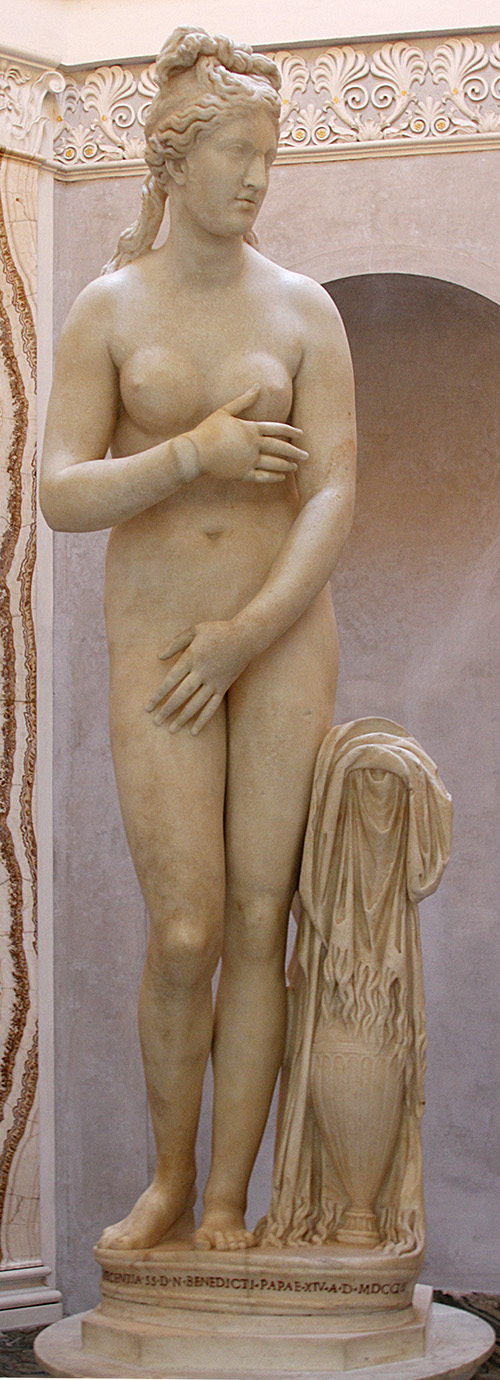
Capitoline Venus, originally by Praxiteles, late Roman copy, Musei Capitolini
The Latin name Venus (genitive Veneris) is among the most transparently native of the great Roman theonyms. It derives from an inherited noun venus, "charm, allurement, the quality that arouses desire," itself from the Proto-Italic and Proto-Indo-European root *wenh₁- ("to desire, to strive for"), the same root that yields venia ("favour, indulgence") and venerari ("to venerate, to seek the favour of a god"). The goddess is thus, at the level of language, the personification of an abstract quality, the power of attraction, rather than a figure imported ready-made from abroad.1,2
The earliest secure surviving attestation of the name in Latin is not the nominative Venus but an archaic inflected form. Painted upon a small black-gloss vessel from Tarquinii, catalogued as CIL I² 451, is the legend VENERES POCOLOM, in normalized classical spelling Veneris poculum, "the cup of Venus." Here VENERES is an archaic genitive singular corresponding to the classical Veneris, and pocolom the older spelling of poculum. The vessel belongs to the pocola deorum, a series of dedicatory cups bearing the formula "name of a deity in the genitive + pocolom," conventionally dated to the early third century BCE.3,4,5
A second, approximately contemporary fragment from Caere, CIL I² 2495, preserves VENERE[S POCOLOM?], likewise an archaic genitive of Venus but too fragmentary to be shown earlier than the Tarquinian example. The first attestation of the theonym therefore belongs to an early-third-century epigraphic horizon, most securely represented by the Tarquinian cup, a generation or so before the goddess acquired her first securely dated temple at Rome.3,6
Sources: Corpus Inscriptionum Latinarum I² 451, 2495; Livy, Ab Urbe Condita; de Vaan, Etymological Dictionary of Latin and the Other Italic Languages, (2008); Padilla Peralta, Divine Institutions, (2020); Blanchet, Graphie, syntaxe et théonymie des pocola deorum, (2021).1,3,4,5,7
II. History
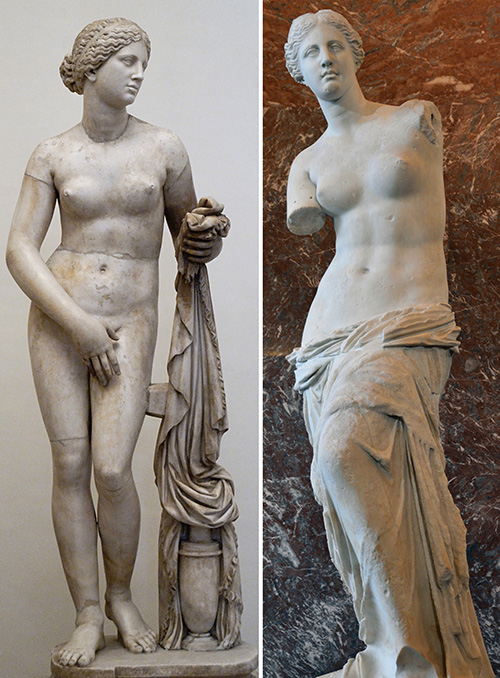
Aphrodite of Knidos, Praxiteles, 4th century BCE, Ludovisi; Venus de Milo, 2nd century BCE, Louvre
Although the recorded history of Venus extends far back into the mists of Latium, her presence in the Roman cult occurred rather late.2,8
The earliest securely dated public act of her state cult is the temple vowed near the Circus Maximus in 295 BCE, built by the aedile Quintus Fabius Gurges from money raised in fines levied upon matrons convicted of sexual misconduct, a beginning that already bound the goddess to the ordering of Roman sexual life rather than to any imported Aphrodite. Yet the painted cups of the pocola show her name in Latin cult use a generation earlier still, so that her worship was clearly established before the state gave it monumental form.4,7
By the time she entered the Roman state cult, Venus already carried the weight of the Trojan legend. Through her son Aeneas she was made the ancestress of the Latins and, in time, of the Roman people, a genealogy that Dionysius of Halicarnassus and the antiquarian tradition traced from the Troad to Lavinium and Rome. Whether her name and cult were an old Italic inheritance or a comparatively late systematization under Greek and Sicilian influence was a question disputed already in antiquity and unresolved today.2,9,10
III. Epithets
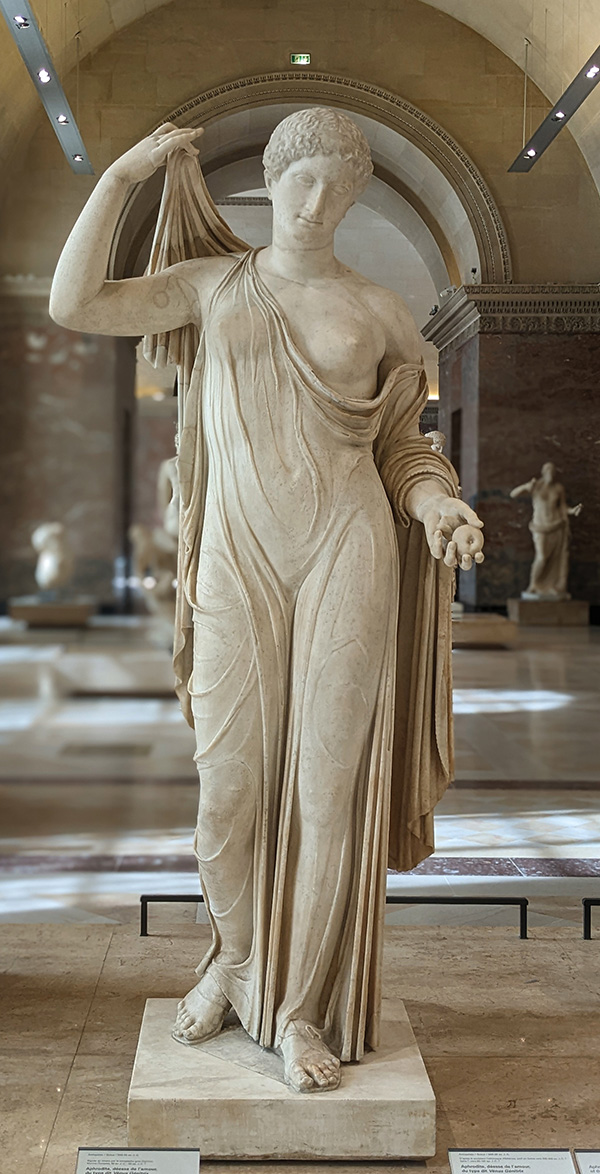
Venus Genetrix, copy of Callimachus, Louvre
| Epithet | Meaning | Domain |
|---|---|---|
| Venus Genetrix | Venus the Ancestress | Divine ancestress of all |
| Venus Victrix | Venus the Victorious | Military victory |
| Venus Felix | Venus the Favorable | Good fortune, Tyche |
| Venus Obsequens | Venus the Gracious | Vinalia |
| Venus Verticordia | Venus the Turner of Hearts | Chastity, moral law |
| Venus Cloacina | Venus the Purifier | Purification, reconciliation |
| Venus Murcia | Venus of the Myrtle | The myrtle, her sacred plant |
| Venus Libitina | Venus of Funerals | Death and burial |
| Venus Libentina | Venus of Desire | Sensual pleasure |
| Venus Calva | Venus the Bald | Matrons with hair |
Sources: Ovid, Fasti; Varro, De Lingua Latina; Schilling, La religion romaine de Vénus, (1954); Platner and Ashby, A Topographical Dictionary of Ancient Rome, (1929); Richardson, A New Topographical Dictionary of Ancient Rome, (1992); Beard, North, and Price, Religions of Rome, (1998).2,10,11,12,13,14
IV. Temples and Sacred Sites of Venus
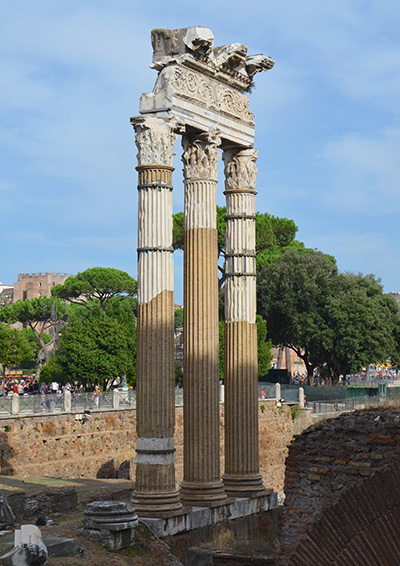
Temple of Venus Genetrix, Rome
The greatest of her sanctuaries was the Temple of Venus and Roma, dedicated by Hadrian on the Velia between the Forum and the Colosseum. Probably the largest temple ever raised in the city, it held two adjoining cellae set back-to-back: Venus Felix, "Fortunate Venus," facing the Colosseum, and Roma Aeterna, "Eternal Rome," facing the Forum, a pairing that fused the mother of Aeneas with the personified and everlasting city, and that turned on the play by which AMOR reversed spells ROMA. Cassius Dio reports that Hadrian sent the design to Apollodorus of Damascus, who is said to have criticized both its raised platform and the cramped proportions of its colossal seated images.15,16,17
The earliest securely dated temple of Venus at Rome was that of Venus Obsequens ("Compliant" or "Propitious Venus"), vowed near the Circus Maximus in 295 BCE by the curule aedile Quintus Fabius Gurges. Built from the fines of convicted matrons, it gave the goddess her first monumental civic form and tied her from the outset to fertility, sexual conduct, and social order.7,14
The most politically consequential was the Temple of Venus Genetrix, dedicated by Julius Caesar in his new Forum Iulium on 26 September 46 BCE. Caesar had vowed a temple to Venus Victrix before Pharsalus but dedicated the completed building to Venus as Genetrix, "Mother" or "Ancestress"; through Aeneas and his son Iulus she was proclaimed the divine progenitor of the Julian house. Cassius Dio records that Caesar dedicated the temple to Venus "as the founder of his family," and the placement of the shrine at the head of his forum made the whole civic complex a precinct of his divine ancestress, the model for every later imperial forum.18,19,20
A generation earlier, Pompey the Great had placed the Temple of Venus Victrix, "Victorious Venus," at the summit of Rome's first permanent stone theatre in the Campus Martius, inaugurated in 55 BCE, so that the ascending tiers of seats formed a monumental stair leading up to her shrine. The complex joined temple, theatre, portico, gardens, and a senate-house on an unprecedented scale, and stood as the immediate political rival to Caesar's later temple of the Genetrix.21,22,23
The principal Republican temple of female morality was that of Venus Verticordia, "Venus who turns the heart," established in 114 BCE after the prosecution of several Vestals for incestum and a consultation of the Sibylline Books. Ovid explains that the goddess took her name from the turning of Roman hearts from vice toward chastity; Valerius Maximus records that one hundred matrons were examined and Sulpicia, judged the most chaste, was chosen to dedicate the cult image.11,24
Outside Rome, the most important municipal sanctuary was the Temple of Venus Pompeiana at Pompeii, patron goddess of the Sullan colony whose formal name carried the element Veneria. Overlooking the coastal plain from the town's south-western edge, its monumental temple and three-sided portico are now assigned to the period after Sulla's capture of Pompeii in 80 BCE, and it was still under reconstruction after the earthquake of 62 CE when Vesuvius erupted in 79.25
V. Mars and Venus
As far as the state was concerned, the cult of Venus and Mars in Rome was officially inaugurated in a manner that was not necessarily tied to the mythological affair of Aphrodite and Ares. Augustus established it for a symbolic reason. One major sculptural group likely part of the Temple of Mars Ultor showed Venus receiving and restraining the sword of Mars, with the deified Julius Caesar nearby. Here Venus represented the divine ancestress of the Julian family, while Mars represented the father of Romulus, the ancestral father of Rome. The two figures are represented as ancestors; Venus through her son Aeneas, the Trojan founder of Rome, and Mars, the father of Romulus and Remus, in his union with Rhea Silvia (herself named Ilia, often taken to be an allusion to Troy).26
The Ara dei Gemelli, or Altar of the Twins, at Ostia has the clearest surviving example of Mars and Venus appearing together upon an object used for religious purposes. The altar possessed an offering receptacle and depicted Mars, Venus accompanied by a sacred goose, Amor, Hymenaeus the god of union, Romulus and various Cupids. A dedication by Publius Aelius Syneros and his sons, authorized by the Ostian decurions, on October 1, 124 CE, was made.27
Funerary cults as discussed on the Mars page, on the other hand, emphasized the erotic or eternal aspect of their union, something that existed ambivalently, in a tense thread with the divine concept of Concordia, proper marriage. This is suggestive of the Romans viewing the two gods through distinctive layers depending on which occasion or layer of society they belonged to.2
VI. The Many Venuses of Latium
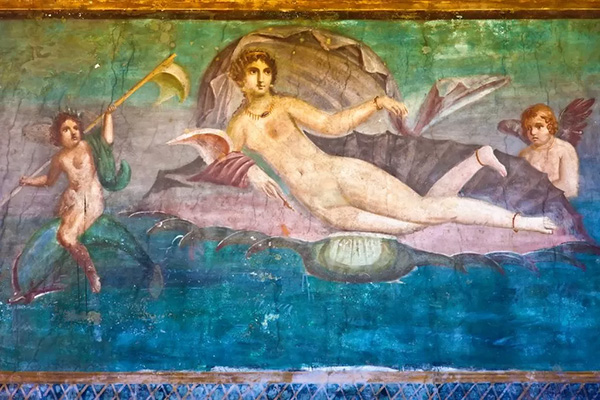
Venus, House of Via dell'Abbondanza, Pompeii
The cultural background of Venus is shrouded in enigma. The goddess is viewed by some historians as the Roman variant of an already Greek interpolation of a Middle Eastern deity, brought to Rome to her temple at a relatively late period where she gained all of the mythology and symbolism of Aphrodite. Even some Roman commentators believed certain cults of Venus were a stimulant of loose Greek morals.2,8
A core problem is that many native traditions of Venus existed in Latium before any aggressive Greek influence; she is, awkwardly, the most Roman of deities alongside Ceres and Dis Pater, a matter that some learned Romans pointed out. Venus Murcia, for instance, had an ancient chapel in the valley between the Palatine and Aventine, and an associated myth of being tied to myrtle that has no real Greek antecedent.14
Cloacina is an example of the clearest archeological case occupying a space near the cloaca of Rome, a local power subsequently described as Venus. Plautus, around the beginning of the second century BCE, refers simply to the sacrum Cloacinae, while Livy locates the shrine by the tabernae novae in his narrative of Verginia’s death. The reconciliation narrative of Pliny the Elder associates this curious choice of a holy site with purification after conflict and the restoration of civic union.21,28,29
Another example which even the Romans found confusing was Libitina, the goddess of Rome's vast network of graves and daily funerals. The highly educated Cicero questioned why a form of Venus was associated with the sale of funerary items in certain districts, or why 30,000 Romans dead from plague were 'entered into her accounts'. Objects with inscriptions detailing her flute players and undertakers exist. Possibly this form of Venus was connected to Libera, but no evidence survives to prove that claim.30,31
As in the case of Obsequens, the Romans attempted to use the cult of Venus for moral ends fixating on the productive use of sexuality, though this was clearly inspired by the cult of Aphrodite Apostrophia from Thebes. Venus Verticordia (Venus who turns the heart, the Latin for Apostrophia) was dedicated by the Senate to promote chastity. This went quite far beyond the use of the Greek xoanon in Thebes. One hundred matrons were selected, ten chosen by lot, and Sulpicia, daughter of Servius Paterculus and wife of Q. Fulvius Flaccus, was judged the most chaste and authorized to dedicate the image. Another statue to her was built after a scandal involving the Vestals in 114BCE, and the worship of Verticordia became completely integrated into the Veneralia.24,32
The worship of Isis also spread into Rome by the late Republican period, causing a synchronization and identification with Venus and Ceres to varying extents. Although many Romans found the cult of Isis and Serapis to be suspicious, particularly during the War of Actium because of Cleopatra's identification with Isis, the popularity of the cult nonetheless skyrocketed in imperial times; the worship of the Egyptian goddess took on an almost Romanized form.10,33
VII. Victrix and Triumph
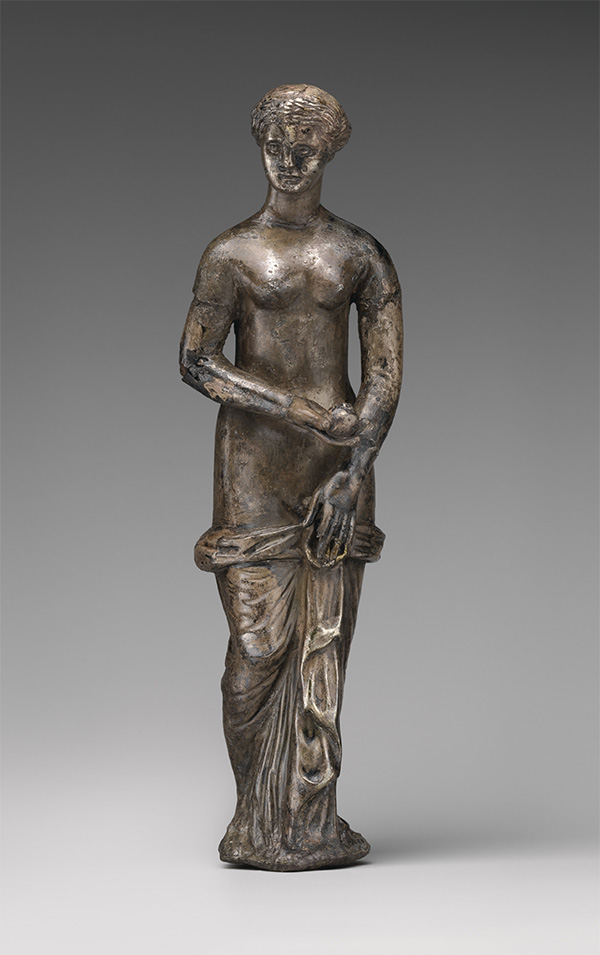
Silver statuette of Venus, 1st-2nd century CE, the Met
Venus became conflated in part with the goddess of victory, Victoria. One aspect of the goddess that is less attested in Greek sources is her presence in the shadow of military triumphs and dedications. The later Roman dictators such as the scandalous Sulla, the resolute Pompey and Julius Caesar himself took on Venus as their divine patron, but ultimately it was Pompey who dedicated the temple in her name.21,34
This dedication was not just moored in Pompey's victory over his rivals for control of the Republic. The association of Victory was understood as belonging to the Iliad and the triumph of Aphrodite over Hera and Athena in being chosen by the Trojan prince Paris. The episode of the apple of discord provided Roman writers with an analogy, even a nationalist one, revolving around the son of Aphrodite being the ancestor of the Romans. Hence, Victrix was continually deployed in Roman art as holding the infamous apple in her hand.2,35
Beneath it all, perhaps there is a deeper analogy to be made. Venus philosophically represents reconcilation and merging, in the words of Proclus: “to bind and adjust that which has been separated.” It is that philosophical property that lies beneath the pattern of wars in Rome. If Mars represented the front-facing capacity for separation, warfare and conquest, Venus was used in civic aftermath for reconciliation, the tying together of disparate peoples that continually occurred in Rome from its meager beginnings under Romulus.36
VIII. Venus in Roman Poetry
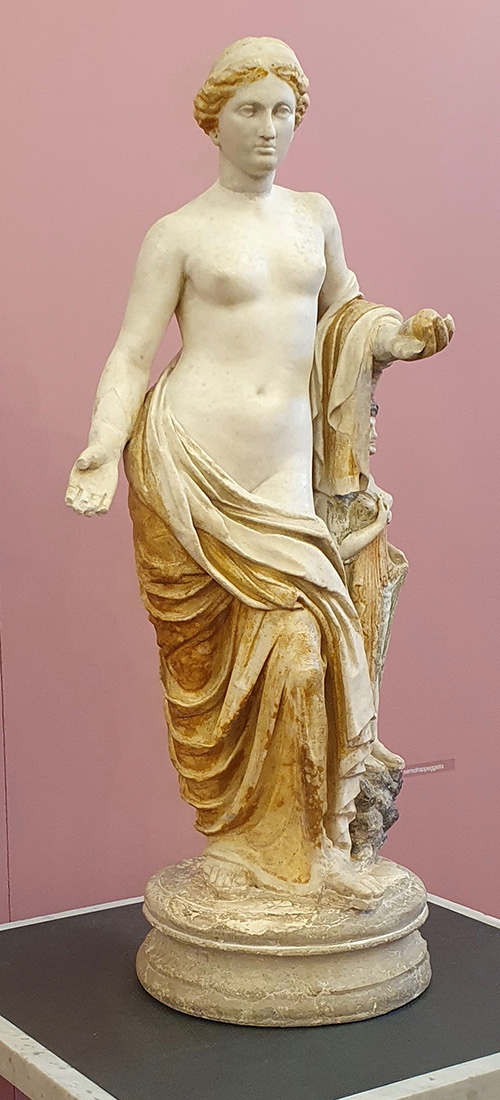
The Lovatelli Venus, Roman, 200–1BCE (Roman copy of Greek original) Marble and pigment, from Pompeii Museo Archeologico
Venus stood at the head of Latin poetry from its very beginnings. Lucretius opened On the Nature of Things with a hymn to her as Aeneadum genetrix, the life-giving delight of gods and men, through whom every living thing is conceived and rises into the light of the sun; in his Epicurean vision she is desire itself raised to the generative principle of the whole natural world, the power before whom even Mars lays down his arms.37
For Virgil she is the anxious divine mother of Aeneas, guiding and shielding her son through the founding labours of the Aeneid, pleading his cause before Jupiter, and binding the destiny of Rome to her care; the epic makes her tenderness and her providence inseparable from the birth of the Roman name.38
Horace invokes her as the queen of Cnidus and Paphos and, in a gentler key, begs the goddess to bear her campaigns lightly upon those no longer suited to love. Ovid opens the fourth book of the Fasti by laying down his own weapons to sing of alma Venus, the fostering goddess who gives her name to the month of April and quickens the fields in spring.11,39
In the Metamorphoses she is the goddess of transformation through love, moulding the ivory of Pygmalion into a living bride and mourning the death of her beloved Adonis; across all these poets Venus is at once a literary convention and a genuine cosmological power, the tender ancestress who presides over the Roman name and the creative warmth that renews the living world.40
IX. The Interpretation of the Frontiers
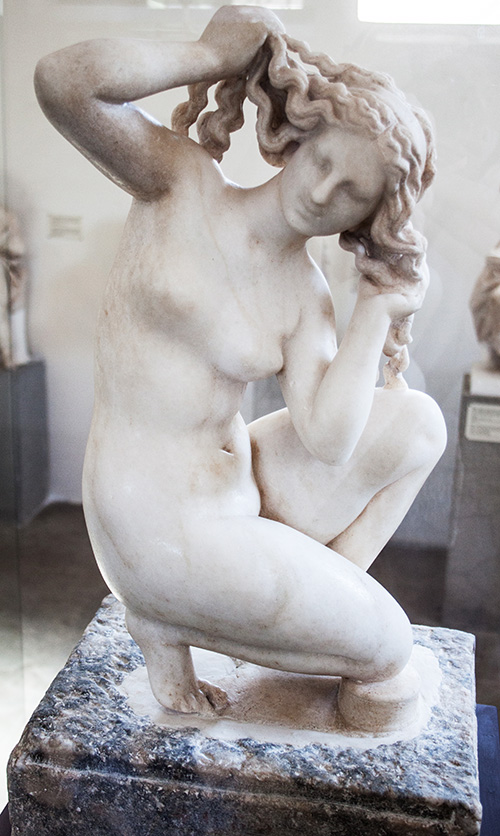
Aphrodite Anadyomene (of Rhodes), 2nd-1st century BCE
Beyond Italy, Venus travelled under other names and other faces. Where Roman and Germanic religion met, the goddess was matched to a native power of love and marriage: the Roman dies Veneris, the "day of Venus," was rendered by the Germanic peoples as the day of Frigg (or the closely related Freyja), giving Old English Frīgedæg and modern Friday, while the Romance languages kept the Roman name in vendredi, venerdì and viernes. The weekday is a linguistic fossil of the interpretatio by which one people read its own goddess in the divinity of another.41
In the north-western provinces Venus took a more tangible provincial form. Mass-produced white pipeclay figurines of a nude Venus, moulded in Gaul and the Rhineland and carried across Britain and the Germanies in the first three centuries CE, were set up in domestic shrines and laid in graves. Their find-contexts and their fusion with the imagery of the native Mother Goddesses have led scholars to read them less as the classical Venus than as a provincial divinity of fertility, protection and the waters, so distinct that the type has sometimes been called a "pseudo-Venus."42,43
X. Desire and Ambiguity among the Stoics
The Stoics, who read the traditional gods as names for aspects of the single rational power that pervades and orders the cosmos, found in Venus a principle rather than a person. Where the poets sang of desire, the philosophers allegorized her as the force of union and mixture, the drawing-together by which separated things are joined, generation is sustained, and the world is held in a productive concord.44
The reading passed readily into Latin thought. In Cicero's account of Stoic theology the goddess's very name is derived from her "coming" to all things (a veniendo), so that Venus becomes the aspect of the one divine nature under which the union of the sexes and the continuance of life are honoured.45
Yet the tradition remained ambivalent. The same desire that binds the cosmos could, left ungoverned, harden into a disordered passion, one of the very perturbations (pathe) that Stoic ethics sought to master. The school therefore honoured Venus as a cosmic and civic good while warning against the erotic excess that her poetic image so readily invited, an ambiguity that the later allegorists and the medieval moralists would inherit in full.46,47
XI. Festivals
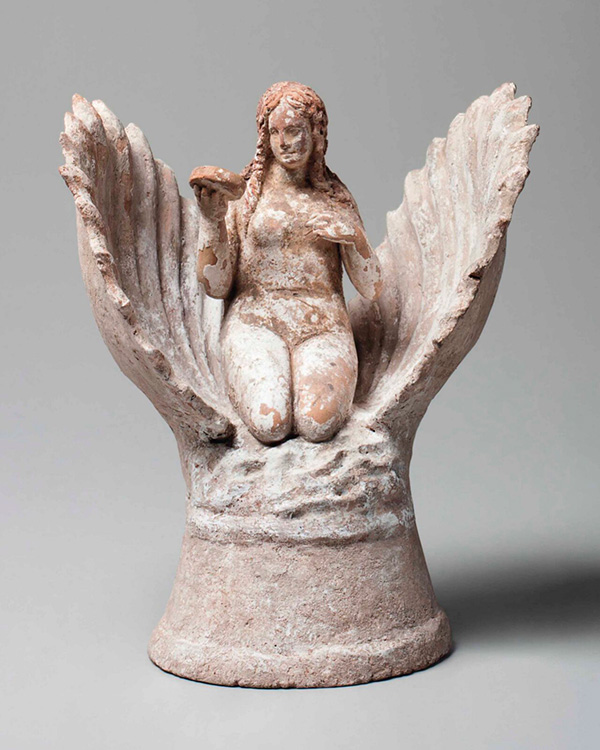
Aphrodite rising from a scallop shell, 3rd century BCE
| Venus Ritual Days | Place | Description | Importance | Date Recorded |
|---|---|---|---|---|
| Veneralia | Rome | Feast of Venus Verticordia | Washing and adorning the image, women's baths, myrtle | Ovid (1st century CE) |
| Vinalia Priora | Rome | Urban Wine Festival | First wine broached, Venus Erycina honored | Ovid (1st century CE) |
| Venus Victrix | Rome (Theatre of Pompey) | Venus the Victorious | Dedication games, elephant fight | Pliny (1st century CE) |
| Vinalia Rustica | Rome / Latium | Rustic Wine Festival | Vineyards and gardens under Venus, Obsequens | Varro (1st century BCE) |
| Venus Genetrix | Rome (Forum Iulium) | Venus the Ancestress | Dedication of Caesar's temple, ludi | Appian (2nd century CE) |
Sources: Ovid, Fasti; Varro, On the Latin Language; Pliny, Natural History; Appian, The Civil Wars; Degrassi, Inscriptiones Italiae XIII.2, (1963).11,12,20,21,48
The Veneralia was instituted in part as a moral festival dedicated to Venus Verticordia after a variety of scandals. Although it is obviously related to the Theban cult of the third Aphrodite, it also shares some similarity with the Tonaia and Plataea of Hera in Greece. An image of Venus would be washed and adorned, while women would bathe. The festival of Venus Victrix shows the association of Venus with military victory and her association with Victoria, particularly because Venus was the patron deity of many prominent Roman families.11,32
Her festival of the Vinalia is perhaps quite curious, as here she was associated with wines and everything rustic in a way traditionally ascribed to Bacchus. The Genetrix ceremony was the most solemn; here her patronage of the Julii gens and other elite families, ancestress of Rome and role as generating principle of humanity were conflated in religious rite at the Forum Iulium itself, crediting Venus for the existence of the Roman Empire. This perhaps gave Venus an aristocratic luster not quite present in Greece.12,20
XII. Venus in Medieval Culture
The slander layered upon Aphrodite was perhaps some of the most spiteful of invectives. Augustine attributing a marvel of an ever-burning lamp in a temple to “some devil under the name of Venus" held sway over the era, while the Vulgata itself supplied the axiom that “all the gods of the nations are demons” propitiated to sacrifice.49,50,51
Martin of Braga in the 6th century went as far as to smear those planning marriage on a Friday as participating in demonic rites. The De falsiis Diis by Aelfric of Eynsham, adapted by Archbishop Wulfstan, named her as an incestuous being who was worshipped as a goddess, a religion that divinized lust. Isidore of Seville on the other hand made a distinction, linking her connection to generative heat and the sea as an explanation for the proliferation of life. Astronomical manuscripts preserve a different Venus. A document of the National Library of Wales MS 735C, produced probably at Limoges around the year 1000, represents planetary figures as heads in medallions.52,53,54,55
The Venus in the Roman de la Rose by Guilliame de Loris changed the emphasis somewhat; she becomes an allegorical figure of desire in the Lover's pursuit of the Rose, pressing Chastity to disarm itself. Illuminated copies commonly show Venus as a courtly woman, sometimes crowned, richly dressed or armed with a torch. In Jean de Mehun's addition, the Lover needs Venus to command his army against Chastity, and the Genius of Nature is sent to Venus, to whom she gives a candle and he preaches human beings must always generate through erotic force. The visual type merges the classical nomenclature with contemporary aristocratic dress. The poem was very controversial for its sexual frankness and depictions of women, later causing outrage.56,57
Medieval culture possessed not one Venus but several overlapping Venuses: the demonic idol, the immoral mortal, the astronomical power, the natural principle of generation and the allegorical figure of desire, the latter of which began to evolve into a romantic figure through Franco-Italian court culture. But it is the latter that completes the philosophical reapproachment with the classical Aphrodite Pandemos through the elegant medium of de Loris and de Mehun.58,59
XIII. Venus as the Eternal Renaissance Symbol
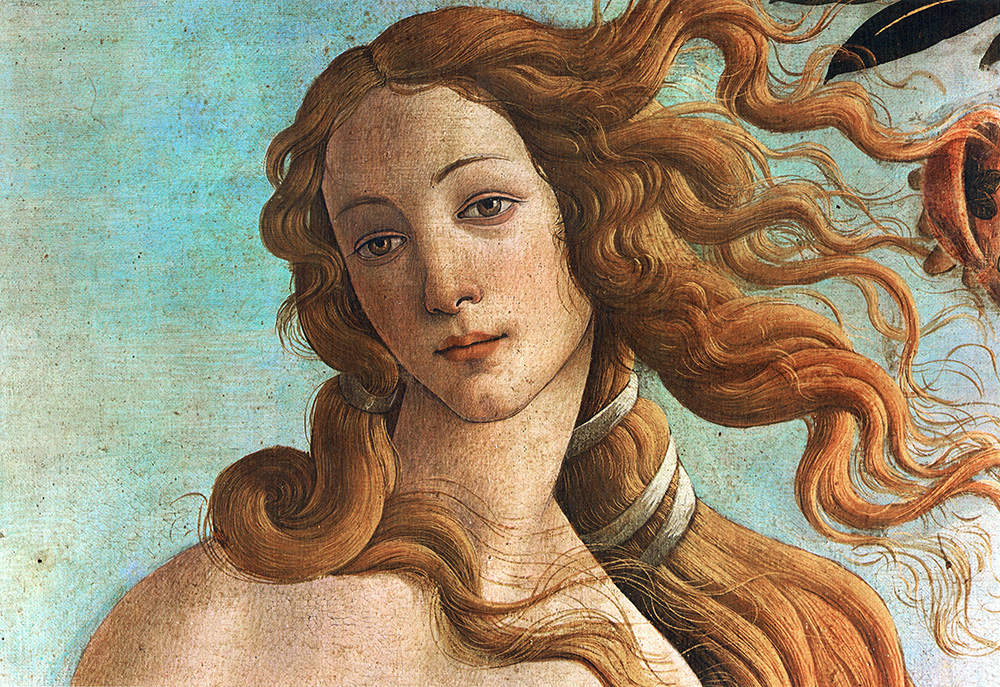
Detail of the Birth of Venus, Sandro Botticelli (1484-1486)
The fourteenth century began to allow for a broader spectrum of views about the goddess. Boccaccio, for example, wrote about Venus in numerous ways, drawing on Cicero's works to speculate about Venus Caelestis (Aphrodite Ourania), Venus Genetrix (Aphrodite Pandemos) and Venus Meretrix (the sexual aspect) as separate functions. His biography De mulieribus claris positions her as a mortal Queen of Cyprus turned into a goddess on account of her beauty. In the Decameron, she appears as the nominal head of the Seventh Day, where wives outwit their husbands and an atmosphere of charged eroticism prevails.60,61,62,63,64,65
Up in England, the Canterbury Tales represented Venus as a stern planetary deity who rules over the conspicuous joys and horrors of the passions. Her temple walls vividly display the dark costs of love: despair, weeping, burning desires, and the historical figures ruined by passion, such as Solomon and Turnus. The allegorization of Venus by Chaucer, however, shows some insight by harkening to her Platonic role.66
Those of the Florentine circle in the next centuuy altered the frame of Venus the most, Angelo Poliziano’s unfinished Stanze per la giostra, composed in connection with Giuliano de’ Medici’s tournament victory of 1475 and worked on through the later 1470s, made courtly celebrations into an elaborate mythological poem. Its descriptions of Venus’s realm and of images on the doors of her palace draw on the Homeric hymns, Hesiod, Ovid, Claudian and other ancient sources. The poem evokes Venus emerging from the sea, driven by winds towards the shore, attended by the Horae and modestly covering her body.67,68
Sandro Botticelli's painting of Venus from 1485, the Birth of Venus, is perhaps the most famous painting on earth after the Mona Lisa of Leonardo, showing evidence of knowing Poliziano's conventions. It is perhaps appropriate that the goddess Sappho immortalized as the artistic lover many centuries before became the subject of love's most enduring depiction. His other paintings draw on Boccaccio's characterization of the goddess.69,70,71,72,73,74
From this point Venus becomes a fixation of Western art. The sleeping Venus of Giorgione (1510) was one of the first female nudes to gain prominence, while Venus Anadyomene (1520) by Titian replicates the hair clutching statues of Ancient Greece. Titian's own nude, the Venus of Urbino (1534), set conventions in art. Paintings by him and others of Mars and Venus continued to elaborate on the theme up to the 18th century.75,76,77,78
Far from mere creative pursuits, however, a newer philosophical picture of Venus emerged, particularly in the writings of Marsilio Ficino. In his commentary on the Symposium of Plato commonly dated to 1469, adapted the two Aphrodites to a Platonic cosmology. The heavenly Venus signifies an intellectual power oriented towards divine beauty; the lower or “vulgar” Venus is associated with the generative power expressed through bodies. Although Ficino condemns disordered sensuality, corporeal love is not intrinsically demonic. Visible beauty can awaken desire, and desire can be redirected upwards towards the intelligible source of beauty.79,80,81
Sources and Bibliography
- de Vaan, Michiel. Etymological Dictionary of Latin and the Other Italic Languages. Leiden Indo-European Etymological Dictionary Series 7. Leiden: Brill, 2008. S.v. “venus.”
- Schilling, Robert. La religion romaine de Vénus depuis les origines jusqu’au temps d’Auguste. Bibliothèque des Écoles françaises d’Athènes et de Rome 178. Paris: E. de Boccard, 1954.
- Lommatzsch, Ernst, ed. Corpus Inscriptionum Latinarum. Vol. 1, 2nd ed., part 2, fasc. 1, Inscriptiones Latinae antiquissimae. Berlin: Georg Reimer, 1918. See I² 451 (VENERES POCOLOM) and I² 2495.
- Padilla Peralta, Dan-el. Divine Institutions: Religions and Community in the Middle Roman Republic. Princeton, NJ: Princeton University Press, 2020. See 204–6, 251–52.
- Blanchet, Hugo. “Graphie, syntaxe et théonymie des pocola deorum.” In Des mots pour les dieux: Dédicaces cultuelles dans les langues indigènes de la Méditerranée occidentale, edited by María José Estarán Tolosa, Emmanuel Dupraz, and Michel Aberson, 21–34. Études genevoises sur l’Antiquité 8. Bern: Peter Lang, 2021.
- Miano, Daniele. “Spreading Virtues in Republican Italy.” In Processes of Cultural Change and Integration in the Roman World, edited by Saskia T. Roselaar, 253–77. Mnemosyne Supplements 382. Leiden: Brill, 2015.
- Livy. History of Rome, Volume IV: Books 8–10. Translated by B. O. Foster. Loeb Classical Library 191. Cambridge, MA: Harvard University Press, 1926. See 10.31.9.
- Orlin, Eric M. “Foreign Cults in Republican Rome: Rethinking the Pomerial Rule.” Memoirs of the American Academy in Rome 47 (2002): 1–18.
- Dionysius of Halicarnassus. Roman Antiquities, Volume I: Books 1–2. Translated by Earnest Cary. Loeb Classical Library 319. Cambridge, MA: Harvard University Press, 1937.
- Beard, Mary, John North, and Simon Price. Religions of Rome. 2 vols. Cambridge: Cambridge University Press, 1998.
- Ovid. Fasti. Translated by James George Frazer. Revised by G. P. Goold. Loeb Classical Library 253. Cambridge, MA: Harvard University Press, 1989. See 4.133–164, 4.159–60, 4.863–900.
- Varro, Marcus Terentius. On the Latin Language. Translated by Roland G. Kent. 2 vols. Loeb Classical Library 333–334. Cambridge, MA: Harvard University Press, 1938. See 6.16, 6.20.
- Platner, Samuel Ball, and Thomas Ashby. A Topographical Dictionary of Ancient Rome. London: Oxford University Press, 1929.
- Richardson, Lawrence, Jr. A New Topographical Dictionary of Ancient Rome. Baltimore: Johns Hopkins University Press, 1992.
- Cassius Dio. Roman History, Volume VIII: Books 61–70. Translated by Earnest Cary. Loeb Classical Library 176. Cambridge, MA: Harvard University Press, 1925. See 69.4.
- Boatwright, Mary Taliaferro. Hadrian and the City of Rome. Princeton, NJ: Princeton University Press, 1987.
- Güven, Suna. “A Vision of Imperial Unity: The Temple of Venus and Roma.” METU Journal of the Faculty of Architecture 10, nos. 1–2 (1990): 19–30.
- Cassius Dio. Roman History, Volume IV: Books 41–45. Translated by Earnest Cary. Loeb Classical Library 66. Cambridge, MA: Harvard University Press, 1916. See 43.22.2.
- Ulrich, Roger B. “Julius Caesar and the Creation of the Forum Iulium.” American Journal of Archaeology 97, no. 1 (1993): 49–80.
- Appian. Roman History, Volume IV: The Civil Wars, Books 1–2. Edited and translated by Brian McGing. Loeb Classical Library 5. Cambridge, MA: Harvard University Press, 2020. See 2.102.
- Pliny the Elder. Natural History. Translated by H. Rackham. Loeb Classical Library. Cambridge, MA: Harvard University Press, 1938–1962. See 8.20–21, 15.119, 18.287.
- Aulus Gellius. Attic Nights, Volume II: Books 6–13. Translated by J. C. Rolfe. Loeb Classical Library 200. Cambridge, MA: Harvard University Press, 1927.
- Temelini, Mark A. “Pompey’s Politics and the Presentation of His Theatre-Temple Complex, 61–52 BCE.” Studia Humaniora Tartuensia 7.A.4 (2006): 1–14.
- Valerius Maximus. Memorable Doings and Sayings, Volume II: Books 6–9. Edited and translated by D. R. Shackleton Bailey. Loeb Classical Library 493. Cambridge, MA: Harvard University Press, 2000. See 8.15.12.
- Battiloro, Ilaria, Marcello Mogetta, et al. “New Investigations at the Sanctuary of Venus in Pompeii: Interim Report on the 2017 Season of the Venus Pompeiana Project.” Fasti Online Documents & Research 425 (2018): 1–37.
- Zanker, Paul. The Power of Images in the Age of Augustus. Translated by Alan Shapiro. Ann Arbor: University of Michigan Press, 1988.
- Van Haeperen, Françoise. “Ostie. Chapelle de l’autel des jumeaux (sacellum dell’ara dei gemelli; II, VII, 3).” In Fana, templa, delubra. Corpus dei luoghi di culto dell’Italia antica (FTD) 6: Regio I: Ostie, Porto. Rome: Collège de France, 2019.
- Plautus. Curculio. In Casina. The Casket Comedy. Curculio. Epidicus. The Two Menaechmuses, edited and translated by Wolfgang de Melo. Loeb Classical Library 61. Cambridge, MA: Harvard University Press, 2011.
- Livy. History of Rome, Volume II: Books 3–4. Translated by B. O. Foster. Loeb Classical Library 133. Cambridge, MA: Harvard University Press, 1922. See 3.48.
- Miano, Daniele. “Love, Death, and Funerals in Ancient Rome: On the Goddess Libitina.” Mortality 27, no. 2 (2022): 159–70.
- Plutarch. Roman Questions. In Moralia, Volume IV, translated by Frank Cole Babbitt. Loeb Classical Library 305. Cambridge, MA: Harvard University Press, 1936. See 23.
- Pausanias. Description of Greece. Translated by W. H. S. Jones and H. A. Ormerod. 5 vols. Loeb Classical Library. Cambridge, MA: Harvard University Press, 1918–35. See 9.16.3–4 (Aphrodite at Thebes).
- Takács, Sarolta A. Isis and Sarapis in the Roman World. Religions in the Graeco-Roman World 124. Leiden: Brill, 1995.
- Plutarch. Sulla. In Lives, Volume IV, translated by Bernadotte Perrin. Loeb Classical Library 80. Cambridge, MA: Harvard University Press, 1916.
- Homer. Iliad. Translated by A. T. Murray. Revised by William F. Wyatt. 2 vols. Loeb Classical Library 170–171. Cambridge, MA: Harvard University Press, 1999. See 24.25–30.
- Proclus. On Plato Cratylus. Translated by Brian Duvick. Ancient Commentators on Aristotle. London: Bloomsbury, 2007.
- Lucretius. On the Nature of Things. Translated by W. H. D. Rouse. Revised by Martin Ferguson Smith. Loeb Classical Library 181. Cambridge, MA: Harvard University Press, 1924. See 1.1–40.
- Virgil. Aeneid. Translated by H. Rushton Fairclough. Revised by G. P. Goold. 2 vols. Loeb Classical Library 63–64. Cambridge, MA: Harvard University Press, 1999–2000.
- Horace. Odes and Epodes. Edited and translated by Niall Rudd. Loeb Classical Library 33. Cambridge, MA: Harvard University Press, 2004. See 1.30, 4.1.
- Ovid. Metamorphoses. Translated by Frank Justus Miller. Revised by G. P. Goold. 2 vols. Loeb Classical Library 42–43. Cambridge, MA: Harvard University Press, 1916. See 10.238–739 (Pygmalion; Adonis).
- Simek, Rudolf. Dictionary of Northern Mythology. Translated by Angela Hall. Cambridge: D. S. Brewer, 1993. S.vv. “Frigg,” “Freyja,” “interpretatio germanica.”
- Rouvier-Jeanlin, Micheline. Les figurines gallo-romaines en terre cuite au Musée des Antiquités nationales. Gallia Supplément 24. Paris: CNRS, 1972.
- Green, Miranda J. Symbol and Image in Celtic Religious Art. London: Routledge, 1989.
- Cornutus, Lucius Annaeus. Greek Theology, Fragments, and Testimonia. Edited and translated by George Boys-Stones. Writings from the Greco-Roman World 42. Atlanta: SBL Press, 2018.
- Cicero, Marcus Tullius. On the Nature of the Gods; Academics. Translated by H. Rackham. Loeb Classical Library 268. Cambridge, MA: Harvard University Press, 1933. See De Natura Deorum 2.69, 3.62.
- Diogenes Laertius. Lives of Eminent Philosophers, Volume II: Books 6–10. Translated by R. D. Hicks. Loeb Classical Library 185. Cambridge, MA: Harvard University Press, 1925. See 7.147.
- Long, A. A., and D. N. Sedley. The Hellenistic Philosophers. 2 vols. Cambridge: Cambridge University Press, 1987. See 54.
- Degrassi, Attilio, ed. Inscriptiones Italiae. Volume XIII: Fasti et Elogia. Fasciculus 2: Fasti Anni Numani et Iuliani. Rome: Libreria dello Stato, 1963.
- Biblia Sacra iuxta Vulgatam versionem. Edited by Robert Weber and Roger Gryson. 5th ed. Stuttgart: Deutsche Bibelgesellschaft, 2007. See Ps. 95:5 and 1 Cor. 10:20.
- Augustine. The City of God against the Pagans. Translated by R. W. Dyson. Cambridge: Cambridge University Press, 1998. See especially Books II and XXI.6.
- Russell, Jeffrey Burton. Lucifer: The Devil in the Middle Ages. Ithaca, NY: Cornell University Press, 1984.
- Martin of Braga. “On the Correction of Country People.” In Iberian Fathers, Volume 1, translated by Claude W. Barlow, 71–85. Washington, DC: Catholic University of America Press, 1969.
- Ælfric of Eynsham. De falsis diis. In Homilies of Ælfric: A Supplementary Collection, edited by John C. Pope, vol. 2, 667–724. Early English Text Society 260. London: Oxford University Press, 1968.
- Isidore of Seville. The Etymologies of Isidore of Seville. Translated by Stephen A. Barney, W. J. Lewis, J. A. Beach, and Oliver Berghof. Cambridge: Cambridge University Press, 2006. See VIII.11.76–80.
- National Library of Wales. MS 735C, astronomical and computistical miscellany, probably Limoges, c. 1000. Aberystwyth.
- Guillaume de Lorris and Jean de Meun. The Romance of the Rose. Translated by Frances Horgan. Oxford: Oxford University Press, 1994.
- Guillaume de Lorris and Jean de Meun. Le Roman de la Rose. Edited by Félix Lecoy. 3 vols. Classiques français du Moyen Âge. Paris: Champion, 1965–70.
- Seznec, Jean. The Survival of the Pagan Gods: The Mythological Tradition and Its Place in Renaissance Humanism and Art. Translated by Barbara F. Sessions. Princeton, NJ: Princeton University Press, 1953.
- Panofsky, Erwin. Renaissance and Renascences in Western Art. 2 vols. Stockholm: Almqvist & Wiksell, 1960.
- Boccaccio, Giovanni. Genealogy of the Pagan Gods. Edited and translated by Jon Solomon. 2 vols. Cambridge, MA: Harvard University Press, 2011–17. See III.22–23, XI.
- Boccaccio, Giovanni. Famous Women. Edited and translated by Virginia Brown. Cambridge, MA: Harvard University Press, 2001. See chap. 7, “Venus, Queen of Cyprus.”
- Boccaccio, Giovanni. The Decameron. Translated by Wayne A. Rebhorn. New York: W. W. Norton, 2013.
- Mulryan, John. “The Three Images of Venus: Boccaccio’s Theory of Love in the Genealogy of the Gods and His Aesthetic Vision of Love in the Decameron.” Romance Notes 19 (1979): 388–94.
- Schreiber, E. G. “Venus in the Medieval Mythographic Tradition.” Journal of English and Germanic Philology 74, no. 4 (1975): 519–35.
- Chance, Jane. Medieval Mythography: From Roman North Africa to the School of Chartres, A.D. 433–1177. Gainesville: University Press of Florida, 1994.
- Chaucer, Geoffrey. The Riverside Chaucer. Edited by Larry D. Benson. 3rd ed. Boston: Houghton Mifflin, 1987. See The Knight’s Tale and The Parliament of Fowls.
- Poliziano, Angelo. The Stanze of Angelo Poliziano. Translated by David Quint. University Park: Pennsylvania State University Press, 1993.
- Warburg, Aby. “Sandro Botticelli’s Birth of Venus and Spring: An Examination of Concepts of Antiquity in the Italian Early Renaissance.” In The Renewal of Pagan Antiquity, translated by David Britt, 89–156. Los Angeles: Getty Research Institute, 1999. Originally published 1893.
- Gallerie degli Uffizi. “The Birth of Venus,” by Sandro Botticelli, c. 1485. Collection catalogue entry. Florence: Gallerie degli Uffizi.
- Gallerie degli Uffizi. “Spring” (Primavera), by Sandro Botticelli, c. 1480. Collection catalogue entry. Florence: Gallerie degli Uffizi.
- Sappho. “Hymn to Aphrodite” (fr. 1). In Greek Lyric, Volume I: Sappho and Alcaeus, edited and translated by David A. Campbell. Loeb Classical Library 142. Cambridge, MA: Harvard University Press, 1982.
- Gombrich, E. H. “Botticelli’s Mythologies: A Study in the Neoplatonic Symbolism of His Circle.” Journal of the Warburg and Courtauld Institutes 8 (1945): 7–60.
- Dempsey, Charles. The Portrayal of Love: Botticelli’s “Primavera” and Humanist Culture at the Time of Lorenzo the Magnificent. Princeton, NJ: Princeton University Press, 1992.
- Lightbown, Ronald. Sandro Botticelli: Life and Work. 2 vols. Berkeley: University of California Press, 1978.
- Gemäldegalerie Alte Meister. “Sleeping Venus,” by Giorgione (and Titian), c. 1508–10. Collection catalogue entry. Dresden: Staatliche Kunstsammlungen.
- Gallerie degli Uffizi. “Venus of Urbino,” by Titian, 1538. Collection catalogue entry. Florence: Gallerie degli Uffizi.
- National Gallery. “Venus and Mars,” by Sandro Botticelli, c. 1485. Collection catalogue entry. London: National Gallery.
- Bull, Malcolm. The Mirror of the Gods: How Renaissance Artists Rediscovered the Pagan Gods. Oxford: Oxford University Press, 2005.
- Ficino, Marsilio. Commentary on Plato’s Symposium on Love. Translated by Sears Jayne. 2nd ed. Dallas: Spring Publications, 1985.
- Plato. Symposium. Translated by Alexander Nehamas and Paul Woodruff. Indianapolis: Hackett, 1989. See 180d–181e.
- Wind, Edgar. Pagan Mysteries in the Renaissance. Rev. ed. New York: W. W. Norton, 1968.