













| Language or Culture | Name | Earliest Secure Attestation |
|---|---|---|
| Etruscan | 𐌕𐌖𐌓𐌀𐌍 (Turan) | Gravisca Inscription (sixth to fifth century BCE) |
14 min read
TURAN
author: High Priest Zevios Metathronos
co-author: Novice Priest Karnonnos
Hieratic Information about Turan
| Divine Symbols | |
|---|---|
|
I. The Name
Turan was the Etruscan goddess of love, and unlike many other imported deities here, was possibly a native to her own name's root. The name appears as Turán, while in votive inscriptions found at her primary sanctuary, the genitive form of the name has been recorded both as Túruns and Turns, as well as another version (Turún). The likely etymology for this name would derive from the Etruscan verb tur- "to give" or "to consecrate", along with an agent noun suffix, thus; Turan means "the donor/giver" or "she who provides, donates"; appropriate for a goddess of desire, and exemplified by her sanctuary through the language of donation.1,2
A second derivation that includes a possible Greek origin for her name was proposed by Clemen (1940), according to which Turan derives from the dative case tāi Ouraniāi ("the heavenly one") which was a title for Aphrodite Ourania, who became transformed into an Etruscan-sounding form due to heavy Greek influence in Etruria throughout the 7th and 6th centuries BCE. The two derivations represent two different interpretations of how Etruscans viewed Turan; either she was an Etruscan deity that adopted elements of the mythological narrative of Aphrodite Ourania, or alternatively, she represents a very early adaptation of the Aphrodite mythology in Etruria, such that it has developed distinctively Etruscan characteristics. On the other hand, other viewpoints derive her name from τύραννος (tyrannos) through 𐌕𐌖𐌓𐌏𐌍 ('lady', probably a loanword from Greek) or even from the word for Etruscan in Greek (Τυρρηνός, Tyrhennian).
She is often compared to the goddesses Aphrodite (Greece) and Venus (Roman). One of her titles makes this comparison a part of the actual worship. The title "Turan Ati", or "Mother Turan" appears in an inscription that some have interpreted as a pre-Venus Genetrix Etruscan title for Mother Ancestor. Her month corresponds to our July. The Latin equivalent of her name survives to this day as Traneus. There are inscriptions from the sixth and fifth century BCE, that document her as being worshipped. They were found at the temple at Tarquinia and represent votives. Additionally, she appeared on engraved mirrors that date back to those centuries and beyond.1,3
Sources: the Etruscan religion overview for the Gravisca inscriptions and the genitive forms;1 the etymology, native and Greek, and the month-name;2 the reading of Turan ati against Venus Genetrix.3
II. The Goddess of the Mirror-Back
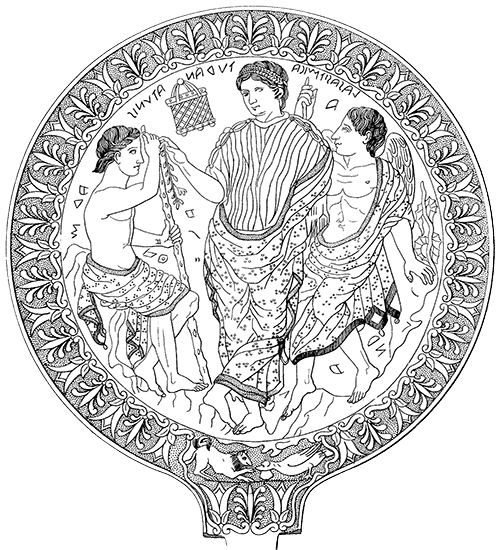
Turan is basically the Etruscan goddess of the mirror. Her domain as the Etruscan goddess of beauty and love means that it was through the polished mirror (the "instrument" or tool) used for reflection to determine one's beauty where Turan would be represented. As such, Turan's representation would appear at least more frequently than most any other deity depicted on these mirrors, with the depiction scenes involving her representing the greatest surviving collection of Etruscan mythology, because no narrative texts have survived from the Etruscans. In many ways, the Etruscans were a civilization that had Venusian characteristics.4
Early and late representations are that of a young winged female; dressed in ornate robes, decorated in jewelry, and winged which signifies her divinity. During the third and second century BCE, under Hellenistic artistic influences, she was represented as a naked female (like the Greek goddess Aphrodite) from then onward. The sacred birds attending to her include the dove, the goose and most importantly the swans. One swan has been named, Tusna or "the swan of Turan", while a retinue of winged servants wait upon her.4,5
The Judgement of Paris
The Etruscan equivalent of the "Judgment of Alexandros" (Paris) is by far the most common mythological subject that she is shown in. In the Etrussian version of the myth, the Trojan prince, named Elcsntre or Elachsantre in Etruria, sits upon a rock, while the three goddesses are presented before him; these are Uni, the Etruscan Juno, Menrva, the Etruscan Minerva, and Turan. As depicted in some of the Etrussian mirrors from as early as the late fourth century BCE, Turan is chosen by Paris, and she is also typically easy to identify in depictions because while the other two goddesses present themselves with dignified posture, Turan lifts up her skirt to show off her knee-high boots and legs, thus presenting herself as the goddess of love and visible beauty.5
Turan and Atunis
The Etruscans clearly put large stock in the myth of Turan and Atunis (the Etruscan Adonis). Therefore, this is the scene which best defines her. In the mirrors we see Turan and Atunis embracing. We also see the young man, at times half naked but wearing amulets, either on the lap of the goddess or sharing a bed with her. A bird is near them as well as the swan Tusna. Some of the mirrors depict Turan and Atunis, accompanied by an array of winged figures representing various aspects of their relationship; other mirrors simply show the pair surrounded by laurels and name the two lovers.
The Etruscans adapted the Greek myth of Adonis, who was the handsome youth loved by Aphrodite and died too soon in life, and altered its themes to include domesticity and the inevitable fate of death. Therefore, while the mirrors depicting Turan and Atunis convey a sense of tender affection towards each other, they are ultimately imbued with the same mortuary significance that led to the placement of those mirrors in tombs.6
The Wider Company
Turan is depicted at the adornment of brides and at the toilette, the divine reason for a woman's use of her mirror. In assemblies with Tinia and Uni, and Hercle and Menrva, she is often shown too. With the Dioscuri (the sons of Tinia) and the Tinas Cliniar (or "sons of Tinia") she is often depicted and on some mirrors, Turan can be seen as the lover of Laran, the war god. Women named Zipna, Munthuch, Mean and Alpan are often placed around her along with the winged nymphs referred to as Lasas, probably equivalent to the Erotes, but in Etruscan scenes, they appear to be attendants who are figures of Fate and ancestral worship.5,6
These "companions" or "assistants" within the mirrors and how they were interpreted by many is in question. The people surrounding Turan are not characters in a tale; instead, each one represents an aspect of what love gives, as Nancy de Grummond noted that these are representations of wealth and good fortune. Therefore, with a Turan mirror, an Etruscan woman was not just getting a picture of the goddess, she was also acquiring a small amount of the goddess's magic because, essentially, she could obtain beauty and plenty with the same object she used daily.7
III. Her Aspects
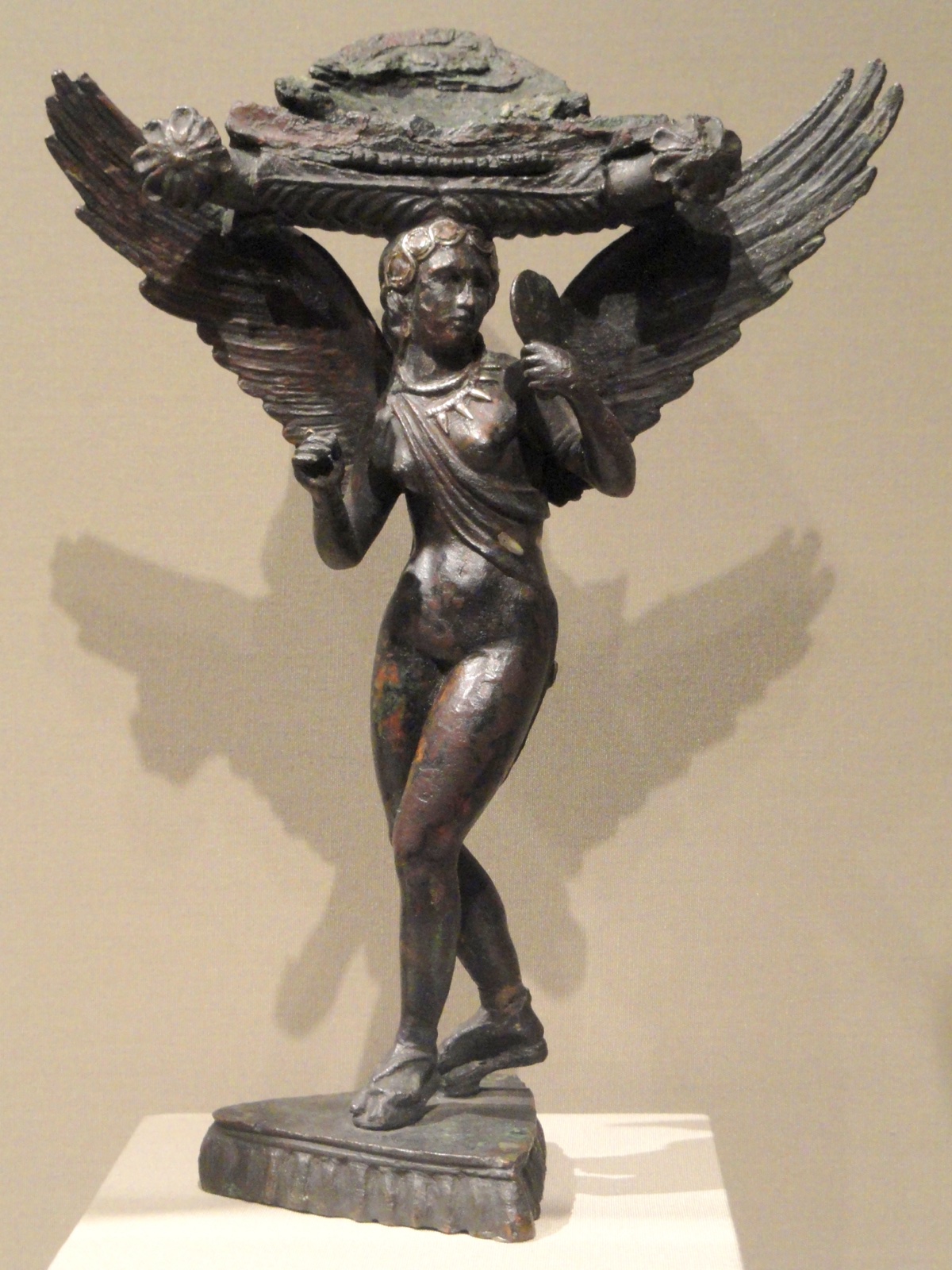
Lasa (patera support), 300-280 BC, Etruscan, bronze with silver inlays, Cleveland Museum of Art
| Epithet | Meaning | Domain |
|---|---|---|
| Turan Ati | Turan the Mother | Mother of Goddesses |
Sources:
The primary epithet of Turan is Turan Ati, assumed to mean Turan the Mother. Other epithets are functionally unknown.
IV. Her City, Her Sanctuary, and Her Cult
Turan is exceptional on the other hand for being one of the few Etruscan divine figures to have an area of worship that was both known and documented. This kind of attribution is highly rare among Etruscan deities, about whom we know only so much.
Velch
Turan was the patron of Velch (the Roman name for which was Vulci) the Etruscan city in the coastally located region of southern Etruria. It was one of the largest cities in southern Etruria and it was primarily a production site for bronze mirrors. The sheer volume of Turan mirrors found in burial sites and sanctuaries is evidence that the city and the goddess were tightly linked. Holding a Turan mirror made by the craftsmen of Vulci was a way to possess both a representation of their work and an icon of their goddess.2,9
Velch was known as one of the wealthiest cities in Italy prior to Roman expansion. It was the leading city of a confederation of six other city states. The lion's share of notable Etruscan art is from the tombs of Velch, one of the most fertile sites for archeological finds of Antiquity in general. The Temple
Gravisca
Where she is best represented in terms of her cult is not at Vulci, however; rather it is at Gravisca (the port for Tarquinia), which is located near the Etruscan coastline along the Tyrrhenian Sea approximately ten kilometers from the city to which it provided service. Gravisca was an emporium. In this sense, it was a trading post, where Greek merchant vessels from the Eastern Mediterranean would exchange their goods with the local Etruscans under th protection of the deities who were believed to guarantee the sanctity of the sacred area. The site was excavated by M. Torelli and F. Boitani between 1968-79 so as such, it provides us with our best evidence of cult practices among the Etruscans.8,10
The temple's earliest shrine was built ca. 590–480 BCE during which time the shrine was primarily frequented by eastern Greeks who made many sacrifices to Hera using the Ionic dialect and writing system. They also established an aniconic votive offering to Apollo of Aegina around 500BCE through a man named Sostratos. This is very likely the same individual referred to by Herodotus as the person who made the greatest profits of all Greek merchants of that era. There are over 1,000 Greek oil lamps and large amounts of Attic, East Greek, Laconian, and Corinthian ceramics, etc., that reflects the port's volume of activity. When the Greeks founded this temple, they brought the Etruscan face of the Aphrodite worshipped by the Greek traders to the temple.8,10,11
Turun is spelled as Turan in the inscriptions found at Gravisca and was one of the most commonly invoked deities at Gravisca during the Etruscan period. During this time, the sanctuary associated with Turan was specifically concerned with female fertility as indicated by both the objects placed within it and the texts produced by those placing them there. The clearest example of these inscribed texts are the ceramic objects containing inscriptions that indicate both the deity being honored and the person making the offering. The clearest of these is a kylix of the late fifth or early fourth century BCE bearing the words turns turce ramθa venatres, "belonging to Turan; Ramtha Venatres gave this," the dedication of a woman, or as Torelli read it a servant, naming the goddess and the giver in the plainest terms. The simplicity of this text is evident when looking at the two words: turce = "gave"; turan = "the giver".
The Tomb of Atunis
Within the plan of the seashore sanctuary the excavators identified a cult of Adonis, the Atunis of the mirrors, complete with a symbolic "tomb" of the god that Torelli and Lucio Fiorini connected to the summer solstice, the season of the Greek Adonia with its gardens and its mourning for the dying youth. The cult of Adonis proved the most durable thing at the site: after Rome destroyed Gravisca in 281 BCE, it was the Adonis cult, alone of all the sanctuary's rites, that is said to have been revived. So the cult that the mirrors show as an embrace was, at Gravisca, a cult with a place and a calendar too.
Veii and the Shared Temple
Turan's worship reached inland as well. At Veii, in the great sanctuary of Portonaccio, she is thought to have shared a temple with Menrva and probably a third divinity, likely Aritimi or Aplu, in a building of three chambers on the model that Rome would later raise for the Capitoline triad. A shared cella in a triple temple is a different order of evidence from a mirror in a tomb: it places Turan in the formal, civic religion of a major Etruscan city, not only in the private devotion of women and lovers.4
V. Unique Aspects
Turan is with Aritimi, Fufluns, and Persipnei among the Etruscan gods who wear a Greek identity, but like Fufluns she wears it in a way that lets the native goddess show through at times.
The differences between Aphrodite and Turan are numerous. Mythologies of hers are strange (Lasas who were also the Fates, plus Zipna, Munthuch, Mean and Alpan) which are not from Greek mythology. Her role as a mother goddess, her title "Turan Ati". Her being known as such both opposes and supports the idea of Aphrodite as the Greek goddess of love, but points more towards Venus Genetrix. The name itself is likely her own term to describe what she does, to give. Having the goddess of love be put into tombs was a unique Etruscan twist on the Greek version of her which they kept alive, but possibly is connected to Persephone and the Roman funerary cult of Venus Libitina, as well as the Roman practice of representing noblewomen as Venus in their funerary grounds and gardens.3,4,5,6
Sources and Bibliography
- de Grummond, Nancy Thomson. Etruscan Myth, Sacred History, and Legend. Philadelphia: University of Pennsylvania Museum of Archaeology and Anthropology, 2006. Cited for the genitive forms turuns and turns and the variant turun, the Gravisca kylix of Ramtha Venatres reading turns turce ramθa venatres, Turun as one of the most frequently invoked deities at the sanctuary, its association with female fertility, and the title Turan ati.
- Bonfante, Giuliano, and Larissa Bonfante. The Etruscan Language: An Introduction. Rev. ed. Manchester: Manchester University Press, 2002. Cited for the derivation of the name from the verb tur, "to give," against the alternative loan from Greek tāi Ouraniāi, her patronage of the city of Velch (Vulci), her absence from the Liver of Piacenza and from Martianus Capella's list, and the month-name Traneus.
- de Grummond, Nancy Thomson, and Erika Simon, eds. The Religion of the Etruscans. Austin: University of Texas Press, 2006. Cited for the inscription Turan ati, "Mother Turan," and its interpretation as an Etruscan counterpart to the Roman Venus Genetrix, the ancestral mother of Aeneas.
- Bonfante, Larissa, and Judith Swaddling. Etruscan Myths. The Legendary Past. London: British Museum Press; Austin: University of Texas Press, 2006. Cited for Turan as a young winged woman on the engraved mirrors, her dominance of the mirror corpus, the sacred birds including the swan Tusna, the myrtle, the toilette and bridal scenes, the assemblies with Tinia and Uni and Hercle and Menrva, and the shared three-chamber temple with Menrva at the Portonaccio sanctuary of Veii.
- de Grummond, Nancy Thomson. "The Mirror." In The Religion of the Etruscans, edited by Nancy Thomson de Grummond and Erika Simon, 27–44. Austin: University of Texas Press, 2006. Cited for the Judgement of Paris with Elcsntre and the goddesses Uni, Menrva, and Turan, Turan lifting her skirt to display her boots, the late-fourth-century mirror of the scene, the Hellenistic nudity of the third and second centuries BCE, her pairing with Laran, the Dioscuri as Tinas Cliniar, and the attendants Zipna, Munthuch, Mean, Alpan, and the Lasas.
- de Grummond, Nancy Thomson. "For the Mother and for the Daughter: Some Thoughts on Dedications from Etruria and Praeneste." In ΧΑΡΙΣ: Essays in Honor of Sara A. Immerwahr, edited by Anne P. Chapin, 351–70. Hesperia Supplement 33. Athens: American School of Classical Studies at Athens, 2004. Cited for the mirror scenes of Turan and Atunis, their embrace and shared bed, the amulets of the youth, and the Etruscan turning of the Adonis myth toward domesticity and death and its funerary use in tombs.
- de Grummond, Nancy Thomson. "Etruscan Personified Abstractions and the Iconography of Turan." In Etruscan Studies (De Gruyter), cited for the argument that the named women around Turan personify prosperity and good fortune and confer those qualities on the owner of the mirror. Source to be verified by the author against the specific volume and page.
- Torelli, Mario. "Il santuario greco di Gravisca." La Parola del Passato 32 (1977): 398–458. Cited for the emporic sanctuary at Gravisca as the seaport of Tarquinia, its identification as a trading station under divine protection, the worship of Turan there tied to female fertility, and the interpretation of the Ramtha Venatres dedication.
- Haynes, Sybille. Etruscan Civilization: A Cultural History. Los Angeles: J. Paul Getty Museum, 2000. Cited for Vulci as a leading city of southern Etruria and the principal center of Etruscan bronze-mirror production, from which the great mass of Turan mirrors derives.
- Torelli, Mario, and Francesca Boitani. Gravisca: Scavi nel santuario greco. Bari: Edipuglia, 1969–. Cited for the excavation of Gravisca between 1969 and 1979, the earliest East Greek shrine of c. 590–480 BCE with its dedications to Hera, the aniconic votive to Apollo of Aegina by Sostratos, and the Greek lamps and imported pottery attesting the traffic of the emporion.
- Herodotus. The Persian Wars. Translated by A. D. Godley. 4 vols. Loeb Classical Library 117–120. Cambridge, MA: Harvard University Press, 1920–25. Cited: 4.152, for Sostratos of Aegina as the Greek trader who made the greatest profit of any of his time, identified with the dedicator of the Gravisca anchor-stock to Apollo.
- Fiorini, Lucio, and Mario Torelli. "Quarant'anni di ricerche a Gravisca." In Material Aspects of Etruscan Religion: Proceedings of the International Colloquium, Leiden, May 29 and 30, 2008, edited by L. Bouke van der Meer, 29–49. BABesch Supplement 16. Leuven: Peeters, 2010. Cited for the cult of Adonis at Gravisca with its symbolic tomb tied to the summer solstice, the survival of the Adonis cult after the Roman destruction of 281 BCE, and Torelli's argument for sacred prostitution at Gravisca and Pyrgi read from the servile dedications.