




13 min read
The Cat of Bastet
author: High Priest Zevios Metathronos
αἴλουρος (aílouros)
The animal of Bastet, Artemis and Freyja, and the form of Ra who slays Apep: sight in the dark.
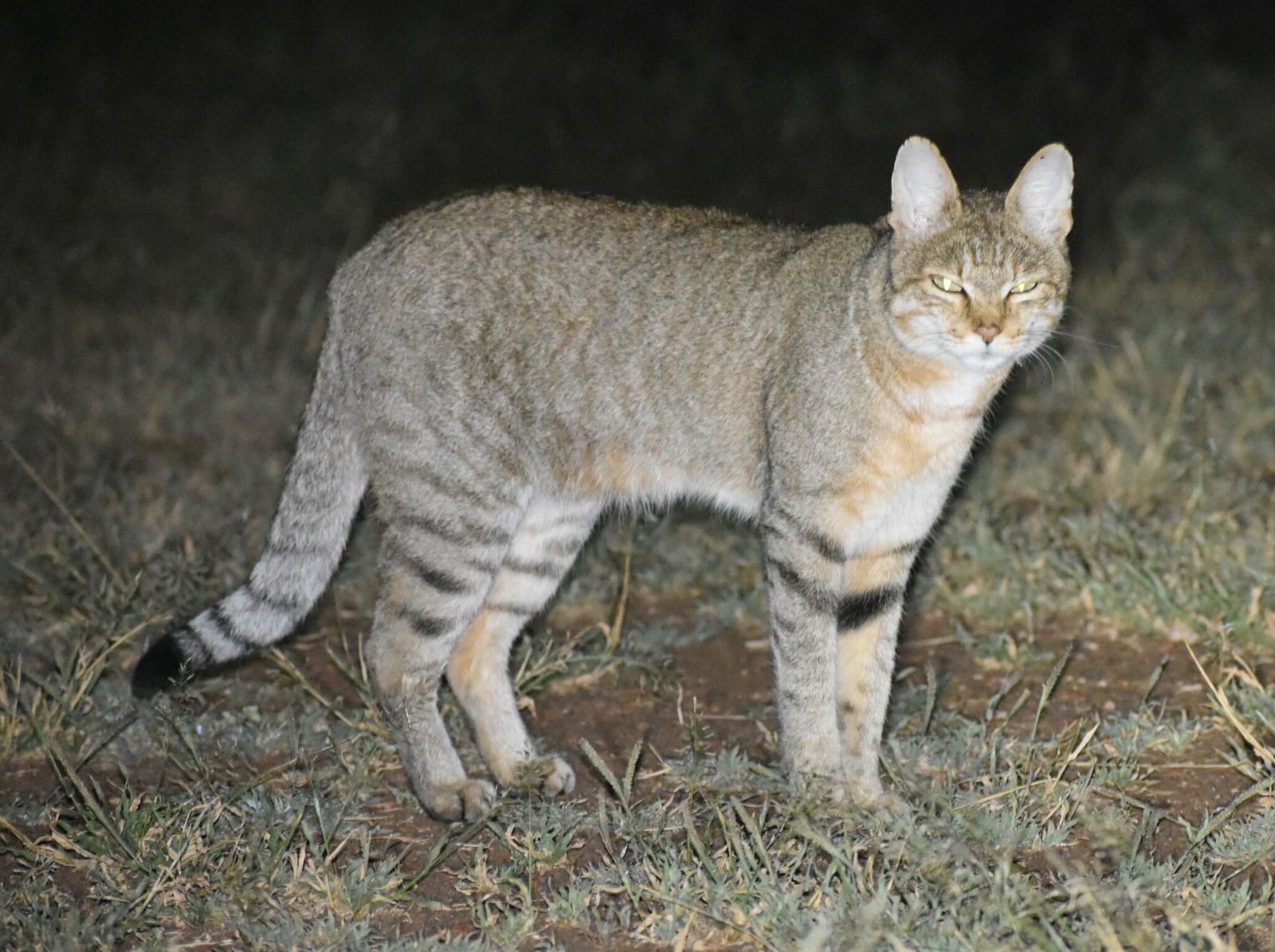
Justin Ponder · CC BY 4.0 · Wikimedia Commons

The cat is the animal of Bastet of Bubastis, whom Herodotus calls Artemis, and the form in which Ra cuts down the serpent of chaos at Heliopolis. Its eyes gather light in the dark and its body rights itself in a fall, and both capacities are lessons for the soul.
| Realm | Beasts of the Earth |
|---|---|
| Greek | αἴλουρος (aílouros); Herodotus writes αἰέλουρος |
| Latin | feles |
| Other Names | African wildcat; domestic cat |
| Species | Felis lybica (African wildcat), ancestor of the domestic cat |
| Gods | Bastet, Ra (the Great Cat), Artemis, Diana, Freyja |
| Material Capacity | Eyes that shine and see in dim light; hearing to about 64,000 Hz; the righting turn in a fall |
| Spiritual Capacity | Sight in darkness, vigilant calm, and the armed guardianship of Ma'at |
| Element and Sphere | Fire and Night; the Sun at Heliopolis and the Moon of Artemis; the threshold of the house |
The Living Animal
Every house cat descends from a wild ancestor, and domestic cats are thought to come from the African wildcat[1], Felis lybica, also classed as Felis silvestris lybica[2]. Wildcat females average 2.7 to 4 kg, the body runs 500 to 750 mm and the tail 210 to 350 mm[1]. Wildcats live alone, hunt mainly small rodents, and the males mark their ranges with urine; 1 African wildcat was recorded holding a home range of 4.3 square kilometres[1].
Ancient DNA traces how the wildcat came into the house. The cat's conquest of the world began in the Neolithic of the Near East and gained momentum in the Classical period, when the Egyptian cat spread through the Old World; both the Near Eastern and the Egyptian populations of Felis silvestris lybica contributed to the domestic cat at different times[2]. The expansion followed human routes of trade by sea and land[2].
The cat's eyes are built for the half-light, adapted to hunt just after dusk and before dawn[1]. Behind the retina lies the tapetum lucidum, a reflective layer that gives the photoreceptors a second chance to catch each photon and so improves sight in dim light; in the cat family it is a layer of guanine, and it makes the eyes shine at night when light falls on them[3].
Its hearing reaches far past the human range. Cats hear from about 45 to 64,000 Hz, against about 64 to 23,000 Hz for humans and 67 to 45,000 Hz for dogs[4], and the ears can rotate rapidly to fix the source of a sound[1].
A falling cat turns in the air and lands on its feet. In 1894 Nature reported the photographs that Marey had taken of a tumbling cat to determine the mechanical conditions which enable the animal to alight on its feet, figures presented with his paper to the Paris Academy[5].
The Spiritual Capacity
In Egypt the cat belongs to Bastet of Bubastis, a Goddess shown first as a lioness and later as a cat, the daughter of Re, whose worship began at Bubastis in the Delta and flourished also at Memphis; She appears as a woman with a cat's head holding a sistrum[6]. Herodotus states it plainly: "Bubastis in the Greek tongue is Artemis"[7]. In the Temple's teaching Artemis is Diana, and Bastet answers to Her in Egypt, as Herodotus saw: the cat is the animal of all 3. See Bastet, Artemis and The Sistrum; the lioness, the form of Sekhmet, belongs to the page of The Lion.
The cat is also the Sun God's own fighting form. In chapter 17 of the Book of the Dead the speaker names himself "the Cat which fought (?) by the Persea tree hard by in Annu, on the night when the foes of Neb-er-tcher were destroyed," and the gloss answers that "the male cat is Ra himself"[8]. In the Temple's teaching Ra is Amon Ra[9], and Amun is Zeus: the Great Cat of Heliopolis is the Head God in His solar sovereignty, cutting down Apep, the serpent of Izfet (see The Serpent). See Amon Ra.
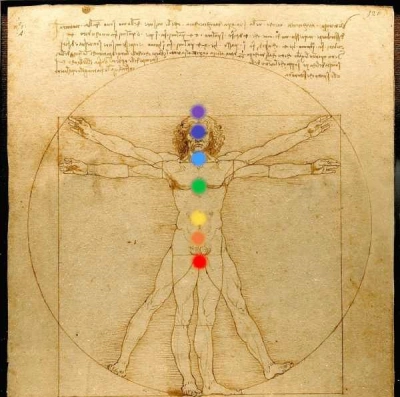
The faculty the cat reveals is sight in darkness. The cat moves without fear where others see nothing, because its eye gathers the faintest light and returns it; in the soul this is the work of the 6th chakra, the Third Eye. Darkness is positive when bound by Ma'at, and the cat is the creature that keeps its order inside the dark, watching for the agents of dissolution and striking them down.
Its second faculty is return to the centre. Thrown off balance, the cat turns in mid-air and lands on its feet; the Zevist reads this as the soul that, struck from its axis, rights itself around the solar chakra, the inner Sun of Ra. Bastet's gentleness and the Great Cat's knife are 1 power: the household kept in peace because the guardian of the threshold is armed.
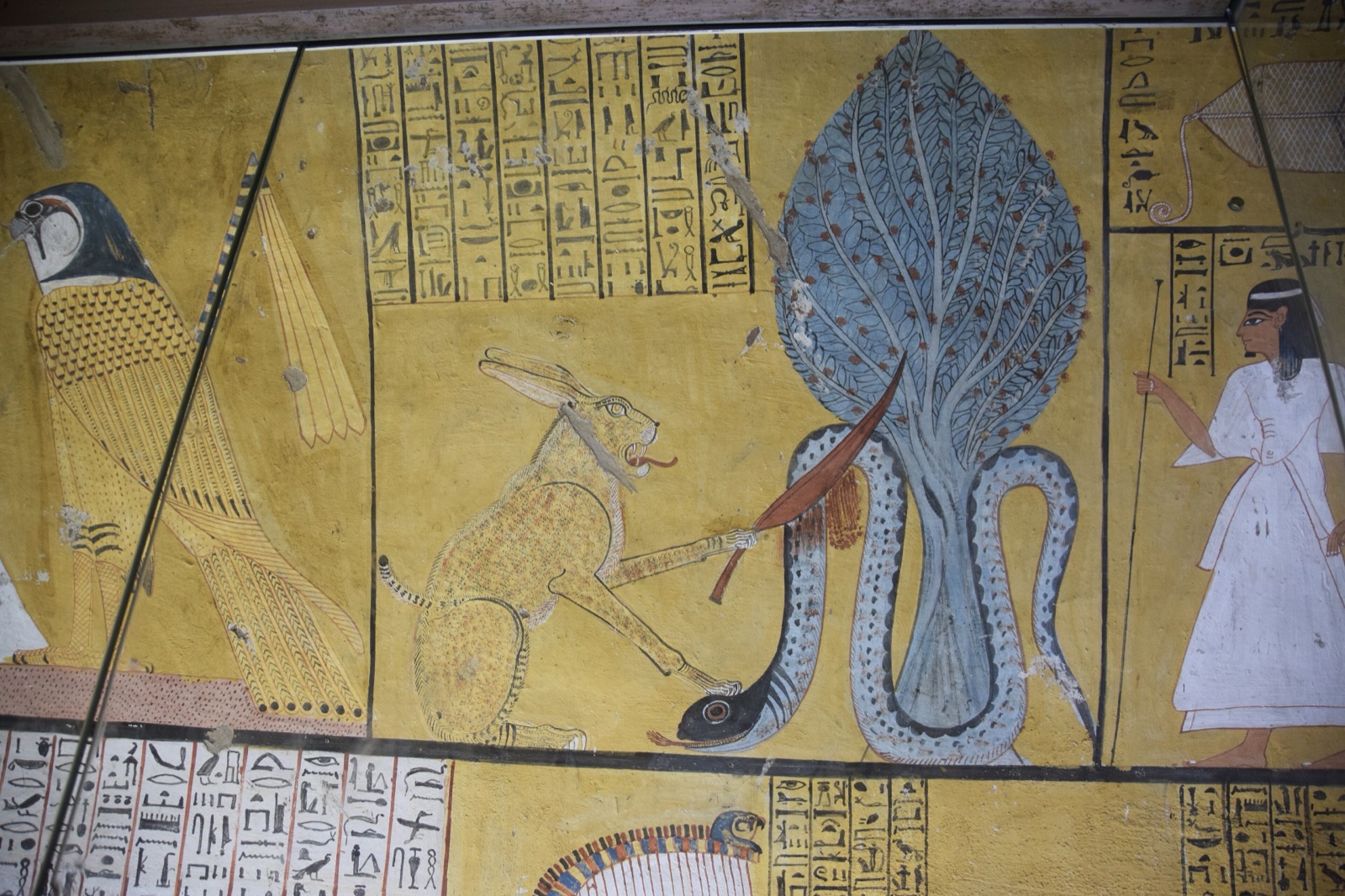
Mig Gilbert · CC BY-SA 2.0 · Wikimedia Commons

Where Matter and Spirit Meet
Each capacity of the living cat is the visible form of a power that Bastet, Artemis and Ra exercise in the soul.
- The shining eye and the Third Eye. The tapetum lucidum returns light through the retina a second time and makes the eye shine in the dark[3]. The Third Eye works the same way: it takes the faint light of what is hidden and doubles it, until the soul sees where the outer eye is blind.
- Hearing beyond the human range and the subtle sense. The cat hears up to about 64,000 Hz, almost 3 times the human ceiling[4]. The Zevist trains the same subtlety in the aura: the perception of what is spoken below the threshold of ordinary attention.
- The righting turn and Arete. Marey's photographs showed the falling cat organising itself in the air until it alights on its feet[5]. Arete, the vehicle by which the soul rises, is this capacity in the moral order: the trained power to recover the true orientation after every fall.
- The rodent hunter and the guardian of Ma'at. The wildcat lives mainly on small rodents[1]. At the scale of the household, the cat removes the small agents of decay; at the scale of the cosmos, Ra as the Great Cat removes Apep. The same office runs from the granary floor to the persea tree of Heliopolis.
- The solitary hunter and the sovereign soul. Wildcats are solitary animals[1]. The cat's self-possession is the image of the soul that stands in its own centre, keeps company by choice and depends on no crowd for its direction.
The Gods and Their Many Names
The cat gathers round Goddesses whom the ancients themselves joined, and Herodotus states the key equation. He calls the Goddess of Bubastis Artemis[7], names Bubastis as the city of the chief and most zealous festival of Egypt, held for Artemis[10], and gives the Egyptian equation directly: "Artemis is Bubastis"[11].
| Civilization | God (and the Temple's identity) | The Bond with the Animal | Witness |
|---|---|---|---|
| Egypt, Bubastis | Bastet (whom Herodotus calls Artemis) | Lioness, then cat; cat-headed woman with the sistrum; great cemeteries of mummified cats at Bubastis and Memphis | Encyclopaedia Britannica, "Bastet"[6] |
| Egypt, Heliopolis | Ra (Amon Ra, Zeus) | "The male cat is Ra himself," who fights by the persea tree in Annu | Book of the Dead 17, trans. Budge[8] |
| Hellas (Herodotus) | Artemis | Bubastis, the Goddess of the cat city, is Artemis in the Greek tongue | Herodotus 2.137.5[7] |
| Rome | Diana, sister of Phoebus (Artemis) | When Typhon assailed the Gods, Diana hid in the form of a cat | Ovid, Metamorphoses 5.330[12] |
| Roman Italy | Bastet | Her cult was carried to Italy, with traces at Rome, Ostia, Nemi and Pompeii | Encyclopaedia Britannica, "Bastet"[6] |
| Scandinavia | Freyja, daughter of Njord | When She travels, She drives 2 cats and sits in a chariot | Snorri, Gylfaginning 24[13] |
The chain is unbroken. Bastet is Artemis in Herodotus; Artemis is Diana in Rome; and Ovid, telling the flight of the Gods into Egypt, gives the cat to "soror Phoebi", the sister of Apollo, as if he were translating the temple of Bubastis into Latin verse[12]. Above Them stands Ra, the Great Cat, whom the Temple knows as Amon Ra, the Head God.
In the north the same animal draws the chariot of Freyja, whose father Njord the Temple identifies with Poseidon[13]. The cat recurs because its powers recur in the divine: night-sight, silence, the sudden strike against what threatens order. Where a people saw those powers in a Goddess or in the Sun, they gave Her or Him the cat.
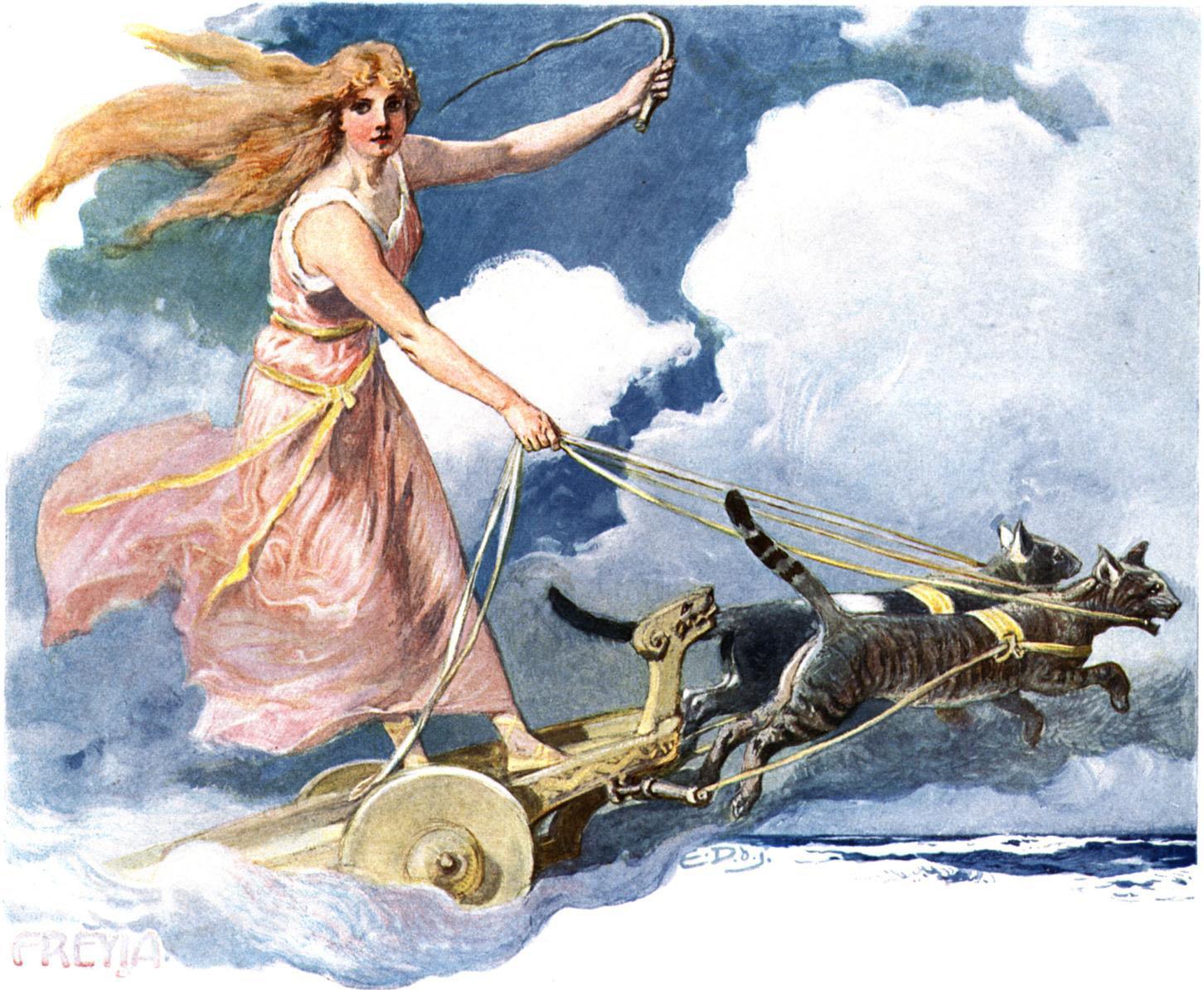
Emil Doepler · Public domain · Wikimedia Commons

Ancient Witnesses
The witnesses come from Greek, Latin, Egyptian and Old Norse sources. Herodotus gives the mourning for a cat and the identity of Bubastis, Ovid the Gods hidden in animal forms, the Book of the Dead the Great Cat of chapter 17 in Budge's translation, and Snorri the cats of Freyja.
Herodotus, Histories 2.66.4 [14]
ἐν ὁτέοισι δʼ ἂν οἰκίοισι αἰέλουρος ἀποθάνῃ ἀπὸ τοῦ αὐτομάτου,
οἱ ἐνοικέοντες πάντες ξυρῶνται τὰς ὀφρύας μούνας,In whatever houses a cat dies a natural death, all who live there shave their eyebrows only.
Herodotus, ed. A. D. Godley (Perseus Digital Library) · Translation: Temple of Zeus.
Herodotus, Histories 2.137.5 [7]
ἐν τῇ καὶ ἱρόν ἐστι Βουβάστιος ἀξιαπηγητότατον·
μέζω μὲν γὰρ ἄλλα καὶ πολυδαπανώτερα ἐστὶ ἱρά, ἡδονὴ δὲ ἰδέσθαι οὐδὲν τούτου μᾶλλον.
ἡ δὲ Βούβαστις κατὰ Ἑλλάδα γλῶσσαν ἐστὶ Ἄρτεμις.In this city is a temple of Bubastis most worthy of description: other temples are larger and more costly, but none is more pleasing to look at. Bubastis in the Greek tongue is Artemis.
Herodotus, ed. A. D. Godley (Perseus Digital Library) · Translation: Temple of Zeus.
Ovid, Metamorphoses 5.329-331 [12]
Delius in corvo, proles Semeleia capro,
fele soror Phoebi, nivea Saturnia vacca,
pisce Venus latuit, Cyllenius ibidis alis.”The Delian hid in a crow, the son of Semele in a goat, the sister of Phoebus in a cat, the daughter of Saturn in a snow-white cow, Venus in a fish, the Cyllenian in the wings of an ibis.
Ovid, Metamorphoses, ed. H. Magnus (Perseus Digital Library) · Sung by the Pierid challenger of the Muses. The Delian is Apollo, the son of Semele Bacchus, the sister of Phoebus Diana, the daughter of Saturn Juno, the Cyllenian Mercury. Translation: Temple of Zeus.
Book of the Dead, chapter 17, Papyrus of Ani (British Museum EA 10470) [8]
I am the Cat which fought (?) by the Persea tree hard by in Annu, on the night when the foes of Neb-er-tcher were destroyed.
What then is this? The male cat is Ra himself, and he is called MaauE. A. Wallis Budge, The Book of the Dead: The Papyrus of Ani (1895), Plates VII-X · The original column gives Budge's public-domain translation; his closing quotation mark and footnote number are omitted. Modern rendering: Temple of Zeus.
Snorri Sturluson, Gylfaginning 24 [13]
Salr hennar Sessrúmnir, hann er mikill ok fagr.
En er hon ferr, þá ekr hon köttum tveim ok sitr í reið.Her hall is Sessrúmnir; it is great and fair. And when She travels, She drives 2 cats and sits in a chariot.
Snorra Edda, Old Norse text as given at Heimskringla.no · Translation: Temple of Zeus.
Universal Significance
Egypt honoured the cat in its greatest festival. Herodotus describes the crowds sailing to Bubastis, men and women together in every boat, some women playing castanets and some men the pipe, the rest singing and clapping; at Bubastis more grape wine was drunk at the feast than in all the rest of the year, and the people of the place reckoned the gathering at 700,000 men and women, children not counted[15]. He adds that when a house caught fire the Egyptians stood guard over their cats instead of fighting the flames[14], and that dead cats were embalmed and buried in sacred buildings at Bubastis[16].
The law was absolute. Diodorus writes that whoever killed a cat or an ibis, deliberately or by accident, was put to death, and he saw with his own eyes a Roman killed by an Egyptian mob for killing a cat by accident, at a time when the King had not yet been named a friend of the Roman people[17].
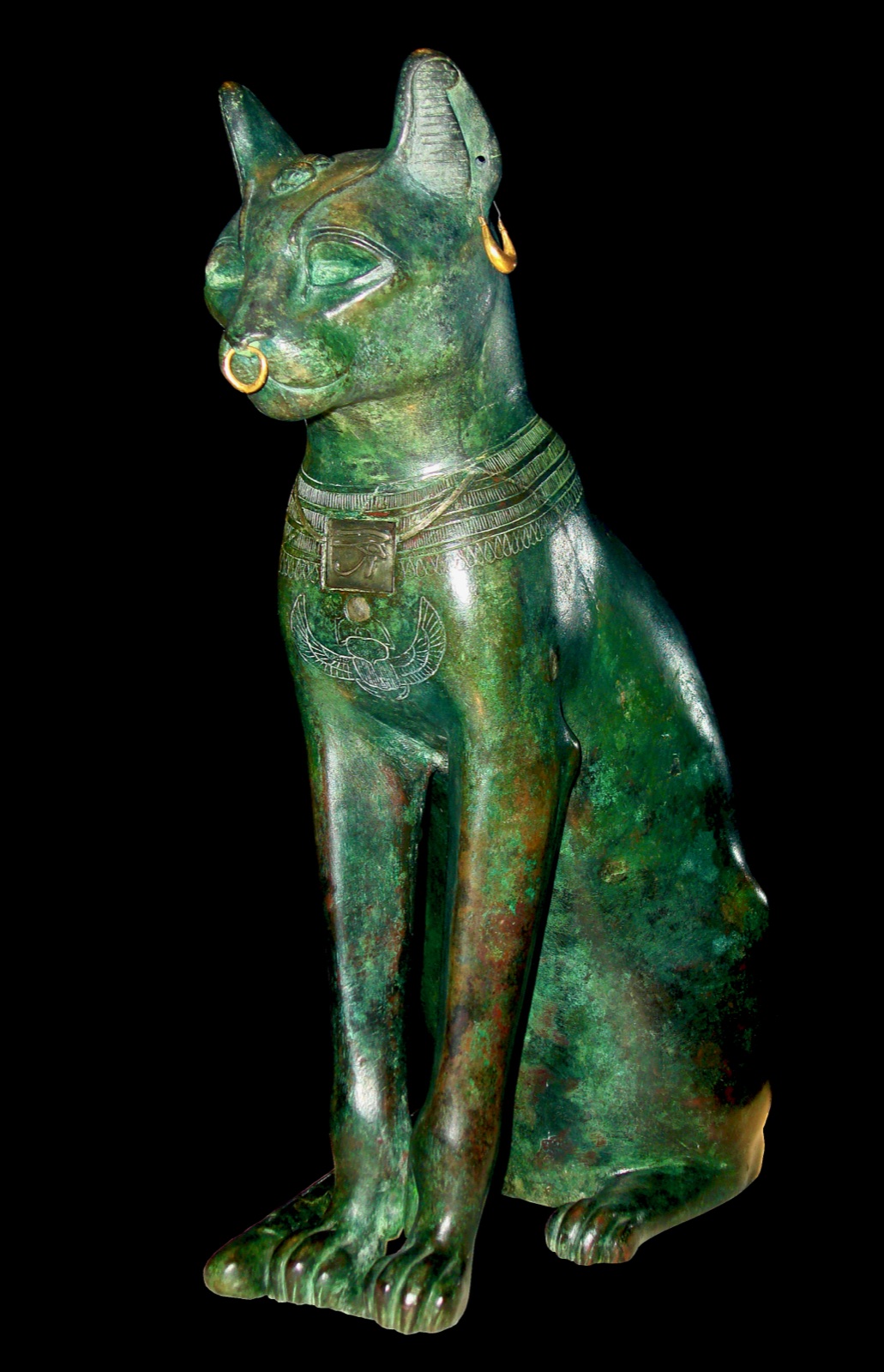
In the Late and Ptolemaic periods both Bubastis and Memphis had great cemeteries of mummified cats, and thousands of bronze statuettes of the Goddess were dedicated there[6]. The Gayer-Anderson Cat in the British Museum is 1 of them: a hollow-cast copper-alloy figure of the Late Period with gold earrings and a gold nose-ring, perhaps from Saqqara, which probably once held the mummified body of a cat; R. G. Gayer-Anderson and Mary Stout presented it in 1939[18].
From Egypt the cat travelled the trade routes of the ancient world[2], and Rome carried the cult of Bastet into Italy[6]. The genome still keeps the record of later ages: the tabby coat variant became frequent only after the Middle Ages[2].
Peter D. Tillman from USA · CC BY-SA 2.0 · Wikimedia Commons

In Zevist Contemplation
The Zevist uses the cat as an image of vigilant calm: the guardian at rest who never stops watching. Its practice belongs to the evening, to the dark hours and to the moments after a fall.
- The eye in the dark. Sit in a dim room and hold the image of the cat's shining eyes, with the attention at the Third Eye and the breath slow. The aim is a sight that gathers faint light and returns it, never one that fears the dark.
- The Cat under the persea tree. Contemplate Ra as the Great Cat cutting down Apep in Heliopolis, and place the image at the solar chakra. Whatever in the day has pressed toward disorder is met there by the knife of Ma'at.
- Landing on the feet. After a failure or a shock, recall the cat turning in mid-air before it touches the ground. The soul's first task is to recover its own axis; action comes after orientation.
- The listening ear. Keep a period of silence and listen as the cat listens, with the ears turned toward the faintest sound. Subtle perception grows from this discipline of attention, and it refines the aura.
- The festival of Bastet. Joy is part of worship: the crowds of Bubastis sang and played on their way to the Goddess. Let the sistrum's rattle, or any music, mark the hour of thanks to Bastet and Artemis.
Read this page alongside Bastet, Artemis and The Sistrum, where Bastet is approached through Her sacred instrument.
Continue exploring
Related Pages
- The Gods: Bastet
- The Gods: Artemis
- The Gods: Amon Ra
- Symbol: The Sistrum
- Sacred Animal: The Lion of Heracles
- Sacred Animal: The Panther of Dionysus
- Sacred Animal: The Serpent
- Previous: The Dog of Hecate
- Next: The Panther of Dionysus
- All 32 Sacred Animals
- All symbols