




13 min read
The Lion of Heracles
author: High Priest Zevios Metathronos
λέων (léōn)
Beast of Heracles, Cybele, Sekhmet and Narasimha: the solar sovereignty of Zeus made flesh.
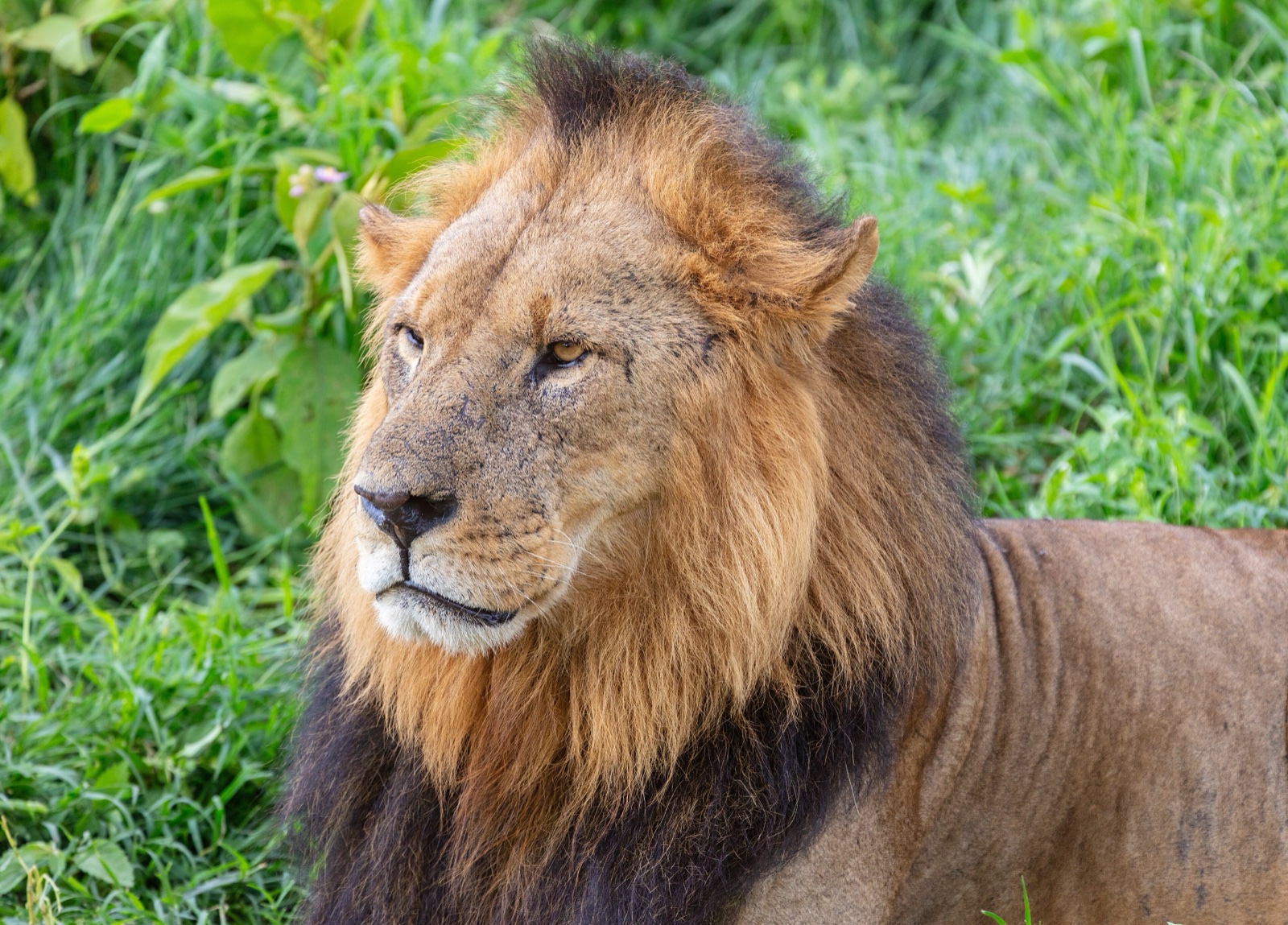
Diego Delso · CC BY-SA 4.0 · Wikimedia Commons
,_parque_nacional_del_lago_Nakuru,_Kenia,_2024-05-18,_DD_59.jpg)
The lion holds the Sun on the earth. Hesiod sets the Nemean lion before Heracles, Lucretius yokes lions to the chariot of the Mother of the Gods, and in the Bhagavadgītā the God names Himself the lord of beasts. In the Temple's teaching every one of these lions carries the same fire: the sovereign will of Zeus, ruling, guarding and burning away what breaks the order of the cosmos.
| Realm | Beasts of the Earth |
|---|---|
| Greek | λέων (léōn) |
| Latin | leo |
| Other Names | Sanskrit mṛgendra, "lord of beasts" (Bhagavadgītā 10.30); narasiṃha, "man-lion" |
| Species | Panthera leo (lion) |
| Gods | Heracles, Cybele, Sekhmet, Ishtar, Durga, Vishnu (Narasimha), Apollo-Helios (Leo), Mithras |
| Material Capacity | Cooperative hunting by the pride and a roar heard as far as 8 km |
| Spiritual Capacity | Sovereign will and courage of the solar chakra; guardianship of order |
| Element and Sphere | Fire; the Sun in Leo; the throne and the gate |
The Living Animal
The lion, Panthera leo, is a large and powerfully built cat, second in size only to the tiger, and Britannica still calls it the proverbial "king of the beasts"[1]. A grown male weighs from 125 to 272 kg[2]. Lions prefer grassland, savanna, dense scrub and open woodland, and they hunt and move most at night[1]. By day the animal rests, and rest can fill up to 20 hours[2].
Among the great cats the lion lives by the pride. A pride holds anywhere from 2 to 40 lions: up to 3 or 4 males, a dozen or so females and their young[3]. The African Wildlife Foundation puts the average at about 15 animals, with 5 to 10 females[2]. The lionesses do 85 to 90 percent of the hunting, usually by setting an ambush[2].
Both males and females roar, and the roar carries as far as 8 km[2]. A roar comes in bouts that last up to 90 seconds and string together up to 50 calls, on a fundamental frequency from 40 to 200 Hz[4]. The instrument is anatomical: the large, square-shaped vocal fold of the Panthera cats eases the onset of sound and widens the range of the voice, and the authors propose that fat shapes the folds into that geometry and protects them[4].
The male alone wears the mane, a thick ruff of brown or black hair around the head and neck, and no other cat carries one[2]. Britannica names the mane the distinguishing mark of the male lion: it makes him look larger and may serve to daunt rivals and win mates[1].
The king of beasts is now a threatened king. The IUCN declared the lion Vulnerable in 1996; in 2 decades populations fell by 43 percent, and perhaps as few as 23,000 remain[2]. National Geographic counts only half as many African lions as 25 years ago[3].
The Spiritual Capacity: The Sun in the Soul
In Zevism the lion is the Sun walking on the earth. Ptolemy assigns Leo to the Sun as its house, because Cancer and Leo stand closest to the zenith and are "most productive of heat and of warmth"[5]. The Temple reads the beast by the same law: the lion carries the solar fire of Apollo-Helios (Apollo), and through Him the sovereign light of Zeus, the Head God who holds the cosmos in Ma'at.
Within the soul the lion is the solar chakra, the Grail, burning beside the heart. Here sit will, courage and royal bearing: the power to rule oneself before ruling anything else. When the solar chakra is strong the Zevist stands upright in the world, and the aura takes on the steady heat of the lion's gaze.
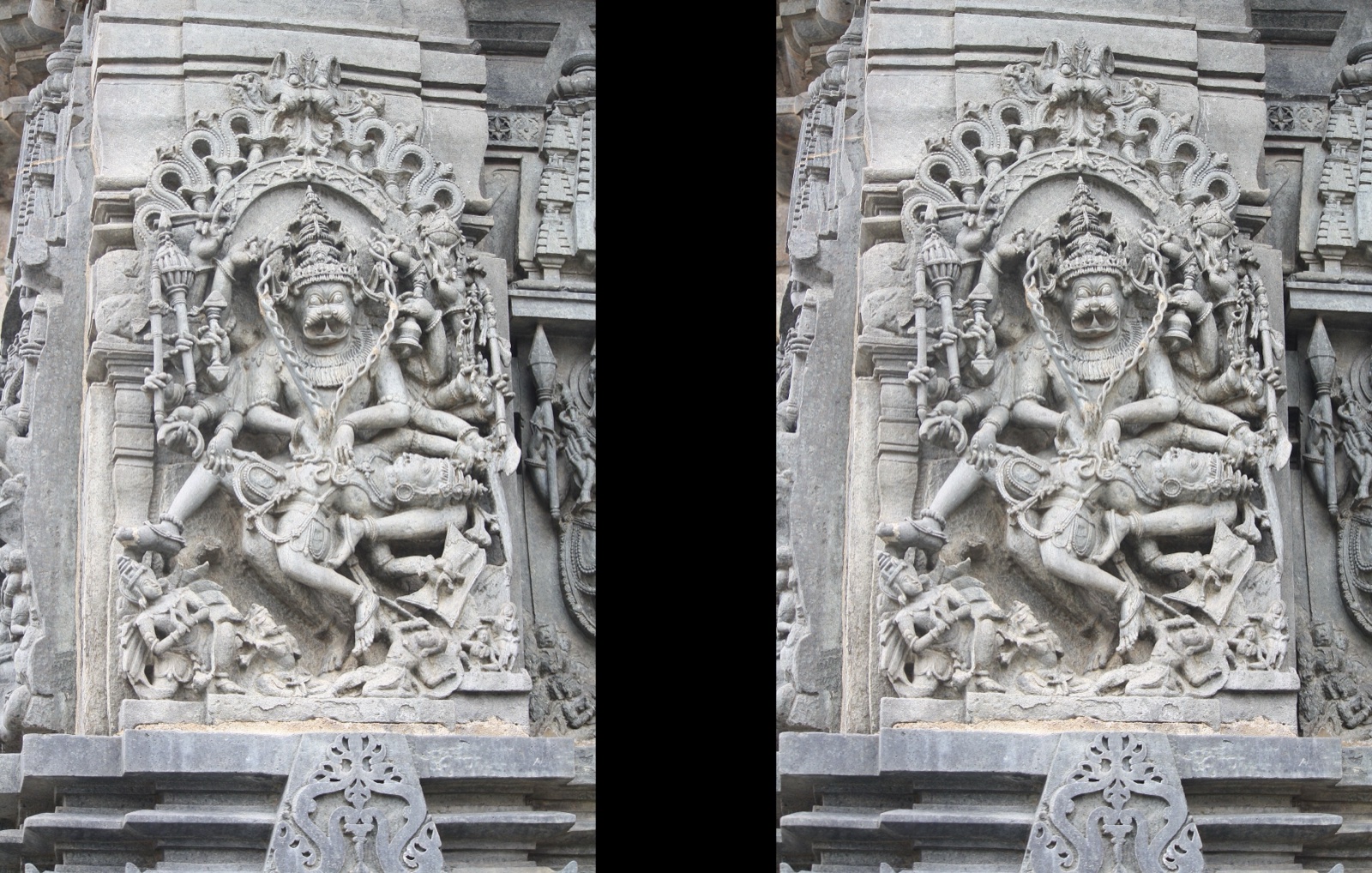
The lion also guards thresholds. Narasimha kills the tyrant at dusk on the threshold[6], the lions of Ishtar protected Babylon's chief street[7], and 2 lionesses stand over the gate of Mycenae[8]. The Temple teaches that the solar power defends the boundary between order and Izfet, the dissolution that would collapse existence; the lion is the form that defence takes when it must strike.
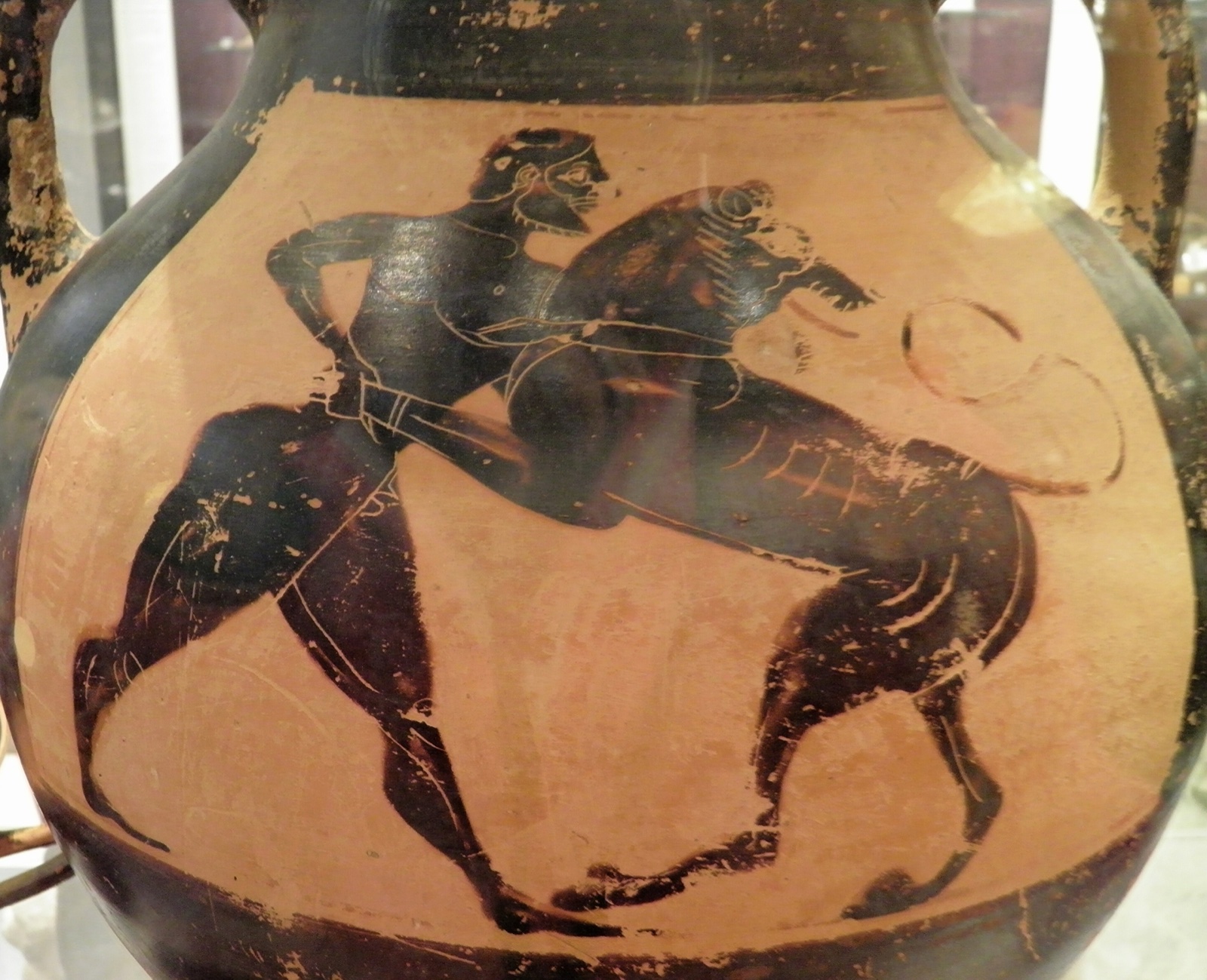
The myths show this fire mastered, never extinguished. In Hesiod the mother who bore the deadly Phix, the Sphinx that destroyed the Cadmeans, also bore the Nemean lion[9]. Heracles finds the Nemean lion invulnerable, chokes it with his arm and drapes its skin over his shoulders[10].
Lucretius explains why the Mother of the Gods yokes lions to Her chariot: the wild offspring, however fierce, must be softened and conquered by duty to its parents[11]. The soul's own raw fire, once yoked by Arete, becomes its armour and its royal mantle.
The lion-Goddess shows the double edge of that fire. Sekhmet was the destroyer of the enemies of the Sun, yet Egypt bound Her both to disease and to healing and medicine[12]. The Temple teaches that solar power is one force with 2 effects: turned against Izfet it burns, turned toward the ordered soul it heals. The Zevist who awakens the solar chakra must learn both, and choose by Ma'at which one to release.
Carole Raddato from FRANKFURT, Germany · CC BY-SA 2.0 · Wikimedia Commons
.jpg)
Where Matter and Spirit Meet
Each power of the living lion is the visible body of a power of the soul. 4 of them show the bond most clearly.
- The roar and the sovereign word. A voice built on square vocal folds sends the lion's claim over 8 km of savanna, and every animal within reach takes notice. In the soul this is the throat chakra joined to the solar will: the word that commands and sets order, the voice of the one Krishna calls the lord of beasts.
- The hunting lioness and the lion-Goddess. The females do 85 to 90 percent of the hunting, so the striking force of the pride is feminine. This is why the lion stands with Sekhmet, Ishtar, Cybele and Durga: the solar power of Zeus acts through the Goddess when order must be defended by force.
- The mane and the solar crown. The mane rings the male's head in brown and black, enlarging his form and marking his rank. It is the corona of the Sun drawn in hair, the halo of the empowered soul, and the earthly figure of the Solar Crown.
- Long rest and the sudden strike. The lion rests up to 20 hours and spends its strength in a short, decisive hunt. The solar chakra works the same way: energy gathered in stillness and meditation, released in a single act of virtue at the right moment, never wasted in agitation.
The Gods and Their Many Names
The lion recurs around one divine power in land after land. In the Temple's teaching Zeus is worshipped under many names, Vishnu is one of the 3 faces of the cosmic power that Zeus embodies as one, Apollo is Helios and Mithra, and Aphrodite is Astarte and Inanna. The son of Zeus, the Mother of the Gods, the Eye of the Sun and the face of Zeus in India all hold the same beast, because They all wield the same solar sovereignty (The Pantheon).
| Civilization | God (and the Temple's Identity) | The Bond with the Animal | Witness |
|---|---|---|---|
| Hellas | Heracles, son of Zeus | Strangles the invulnerable Nemean lion and wears its skin | Hesiod, Theogony 327-332[9]; Apollodorus 2.5.1[10] |
| Phrygia and Rome | Cybele, the Great Mother of the Gods (the Phrygian counterpart of Rhea, Mother of Zeus) | Enthroned on a cart drawn by 2 lions | Lucretius 2.600-605[11]; Met 97.22.24[13] |
| Egypt | Sekhmet, Eye of Ra, companion of Ptah (Hephaestus) | A lioness or a woman with a lioness's head; destroyer of the enemies of the Sun | Britannica, "Sekhmet"[12] |
| Babylon | Ishtar (Inanna, Astarte, Aphrodite: Astarte) | Glazed lions, Her animal, guarded the Processional Way | Met 31.13.1[7]; Britannica[14] |
| India | Vishnu as Narasimha (Vishnu, a face of Zeus) | Emerges from a pillar as a man-lion to kill Hiranyakashipu | Britannica, "Narasimha"[6] |
| India | Durga, the Inaccessible | Rides the lion against the buffalo demon Mahishasura | Britannica, "Durga"[15] |
| Graeco-Roman astrology | Apollo-Helios, the Sun | Leo is the house of the Sun | Ptolemy, Tetrabiblos 1.17[5] |
| Roman Mithraism | Mithras (Apollo, Helios); the grade Leo under Jupiter | The Leo panel bears the fire shovel and the thunderbolt of Jupiter | Mithraeum of Felicissimus, Ostia[16] |
The thread is plain. Heracles, born of Zeus, wins the lion by labour; the Mother of the Gods yokes it; the Eye of Ra, the burning glance of the Sun in Egypt, takes its body; Vishnu takes its head to protect the devoted Prahlada. In the Mithraeum of Felicissimus at Ostia, installed in the second half of the 3rd century AD, the panel of the grade Leo carries the thunderbolt of Jupiter[16]: the lion of the mysteries stands openly under Zeus.
One power keeps the same animal because the animal matches the power. Wherever a people met the sovereign light of the Sun acting to defend order, they gave it the lion's form. The names change with the language; the fire under the names is one.
VasuVR · CC BY-SA 4.0 · Wikimedia Commons

Ancient Witnesses
3 witnesses frame the lion: Hesiod on the Nemean beast and its conqueror, Lucretius on the lions of the Great Mother, and the Bhagavadgītā, where the God names Himself the lord of beasts in the same verse as His devotee Prahlāda.
γουνοῖσιν κατένασσε Νεμείης, πῆμʼ ἀνθρώποις.
ἔνθʼ ἄρʼ ὃ οἰκείων ἐλεφαίρετο φῦλʼ ἀνθρώπων,
κοιρανέων Τρητοῖο Νεμείης ἠδʼ Ἀπέσαντος·
ἀλλά ἑ ἲς ἐδάμασσε βίης Ἡρακληείης.[Hera] settled him in the hills of Nemea, a bane to men. There he dwelt and ravaged the tribes of men, lord of Tretus in Nemea and of Apesas; but the might of mighty Heracles subdued him.
Hesiod, the Homeric Hymns and Homerica, ed. Hugh G. Evelyn-White (London and New York, 1914), Perseus Digital Library · Translation: Temple of Zeus.
Lucretius, De Rerum Natura 2.600-601 [11]
Hanc veteres Graium docti cecinere poetae
sedibus in curru biiugos agitare leones,Her the learned old poets of the Greeks have sung, seated on Her throne in a chariot, driving a yoke of lions.
De Rerum Natura, Latin text, Perseus Digital Library · Translation: Temple of Zeus.
प्रह्लादश् चास्मि दैत्यानां कालः कलयताम् अहम्
मृगाणां च मृगेन्द्रो ऽहं वैनतेयश् च पक्षिणाम्prahlādaś cāsmi daityānāṃ kālaḥ kalayatām aham
mṛgāṇāṃ ca mṛgendro 'haṃ vainateyaś ca pakṣiṇāmOf the Daityas, Prahlāda am I; of those who reckon, Time am I; of beasts, the lord of beasts am I, and of birds, the son of Vinatā.
Bhagavadgītā, chapter 10, GRETIL · Translation: Temple of Zeus. The son of Vinatā is Garuḍa, the eagle of Vishnu.
Universal Significance: From Mycenae to the Modern State
The lion was a royal guardian long before heraldry. At Mycenae the Lion Gate, built about 1250 BC on the northwest of the acropolis, shows 2 confronted lionesses carved in high relief on either side of a central pillar[8]. UNESCO names the Lion Gate among the outstanding works of the Mycenaean world, which dominated the eastern Mediterranean from the 15th to the 12th century BC[18].
In Babylon, Nebuchadnezzar II (reigned 604 to 562 BC) raised the empire to its peak[7]. The Ishtar Gate, built about 575 BC, carried glazed-brick dragons and young bulls, while about 120 lions lined the Processional Way; the remnants have stood in Berlin's Pergamon Museum since its founding in 1930[14]. The lion, the animal of Ishtar, served there to protect the street[7].
The heavens kept the lion too. Pseudo-Hyginus says Leo was set among the stars because he is held to be the king of beasts[10]. In India the Lion Capital of Asoka at Sarnath, with 4 lions back to back, became the State Emblem of India on 26 January 1950, with the motto Satyameva Jayate, "Truth Alone Triumphs"[19].
European heraldry carried the beast into the modern state. Richard I bore 3 lions passant guardant on a red field by 1198, and these became the Royal Arms of England[20]. Venetian armour bore the winged Lion of Saint Mark, emblem of the city's patron saint[21], a Christian emblem that took up a royal beast which had guarded the gates of Mycenae and Babylon many centuries earlier. In the Sejarah Melayu, Sang Nila Utama sees a strange animal judged to be a lion and names the island Singapura, "Lion City"[22].
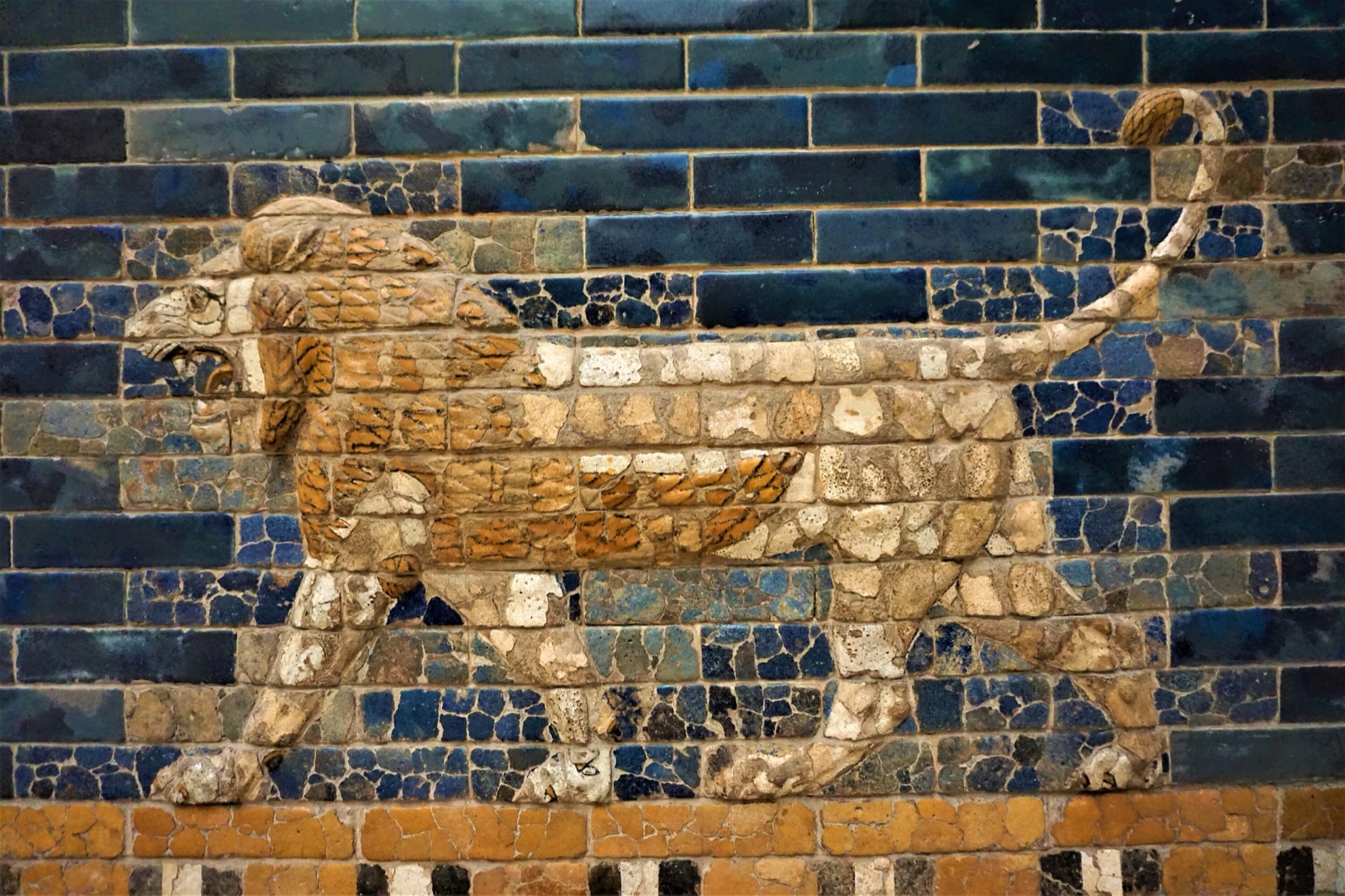
Joyofmuseums · CC BY-SA 4.0 · Wikimedia Commons

In Zevist Contemplation
The Zevist takes the lion as a discipline of the solar chakra and a mirror for conduct. These practices need no temple and no priest; they need attention, breath and honesty about one's own fire.
- The labour of Heracles. Sit upright, breathe slowly into the solar plexus and name the force in oneself that is still wild: anger, pride, hunger for mastery. Do not try to kill it; hold it, as Heracles held the lion, until it is quiet, then picture its skin laid over the shoulders as a mantle of protected strength.
- The Sun in the house of Leo. Visualize a golden sun at the solar chakra, bright as the Sun at the zenith that Ptolemy places in Leo. On each inhalation the light grows; on each exhalation it spreads through the aura. Study astrology to know when the Sun stands in Leo and give that month to this practice.
- The yoke of the Great Mother. Take Lucretius's line as a rule of conduct: the fierce offspring is softened by duty. Before acting in anger, ask what duty the act serves; power yoked to duty draws the chariot, power unyoked overturns it.
- Narasimha at the threshold. At dusk, the hour of Narasimha, stand at a doorway and recall that the solar power guards the boundary between order and Izfet. Resolve to guard one threshold in daily life, a promise, a home, a weaker person, with the lion's steadiness.
The lion has no separate symbol page yet; read it beside The Solar Crown, Heracles and Sekhmet, and follow the solar current inward through The Chakras.
Continue exploring
Related Pages
- The Gods: Heracles
- The Gods: Sekhmet
- The Gods: Apollo
- The Gods: Mithras
- Symbol: The Solar Crown
- Sacred Animal: The Cat of Bastet
- Sacred Animal: The Panther of Dionysus
- Previous: The Ibis of Thoth
- Next: The Bull of Zeus
- All 32 Sacred Animals
- All symbols