





12 min read
The Panther of Dionysus
author: High Priest Zevios Metathronos
πάρδαλις (párdalis)
The spotted beast of Dionysus-Osiris: ecstasy held in measure, the life that descends and returns.
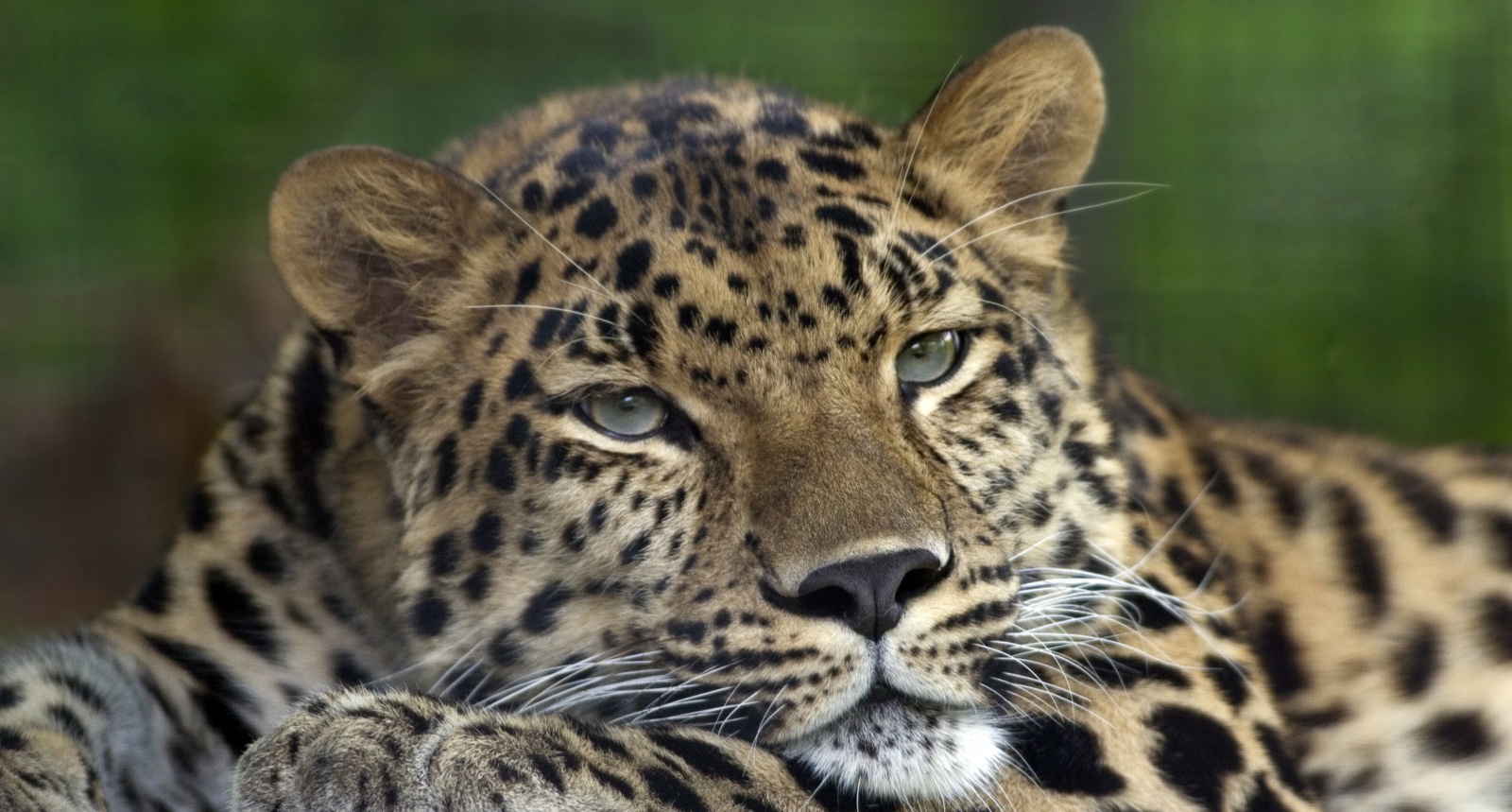
Colin Hines www.ColinHinesPhotography.com · CC BY 2.5 · Wikimedia Commons

The panther moves where Dionysus moves. Pella's pebble floors set the God on its back, Roman sarcophagi yoke it to His chariot, and in Egypt the priest who restores the dead wears its skin. In the Temple's teaching the spotted cat is the beast of Dionysus-Osiris: the life that goes down into darkness and climbs back into the light.
| Realm | Beasts of the Earth |
|---|---|
| Greek | πάρδαλις (párdalis) |
| Latin | panthera, pardus; variae, "the spotted ones" (Pliny) |
| Other Names | Leopard; black panther (the melanistic form) |
| Species | Panthera pardus (leopard), including the Amur leopard P. p. orientalis |
| Gods | Dionysus, Osiris, Bacchus, Seshat |
| Material Capacity | The largest range of the big cats; drags its kills into trees |
| Spiritual Capacity | Ecstasy held in measure; the raising of the life-force; Light and Darkness bound by Ma'at |
| Element and Sphere | Earth and night; the Moon; the tree and the vine |
The Living Animal
The leopard, Panthera pardus, is the cat the ancients called the panther; Britannica still gives "panther" as its other name and places it beside the lion, tiger and jaguar[1]. An average leopard weighs from 50 to 90 kg. It is a solitary animal of bush and forest, mainly nocturnal, and it takes any animal it can overpower, from small rodents to waterbuck[1].
No big cat ranges wider. The leopard holds the largest geographical range of all the big cats, roughly 62 countries across much of Africa and Eurasia[2]. The IUCN Red List classes it as Vulnerable: leopards have been erased from at least two-thirds of their historical habitat in Africa and from 84 percent of their former range in Eurasia[2].
Its strength shows in the trees. The leopard is an agile climber and often stores the remains of its kills in the branches[1], and it is the only wild cat known to drag its meals into trees[2].
The coat carries the leopard's name in every language. Dark spots are arranged in rosettes over much of the body[1], solid spots and rosettes where the jaguar shows blocky rosettes with spots inside[2]. A black form, in which the ground colour turns as dark as the spots, is widely known as the black panther[1].
Black panthers are leopards, nothing else. Melanism appears at a global frequency of 10.75 percent; 59 of 67 melanistic records (88 percent) come from tropical and subtropical moist forests, and south of the Isthmus of Kra the black form is almost fixed[3]. Its cause is a recessively inherited mutation in the ASIP (Agouti Signaling Protein) gene[3]. The Amur leopard of the Russian Far East is Critically Endangered, with about 130 individuals left[4].
The Spiritual Capacity: The Beast of Return
In Zevism the panther is the beast of Dionysus, whom the Temple knows as Osiris, Bacchus and Zagreus. Dionysus-Osiris is the God of the life that is torn apart and restored, of the vine cut back and sprouting again, of the soul that descends and returns. The panther is His mount and His companion: the wild force of life, ecstatic and dangerous, carried under the hand of the God.
Its spotted hide is the teaching in one image. Dark and light lie together on every inch of the coat, neither erasing the other. The Temple teaches that Light and Darkness are both positive when bound by Ma'at; the panther wears that binding on its skin. When Pentheus asks whether the rites are held by night or by day, the Stranger, who is Dionysus in disguise, answers: "by night, for the most part; darkness has solemnity," νύκτωρ τὰ πολλά· σεμνότητʼ ἔχει σκότος[5].
The bacchants wore the spotted hides themselves. Euripides shows them drawing up their fawnskins and girding the dappled hides with living serpents[5]. To wear the hide of the God's beast is to take His nature onto the body: the worshipper clothes the aura in the pattern of ordered ecstasy, and the serpent belt marks the awakened current at the waist. In Zevism every sacred garment carries this meaning: the outer skin declares the inner state.
Egypt gave the panther skin to the priest of restoration. In the Book of the Dead of Hunefer the officiating priest, clad in a panther skin, stands ready for the Opening of the Mouth, which reunites Hunefer's spirit with his body[6]. Seshat, Goddess of writing and measurement, wears a long panther skin with the tail reaching Her feet[7]. The same skin clothes the return of the spirit and the keeping of measure: in the Zevist reading, ecstasy that restores life is always held inside Ma'at.
Pliny records 2 old beliefs about the panther: that its scent draws all 4-footed creatures, and that some say a mark like the Moon sits on its shoulder, waxing to a full circle and hollowing again[8]. The Temple reads the sweet scent as the pull of the divine on every living soul, and the Moon on the shoulder as the shoulder chakras, which "bolt wings" and give the soul its freedom: a freedom that waxes and wanes with discipline, as Dionysus dies and returns.
Where Matter and Spirit Meet
The leopard's body states in flesh what the God reveals in spirit. 5 of its capacities show the bond.
- The kill carried into the tree. The leopard alone among wild cats drags its prey up the trunk and stores it in the branches. This is the ascent of the life-force: power taken from the ground and raised along the spine, the Kundalini current climbing Sushumna between Ida and Pingala, and kept above where nothing can steal it.
- The rosette coat. Each rosette rings a field of gold with dark spots, light and darkness in fixed order. It is Ma'at drawn on a living hide: the dark is present and kept in its place, and the pattern holds because neither side overruns the other.
- The black panther. Melanism comes from a single recessive gene; the black leopard is the same animal in another garment. So the soul in darkness keeps its whole nature, and Sacred Darkness is the receptive form of the same life, waiting for its season.
- The widest range. The leopard lives in some 62 countries across Africa and Eurasia. Dionysus says He came to Thebes first of Greek cities and set up His rites there "that I might be a God manifest to mortals"[5]; the God of the vine arrives in every land, and His beast is at home in every land.
- The solitary night hunter. The leopard works alone and mainly by night. The Dionysian mysteries, by the God's own word, are held "by night, for the most part": the deepest work of the soul is done in silence and darkness, away from the crowd.
The Gods and Their Many Names
The panther follows one God through 3 civilizations. In the Temple's teaching Dionysus is Osiris, Bacchus and Zagreus, and Hermes is Thoth, with whom Seshat writes; so the same spotted beast appears on Macedonian floors, Roman tombs and Egyptian papyri around the same divine power of death and return.
| Civilization | God (and the Temple's identity) | The Bond with the Animal | Witness |
|---|---|---|---|
| Macedon | Dionysus (Osiris, Bacchus, Zagreus) | Rides a panther on the pebble-mosaic floors of Pella, late 4th century BC | Britannica, "Pella"[9] |
| Hellas | Dionysus and His bacchants | Fawnskins drawn up and dappled hides girded with serpents | Euripides, Bacchae 696-698[5] |
| Rome | Bacchus (Dionysus) | Tigers, phantom lynxes and spotted panthers lie around Him | Ovid, Metamorphoses 3.668-669[10] |
| Rome | Dionysus in His Indian triumph | Rides in a chariot pulled by panthers | Walters Art Museum 23.31, about 190 CE[11] |
| Rome | Dionysos with the 4 Seasons | Seated on a panther at the centre of the procession | Met 55.11.5, about 260-270 CE[12] |
| Egypt | Osiris (Dionysus): the rite of restoration | The officiating priest of the Opening of the Mouth wears a panther skin | Book of the Dead of Hunefer, BM EA9901,5[6] |
| Egypt | Seshat, beside Thoth (Hermes) | A long panther skin over Her sheath, the tail reaching Her feet | Britannica, "Seshat"[7] |
The thread runs through death. Hunefer's priest wears the panther skin at the rite that returns the spirit to the body; Roman sarcophagi show Dionysus drawn by panthers, and on them the God's triumphal march through India stood for the dead person's victory over death[11]. On the Metropolitan sarcophagus the God sits on His panther among the 4 Seasons[12], the turning year that dies and returns.
One power keeps the same animal because the animal carries that power's rhythm. The leopard hides by day and rises by night, vanishes into the leaves and reappears with its kill raised high. Osiris and Dionysus are the same God of descent and return, and wherever He was worshipped the spotted cat walked at His side.
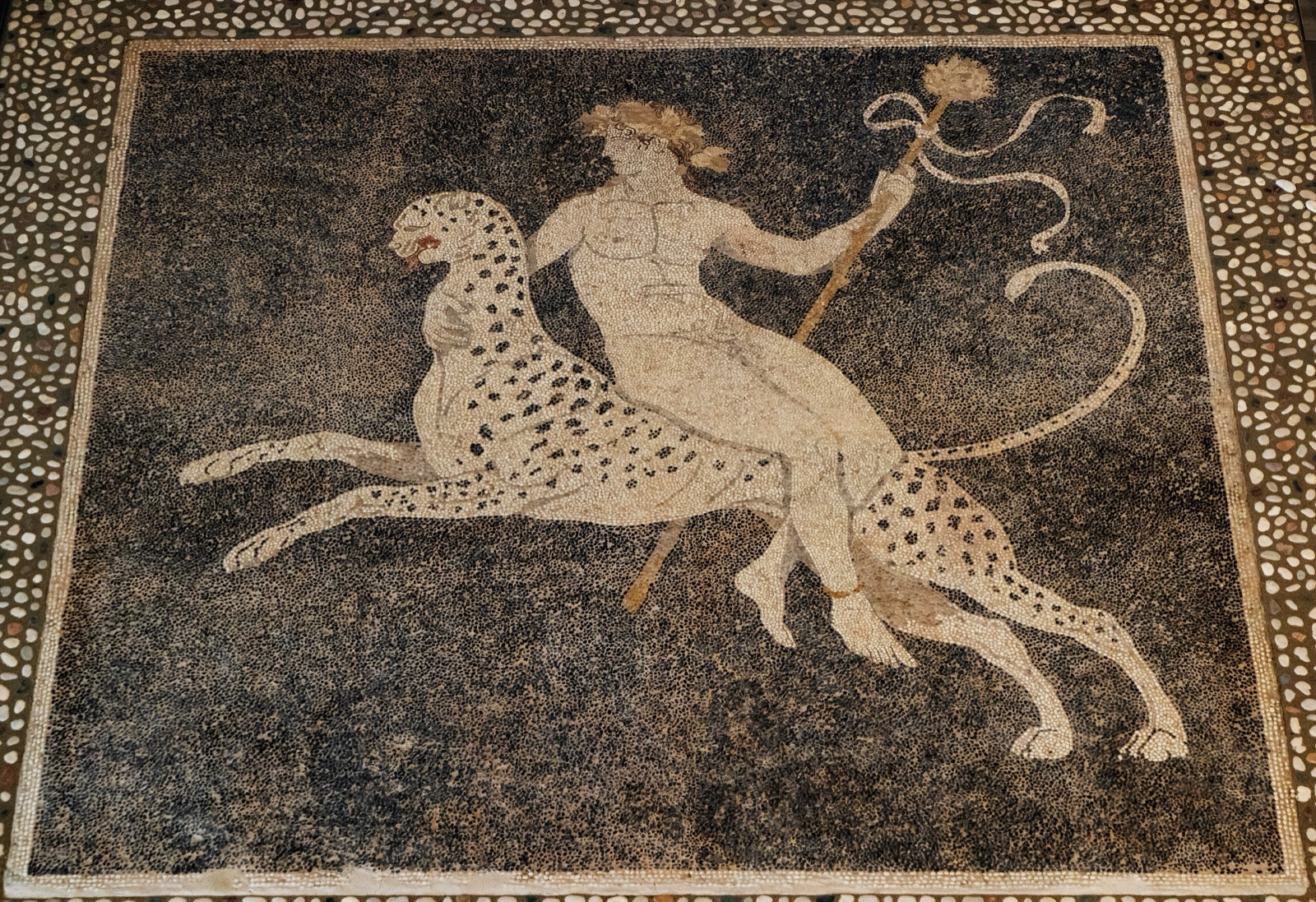
Egisto Sani from Italy · CC BY-SA 2.0 · Wikimedia Commons
.jpg)
Ancient Witnesses
The witnesses speak in Greek and Latin. Euripides gives the dappled hides of the bacchants, Ovid the beasts that lie around Bacchus, and Pliny the panther's spots, its scent and the Moon on its shoulder.
Euripides, Bacchae 696-698 [5]
νεβρίδας τʼ ἀνεστείλανθʼ ὅσαισιν ἁμμάτων
σύνδεσμʼ ἐλέλυτο, καὶ καταστίκτους δορὰς
ὄφεσι κατεζώσαντο λιχμῶσιν γένυν.They drew up their fawnskins, all whose knotted fastenings had come loose, and girded the dappled hides with serpents that licked their cheeks.
Euripidis Fabulae, ed. Gilbert Murray, vol. 3 (Oxford: Clarendon Press, 1913), Perseus Digital Library · Translation: Temple of Zeus.
Ovid, Metamorphoses 3.666-669 [10]
Ipse racemiferis frontem circumdatus uvis
pampineis agitat velatam frondibus hastam.
Quem circa tigres simulacraque inania lyncum
pictarumque iacent fera corpora pantherarum.The God Himself, His brow wreathed with clustered grapes, brandishes a spear veiled in vine leaves; around Him lie tigers, phantom shapes of lynxes, and the fierce bodies of spotted panthers.
Die Metamorphosen des P. Ovidius Naso, ed. Hugo Magnus (Gotha, 1892), Perseus Digital Library · Translation: Temple of Zeus.
Pliny the Elder, Natural History 8.62 [8]
pantheris in candido breves macularum oculi. ferunt odore earum mire sollicitari quadripedes cunctas,
sed capitis torvitate terreri; quam ob rem occultato eo reliqua dulcedine invitatas corripiunt.
sunt qui tradant in armo iis similem lunae esse maculam crescentem in orbem seque cavantem pari modo.Panthers have small eye-like spots on a pale ground. They say that all 4-footed creatures are wonderfully drawn by their scent but frightened by the grimness of their head; so the panthers hide the head and seize the animals lured by the sweetness of the rest. Some report that on the shoulder they bear a mark like the Moon, which grows to a full circle and hollows itself again in the same way.
Naturalis Historia, ed. Karl Mayhoff (Leipzig: Teubner, 1906), Perseus Digital Library · Translation: Temple of Zeus.
Universal Significance: From the Arena to the Rain Forest
The names travelled with the animal. Greek called it πάρδαλις (párdalis), Latin panthera and pardus, and the Romans of Pliny's day called the spotted kind variae; some, Pliny says, told panthers from pards only by their paler ground, and he could find no other difference[8]. Modern zoology keeps both words in the name Panthera pardus, and Britannica still lists "panther" as the leopard's other name[1].
Rome brought the panther into its games. An old decree of the Senate forbade importing African beasts into Italy until the tribune Gnaeus Aufidius carried a law allowing them for the circus; Scaurus as aedile then sent 150 spotted panthers, Pompey the Great 410, and the deified Augustus 420[8]. The animal of the God became a spectacle of the arena.
Art kept the sacred bond for 6 centuries. The rooms of Pella were floored with pebble mosaics of a lion hunt and of Dionysus riding a panther in the late 4th century BC[9]; Roman workshops still carved the God on His panther around 260 to 270 CE[12]. Wherever the vine reached, the spotted cat came with it.
In Zevist Contemplation
The Zevist uses the panther's image to work with the life-force itself: to raise it, to order it, and to rest in darkness without fear. The practices below are private and need no priest.
- The dappled hide. Sit in half-light and picture the leopard's coat in detail, gold field and dark rosette. Let each rosette stand for a dark impulse held inside a ring of light; breathe slowly until the mind holds both without struggle, as Ma'at holds them.
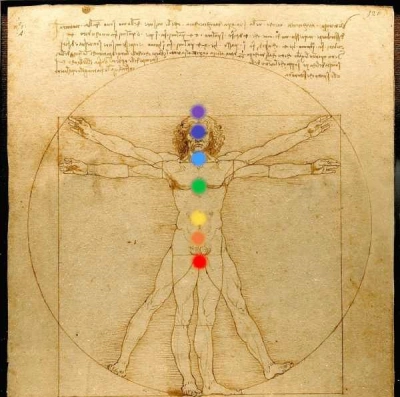
- The ascent into the tree. Breathe in and draw warmth from the base chakra up the spine, as the leopard hauls its kill up the trunk; breathe out and let it settle at the crown. Repeat 7 times, once for each chakra (The Chakras), and end with the energy stored above, unspent.
- The Moon on the shoulder. Rest attention on the points of the shoulders, where the minor chakras "bolt wings". Watch the Moon through one cycle and note how freedom of spirit grows and shrinks with conduct; let the panther's fabled mark remind the Zevist that freedom is kept by discipline.
- The rite by night. Take the God's word "darkness has solemnity" as an instruction for practice: give the last hour of the night to silent meditation, without light or speech, and let the Dionysian joy rise from stillness rather than noise.
The panther has no separate symbol page yet. Read it beside The Thyrsus of Dionysus, The Grapevine of Dionysus and Sacred Darkness and the Receptive Soul.
Continue exploring
Related Pages
- The Gods: Dionysus
- The Gods: Osiris
- The Gods: Thoth
- Symbol: The Thyrsus of Dionysus
- Symbol: Sacred Darkness and the Receptive Soul
- Sacred Animal: The Lion of Heracles
- Sacred Animal: The Cat of Bastet
- Previous: The Cat of Bastet
- Next: The Elephant of Indra
- All 32 Sacred Animals
- All symbols