




15 min read
The Horse of Poseidon
author: High Priest Zevios Metathronos
ἵππος (híppos)
Poseidon's gift, Athena's bridle, the chariot of Zeus: the horse as the soul's force under command.
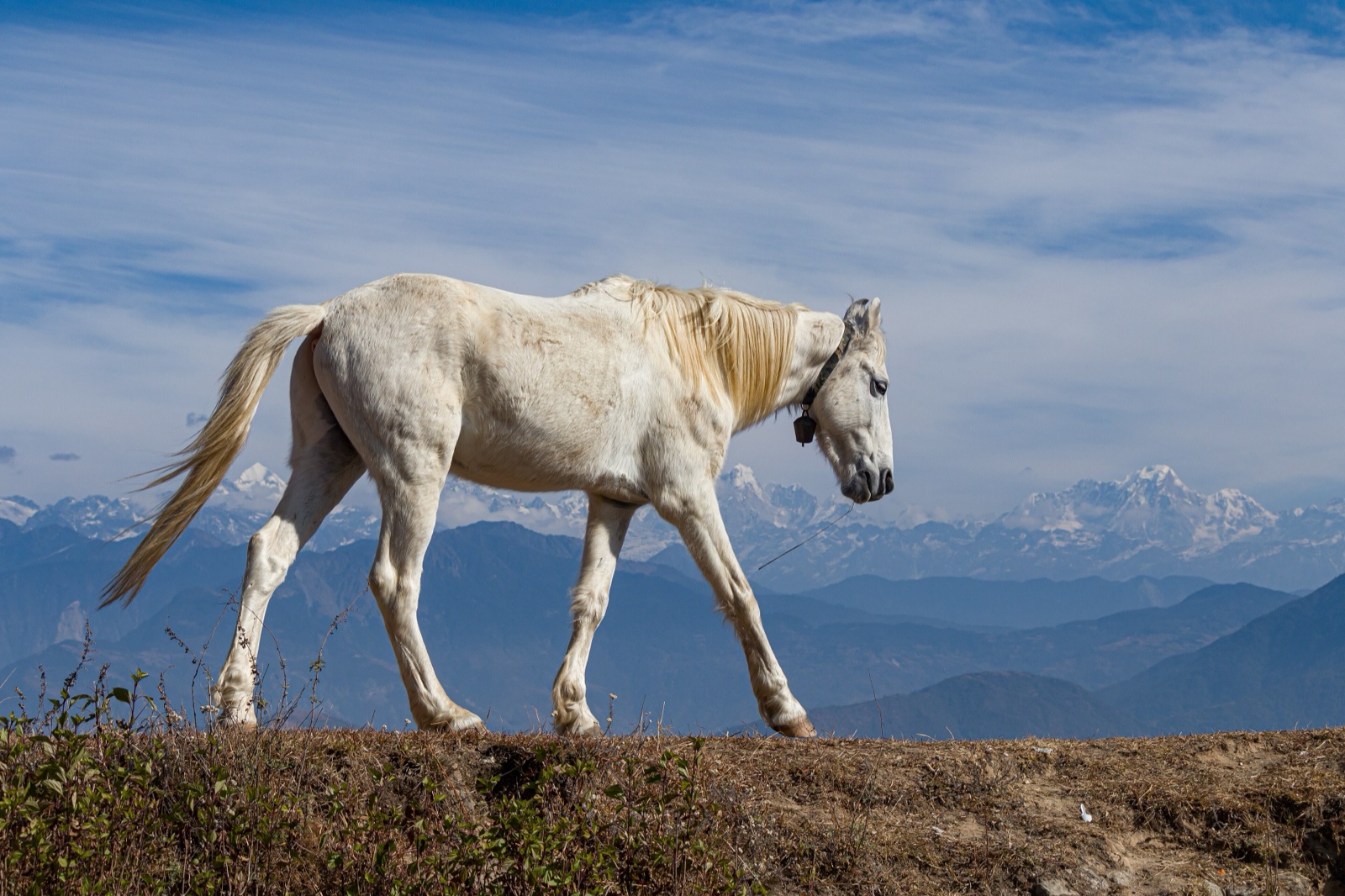
Shadow Ayush · CC BY-SA 4.0 · Wikimedia Commons

The horse rose from the struck rock for Poseidon, took the golden bridle from Athena, and draws the chariot that Zeus drives at the head of the Gods. In Zevism it is the vital force of the soul: swift, strong, and holy when it is guided.
| Realm | Beasts of the Earth |
|---|---|
| Greek | ἵππος (híppos) |
| Latin | equus |
| Other Names | Sanskrit aśva; Old Norse hestr, jór; Gaulish epos (in the name Epona) |
| Species | Equus caballus, the domestic horse of the DOM2 lineage |
| Gods | Poseidon Hippios, Athena Hippia, Zeus, Helios, Selene, Odin, Indra, the Ashvins, Epona |
| Material Capacity | Vision over about 350°; a gallop with all 4 feet in the air; life in ordered bands |
| Spiritual Capacity | The vital force of the soul, governed by the charioteer |
| Element and Sphere | Water and fire; the sea, the solar chariot, the vault of heaven |
The Living Animal
The domestic horses of today descend from one population. Librado and colleagues located the homeland of modern domestic horses on the Western Eurasian steppes, above all the lower Volga-Don region, where their ancestors lived in the late 4th and early 3rd millennia BC[1]. This lineage, called DOM2, appeared beyond the steppe by about 2200 to 2000 BC, in Anatolia, the lower Danube, Bohemia and Central Asia, expanded rapidly across Eurasia from about 2000 BC and replaced almost all other local horses[1]. The genome shows strong early selection at the genes GSDMC and ZFPM1, linked to locomotion and behaviour, and the authors read it as a shift toward more docile horses[1].
The horse is built to see danger from every side. Its field of vision covers about 350°, of which about 65° is binocular and 285° monocular; its eyes are among the largest of any land mammal, and a tapetum lucidum reflects light back through the retina for superior night vision[2]. It has 2 blind spots: a cone in front of the face ending about 90 to 120 cm ahead, and a zone behind the head running over the back[2].
Speed is its answer to danger. The gallop averages about 40 to 48 km/h, and in each stride comes a moment of suspension when all 4 feet are off the ground[3]. The record race speed over 2 furlongs (402 m) is 70.35 km/h, set by the Thoroughbred Winning Brew at Penn National Race Course, Pennsylvania, on 14 May 2008[4].
Horses are prey animals with a strong fight-or-flight response, and their first reaction to a threat is often to flee[5]. They live in bands led by a dominant lead mare, usually with a single herd stallion, and they bond by touch through mutual grooming[5]. A stay apparatus in the legs lets a horse sleep standing up[5].
The Spiritual Capacity
In Zevism the horse is the vital force of the soul: the power that moves, carries and charges, and must be guided. Plato gave the image its classic form. The soul is like the grown-together power of a winged team and its charioteer; the horses and charioteers of the Gods are all good, those of others are mixed[6]. In the human soul one horse is upright, white, a lover of honour joined with temperance and reverence, driven by the word alone; the other is crooked, dark, a companion of insolence, yielding barely to whip and goad[6].
At the head of the procession Zeus, the great leader in heaven, drives a winged chariot, ordering all things and caring for them, and the army of Gods and daimons follows Him[6]. The Temple reads this as the pattern of Theosis: the Zevist becomes like the Gods by driving the soul's team as Zeus drives His, with the charioteer, the mind, at the Third Eye and the force of the solar chakra running true beneath it.
The wings of the team are the shoulder chakras, which bolt wings, give more power to the soul and stand for spiritual freedom. Pegasus is that force made visible. Bellerophon could not yoke him until Athena brought a golden bridle in a dream; with it he mastered the winged horse, and Pindar ends the tale with Pegasus received in the ancient mangers of Zeus on Olympus[7] (see Bellerophon). Force bridled by wisdom comes home to the stable of the Head God.
Force unbridled devours. The Thracian king Diomedes kept man-eating mares; Heracles took them from their mangers, and the mares killed his companion Abderus before they were brought to Eurystheus[8]. Released, they went to the mountain called Olympus and perished there by wild beasts[8]. The Temple reads the passions in this tale: untamed, they feed on the one who keeps them; carried to the mountain of the Gods, they cannot survive.
2 further horses complete the teaching. Sleipnir, grey and 8-legged, is the best horse among Gods and men, and he is Odin's[9]; on him Odin rides down to Niflhel[10], the force that crosses between worlds without stumbling. Uchchaihshravas, the 7-headed white horse, rose from the churning of the ocean and became the mount of Indra[11]: the force born when the depths of the soul are churned in practice, then ridden by the Sovereign.
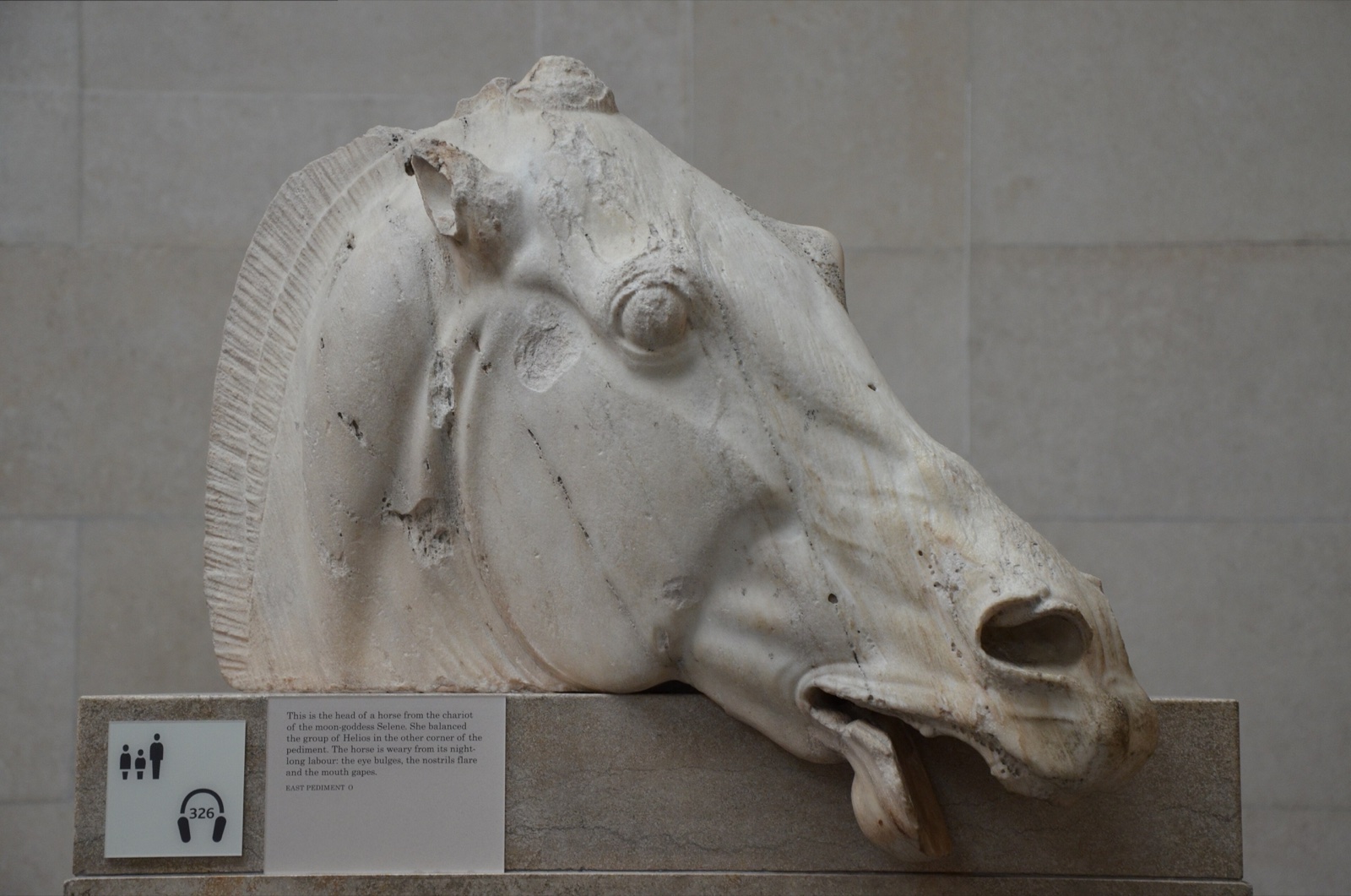
Carole Raddato from FRANKFURT, Germany · CC BY-SA 2.0 · Wikimedia Commons
.jpg)
Where Matter and Spirit Meet
Each material capacity of the horse shows a power of the soul. The Zevist reads them one by one, from the eye to the herd.
- Vision of 350°, blind straight ahead. The horse sees almost all around it, yet a cone directly in front of its face is hidden[2]. The vital force senses everything around it but cannot see the goal before it; the charioteer, the mind at the Third Eye, must direct it forward.
- The moment of flight in the gallop. At full gallop all 4 feet leave the ground[3]. Force at its height lifts from the earth: this is the winged horse, and the wings of the shoulder chakras that the Zevist opens when the force runs true.
- Selection for docility. The horses that spread across Eurasia after about 2000 BC carried genes selected for movement and for a more docile temper[1]. The animal became humanity's partner when it accepted the bit. So the soul's force becomes power only under Athena's golden bridle, which is temperance.
- The band and its lead mare. A horse band moves under one lead mare and one stallion[5]. The powers of the soul likewise move in order under a single command, as the Gods march in their companies behind Zeus[6]; this order is Ma'at, and its collapse is Izfet.
- Sight in the dark. The tapetum lucidum gives the horse superior night vision[2]. Selene's horses run through the night as Helios's run through the day: the trained force keeps its bearing in darkness, because Light and Darkness are both held by Ma'at.
The Gods and Their Many Names
In the Temple's teaching Zeus is Odin and Indra; Poseidon is Neptune, Enki, Ea and Varuna; Apollo is Helios. The horse returns to these powers in every land: it rises from the waters and the rock for the God of the sea, it carries the Head God between worlds, and it draws the Sun across the sky.
| Civilization | God (and the Temple's Identity) | The Bond with the Animal | Witness |
|---|---|---|---|
| Athens (Colonus) | Poseidon Hippios and Athena Hippia | A shared altar at Colonus Hippios, the Horse Hill | Pausanias 1.30.4[12] |
| Corinth | Athena Hippia; Poseidon the Tamer | Athena's golden bridle tames Pegasus; Bellerophon raises an altar to Athena Hippia | Pindar, Olympian 13.65-82[7] |
| Rome and Thessaly | Neptune (Poseidon) | The earth, struck by His trident, pours out the first horse; Lucan sets the birth in Thessaly | Virgil, Georgics 1.12-14[13]; Lucan 6.396-399[14] |
| Hellas | Zeus | He drives the winged chariot at the head of the Gods; Pegasus lives in His mangers | Plato, Phaedrus 246e[6]; Pindar, Olympian 13.92[7] |
| Hellas and Rome | Helios, Sol (Apollo); Selene | The 4 horses of the Sun, whose neighing fills the air with flame; the team of the Moon on the Parthenon | Ovid, Metamorphoses 2.153-155[15]; BM 1816,0610.98[16] |
| Scandinavia | Odin (Zeus) | Sleipnir, 8-legged, best of horses | Gylfaginning 15, 42[9]; Grímnismál 44[17] |
| India | Indra (Zeus); Krishna | Uchchaihshravas, born of the churned ocean, is Indra's mount; Krishna names Himself that horse among horses | [11]; Bhagavadgītā 10.27[18] |
| India and Hellas | The Ashvins; the Dioskouroi | Twin horsemen of the dawn and healers; the Greek "boys of Zeus" are Their counterpart | [19] |
| Gaul and Rome | Epona | Guardian of horses, donkeys and mules; patroness of the cavalry; Her image stood in the stable | [20]; Apuleius, Metamorphoses 3.27[21] |
The Athenian contest needs exact sources. In Apollodorus, Poseidon strikes the Acropolis with His trident and brings forth a sea, not a horse, and Athena wins with the olive[8]. The version in which Poseidon offers the horse at Athens comes from Servius's commentary on Virgil; other writers, Lucan among them, place the birth of the horse in Thessaly[22]. Virgil himself names no place: the earth, struck by the great trident, first poured forth the snorting horse[13].
The horse belongs first to the God of the waters, because the vital force rises from the depths of the soul as the horse leapt from the struck rock. It belongs next to the Head God, who rides or drives it as master: Zeus at the head of the winged chariots, Odin on Sleipnir, Indra on Uchchaihshravas. And it belongs to the Sun, whose team crosses the sky; the Vedic Surya too drives a chariot of horses, often 7 in number[23]. The twin horsemen, the Ashvins and the Dioskouroi (see The Dioskouroi), carry the same force as healing and rescue.
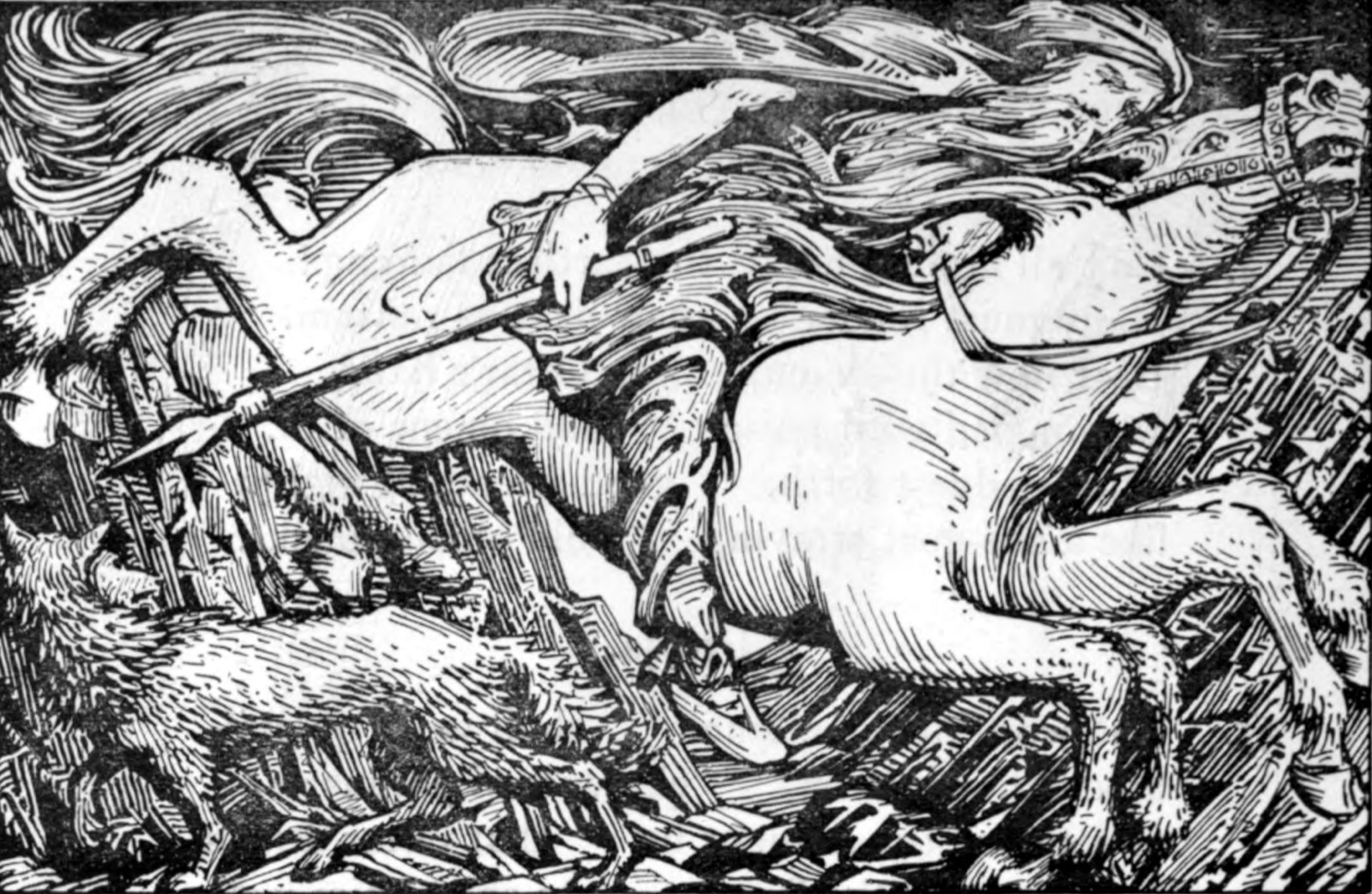
W.G. Collingwood (1854 - 1932) · Public domain · Wikimedia Commons

Ancient Witnesses
The witnesses give the horse in its sacred offices: Plato on the winged team of the soul, Pindar on Athena's bridle, Lucan on the first horse, the Bhagavadgītā on Uchchaihshravas, and the Eddic poem on Odin's ride.
ἐοικέτω δὴ συμφύτῳ δυνάμει ὑποπτέρου ζεύγους τε καὶ ἡνιόχου. θεῶν μὲν οὖν ἵπποι τε καὶ ἡνίοχοι πάντες αὐτοί τε ἀγαθοὶ καὶ ἐξ ἀγαθῶν, τὸ δὲ τῶν ἄλλων μέμεικται.
Let the soul, then, be likened to the grown-together power of a winged team and its charioteer. Now the horses and charioteers of the Gods are all good themselves and of good descent, but those of the others are mixed.
Platonis Opera, ed. J. Burnet, Perseus Digital Library canonical XML · Translation: Temple of Zeus.
πρίν γέ οἱ χρυσάμπυκα κούρα χαλινὸν
Παλλὰς ἤνεγκʼ· ἐξ ὀνείρου δʼ αὐτίκα
ἦν ὕπαρ· φώνασε δʼ· εὕδεις, Αἰολίδα βασιλεῦ;
ἄγε φίλτρον τόδʼ ἵππειον δέκευ,until the maiden Pallas brought him the bridle with its golden band. Out of the dream it was at once waking truth, and She spoke: “Do you sleep, king of the line of Aeolus? Come, take this charm for the horse.”
The Odes of Pindar, ed. J. Sandys (Loeb, 1937), Perseus Digital Library canonical XML · Translation: Temple of Zeus.
Lucan, Pharsalia 6.396-399 [14]
Primus ab aequorea percussis cuspide saxis
Thessalicus sonipes bellis feralibus omen
Exsiluit; primus chalybem fraenosque momordit,
Spumavitque novis Lapithae domitoris habenis.First, from the rocks struck by the sea-God's spear-point, the Thessalian charger leapt out, an omen of deadly wars; first it champed the steel and the bit, and foamed under the new reins of its Lapith tamer.
Pharsalia, ed. K. H. Weise, Perseus Digital Library canonical XML · Translation: Temple of Zeus.
उच्चैःश्रवसम् अश्वानां विद्धि माम् अमृतोद्भवम्
uccaiḥśravasam aśvānāṃ viddhi mām amṛtodbhavam
Among horses know Me as Uccaiḥśravas, born of the nectar.
Bhagavadgītā, GRETIL text file (bhagvg_u) · Translation: Temple of Zeus. Krishna speaks; Airāvata is the elephant of Indra.
Upp reis Óðinn, alda gautr,
ok hann á Sleipni söðul of lagði;
reið hann niðr þaðan niflheljar til;
mætti hann hvelpi, þeim er ór helju kom.Up rose Odin, the Gautr of men, and laid the saddle on Sleipnir; He rode down from there to Niflhel; He met a whelp that came out of Hel.
Sæmundar-Edda, ed. Guðni Jónsson, as given on heimskringla.no (half-lines joined into long lines) · Translation: Temple of Zeus.
Universal Significance
The horse made the Bronze Age. Librado and colleagues conclude that DOM2 horses and the chariot transformed Eurasian societies within a few centuries after about 2000 BC, and they found DOM2 horses buried with the earliest spoke-wheeled chariots in Sintashta kurgans of about 2000 to 1800 BC[1].
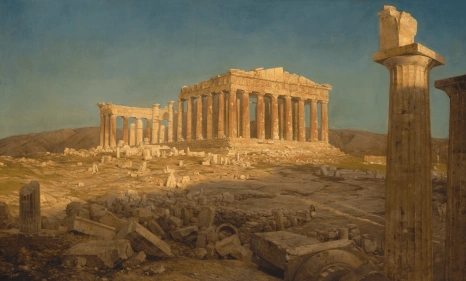
Sacred horses rode on coins and temples. Corinth struck silver staters with the winged Pegasus and the archaic letter koppa, for the early spelling of the city's name; the Cleveland Museum of Art holds one of about 350 to 338 BC[24]. On the east pediment of the Parthenon, carved from 438 to 432 BC, Helios rose while the chariot of Selene, or Nyx, sank beneath the horizon; the British Museum keeps the head of one of Her horses[16].
In India the horse carried sovereignty. In the Ashvamedha a horse wandered for a year guarded by the king's warriors, and a rival who stopped it challenged the king's claim; the Dhanadeva-Ayodhya inscription of the 1st century BC records 2 Ashvamedhas of Pushyamitra Shunga, and Gupta gold coins of Samudragupta and Kumaragupta commemorate theirs[25].
Rome adopted the horse Goddess of Gaul. Epona's worship as patroness of the cavalry spread across the Empire from the 1st to the 3rd centuries AD, and a rustic calendar from Guidizzolo in Italy gives Her feast day as 18 December[20]. In Apuleius Her image stands at the central pillar of a stable, garlanded with fresh roses[21].
The horse still measures the world. The Uffington White Horse on White Horse Hill is a Bronze Age chalk figure that volunteers still re-chalk[26]. James Watt adopted the term horsepower in the late 18th century to compare steam engines with draft horses, and the unit equals about 745.7 watts[27].
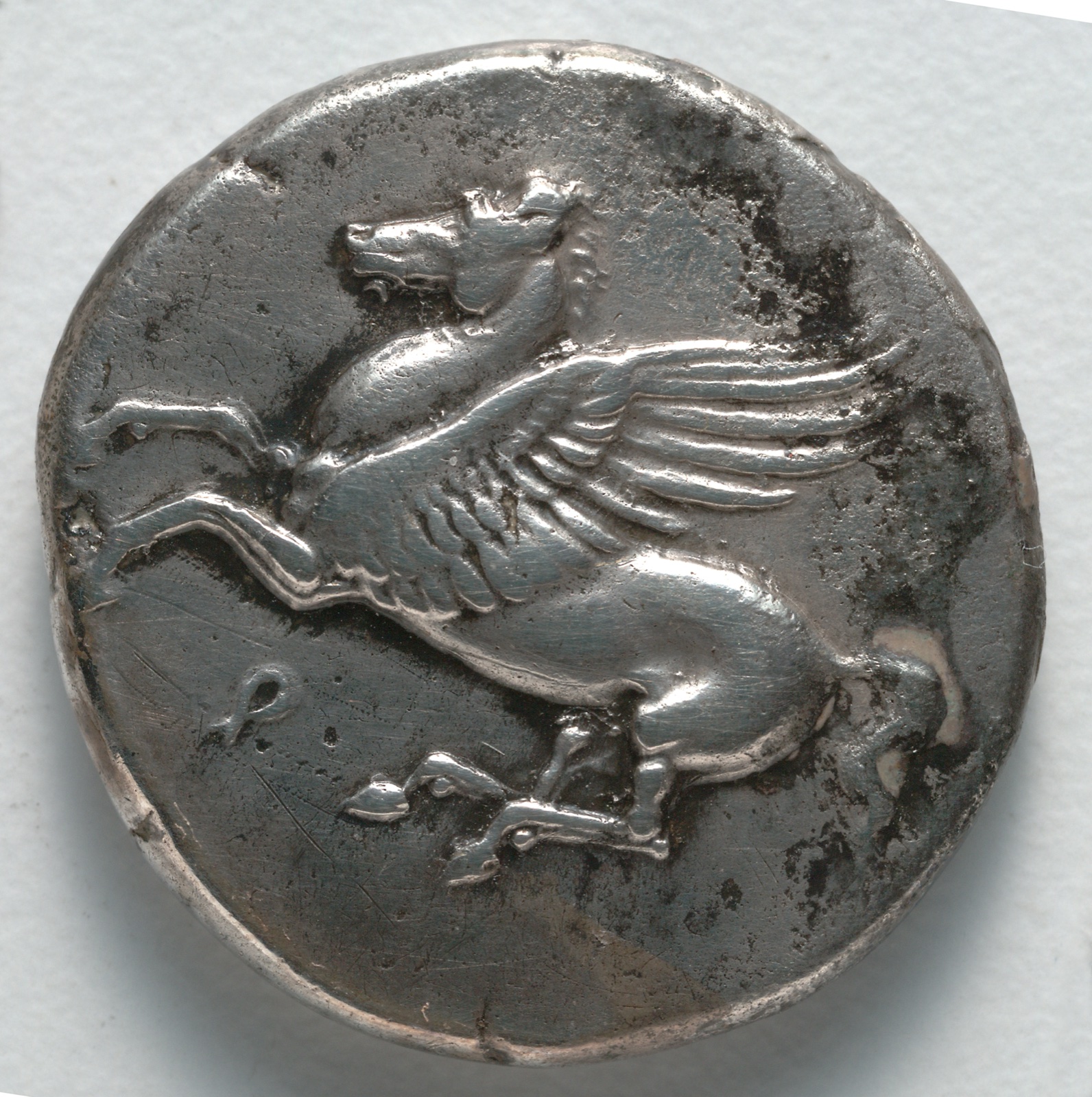
Cleveland Museum of Art · CC0 · Wikimedia Commons
_-_1916.984.a_-_Cleveland_Museum_of_Art.jpg)
In Zevist Contemplation
The Zevist trains the horse within: the vital force of the solar chakra, bridled by the mind and given wings. These practices train attention and conduct; they promise no marvels and need no priest.
- The charioteer. Seated upright, breathe slowly and see the 2 horses of the Phaedrus before you, the white and the dark. Hold the reins at the Third Eye, let the white horse set the pace, and when the dark one pulls, draw it back by the breath, not by force.
- Athena's golden bridle. Gather the warmth of the solar chakra as a horse gathers before the gallop. Then choose one virtue for the day, temperance, courage or justice, and lay it on that force as a bridle; every decision is a turn of the rein.
- The wings of Pegasus. When the force is steady, carry the attention to the shoulder chakras and feel the breath widen across the upper back. The image is Pegasus at full gallop with all 4 hooves off the ground: power that has become freedom.
- The team of the Sun. At sunrise face the east and hold the image of the Sun's 4 horses rising. Draw their light into the solar chakra and let the day's work follow its course from east to west, as the Sun keeps its road under Ma'at.
The God of the horse is taught on Poseidon and the bridle-giver on Athena. The rider of Pegasus is taught on Bellerophon and the twin horsemen on The Dioskouroi; read them beside this page.
Continue exploring
Related Pages
- The Gods: Poseidon
- The Gods: Athena
- The Gods: Bellerophon
- The Gods: The Dioskouroi
- The Gods: Surya
- Sacred Animal: The Dolphin of Poseidon
- Sacred Animal: The Fawn of Artemis
- Previous: The Goat of Zeus
- Next: The Fawn of Artemis
- All 32 Sacred Animals
- All symbols