





212 min read
Coming Home · Historical Review
Things Nobody Wants to Accept about Christianity
author: High Priest Zevios Metathronos
52 historical dossiers drawn from Christianity’s own scriptures, manuscripts, Church Fathers and Church publications, each with its source and the Temple’s answer. A review written for your return to God, with no accusation against you.
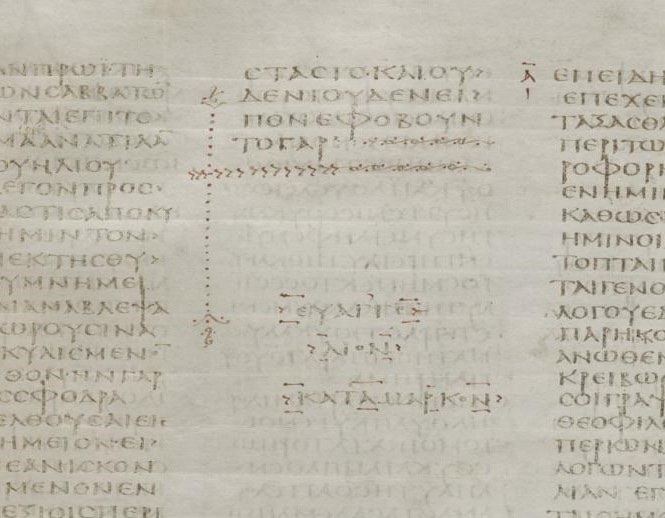
CC0 (public domain dedication) via Wikimedia Commons · Source and licence

- For
- Readers who need the detailed record before they choose
- You Will Find
- 52 dossiers in 5 groups, each with its source and answer
- Next Step
- Discover a Life with the Gods
Paul, 1 Thessalonians 5:21, NRSV
πάντα δὲ δοκιμάζετε, τὸ καλὸν κατέχετε·
…test everything; hold fast to what is good.
I. A Historical Review
This page is a historical review, and it accuses no reader of anything. It is written to wake the Children of the Gods and to welcome them back. It shows the religious errors we have made together as mankind, and invites you to set them right under Zeus and the Eternal Gods.
It sets out what Christianity’s own Bibles, manuscripts, Church Fathers and modern Church publications say about themselves. The Temple of Zeus writes it for one purpose: to help you reconnect with God, Zeus the Father and King of the Gods, and return to the Gods your ancestors knew. You read it as a guest of the Temple, and the review speaks with conviction because its sources speak plainly.
Examining a religion’s claims needs no apology. Paul told his own readers to test everything and hold fast to what is good. The Temple’s Welcome says the same in its own words: Freedom of belief is paramount, as ordained by the Gods themselves.
[1] Freedom includes the freedom to read the record.
Each dossier opens with the source’s own words: the New Revised Standard Version and the King James Version, the Greek New Testament, the Church Fathers, the notes of the evangelical NET Bible and the New American Bible published by the United States Conference of Catholic Bishops. Then come the claim the witness tests, the Temple’s answer and the consequence for your decision.
The criticism falls on texts, doctrines, institutions and named historical acts. It never falls on you. Many readers were raised inside these claims and never saw the notes printed at the foot of their own Bible’s pages. Read the passage. Then follow what it shows.
II. The Short Route
If you have only a short time, read these 6 dossiers. They cover the book’s text, the making of its canon, the councils that defined the doctrine, the Christian explanation of the older Gods, the reuse of their temples and the laws against their worship. Each one stands alone, and together they carry the whole case.
- C4Mark’s Longer Ending Is Absent from the Earliest Major WitnessesSinaiticus and Vaticanus end at 16:8 with the women afraid; every appearance of the risen Jesus in Mark comes from a later hand.
- C14The Canon Was Settled Through Lists That DisagreedEusebius counted 5 letters as disputed, and Codex Sinaiticus bound Barnabas and the Shepherd into its New Testament.
- C25Councils Defined the Faith and the Emperor Enforced ItConstantine sat among the bishops at Nicaea in 325, the creed anathematised dissent, and a law ordered death for hiding Arius’s books.
- C32The Fathers Admitted the Parallels and Blamed the DemonsJustin told the emperor that Christians teach nothing different from what Rome believed of the sons of Jupiter, then blamed demons for the likeness.
- C38Gregory Ordered the Temples Kept and the Worship ReplacedGregory’s letter of 601 keeps the temples and feasts and changes only the one addressed; Boniface IV made the Pantheon a church.
- C45The Empire Outlawed the Worship of the Gods, Down to the Household HearthCodex Theodosianus 16.10 closed the temples, made sacrifice a capital crime and followed worship indoors to the lar and the penates.
III. All 52 Dossiers
The dossiers fall into 5 groups. Every heading states the exact issue, and every dossier carries its own source, so you can begin anywhere.
IV. The Book: Authorship, Transmission and Canon
The first group examines the book itself: who wrote it, how it was copied and who decided what belongs in it. Every witness comes from Christian Bibles, their manuscripts, the Church Fathers or the notes of modern Christian editions.
C1 The Gospel Writers Never Name Themselves, and the Names Come from Later Tradition
Luke’s author gives no name, John’s last verse speaks of the disciple from outside, and Irenaeus supplies the names more than a century later.
Read the dossier
The preface of the Gospel of Luke, Luke 1:1 to 3, NRSV · Read the passage
Since many have undertaken to set down an orderly account of the events that have been fulfilled among us, just as they were handed on to us by those who from the beginning were eyewitnesses and servants of the word, I too decided, after investigating everything carefully from the very first, to write an orderly account for you, most excellent Theophilus…
- The Claim Examined
Christians are taught that the 4 Gospels are the testimony of Matthew, Mark, Luke and John. The texts never say so. Luke’s author gives no name and places himself after the eyewitnesses.[2] John’s closing verse speaks of the beloved disciple from outside:
we know that his testimony is true.
The US Catholic bishops’ Bible states that Mark isanonymous, apart from the ancient heading ‘According to Mark’ in manuscripts
.[3]The names come from tradition. Irenaeus, writing while Eleutherius was bishop of Rome (about 174 to 189), assigns all 4 Gospels to their authors.[4][5]
- The Temple’s Answer
Irenaeus reports the names more than a century after the events; he didn’t witness the authorship. The authors chose silence about their identities, and the one who describes his method says he depended on others. A faith that asks you to stake your soul on eyewitness testimony can’t show you a Gospel author who signs his name as an eyewitness.
- For Your Decision
Read the Gospels as anonymous religious literature, and judge them as you would any other. See how the first Gospel was written.
C2 Papias Reports a Hebrew Matthew, but the Greek Gospel of Matthew Copies Mark
Papias spoke of oracles in Hebrew; the Greek Matthew follows Mark’s Greek, and the US bishops call its author unknown.
Read the dossier
Papias (about 135), quoted by Eusebius, Church History III.39.16, tr. A. C. McGiffert; and the United States Conference of Catholic Bishops, New American Bible, Revised Edition, Introduction to Matthew · Read Papias · Read the introduction
Matthew wrote the oracles in the Hebrew language, and every one interpreted them as he was able.
The ancient tradition that the author was the disciple and apostle of Jesus named Matthew (see Mt 10:3) is untenable because the gospel is based, in large part, on the Gospel according to Mark…
- The Claim Examined
The belief that the apostle Matthew wrote the first Gospel goes back to Papias, whom the bishops’ Bible dates to about 135.[3] Papias speaks of λόγια, oracles, composed Ἑβραΐδι διαλέκτῳ, in the Hebrew language.[6][7] The Gospel in every Bible is Greek and follows Mark’s Greek closely. Mark 2:10 and Matthew 9:6 break off mid-sentence at the same point with the same aside, λέγει τῷ παραλυτικῷ,
he said to the paralytic
.[8] Matthew’s own call is told in Mark’s words, with Mark’sLevi son of Alphaeus
replaced bya man called Matthew
.[2]The Catholic bishops conclude that a companion of Jesus would hardly follow
an account that came from one who admittedly never had such an association rather than rely on his own memories
.[9]- The Temple’s Answer
Papias’s words end the old claim on either reading. If Papias meant a Hebrew book, the Greek Gospel in your hands isn’t that book.
If he meant something else, the attribution to Matthew loses its earliest support. The bishops call the author
unknown
: an unnamed editor reworking Mark, who told an apostle’s calling in another man’s words.- For Your Decision
An unknown editor’s revision of Mark holds no authority to forbid you the Gods. Follow how the text was then copied.
C3 The Text Comes Through Manuscripts That Disagree, and Editors Must Choose
Editors weigh disagreeing manuscripts verse by verse; a verse King James readers took as proof of Christ’s divinity is a scribe’s reading.
Read the dossier
1 Timothy 3:16 in 2 English Bibles, with the NET Bible’s textual note · Read the note
King James Version (1611): “And without controversy great is the mystery of godliness: God was manifest in the flesh…”
New Revised Standard Version (1989): “Without any doubt, the mystery of our religion is great: He was revealed in flesh…”
- The Claim Examined
Many Christians believe their Bible reproduces the original words. The oldest New Testament manuscript, P52, is a scrap 8.9 by 6 centimetres with parts of John 18:31 to 33 and 37 to 38, dated on its handwriting to 100 to 150 by its first editor, C. H. Roberts, and by later palaeographers as late as the early 3rd century.[10] Everything fuller is later, and the copies differ.
At 1 Timothy 3:16 the King James reads
God was manifest
, modern editionsHe was revealed
.[11][2] The evangelical NET Bible explains that θεός, abbreviated as a sacred name, looked like ὅς,who
, the reading of the early witnesses, and calls the defence ofGod
special pleading
.[12] It brackets the angel and the bloody sweat of Luke 22:43 to 44, absent from P75 and Vaticanus.[13]- The Temple’s Answer
A verse King James readers took as proof of Christ’s divinity is, by evangelical editors’ own judgement, a scribe’s reading. Editors weigh manuscripts and decide, verse by verse, what the Word of God says. The final authority over the text is human judgement.
- For Your Decision
A text settled by editors can be studied with respect; it can’t claim to stand above all inquiry. See the largest example.
C4 Mark’s Longer Ending Is Absent from the Earliest Major Witnesses
Sinaiticus and Vaticanus end at 16:8 with the women afraid; every appearance of the risen Jesus in Mark comes from a later hand.
Read the dossier
Mark 16:8, Nestle 1904 Greek and NRSV; Eusebius of Caesarea, To Marinus 1, tr. J. W. Burgon (1871), who defended the longer ending · Read Burgon’s translation
καὶ οὐδενὶ οὐδὲν εἶπαν· ἐφοβοῦντο γάρ.
…and they said nothing to anyone, for they were afraid.
…the accurate copies, at all events, making the end of Mark’s narrative come after the words of the young man… For at those words, in almost all copies of the Gospel according to Mark, comes the end. What follows, (which is met with seldom, [and only] in some copies, certainly not in all,) might be dispensed with…
- The Claim Examined
Mark 16:9 to 20 gives the appearances of the risen Jesus, the commission, the signs of serpents and poison, and the ascension. The oldest major witnesses stop at 16:8, the women silent and afraid. The NET Bible names
two of the most respected mss (א B)
, Codex Sinaiticus and Codex Vaticanus, and says Eusebius and Jeromeknew of almost no Greek mss that had this ending
.[14] Sinaiticus is a 4th-century Bible.[15] Eusebius reaches you here through John Burgon, who wrote a whole book defending the passage.[16]The endings compete: a shorter ending survives in
four seventh-to-ninth-century Greek manuscripts
, and the Freer Logion in another. The US bishops’ note says the longer endingwas defined as such by the Council of Trent
, as canonical, whilevocabulary and style indicate that it was written by someone other than Mark
.[17]- The Temple’s Answer
A council declared canonical a passage the Church’s own scholars say Mark didn’t write, chosen from rival endings and joined to a Gospel whose oldest form ends in fear and silence. Every appearance of the risen Jesus in Mark comes from a later hand. Here Scripture is what a council decided to keep.
- For Your Decision
Open your own Bible at Mark 16:8 and read its note. Then discover a relationship with the Gods that rests on no disputed page.
C5 The Woman Taken in Adultery Is Missing from John’s Earliest Manuscripts
P66, P75, Sinaiticus and Vaticanus lack the woman taken in adultery, and copyists placed the story in different books.
Read the dossier
United States Conference of Catholic Bishops, New American Bible, Revised Edition, note on John 7:53 to 8:11 · Read the note
…is a later insertion here, missing from all early Greek manuscripts… it is found in different places in different manuscripts… The Catholic Church accepts this passage as canonical scripture.
- The Claim Examined
Let anyone among you who is without sin be the first to throw a stone at her
is among the most quoted lines in the Gospels.[2] It stands outside John’s earliest recoverable text. The NET Bible lists the omitting witnesses, beginning with P66, P75, Sinaiticus and Vaticanus:The earliest and best mss do not contain the pericope.
Where it appears, it moves: after John 7:36, after John 21:25, or after Luke 21:38 in the manuscript family 13. Some copies mark it with asterisks or obeli.[18] The bishops’ note adds thatthe style and motifs are similar to those of Luke
.[19]- The Temple’s Answer
A book presented as divinely authored took in a floating story, placed in different books by different copyists, and the Church declared it canonical. A text that grows by insertion was assembled by human hands, and the hands are visible in the manuscripts.
- For Your Decision
You can keep a good story without granting its editors authority over your soul. See a verse inserted to support a doctrine.
C6 The Heavenly Witnesses of 1 John 5:7 Are a Later Addition
No Greek manuscript has the heavenly witnesses before the 14th century; Rome defended the verse in 1897 and gave it up 30 years later.
Read the dossier
1 John 5:7 to 8 in the KJV and the NRSV · Read the KJV · Read the NET note
King James Version: “For there are three that bear record in heaven, the Father, the Word, and the Holy Ghost: and these three are one. And there are three that bear witness in earth, the spirit, and the water, and the blood: and these three agree in one.”
New Revised Standard Version: “There are three that testify: the Spirit and the water and the blood, and these three agree.”
- The Claim Examined
For centuries English readers held this as the plainest statement of the Trinity in the Bible.[11] Modern editions omit the heavenly witnesses.[2] The NET Bible:
there is no sure evidence of this reading in any Greek ms until the 14th century
; it arosein a 4th century Latin homily
and enteredthe third edition of Erasmus’ Greek NT (1522) because of pressure from the Catholic Church
.[20]Catholic Answers records the Holy Office’s decree of 13 January 1897 warning scholars against
rashly rejecting or doubting the authenticity of this passage
, and its statement of 2 June 1927 allowing them to doubt it,subject to any forthcoming judgment of the Church
. Its own verdict:No scholar any longer accepts its authenticity.
[21]- The Temple’s Answer
The episode shows how authority over the text works. A Latin gloss entered the printed Greek New Testament under ecclesiastical pressure, Rome defended it as Scripture in 1897 and retreated 30 years later. A guardian of revealed truth that needs 2 rulings to decide whether a verse was revealed has shown its method: human judgement, bending to doctrine first and to evidence later.
- For Your Decision
Ask who decided what you were taught to call the Word of God. See how the list of books was settled.
C7 Matthew and Luke Give Jesus Different Genealogies
Joseph and Shealtiel each get 2 different fathers, and Matthew’s 3 times 14 generations is a count made by omission.
Read the dossier
Matthew 1:16 and Luke 3:23, NRSV · Read Matthew 1 · Read Luke 3
Matthew 1:16: “and Jacob the father of Joseph the husband of Mary, of whom Jesus was born, who is called the Messiah.”
Luke 3:23: “Jesus was about thirty years old when he began his work. He was the son (as was thought) of Joseph son of Heli…”
| Point | Matthew | Luke |
|---|---|---|
| Joseph’s father | Jacob (1:16) | Heli (3:23) |
| Line from David | Solomon (1:6) | Nathan (3:31) |
| Father of Shealtiel (Salathiel) | Jechoniah (1:12) | Neri (3:27) |
- The Claim Examined
Both Gospels give a pedigree to prove descent from David, and they differ on Joseph’s father and on David’s son. Where the lines meet after the exile, both name Shealtiel and Zerubbabel, yet give Shealtiel different fathers.[2]
Matthew announces a pattern of 3 times 14 generations (1:17). To keep it, his line runs
Joram the father of Uzziah
(1:8), while the Chronicler givesJoram his son, Ahaziah his son, Joash his son, Amaziah his son, Azariah his son
(1 Chronicles 3:11 to 12), Azariah being the king also called Uzziah (2 Kings 15:1 and 13; 2 Chronicles 26:1). Matthew omits 3 kings.- The Temple’s Answer
Luke’s text names Joseph:
son (as was thought) of Joseph son of Heli
. Neither Mary’s line nor levirate marriage explains 2 fathers for Shealtiel, and Matthew’s pattern of 14 is a count produced by omission. Each author built a pedigree to serve the claim of royal descent: as history the lists contradict each other, and as argument each was shaped to its conclusion.- For Your Decision
A lineage composed to prove a title proves the author’s purpose. Test the dates of the birth.
C8 The Only Census of Quirinius That Josephus Records Falls 9 Years after Herod’s Death
Matthew needs Herod alive; Josephus ties Quirinius’s census to Archelaus’s removal, 9 years after Herod died.
Read the dossier
Flavius Josephus, Antiquities of the Jews XVIII.1.1 and 2.1, tr. W. Whiston; the assessment that followed the removal of Herod’s son Archelaus · Read the passage
Moreover, Cyrenius came himself into Judea, which was now added to the province of Syria… When Cyrenius had now disposed of Archelaus’s money, and when the taxings were come to a conclusion, which were made in the thirty-seventh year of Caesar’s victory over Antony at Actium…
- The Claim Examined
Matthew sets the birth
In the time of King Herod
; the family returns from EgyptWhen Herod died
(2:1, 19). Luke dates the annunciation to ZechariahIn the days of King Herod of Judea
, sends Gabriel to MaryIn the sixth month
, and places the birth atthe first registration
,taken while Quirinius was governor of Syria
(1:5, 26; 2:2).[2]Josephus has Quirinius (Cyrenius) assess Judea once it was added to Syria, disposing of the estate of Archelaus, Herod’s deposed son.[22] The NET Bible: Herod
died in 4 B.C.
[23]; Josephusonly mentions a census in A.D. 6, too late for this setting
.[24]- The Temple’s Answer
Every harmonisation needs a census or an office no ancient source records. Josephus, the historian Christians themselves cite for the period, ties Quirinius’s assessment to Archelaus’s removal.
Matthew’s flight to Egypt needs a living Herod; Luke binds the birth to an assessment made after Herod’s dynasty lost Judea. The 2 infancy stories meet only through a census no historian mentions.
- For Your Decision
The infancy stories were written for meaning, and their dates yield to it. See how Matthew read his prophecy.
C9 Mark and John Put the Crucifixion on Different Days
In Mark Jesus eats the Passover and dies the next morning; in John he dies at noon on the day of Preparation, as the lambs are slain.
Read the dossier
Mark 14:12 and John 19:14, NRSV, with the Nestle 1904 Greek of John · Read John 19
Mark 14:12: “On the first day of Unleavened Bread, when the Passover lamb is sacrificed, his disciples said to him, ‘Where do you want us to go and make the preparations for you to eat the Passover?’”
ἦν δὲ Παρασκευὴ τοῦ πάσχα, ὥρα ἦν ὡς ἕκτη· καὶ λέγει τοῖς Ἰουδαίοις Ἴδε ὁ Βασιλεὺς ὑμῶν.
John 19:14: “Now it was the day of Preparation for the Passover; and it was about noon. He said to the Jews, ‘Here is your King!’”
- The Claim Examined
In Mark the disciples prepare the Passover on the day the lamb is sacrificed, Jesus eats it with the 12 that evening, and
It was nine o’clock in the morning when they crucified him
(15:25).[2] In John the accusers stay out of Pilate’s headquartersto be able to eat the Passover
(18:28), and atabout noon
onthe day of Preparation for the Passover
Pilate is still presenting Jesus (19:14). The NET Bible names John’s purpose:Jesus was going to die on the cross at the very time that the Passover lambs were being slain.
[25]- The Temple’s Answer
Evangelical editors read John’s hour as theology: the death set at the slaughter of the lambs. Mark sets it a day after the lambs were slain and the meal eaten. One Gospel fixes the date to a symbol, the other to a meal, and the reader receives a chronology governed by doctrine.
- For Your Decision
If the day itself was shaped to a meaning, judge the meaning on its merits. Compare the last words from the cross.
C10 Matthew and Acts Tell Judas’s Death and the Field of Blood Differently
In Matthew Judas hangs himself and the priests buy the field; in Acts Judas buys it himself and bursts open in it.
Read the dossier
Matthew 27 and Acts 1, NRSV · Read Acts 1
Matthew 27:5, 7 to 8: “Throwing down the pieces of silver in the temple, he departed; and he went and hanged himself… After conferring together, they used them to buy the potter’s field as a place to bury foreigners. For this reason that field has been called the Field of Blood to this day.”
Acts 1:18 to 19: “Now this man acquired a field with the reward of his wickedness; and falling headlong, he burst open in the middle and all his bowels gushed out. This became known to all the residents of Jerusalem, so that the field was called in their language Hakeldama, that is, Field of Blood.”
- The Claim Examined
In Matthew, Judas repents, returns the silver, throws it into the temple and hangs himself; the chief priests, unable to put blood money in the treasury, buy the potter’s field, and the name Field of Blood follows from their purchase.[2] In Acts, Judas himself acquires a field with the money, falls headlong and bursts open, and the name follows from what became known of his death.
The 2 accounts differ on who buys the field, how Judas dies and why the field bears its name.
- The Temple’s Answer
The usual harmonisation adds what neither text says: a body that falls after a hanging and a purchase made in another man’s name. Matthew says Judas gave the money back; Acts says he acquired a field with it. When the reader must supply the events that join 2 inspired accounts, the joining is the reader’s work and the inspiration rests on it.
- For Your Decision
Notice how often you’ve been asked to complete the text in order to believe it. Apply the same test to the resurrection.
C11 The 4 Resurrection Accounts Differ on Witnesses, Messengers, Response and Place
Mark’s women tell no one and Matthew’s run to tell; Mark and Matthew send the disciples to Galilee, Luke keeps them in Jerusalem.
Read the dossier
Mark 16:8 and Matthew 28:8, NRSV · Read Matthew 28
Mark 16:8: “…and they said nothing to anyone, for they were afraid.”
Matthew 28:8: “So they left the tomb quickly with fear and great joy, and ran to tell his disciples.”
| Point | Mark | Matthew | Luke | John |
|---|---|---|---|---|
| Women named | Mary Magdalene, Mary the mother of James, Salome (16:1) | Mary Magdalene and the other Mary (28:1) | Mary Magdalene, Joanna, Mary the mother of James and the other women (24:10) | Mary Magdalene (20:1) |
| Messenger | A young man sitting inside (16:5) | An angel descends, rolls back the stone, sits on it (28:2) | 2 men in dazzling clothes (24:4) | 2 angels in white (20:12) |
| Women’s response | Say nothing to anyone (16:8) | Run to tell the disciples (28:8) | Tell the 11 and the rest (24:9) | Mary runs to Peter (20:2) |
| Where the disciples are sent or kept | Galilee (16:7) | Galilee, a mountain (28:10, 16) | Stay in the city (24:49) | Jerusalem, a locked room (20:19) |
- The Claim Examined
Christianity stakes everything on the resurrection, and its 4 accounts differ at every step.[2] Mark’s women flee and tell no one; Matthew’s run to tell. Mark and Matthew send the disciples to Galilee. Luke turns the Galilee message into a memory,
Remember how he told you, while he was still in Galilee
(24:6), and keeps the disciples in Jerusalem until they areclothed with power from on high
. John names Mary Magdalene alone at the tomb, though her words include a plural:we do not know where they have laid him
.- The Temple’s Answer
The accounts set silence against running to tell, and a command to go to Galilee against a command to stay in the city. A harmony of the 4 requires a sequence of events that none of the 4 narrates. The event on which the faith rests reaches you as 4 different stories, and the earliest of them, in its oldest form, narrates no appearance of the risen Jesus at all (C4).
- For Your Decision
Leaving these accounts behind doesn’t mean leaving God. Read the answer to
Am I leaving God?
C12 Isaiah’s Sign Promised a Young Woman’s Child in the Days of Ahaz
Isaiah’s Hebrew has the young woman, a sign for King Ahaz; the US bishops’ own note says it carries no specific reference to virginity.
Read the dossier
Isaiah 7:14 in Hebrew (NRSV) and in the Greek Septuagint (tr. L. C. L. Brenton); the oracle is addressed to King Ahaz of Judah · Read the passage with the Catholic note
הִנֵּה הָעַלְמָה הָרָה
Look, the young woman is with child and shall bear a son, and shall name him Immanuel.
ἰδοὺ ἡ παρθένος ἐν γαστρὶ ἕξει, καὶ τέξεται υἱόν
…behold, the virgin shall conceive in the womb, and shall bring forth a son…
- The Claim Examined
Matthew says the virgin birth took place
to fulfill what had been spoken by the Lord through the prophet
and quotesLook, the virgin shall conceive
(1:22 to 23), in Greek ἡ παρθένος.[2][8] Isaiah’s Hebrew reads הָעַלְמָה, the young woman.[26] The US bishops’ note:Hebrew ‘almah designates a young woman of marriageable age without specific reference to virginity. The Septuagint translated the Hebrew term as parthenos, which normally does mean virgin, and this translation underlies Mt 1:23.
[27][28] The NET agrees.[29]The sign has its own setting:
before the child knows how to refuse the evil and choose the good, the land before whose two kings you are in dread will be deserted
(7:16). In the bishops’ words, itseeks to reassure Ahaz that he need not fear the invading armies of Syria and Israel
.- The Temple’s Answer
Isaiah names his own fulfilment: a child whose early years would see the ruin of Ahaz’s 2 enemies, centuries before Matthew. Matthew’s virgin depends on a Greek translation, and the Catholic bishops’ own note says the Hebrew carries no specific reference to virginity. The virgin birth is defended with a prophecy whose original words don’t contain it.
- For Your Decision
Read Isaiah 7 whole, in a Catholic Bible, and decide what it promised Ahaz. See how Matthew built other fulfilments.
C13 Matthew’s Fulfilments: A Prophecy No Prophet Wrote, a Prophet Misnamed and a Second Animal
He will be called a Nazorean is in no prophet, Zechariah is quoted as Jeremiah, and Jesus rides 2 animals at once.
Read the dossier
Matthew 27:9 and Zechariah 11:13, NRSV, with the NET Bible’s note · Read the note
Matthew 27:9: “Then was fulfilled what had been spoken through the prophet Jeremiah…”
Zechariah 11:13: “So I took the thirty shekels of silver and threw them into the treasury in the house of the Lord.”
- The Claim Examined
Matthew presents the life of Jesus as a chain of fulfilled prophecy. Look at 3 links.
- The Nazorean. Jesus settles in Nazareth so that the prophets’ words might be fulfilled:
He will be called a Nazorean
(2:23).[2] No such sentence exists in the Hebrew Bible. The NET Bible reads it asa current expression of scorn that conceptually (but not verbally) found its roots in the OT
.[23] - Jeremiah for Zechariah. The 30 pieces of silver fulfil
the prophet Jeremiah
, yetThe quotation is most closely related to Zech 11:12-13
. Copyists felt the problem: one manuscript reads Zechariah, others omit the name or change it to Isaiah.[30] - 2 animals. Mark has one colt (11:7). Matthew reads the parallelism of Zechariah 9:9,
on a donkey, on a colt, the foal of a donkey
, as 2 animals:they brought the donkey and the colt, and put their cloaks on them, and he sat on them
(21:7). The plural can refer to the cloaks; the second animal is Matthew’s.
- The Nazorean. Jesus settles in Nazareth so that the prophets’ words might be fulfilled:
- The Temple’s Answer
The fulfilments are readings made by the interpreter. A saying no prophet wrote, a citation under the wrong name and a second animal drawn from a poetic couplet show the method: narrative and proof text were fitted to each other. The copyists who altered “Jeremiah” saw the difficulty first.
- For Your Decision
Prophecy fitted after the event proves an author’s skill. See who chose the books that carry it.
C14 The Canon Was Settled Through Lists That Disagreed
Eusebius counted 5 letters as disputed, and Codex Sinaiticus bound Barnabas and the Shepherd into its New Testament.
Read the dossier
Athanasius of Alexandria, Festal Letter 39, for the year 367, tr. R. Payne-Smith; the second line introduces the Wisdom of Solomon, Sirach, Esther, Judith, Tobit, the Teaching of the Apostles and the Shepherd · Read the letter
These are fountains of salvation… Let no man add to these, neither let him take ought from these.
…not indeed included in the Canon, but appointed by the Fathers to be read by those who newly join us…
- The Claim Examined
Christians often speak as if the New Testament arrived as one bound book. The lists show a long process. Eusebius counted James, Jude, 2 Peter and 2 and 3 John as disputed,
which are nevertheless recognized by many
, and the Acts of Paul, the Shepherd, the Apocalypse of Peter and Barnabas as rejected. The Apocalypse of John stands in both columns: acceptedif it really seem proper
, and listed again among the rejected,which some, as I said, reject
.[31]Athanasius in 367 closes the list at 27 books and sets Esther outside the canon, among books merely to be read.[32] Codex Sinaiticus, a Bible of the same century, binds Barnabas and the Shepherd with its New Testament.[15]
- The Temple’s Answer
Bishops disagreed over Revelation, 2 Peter, Esther, the Shepherd and Barnabas for generations, and a 4th-century Bible carried books every modern Bible excludes. No single council invented the canon; many men decided it, list by list. A collection settled by human judgement can’t bar you from the Gods.
- For Your Decision
If men chose the books, you may weigh their choice. See how councils defined the doctrine.
C15 Christian Authorities Themselves Question Who Wrote Hebrews, 2 Peter and the Pastoral Letters
Origen said only God knows who wrote Hebrews, Eusebius left 2 Peter outside the canon, and the US bishops report the majority judgement on the Pastorals.
Read the dossier
Origen on Hebrews, in Eusebius, Church History VI.25.14, tr. A. C. McGiffert; and the United States Conference of Catholic Bishops, New American Bible, Revised Edition, Introduction to 1 Timothy, on the Pastoral letters · Read Eusebius · Read the introduction
But who wrote the epistle, in truth, God knows.
Most scholars are convinced that Paul could not have been responsible for the vocabulary and style, the concept of church organization, or the theological expressions found in these letters.
- The Claim Examined
Several letters carry authority through an apostle’s name, and Christian authorities have doubted those names from antiquity to the present.
- Hebrews. Origen grants that
not without reason have the ancients handed it down as Paul’s
, then admits that only God knows who wrote it.[33] - 2 Peter. Eusebius:
we have learned that his extant second Epistle does not belong to the canon
.[31] Origen: Peter leftone acknowledged epistle; perhaps also a second, but this is doubtful
.[33] Yet its author claims to be an eyewitness:We ourselves heard this voice come from heaven, while we were with him on the holy mountain
(1:18).[2] - 1 and 2 Timothy and Titus. The US bishops’ introduction reports the majority judgement against Paul’s direct authorship and allows a date
as late as the early second century
.[34]
- Hebrews. Origen grants that
- The Temple’s Answer
The Church’s own scholars state it: letters that gained authority through an apostle’s name were, on their judgement, written by others. 2 Peter goes furthest, because its author claims to have stood on the mountain himself. Apostolic authority rests, at these points, on attributions its own guardians can’t sustain.
- For Your Decision
Authority borrowed from a name can be returned. Zevism asks no borrowed authority of you. Read what Zevism is.
A transmitted text can be read with care, even with admiration, without granting the institution that guarded it exclusive authority over the Divine. These 15 dossiers rest on Christian Bibles, Christian manuscripts, Church Fathers and the notes of Catholic and evangelical editors. Together they show a book written by unnamed authors, copied with variation, corrected by editors and authorised by bishops. Every stage was human work.
Zevism doesn’t ask you to trade one book for another. It returns you to the Gods directly: Zeus the Father and King of the Gods, and the Gods under Him, approached through prayer, study, meditation and a life ordered by truth. The relationship stands on the Gods Themselves.
V. The Founder and the Earliest Teaching
The second group turns to the founder as the Gospels present him and to the first teaching about him. The witnesses are the Gospels and the letters of Paul and James, read in the NRSV with the Greek wherever the exact wording decides the point.
C16 Jesus Sent His Disciples to Israel Alone, and the Universal Mission Came Later
Go nowhere among the Gentiles, he told the 12, and he set a Canaanite mother’s plea beside the dogs’ food.
Read the dossier
Jesus to the Canaanite woman, Matthew 15:24, 26 and 28, NRSV · Read Matthew 15
I was sent only to the lost sheep of the house of Israel… It is not fair to take the children’s food and throw it to the dogs… Woman, great is your faith! Let it be done for you as you wish.
- The Claim Examined
Christians present Jesus as the saviour of all peoples. In Matthew he sends out the 12 with an exclusion:
Go nowhere among the Gentiles, and enter no town of the Samaritans
(10:5). A Canaanite mother begs help for her tormented daughter, andhe did not answer her at all
. He then says he was sent only to Israel, and when she persists he speaks of the children’s food and the dogs. She accepts the image,yet even the dogs eat the crumbs
, and her daughter is healed. Only after the resurrection comesmake disciples of all nations
(28:19).[2]- The Temple’s Answer
The founder of a religion now claimed by nations across the world called his mission Israel’s alone and set a foreign mother’s plea beside dogs’ food before granting it. The universal mission rests on a commission given after the resurrection, in accounts that disagree on where it happened (C11). Zeus is honoured as Xenios, Protector of Strangers,[35] and the stranger comes before Him as a guest.
- For Your Decision
No condition of birth or nation stands between you and the Gods. Begin Your Return.
C17 The End Was Promised within a Generation
Mark 9:1 and 13:30 promise the end to his hearers’ generation, and 2 Peter is already explaining the delay.
Read the dossier
Mark 9:1 and 13:30; 2 Peter 3:4, NRSV · Read Mark 13
Mark 9:1: “Truly I tell you, there are some standing here who will not taste death until they see that the kingdom of God has come with power.”
Mark 13:30: “Truly I tell you, this generation will not pass away until all these things have taken place.”
2 Peter 3:4: “Where is the promise of his coming? For ever since our ancestors died, all things continue as they were from the beginning of creation!”
- The Claim Examined
The earliest texts expect the end soon. Mark’s Jesus promises that some hearers will see the kingdom come with power, and after the Son of Man
coming in clouds
saysthis generation will not pass away
first. Matthew’s 12 will not finish the towns of Israelbefore the Son of Man comes
(10:23). Paul counts himself amongwe who are alive, who are left
(1 Thessalonians 4:17). 2 Peter answers the scoffers thatwith the Lord one day is like a thousand years
(3:8).[2]- The Temple’s Answer
Each later fulfilment fails on its own verse. The Transfiguration follows
Six days later
(9:2), an odd fulfilment forsome standing here who will not taste death
. Jerusalem’s fall supplies no Son of Man in clouds, which Mark 13:24 to 26 setsin those days, after that suffering
.Matthew 10:23 binds the coming to the 12’s own mission. Each reading settles one verse at most, and 2 Peter shows the promise already being reinterpreted inside the New Testament once time refuted it.
- For Your Decision
The Gods hold an eternal order and set no countdown over your life. See the life Zevism offers now.
C18 The Son Did Not Know the Hour, and Matthew Rewrote “Why Do You Call Me Good?”
In Mark the Son doesn’t know the day or the hour, and Matthew turned Why do you call me good into a question about good deeds.
Read the dossier
Mark 10:18 and 13:32; Matthew 19:17, NRSV · Read Mark 10
Mark 10:18: “Jesus said to him, ‘Why do you call me good? No one is good but God alone.’”
Matthew 19:17: “And he said to him, ‘Why do you ask me about what is good? There is only one who is good.’”
Mark 13:32: “But about that day or hour no one knows, neither the angels in heaven, nor the Son, but only the Father.”
- The Claim Examined
Christian doctrine holds that Jesus is fully God, sharing the Father’s knowledge and goodness. Mark’s Jesus states that the Son doesn’t know the day or the hour; only the Father knows. When a man kneels and calls him
Good Teacher
, Mark’s Jesus answers with a question that sets God alone apart as good.[2]Matthew, writing with Mark before him (C2), changes the scene: the man now asks
what good deed must I do
, and the reply becomesWhy do you ask me about what is good?
The question about Jesus himself disappears.- The Temple’s Answer
Matthew’s editing shows how the earliest Christian reader heard Mark’s question: as a difficulty to remove. The limit on the Son’s knowledge needs no interpretation at all. The texts present a Son who distinguishes himself from God in knowledge and in goodness, and the doctrine of the 2 natures was formulated afterwards to reconcile them with a later creed.
- For Your Decision
Read the Gospel’s own words before the creed’s. See how councils defined the creed.
C19 His Family Thought Him Out of His Mind, and His Own Town Did Not Believe
Mark 3:21: his family went out to restrain him; in Nazareth he could do no deed of power, and Matthew softened the limit.
Read the dossier
Mark 3:21 and 6:5; John 7:5, NRSV · Read Mark 6
Mark 3:21: “When his family heard it, they went out to restrain him, for people were saying, ‘He has gone out of his mind.’”
Mark 6:5: “And he could do no deed of power there, except that he laid his hands on a few sick people and cured them.”
John 7:5: “(For not even his brothers believed in him.)”
- The Claim Examined
Those who knew Jesus longest doubted him. His family went out to restrain him, and when his mother and brothers came he answered
Who are my mother and my brothers?
(Mark 3:33). In Nazareth Mark says hecould do no deed of power there
beyond curing a few sick people,And he was amazed at their unbelief
(6:6). John adds that his brothers didn’t believe in him.[2]Matthew again revises Mark:
And he did not do many deeds of power there, because of their unbelief
(13:58).Could do no
becomesdid not do many
.- The Temple’s Answer
The witnesses closest to him judged him out of his mind; Mark says his power was limited by unbelief, and Matthew softened the limit into a choice. The Christian demand is that you believe what his own household, at first, didn’t.
- For Your Decision
You may weigh the same question his brothers weighed. Read why doubt doesn’t separate you from God.
C20 Mark Says the Parables Were Given So That Outsiders Would Not Turn and Be Forgiven
Mark 4:11 to 12 gives outsiders parables so that they may not turn again and be forgiven, and Matthew changed the conjunction.
Read the dossier
Mark 4:11 to 12, Nestle 1904 Greek and NRSV · Read Mark 4
ἵνα βλέποντες βλέπωσιν καὶ μὴ ἴδωσιν, καὶ ἀκούοντες ἀκούωσιν καὶ μὴ συνιῶσιν, μή ποτε ἐπιστρέψωσιν καὶ ἀφεθῇ αὐτοῖς.
…but for those outside, everything comes in parables; in order that ‘they may indeed look, but not perceive, and may indeed listen, but not understand; so that they may not turn again and be forgiven.’
- The Claim Examined
Parables are taught as simple stories that open the truth to everyone. Mark gives a different purpose. To those around him with the 12 belongs
the secret of the kingdom of God
; to outsiders, parables, ἵνα,in order that
they may not understand, μή ποτε,so that they may not
turn and be forgiven.[8][2] Privatelyhe explained everything
to his disciples (4:34).Matthew changes one word. His Jesus speaks in parables ὅτι,
because
,seeing they do not perceive
(13:13). The purpose becomes a reason.- The Temple’s Answer
Isaiah’s commission is itself a hardening:
Make the mind of this people dull
(6:10). Mark’s Jesus applies it to the crowds in front of him. Matthew’s change of one conjunction shows that the earliest editor of Mark found the purpose clause too hard to keep. A teaching given to outsidersso that they may not turn again and be forgiven
divides humanity into insiders and outsiders by design.- For Your Decision
The Temple keeps its first prayer open to anyone who seeks the Gods. See how to begin.
C21 Luke’s Jesus Makes Hating Father and Mother a Condition of Discipleship
Luke 14:26 sets the price of discipleship in the verb to hate, and Matthew 10:34 brings a sword that turns a man against his father.
Read the dossier
Luke 14:26, Nestle 1904 Greek and NRSV · Read Luke 14
Εἴ τις ἔρχεται πρός με καὶ οὐ μισεῖ τὸν πατέρα αὐτοῦ καὶ τὴν μητέρα καὶ τὴν γυναῖκα καὶ τὰ τέκνα καὶ τοὺς ἀδελφοὺς καὶ τὰς ἀδελφάς, ἔτι τε καὶ τὴν ψυχὴν ἑαυτοῦ, οὐ δύναται εἶναί μου μαθητής.
Whoever comes to me and does not hate father and mother, wife and children, brothers and sisters, yes, and even life itself, cannot be my disciple.
- The Claim Examined
Christianity presents itself as the guardian of the family. Luke’s Jesus sets the price of discipleship in the verb μισεῖ, hate.[8] Matthew’s Jesus says
I have not come to bring peace, but a sword
, sets a man against his father and a daughter against her mother, and warns thatone’s foes will be members of one’s own household
(10:34 to 36). Matthew’s version of the demand readsWhoever loves father or mother more than me is not worthy of me
(10:37). Yet in Matthew 15:4 the same Jesus cites the commandment to honour father and mother against his opponents.[2]- The Temple’s Answer
The demand is plain. Love of the founder must outrank love of parents, spouse and children, and division inside the household is announced as a result of his coming.
The commandment to honour parents is quoted when it serves an argument and outranked when it competes with discipleship. Zevism places no such contest between devotion to the Gods and love of father and mother.
- For Your Decision
If your family holds the old faith, you can begin without a breach. Read about practising privately.
C22 The Gospels Give Different Last Words from the Cross
Mark’s Jesus cries out in abandonment, Luke’s forgives and commends his spirit, John’s says It is finished.
Read the dossier
Mark 15:34, Luke 23:46 and John 19:30, NRSV · Read Luke 23
Mark 15:34: “At three o’clock Jesus cried out with a loud voice, ‘Eloi, Eloi, lema sabachthani?’”
Luke 23:46: “Then Jesus, crying with a loud voice, said, ‘Father, into your hands I commend my spirit.’ Having said this, he breathed his last.”
John 19:30: “When Jesus had received the wine, he said, ‘It is finished.’ Then he bowed his head and gave up his spirit.”
- The Claim Examined
Mark and Matthew give one saying from the cross, the cry of abandonment, followed by a wordless loud cry and death (Mark 15:34, 37; Matthew 27:46, 50). Luke omits the cry of abandonment; his Jesus commends his spirit to the Father, promises paradise to a criminal and prays
Father, forgive them
(23:34, 43, 46). John’s Jesus saysIt is finished
.[2]One of Luke’s most loved lines has its own history. The NET Bible:
Many important mss
, among them P75 and Codex Vaticanus,lack v. 34a
, the prayer for forgiveness.[36]- The Temple’s Answer
The selection shows purpose: Mark’s abandoned sufferer, Luke’s serene martyr who forgives and commends, John’s sovereign who declares his work complete. Each author chose the death that fitted his theology, and one of Luke’s best-known lines is missing from his earliest manuscripts. You receive portraits, painted to doctrine.
- For Your Decision
Judge the portraits as portraits. Then see the life the Gods offer.
C23 Paul Rests His Authority on a Revelation No One Else Could Check
Galatians 1: his gospel came by revelation, he conferred with no one, and he swears before God that he doesn’t lie.
Read the dossier
Paul, Galatians 1:12, Nestle 1904 Greek and NRSV · Read Galatians 1
οὐδὲ γὰρ ἐγὼ παρὰ ἀνθρώπου παρέλαβον αὐτό οὔτε ἐδιδάχθην, ἀλλὰ δι’ ἀποκαλύψεως Ἰησοῦ Χριστοῦ.
…for I did not receive it from a human source, nor was I taught it, but I received it through a revelation of Jesus Christ.
- The Claim Examined
13 of the New Testament’s 27 books carry Paul’s name, and his authority rests on a claim to revelation. His gospel
is not of human origin
; afterwardsI did not confer with any human being
; he saw Cephas for 15 days only after 3 years; and he swears,before God, I do not lie!
(Galatians 1:11 to 20).[2]Elsewhere he hands on a creed he received, ὃ καὶ παρέλαβον,
what I in turn had received
(1 Corinthians 15:3), with the same verb he uses in Galatians.[8] His own sight of the risen Jesus comesLast of all, as to one untimely born
(15:8).- The Temple’s Answer
Paul defends his apostleship by a private revelation no one else witnessed, and swears an oath because others doubted it. The church built on these letters asks you to reject the Gods on the strength of one man’s vision.
- For Your Decision
Weigh a single vision against the Gods whom whole civilisations knew. See how the first leaders disagreed.
C24 Paul and James Draw Opposite Lessons from Abraham on Faith and Works
Paul says Abraham wasn’t justified by works, James says he was, and Luther called James an epistle of straw.
Read the dossier
Paul, Romans 3:28, and James 2:24, Nestle 1904 Greek and NRSV · Read James 2
λογιζόμεθα γὰρ δικαιοῦσθαι πίστει ἄνθρωπον χωρὶς ἔργων νόμου.
For we hold that a person is justified by faith apart from works prescribed by the law.
ὁρᾶτε ὅτι ἐξ ἔργων δικαιοῦται ἄνθρωπος καὶ οὐκ ἐκ πίστεως μόνον.
You see that a person is justified by works and not by faith alone.
- The Claim Examined
The first leaders split in public. At Antioch Paul opposed Cephas
to his face
, because Cephas ate with Gentilesuntil certain people came from James
and then withdrew (Galatians 2:11 to 13).[2]The split reaches salvation itself. Paul:
if Abraham was justified by works, he has something to boast about, but not before God
(Romans 4:2). James:Was not our ancestor Abraham justified by works when he offered his son Isaac on the altar?
(2:21). Same patriarch, same Greek words, ἔργων, πίστεως, δικαιοῦται.[8] Martin Luther judged Jamesflatly against St. Paul
and called it, in the preface to his New Testament of 1522,an epistle of straw, compared to these others
.[37]- The Temple’s Answer
Abraham stands between the 2 letters: Paul declares him not justified by works before God, and James declares him justified by works on the altar. Luther, whose reading of Paul launched the Reformation, read James as a contradiction. Zevism holds what both letters strain toward: Arete is generated by ethics, and the Good is Ma’at and right action together.
- For Your Decision
Choose a path where truth and right action stand together. Discover a Life with the Gods.
Criticism of a narrative leaves an empty place unless something worthy fills it. The forefathers of the Ancient Religion left works to read and a discipline to practise. Plato set the aim of the soul as ὁμοίωσις θεῷ κατὰ τὸ δυνατόν, to become like God, as far as this is possible
.[38] Aristotle taught that a human being should not think only mortal thoughts, but must, so far as we can, make ourselves immortal, and strain every nerve to live in accordance with the best thing in us
.[39]
Zevism carries that aim forward as a living path: meditation for capacity of power, ethics for wisdom and justice, a life in service of becoming like the Gods, and theurgy that joins the mind to Theirs. The Temple’s Basic Meditation Program gives the daily practice. The Gods guide the one who begins.
VI. Doctrine and the Exercise of Authority
Doctrine is where an institution claims the right to bind your conscience. These 10 dossiers follow the decisions themselves: who voted, who enforced, who reversed the teaching later, and what the institution’s own documents say about it. Each one shows human authority at work. Weigh that authority against the Gods, who were never put to a vote.
C25 Councils Defined the Faith and the Emperor Enforced It
Constantine sat among the bishops at Nicaea in 325, the creed anathematised dissent, and a law ordered death for hiding Arius’s books.
Read the dossier
Constantine, letter
to the bishops and peopleafter the Council of Nicaea (325), preserved by Socrates Scholasticus, Church History I.9 · Read the letter… if any treatise composed by Arius should be discovered, let it be consigned to the flames … if any one shall be detected in concealing a book compiled by Arius, and shall not instantly bring it forward and burn it, the penalty for this offense shall be death …
- The Claim Examined
The creed is presented as the faith handed down from the apostles. Socrates records how it was settled in 325. The emperor
came also in person to Nice
and stood in the bishops’ midst; the creed closed with an anathema on those who said of the SonThere was a time when he was not
; 5 bishops objected to the word homoousios; an imperial edict sent Arius into exile with Eusebius and Theognis.[40] Then came the letter above: the books burned, their concealment a capital crime. In 380 Theodosius commandedcunctos populos
, all peoples, to hold the faith of the one deity of Father, Son and Holy Spirit, judged the restdementes vesanosque
, demented and insane, and promised themdivina primum vindicta, post etiam motus nostri
, divine vengeance first and then the emperor’s own.[41][42]- The Temple’s Answer
A vote of bishops records a human judgement. An edict records state power. A death sentence for owning a book records what that power was prepared to do to keep the judgement standing.
None of the 3 is a revelation of the Divine. Zeus was worshipped for centuries before any council met, and no council ever had the Father of Gods and men within its jurisdiction.
- For Your Decision
When you test a doctrine, ask first who enforced it and how. Then read how the same method was turned on the Gods in The Inversion Was Politics.
C26 Augustine’s Inherited Guilt and the Clause “In Whom All Have Sinned”
Augustine read in whom all have sinned in his Latin of Romans 5:12; the Greek ἐφ’ ᾧ reads for that.
Read the dossier
Romans 5:12, Greek text of Nestle 1904, English of the King James Version (1611) · Read the verse
καὶ οὕτως εἰς πάντας ἀνθρώπους ὁ θάνατος διῆλθεν, ἐφ’ ᾧ πάντες ἥμαρτον·
and so death passed upon all men, for that all have sinned:
- The Claim Examined
The Western Church teaches that every child is born carrying Adam’s sin. Augustine argued it against the Pelagians from this verse. His Latin read the clause as in whom all sinned, and he concluded
that all men are understood to have sinned in that first “man,” because all men were in him when he sinned
, so that sinis derived by birth, and is not remitted save by being born again
. His opponents took the clause otherwise.[43] The Greek ἐφ’ ᾧ is renderedfor that
in the English above.[44]- The Temple’s Answer
The doctrine had to be argued into the text by its greatest Western teacher, against Christians who read the same verse and found no guilt of the newborn in it. A teaching so disputed inside the Church can’t carry the weight laid on it: that you arrive in the world condemned and need an institution’s rite to be released.
Zevism teaches the opposite origin. The initiate of the Gods speaks the words of the Orphic gold tablet: γῆς παῖς εἰμι καὶ οὐρανοῦ ἀστερόεντος,
I am a child of Earth and starry Heaven; my lineage is heavenly.
[45]- For Your Decision
You can set down a guilt you never committed. See what the Temple says you are, in Your Place in the Divine Family.
C27 Unbaptised Infants: From “the Mildest Punishment” to an Admission of No Sure Knowledge
Augustine sent unbaptised infants to the mildest punishment; in 2007 Rome’s theologians admitted no sure knowledge of their fate.
Read the dossier
Augustine, Enchiridion 93, tr. J. F. Shaw · Read the chapter
… the mildest punishment of all will fall upon those who have added no actual sin, to the original sin they brought with them …
- The Claim Examined
Augustine placed the infant who dies unbaptised under punishment, the mildest, but punishment.[46] Later theologians softened this into Limbo. In 2007 the International Theological Commission reviewed the whole history. It found
theological and liturgical reasons to hope that infants who die without baptism may be saved
, said that Limbonever entered into the dogmatic definitions of the Magisterium
andremains a possible theological opinion
, and conceded thatthe Church does not have sure knowledge about the salvation of unbaptised infants who die
.[47]- The Temple’s Answer
For centuries the fate of dead children was governed by theories that were never defined, never binding and never withdrawn, while the grief of parents was answered with them. When Rome’s theologians finally faced the question directly, their answer was hope and an admission of ignorance. An authority that doesn’t know what becomes of a dead infant can’t hold you by the fear of what becomes of you.
Zeus is Father. The Gods don’t condemn a child for a rite the child couldn’t request.
- For Your Decision
Fear that its own authors couldn’t ground has no claim on you. Read
Am I Leaving God?
C28 No Salvation Outside the Church, Then Salvation for Those Outside It
In 1442 a council sent pagans, named first, into eternal fire; in 1964 Vatican II opened salvation to those outside the Church.
Read the dossier
Council of Florence, bull of union with the Copts Cantate Domino, 4 February 1442, Latin text of the Holy See, tr. Temple of Zeus · Read the bull
Firmiter credit, profitetur et predicat nullos extra ecclesiam catholicam existentes, non solum paganos, sed nec iudeos aut hereticos atque scismaticos eterne vite fieri posse participes, sed in ignem eternum ituros, qui paratus est dyabolo et angelis eius … nisi ante finem vite eidem fuerint aggregati.
It firmly believes, professes and preaches that none of those existing outside the Catholic Church, not only pagans but neither Jews nor heretics and schismatics, can become partakers of eternal life, but they will go into the eternal fire which was prepared for the devil and his angels … unless before the end of life they have been joined to it.
- The Claim Examined
In 1302 Boniface VIII declared, proclaimed and defined
that it is absolutely necessary for salvation that every human creature be subject to the Roman Pontiff
.[48] In 1442 a council sent pagans, named first, into eternal fire.[49] In 1964 the Second Vatican Council taught thatThose also can attain to salvation who through no fault of their own do not know the Gospel of Christ or His Church
and sincerely seek God. The same constitution keeps the older edge: whoever knows the Churchwas made necessary by Christ
and refuses to enter itcould not be saved
.[50]- The Temple’s Answer
Read the 2 texts side by side and the practical meaning has turned over. In 1442 the worshipper of Zeus was named and sent to the fire. In 1964 the same person may be saved, unless they have understood the Church’s claim and declined it. Salvation now depends on not having been persuaded. A teaching that rewards ignorance of itself and condemns understanding has told you how much it trusts examination. Zevism asks for the opposite: study first, then commit when you understand.
- For Your Decision
Your examination of the claim is no offence against the Divine. Read
Am I Leaving God?
and judge freely.
C29 A Council Anathematised Pope Honorius; Infallibility Was Later Defined Around the Case
An ecumenical council and Pope Leo II condemned Pope Honorius for heresy; in 1870 Rome defined papal infallibility.
Read the dossier
Third Council of Constantinople, Sentence against the Monothelites, Session XIII (681), NPNF 2.14 · Read the sentence
… we define that there shall be expelled from the holy Church of God and anathematized Honorius who was some time Pope of Old Rome, because of what we found written by him to Sergius, that in all respects he followed his view and confirmed his impious doctrines.
- The Claim Examined
An ecumenical council condemned a pope for his teaching on Christ’s will, and Pope Leo II confirmed it, anathematising
Honorius, who did not attempt to sanctify this Apostolic Church with the teaching of Apostolic tradition
.[51][52] In 1870 the First Vatican Council defined that when the Roman pontiff speaks ex cathedra he possessesthat infallibility which the divine Redeemer willed his church to enjoy
, that such definitions are irreformableof themselves, and not by the consent of the church
, and thatthis see of St. Peter always remains unblemished by any error
.[53]- The Temple’s Answer
The Catholic Encyclopedia saves the dogma by definition: of Honorius’s letter,
it is of course impossible to regard it as an ex cathedra utterance
.[52] Every papal error the record discloses falls, by definition, outside the conditions of infallibility. A claim that no historical case can test has stopped being a finding about history.And the same chapter that drew the conditions asserted a see
unblemished by any error
, about a see whose occupant a council had cast out of the Church for heresy. It ended by anathematising anyone who rejects it.- For Your Decision
No office on earth is unblemished; the Temple asks you to judge every authority by Ma’at, its own included. See Why This Temple.
C30 The Blessed Will Watch the Damned: Aquinas and Tertullian on the Joy of Heaven
Aquinas has the saints rejoice in the punishment of the wicked, and Tertullian looks forward to Jove and the philosophers burning.
Read the dossier
Thomas Aquinas, Summa Theologiae, Supplement, Q.94 a.1 · Read the question
… in order that the happiness of the saints may be more delightful to them … they are allowed to see perfectly the sufferings of the damned.
- The Claim Examined
The question’s third article asks
Whether the blessed rejoice in the punishment of the wicked?
and answers thatthe saints will rejoice in the punishment of the wicked
,by considering therein the order of Divine justice and their own deliverance
.[54] Tertullian had already imagined the scene as a show:How vast a spectacle then bursts upon the eye!
He would laugh and exult to see philosophers burning with their pupils,as one fire consumes them
, and deified monarchsgroaning now in the lowest darkness with great Jove himself
.[55]- The Temple’s Answer
Aquinas gives the reason: the order of Divine justice and the saints’ own deliverance. Heaven, in this account, includes a perfect view of torment, granted so that happiness may be
more delightful
. Tertullian names whom he expects to see burning: the philosophers and Jove, that is, the teachers of your inheritance and its King.Zevism judges a doctrine by the soul it forms. A soul trained to enjoy the suffering of the condemned is moving away from the Divine, whatever name it calls it by. The Temple’s aim is ὁμοίωσις θεῷ, becoming like God as far as possible, which Plato defines as becoming holy, just and wise.[56]
- For Your Decision
Choose a religion whose heaven you would be proud to stand in. Read what the Gods ask of the soul in Power Given a Direction.
C31 The Bible Changes Its Account of the Dead, and Borrows Tartarus
Ecclesiastes gives the dead no knowledge, Daniel 12:2 brings everlasting contempt, and 2 Peter 2:4 casts angels into Tartarus.
Read the dossier
Ecclesiastes 9:5 and 9:10, New Revised Standard Version Updated Edition (2021) · Read the passages
… the dead know nothing … there is no work or thought or knowledge or wisdom in Sheol, to which you are going.
- The Claim Examined
Christian preaching presents one settled teaching on the afterlife as biblical. The Bible holds more than one. Ecclesiastes gives the dead no knowledge in Sheol. Daniel 12:2 announces that
Many of those who sleep in the dust of the earth shall awake, some to everlasting life and some to shame and everlasting contempt
.[57] And 2 Peter 2:4, for the fallen angels, uses a Greek verb: σειροῖς ζόφου ταρταρώσας, consigning them to Tartarus in pits of gloom.[58] Tartarus is the prison of Hesiod’s Theogony, whereby the counsel of Zeus who drives the clouds the Titan gods are hidden under misty gloom
.[59]- The Temple’s Answer
Across writers and centuries the teaching of eternal punishment grew; it wasn’t given whole. When the New Testament needed a word for the deepest prison of rebellious powers, it took one from the cosmos ruled by Zeus. The punishment vocabulary used to frighten you away from the Gods was borrowed from Their own sacred poetry.
- For Your Decision
A threat assembled over centuries isn’t a fixed decree of God. Follow the borrowings in The Borrowed Testament, then decide.
C32 The Fathers Admitted the Parallels and Blamed the Demons
Justin told the emperor that Christians teach nothing different from what Rome believed of the sons of Jupiter, then blamed demons for the likeness.
Read the dossier
Justin Martyr, First Apology 54 (mid 2nd century), tr. M. Dods and G. Reith (ANF 1) · Read the chapter
… having heard it proclaimed through the prophets that the Christ was to come, and that the ungodly among men were to be punished by fire, they put forward many to be called sons of Jupiter, under the impression that they would be able to produce in men the idea that the things which were said with regard to Christ were mere marvellous tales, like the things which were said by the poets.
- The Claim Examined
Christianity presents its central story as unique. Its first apologists faced readers who saw otherwise. Justin told the emperor that Christians
propound nothing different from what you believe regarding those whom you esteem sons of Jupiter
.[60] His explanation, in chapter 54 above, is that demons planted the stories of Zeus’s sons in advance. Of the Mithraic rite of bread and a cup of water he wrote:Which the wicked devils have imitated in the mysteries of Mithras, commanding the same thing to be done.
[60] Tertullian said the devilvies even with the essential portions of the sacraments of God
: Mithrasets his marks on the foreheads of his soldiers
andcelebrates also the oblation of bread, and introduces an image of a resurrection
.[61]- The Temple’s Answer
Justin’s own argument settles the order for the sons of Zeus: demons could only
put forward
the stories in advance if the stories came first. The Fathers saw the likeness and called the older Gods devils. That decision is the root of the inversion: the Gods of your ancestors became demons because the resemblance had to be explained away.A daemon, δαίμων, is a divine spirit. The hostile word was made from the holy one.
- For Your Decision
The fear of the Gods began as an apologist’s answer to an awkward question. Trace it in The Inversion Was Politics and the Temple’s The Inversion.
C33 Beliefs Made Binding Centuries Later, Under Pain of Shipwreck
Transubstantiation in 1215, the Immaculate Conception in 1854, the Assumption in 1950: each made binding on a stated day.
Read the dossier
Pius XII, Munificentissimus Deus 45, 1 November 1950 · Read the constitution
… if anyone, which God forbid, should dare willfully to deny or to call into doubt that which we have defined, let him know that he has fallen away completely from the divine and Catholic Faith.
- The Claim Examined
The faith is said to be the deposit given once for all. Its binding definitions arrive on dates. In 1215 the Fourth Lateran Council taught that the bread and wine are
changed in substance, by God’s power, into his body and blood
.[62] On 8 December 1854 Pius IX defined the Immaculate Conception and warned that whoever daresto think otherwise
iscondemned by his own judgment; that he has suffered shipwreck in the faith
.[63] On 1 November 1950 Pius XII defined that Marywas assumed body and soul into heavenly glory
, with the penalty quoted above.[64]- The Temple’s Answer
A belief that Christians held or doubted freely for centuries became, on a stated day, a condition of belonging, so that a Catholic who doubted on 31 October 1950 was a faithful doubter and on 2 November had
fallen away completely
. The truth about Mary didn’t change overnight.The authority’s claim over your mind did. The Temple holds that freedom of belief is ordained by the Gods, and it doesn’t force or coerce anyone into its religion.[65]
- For Your Decision
Your conscience doesn’t belong to a calendar of definitions. See how commitment works in Zevism: study, then dedicate when you understand.
C34 One Faith, and Anathemas Across Every Dividing Line
Trent anathematised the Protestants, Luther’s articles called the pope Antichrist, and Rome and Constantinople lifted their excommunications only in 1965.
Read the dossier
Council of Trent, Session VI, canon 9 on justification, 13 January 1547 · Read the canons
If any one saith, that by faith alone the impious is justified … let him be anathema.
- The Claim Examined
Ephesians 4:5 promises
One Lord, one faith, one baptism
.[66] The churches that read it condemned each other in the Spirit’s name. Trent anathematised the Protestant doctrine of justification by faith alone. Luther’s Smalcald Articles of 1537 declaredthat the pope is the true Endchrist or Antichrist
.[67][68] The excommunications exchanged between Rome and Constantinople in 1054 stood until 7 December 1965, when Paul VI and Patriarch Athenagoras resolved toremove both from memory and from the midst of the Church the sentences of excommunication
andcommit these excommunications to oblivion
, 911 years later.[69]- The Temple’s Answer
Each side claimed the Holy Spirit’s guidance, and each used it to curse the other. When a claim of divine guidance yields anathemas in both directions, that claim can’t settle anything for you. The 1965 declaration proves the point: sentences pronounced in God’s name for 9 centuries were consigned to oblivion by 2 men by agreement. The Temple names the pattern without malice. It also invites you past it, to the source that preceded every schism, which is Zeus, Father and King of the Gods.
- For Your Decision
You don’t have to choose which anathema to live under. Read What Is Zevism?
Every decision in this group was made by men in councils, chanceries and imperial courts, and then enforced, reversed or reinterpreted by other men. That record leaves the Divine untouched and shows the difference between the Divine and the offices that claimed to hold it. Zeus was never defined by a council, and the Gods never needed a decree to exist.
Zevism gives your return to the Gods a daily form: prayer, study, practice and a life ordered by truth. There are no required mediators between you and the Gods.[70]
VII. Appropriation, Representation and Disputed Authority
The next 8 dossiers show what the Church took from the world it replaced: the day of the Sun, the solstice birthday, the chariot of the Sun, the temples, the feasts, the title of Rome’s high priest. They also show where authority was manufactured outright. Each act is documented by the Church’s own writers and reference works.
C35 Constantine’s Law Named the Day of Rest for the Sun
Constantine’s law of 321 rested the courts on the venerable day of the Sun, and Justin already called the Christian meeting day the day of the Sun.
Read the dossier
Constantine to Helpidius, Codex Iustinianus 3.12.2, 3 March 321, tr. Temple of Zeus · Read the law
Omnes iudices urbanaeque plebes et artium officia cunctarum venerabili die solis quiescant.
Let all judges and the people of the cities and the workshops of every craft rest on the venerable day of the Sun.
- The Claim Examined
Christians speak of Sunday as purely the Lord’s Day of the resurrection. The empire’s first law of rest on it called it dies solis, the day of the Sun, and let farmers continue their work.[71][72] A Christian apologist of the mid 2nd century had already used the same name:
on the day called Sunday, all who live in cities or in the country gather together to one place
, in Greek τῇ τοῦ Ἡλίου λεγομένῃ ἡμέρᾳ,the day called of the Sun
.[60]- The Temple’s Answer
The record shows how the day was named from the start. Justin explained his religion’s weekly meeting to Rome by the Sun’s day, and the first Christian emperor legislated rest for it under the Sun’s title, venerabilis.
Europe still keeps the name. Every week your calendar honours the light of the sky, and Zevism tells you whose light that is.
- For Your Decision
The sacred week you grew up with already belongs to the older world. Read The Name You Already Speak.
C36 December 25: The Unconquered’s Birthday and Christ’s in the Same Roman Book
The Chronograph of 354 lists the Unconquered Sun’s birthday and Christ’s birth on 25 December, and Pope Leo found Romans bowing to the Sun at St Peter’s.
Read the dossier
The Chronography of 354, calendar for December and the list of the burials of the martyrs, ed. T. Mommsen, transcribed by R. Pearse, tr. Temple of Zeus · Read the calendar and the martyrs’ list
N·INVICTI·CM·XXX · VIII kal. Ian. natus Christus in Betleem Iudeae.
25 December: birthday of the Unconquered, games ordered in the circus. 25 December: Christ born in Bethlehem of Judaea.
- The Claim Examined
The festival of Christ’s birth is presented as purely Christian. A Roman almanac of the year 354 lists, for the same day, the Natalis Invicti, the birthday of the Unconquered Sun with circus games, and in its list of Christian commemorations the birth of Christ in Bethlehem.[73] About a century later Pope Leo the Great complained that some Christians, before entering St Peter’s,
turn round and bow themselves towards the rising sun and with bent neck do homage to its brilliant orb
, a practice he blamedpartly to the fault of ignorance and partly to the spirit of heathenism
.[74]- The Temple’s Answer
Rome kept both birthdays on the same day in the same book, and a century later its own bishop found his flock saluting the Sun on the steps of St Peter’s. The people kept their reverence for the light while the Church renamed its object. The Temple keeps the winter solstice as the Holy Night of Zeus.
- For Your Decision
Keep the light you already loved, and give it back its name. Read the Temple’s Winter Solstice.
C37 Christ in the Chariot of the Sun Beneath St Peter’s
In the tomb of the Julii under St Peter’s, a figure with rays and a globe drives the white horses of the Sun.
Read the dossier
Catalogue entry, Ceiling mosaic from the Tomb of the Julii, Vatican Necropolis, Rome, 3rd century, Harvard History of Art and Architecture image collection · Read the entry
This figure has been identified as Christ in the guise of the sun god, Sol Invictus. He is shown driving a horse-drawn chariot.
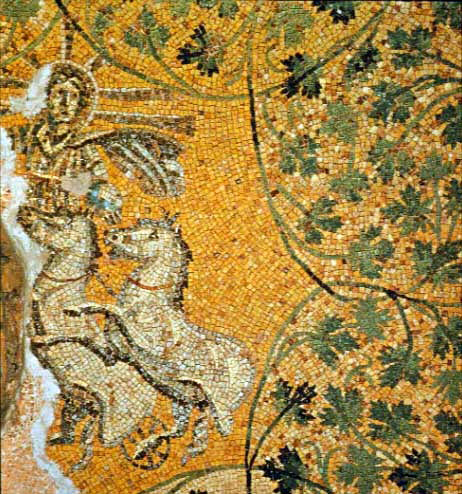
Public domain via Wikimedia Commons · Source and licence

- The Claim Examined
Mausoleum M in the necropolis under St Peter’s was built for the Julii in the late 2nd or early 3rd century. Its vault mosaic shows a figure in the chariot of the sun drawn by white horses, rays rising from his head, a globe in his hand. The walls carry a fisherman, a shepherd and a boat scene read as Jonah.[75][76] Catalogues date the mosaic differently, from the 3rd century to the 4th.[77]
- The Temple’s Answer
The figure is read 2 ways: as Christ, or, with Steven Hijmans, as Sol alone.[75] Where the Church reads Christ, it names him with Malachi 4:2, the Sun of righteousness.[78] If the figure is Christ, a Christian family under the site of St Peter’s gave its Lord the radiate crown and the solar chariot.
If it’s Sol, the same vault set the Sun’s chariot above Christian scenes. On both readings Christian burial art beneath the Vatican spoke the visual language of the Gods. The image is there.
- For Your Decision
The face you were taught to worship was drawn with the features of the older Gods. Read For Christians: The Faith Before the Faith.
C38 Gregory Ordered the Temples Kept and the Worship Replaced
Gregory’s letter of 601 keeps the temples and feasts and changes only the one addressed; Boniface IV made the Pantheon a church.
Read the dossier
Gregory the Great to Abbot Mellitus, 601, in Bede, Ecclesiastical History I.30, ed. A. M. Sellar (1907) · Read the letter
… the temples of the idols in that nation ought not to be destroyed; but let the idols that are in them be destroyed; let water be consecrated and sprinkled in the said temples, let altars be erected, and relics placed there. For if those temples are well built, it is requisite that they be converted from the worship of devils to the service of the true God …
- The Claim Examined
Christianity is said to have won Europe by the truth of its message. Its own pope set down the method in 601. Keep the sacred places so
that the nation, seeing that their temples are not destroyed, may remove error from their hearts
andmay the more freely resort to the places to which they have been accustomed
. Because the Englishare used to slaughter many oxen in sacrifice to devils, some solemnity must be given them in exchange for this
: huts of boughsabout those churches which have been turned to that use from being temples
. His reason:it is impossible to cut off every thing at once from their rude natures
.[79]- The Temple’s Answer
Bede shows that the month
was once called after a goddess of theirs named Eostre, in whose honour feasts were celebrated in that month
, and that the English now callthe joys of the new rite by the time-honoured name of the old observance
.[80] The English name of the Paschal feast is the name of a Goddess.The letter is the confession. It keeps the place, the day, the feast and the people’s devotion, and changes only the one addressed, whom it calls
devils
. At Rome the same policy reached the greatest temple of all.Boniface IV obtained from Emperor Phocas
the temple at Rome called by the ancients Pantheon, as representing all the gods
, and dedicated itto the holy Mother of God
andto all Christ’s martyrs
.[79] That is the inversion in Church documents: your ancestors kept walking to the same sacred places while the Gods who had stood there were renamed devils. Recovering the Gods restores the address the letter changed.- For Your Decision
The sacred places and feasts were never taken from the Gods; only Their names were. Read The Inversion Was Politics and the Temple’s Spring Equinox.
C39 Pontifex Maximus: Rome’s High-Priestly Title on a Papal Façade
A Christian emperor refused the pagan high priest’s robe as unlawful, and the title Pontifex Maximus stands carved over St Peter’s.
Read the dossier
Zosimus, New History IV.36 (of the reign of Gratian), English translation (London: Green and Chaplin, 1814) · Read the passage
But when the Pontifices, in the accustomed manner, brought the sacred robe to Gratian, he, considering it a garment unlawful for a Christian to use, rejected their offer.
- The Claim Examined
The pontifex maximus headed the priestly colleges of Rome’s worship of the Gods. Zosimus records that a Christian emperor refused its robe as
unlawful for a Christian
, and that a priest answered:If the emperor refuses to become Pontifex, we shall soon make one.
[81] In the early 3rd century Tertullian mocked a Christian bishop with the title:The Pontifex Maximus, that is, the bishop of bishops, issues an edict
.[82] In 1612 Paul V Borghese set his name across the façade of St Peter’s with the titleRomanus Pont. Max
.[83]- The Temple’s Answer
The record traces usage: a title a Christian emperor rejected as unlawful, a title a Christian writer used as an insult for an overreaching bishop, became the title carved in stone over the Church’s central basilica. The Church whose emperors dismantled Rome’s priesthoods gave its own bishop the title of their head. Names carry power, and this one was borrowed from the Gods’ own priesthood.
- For Your Decision
When the successor wears the predecessor’s title, ask whose authority is really being invoked. Read The Name You Already Speak.
C40 Forged Authority: the Donation, the False Decretals and the False Areopagite
The Donation of Constantine was forged between 750 and 850, and Proclus’s Neoplatonism passed into the Church under the name of Paul’s convert.
Read the dossier
J. P. Kirsch,
Donation of Constantine, The Catholic Encyclopedia 5 (1909) · Read the articleThis document is without doubt a forgery …
- The Claim Examined
3 documents shaped papal and mystical authority under false names, and the Church’s own encyclopedia says so. The Donation of Constantine,
fabricated somewhere between the years 750 and 850
, had the emperor grant the pope Rome and the provinces of Italy and the West; Leo IX wasthe first pope who used it in an official act
, in 1054, and later popes relied on it.[84] The False Decretals,published between 847 and 852
under the pseudonym Isidore Mercator, are letters of early popes of whichevery one agrees
they are forgeries; the article concedesthe popes benefited by the forgeries
.[85] The writings of Dionysius claim the Areopagite converted by Paul, yet date from no earlier than the close of the 5th century and showan astonishing agreement
with the Neoplatonist Proclusin arrangement, sequence of thought, examples, figures, and expressions
.[86]- The Temple’s Answer
The exposure came centuries after the use. The forgeries did their work while they were believed: a territorial claim in papal acts, a canon law of papal precedent, a mystical theology the Scholastics, Thomas Aquinas among them,
adopted
.[86] The last case matters most to you. The Church’s mysticism of the divine names and the hierarchies of light rests in large part on Proclus, a Neoplatonist of the old religion, published under the name of Paul’s convert. The ascent the Church taught is older than the Church. Go to its source.- For Your Decision
What was borrowed under a false name can be received under its true one. Begin with An Inheritance You Can Live In.
C41 The Shroud of Turin: Radiocarbon, a Bishop’s Report and a Pope’s Instruction
The 1989 radiocarbon test dated the linen to the Middle Ages, and the Avignon pope ordered it shown as a picture.
Read the dossier
P. E. Damon and others,
Radiocarbon dating of the Shroud of Turin, Nature 337 (16 February 1989), abstract · Read the abstractVery small samples from the Shroud of Turin have been dated by accelerator mass spectrometry in laboratories at Arizona, Oxford and Zurich … The results provide conclusive evidence that the linen of the Shroud of Turin is mediaeval.
- The Claim Examined
The Shroud is venerated as Christ’s burial cloth. 3 kinds of evidence bear on it, and the Temple keeps them apart. First, the 1989 radiocarbon result above.[87] Second, an allegation: in 1389 the Bishop of Troyes appealed to the Avignon pope Clement VII and declared the cloth
the work of an artist who some years before had confessed to having painted it
. That is the bishop’s report; no confession by a named painter survives in this record. Third, a papal instruction: Clement VII,without absolutely prohibiting the exhibition
, ruled that when it was shown the priest should declarethat it was not the real shroud of Christ
,but only a picture made to represent it
.[88]- The Temple’s Answer
The papal record settles it apart from the laboratory. The earliest papal ruling on record ordered the cloth announced to the people as a picture. The Catholic Encyclopedia’s own author reported in 1912 that
the immense preponderance of opinion among learned Catholics
was against its authenticity.[88]Devotion grew around an object its own authorities had labelled a representation. Faith in the Gods doesn’t depend on a relic surviving a laboratory.
- For Your Decision
Build your relationship with the Divine on practice you can test in your own life. See An Ordinary Day with the Gods.
C42 A Reformer’s Inventory of the Relics
Calvin judged that the nails are all spurious and that every apostle has more than 4 bodies.
Read the dossier
John Calvin on the fragments of the True Cross, Treatise on Relics (1543), as rendered by Philip Schaff, History of the Christian Church VIII §122 · Read the section
… would form a good shipload, which it would take three hundred men to carry instead of one.
- The Claim Examined
Relic cults claimed physical contact with the sacred. A Christian reformer audited the claims. Calvin’s tract, as Schaff summarises it, judged that
the nails are all spurious
and thatevery apostle has more than four bodies and every saint two or three
.[89] An English version of the 16th century has the fragments of the Crossinough to fraighte a great ship
.[90]- The Temple’s Answer
Calvin is a witness from inside Christendom: a Christian theologian testified that relic claims multiplied bodies and objects beyond reckoning, and that no authority had stopped it. One branch of Christianity had to accuse the other of venerating the counterfeit sacred, and Catholic writers still defend the fragments of the Cross by measuring them.[91] The Gods are approached by prayer, meditation and right conduct, open to anyone who practises them.
- For Your Decision
You need no fragment to stand before the Gods. Begin with the Temple’s Prayer to Zeus for Protection.
Days, feasts, temples, images and titles: the record shows them carried across from the worship of the Gods into the Church, renamed on the way. What was carried across was never destroyed. It waits under its new name for you to recognise it.
Keep the feasts you love, the light you honour and the sacred places your family knew, and restore their true address.
VIII. Institutional Actions and Their Consequences
The last 10 dossiers concern acts: laws, bulls, sentences, wars and the handling of abuse. The Temple keeps 4 things apart throughout: an allegation, a finding, an estimate and a conviction. Each figure stays with the source that reported it. The criticism falls on laws, offices and named acts. It never falls on you.
C43 Scripture Told Slaves to Obey; Popes Licensed the Enslavement of Pagans
Ephesians 6:5 told slaves to obey with fear and trembling, Augustine made sin the cause of slavery, and Dum Diversas licensed enslaving pagans in 1452.
Read the dossier
Nicholas V, Romanus Pontifex, 8 January 1455, recalling his earlier grant to King Alfonso V of Portugal, tr. F. G. Davenport (1917) · Read the bull
… to invade, search out, capture, vanquish, and subdue all Saracens and pagans whatsoever … and to reduce their persons to perpetual slavery …
- The Claim Examined
Christianity is credited with ending slavery. Its scripture commanded:
Servants, be obedient to them that are your masters according to the flesh, with fear and trembling
.[92] Augustine explained:The prime cause, then, of slavery is sin
, andthe apostle admonishes slaves to be subject to their masters, and to serve them heartily
.[93] In 1455 a pope confirmed a king’s licence to reducepagans whatsoever
to perpetual slavery.[94] On 30 March 2023 the Vatican’s dicasteries for culture and education and for integral human development acknowledged that such bullsdid not adequately reflect the equal dignity and rights of indigenous peoples
and stated that theyhave never been considered expressions of the Catholic faith
.[95]- The Temple’s Answer
The grant stands in the record: the head of the Church authorised the permanent enslavement of people because they weren’t Christian, and
pagans
were named as a class. Worshippers of the Gods were made lawful captives by a papal act.Now the Church says such acts were never expressions of its faith. Then you’re entitled to ask what a papal bull expresses when it disposes of human beings, and why the same office should be trusted when it disposes of your soul.
- For Your Decision
The Gods made no one a slave for worshipping Them. Read how Zevism grounds human dignity in Your Place in the Divine Family.
C44 Women Commanded to Silence in the Assembly
1 Timothy 2:14 grounds women’s silence in Eve’s deception, and 1 Corinthians 14 calls it a shame for a woman to speak in church.
Read the dossier
1 Timothy 2:12 to 13, King James Version (1611) · Read the chapter
But I suffer not a woman to teach, nor to usurp authority over the man, but to be in silence. For Adam was first formed, then Eve.
- The Claim Examined
The text grounds the restriction in creation itself, then adds:
the woman being deceived was in the transgression
. The Corinthian letter repeats it:Let your women keep silence in the churches: for it is not permitted unto them to speak
, andit is a shame for women to speak in the church
.[96] Tertullian drew the conclusion for every woman:You are the devil’s gateway
,you are she who persuaded him whom the devil was not valiant enough to attack
.[97]- The Temple’s Answer
The same letters name Phoebe a deacon of the church at Cenchreae[98] and give women’s silence a ground of its own: the order of creation and Eve’s deception, reasons that apply to every woman in every age. Churches that ordain women today have had to argue against their own scripture’s stated rationale. Zevism has no such quarrel to settle.
Wisdom proceeds from Zeus as Athena, and the initiate’s dedication asks acceptance from the Great Father and from
Hera the Divine Mother
.[45] The divine world you return to has Goddesses at its height.- For Your Decision
Bring your daughters into a religion whose heaven includes Them. Meet the Gods in Zeus and the Gods.
C45 The Empire Outlawed the Worship of the Gods, Down to the Household Hearth
Codex Theodosianus 16.10 closed the temples, made sacrifice a capital crime and followed worship indoors to the lar and the penates.
Read the dossier
Theodosius I, Arcadius and Honorius, Codex Theodosianus XVI.10.12, 392, tr. C. Pharr (1952) · Read the law
No person at all, of any class or order whatsoever of men or of dignitaries … shall sacrifice an innocent victim to senseless images in any place at all or in any city. He shall not, by more secret wickedness, venerate his Lar with fire, his Genius with wine, his Penates with fragrant odors; he shall not burn lights to them, place incense before them, or suspend wreaths for them.
- The Claim Examined
Christianity is said to have spread by persuasion. The Christian emperors legislated. An earlier law in the same title, issued under Constantius II, ordered that
the temples should be closed at once
and that whoever sacrificed shouldbe stricken with the avenging sword
.[42] In 392 the prohibition reached the family shrine, as above: the lamp, the incense and the garland offered to the household Gods at home.[99] In 435, Schaff records,Theodosius II. commanded the temples to be destroyed or turned into churches
, and Justinian laterprohibited heathenism as a form of worship in the empire on pain of death
.[100]- The Temple’s Answer
The legislation repeated over 2 centuries shows 2 facts at once: the worship of the Gods continued, and the state kept legislating to end it. The intent is written in the law’s own words, which follow the worshipper indoors to the hearth.
Nothing in that record is persuasion. Today you can light the lamp at a home shrine that 392 forbade, and no one can forbid it to you.
- For Your Decision
The first act of return is the one the law tried hardest to prevent: worship of the Gods in your own home. Begin at How to Begin; the full record is in the Temple’s The Inquisition Is Not Over.
C46 Christian Armies Against Christians: Béziers and Constantinople
In 1204 crusaders broke the great church’s altar table into pieces at Constantinople, and in 1209 the legate reported Béziers to the pope.
Read the dossier
Arnaud Amalric, abbot of Cîteaux and papal legate, report to Innocent III on Béziers, August 1209, Patrologia Latina 216, col. 139 · Read the text and its sources
nostrique non parcentes ordini, sexui, vel aetati, fere viginti millia hominum in ore gladii peremerunt
Our men spared no one, irrespective of rank, sex, or age, and put to the sword almost 20,000 people.
- The Claim Examined
The crusades are defended as wars for Christendom. In 1209 a crusade called by the pope fell on a Christian city in southern France, and the papal legate reported the slaughter to the pope.[101] The figure is the legate’s own medieval claim, and modern estimates of the town’s population are lower; the famous
Kill them all, God will know his own
comes later, from Caesarius of Heisterbach, who reported it at second hand.[101] In 1215 the Fourth Lateran Council granted toCatholics who take the cross and gird themselves up for the expulsion of heretics
the same indulgence as crusaders to the Holy Land.[62] In 1204 crusaders sacked Constantinople; Niketas Choniates saw its altar tablebroken into pieces and divided among the despoilers
.[102]- The Temple’s Answer
A pope called the sack of 1204
tragic
in 2001.[103] The papacy authorised holy war against Christians it judged heretical and rewarded it with the indulgence of a crusader to the Holy Land.Its victims were Christians, and their suffering belongs in this account. The Temple’s Declaration names the cycle in which each claimant justifies destruction by calling the destroyed unholy, and it commits Zevism never to convert by force.[104]
- For Your Decision
Choose a faith that has bound itself never to build on another’s ruins. Read Why This Temple.
C47 Torture by Papal Law, Bruno Burned, Galileo Condemned
Ad extirpanda made torture a duty of civil rulers in 1252, Bruno burned in 1600, and Galileo knelt to abjure in 1633.
Read the dossier
Innocent IV, Ad extirpanda, 15 May 1252, Lex 25, tr. Temple of Zeus · Read the bull
Teneatur praeterea Potestas, seu Rector omnes haereticos, quos captos habuerit, cogere citra membri diminutionem, et mortis periculum … errores suos expresse fateri, et accusare alios haereticos
The governor or ruler shall furthermore be bound to compel all heretics he holds captive, short of loss of limb and danger of death … to confess their errors expressly and to accuse other heretics.
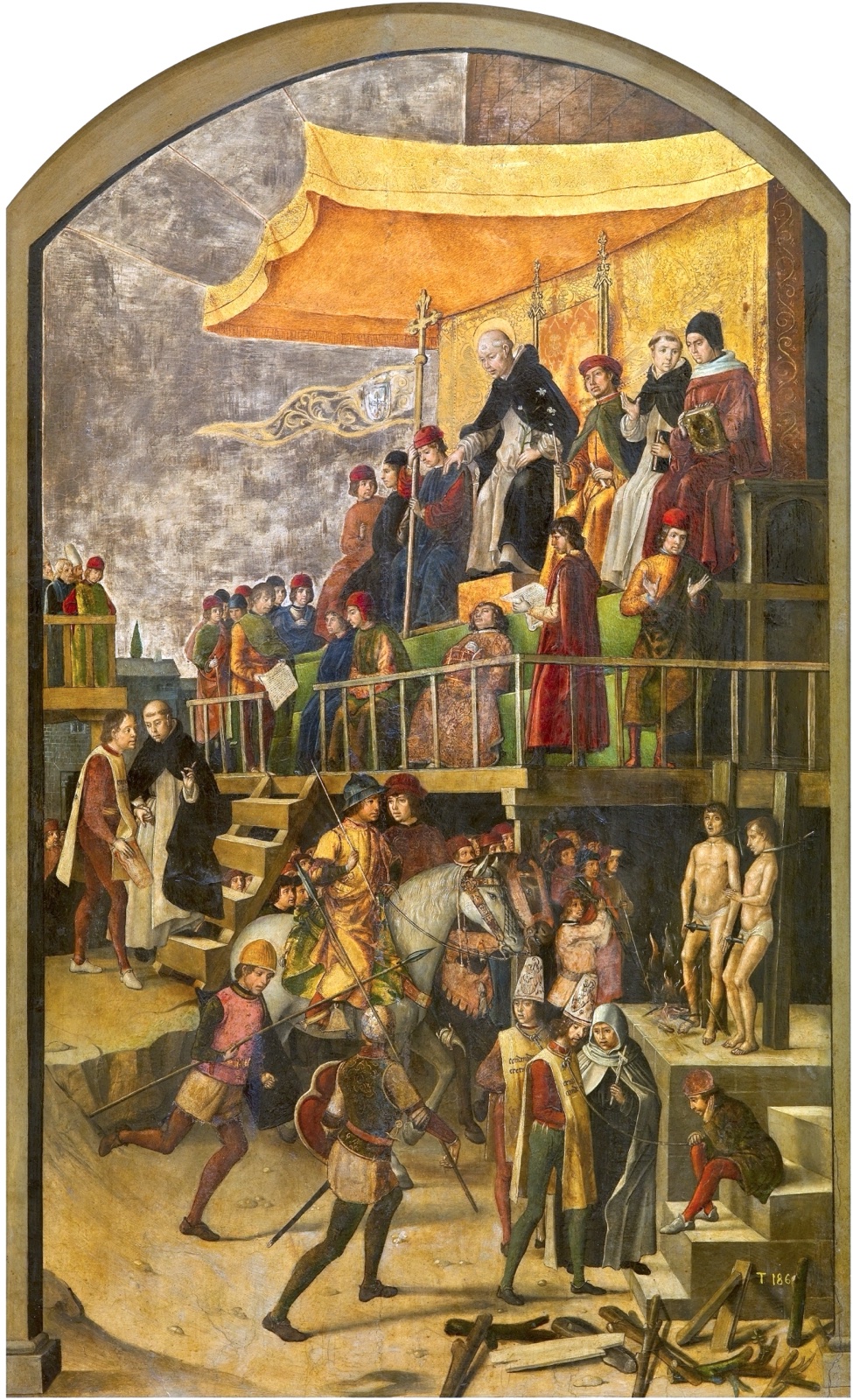
Public domain via Wikimedia Commons · Source and licence

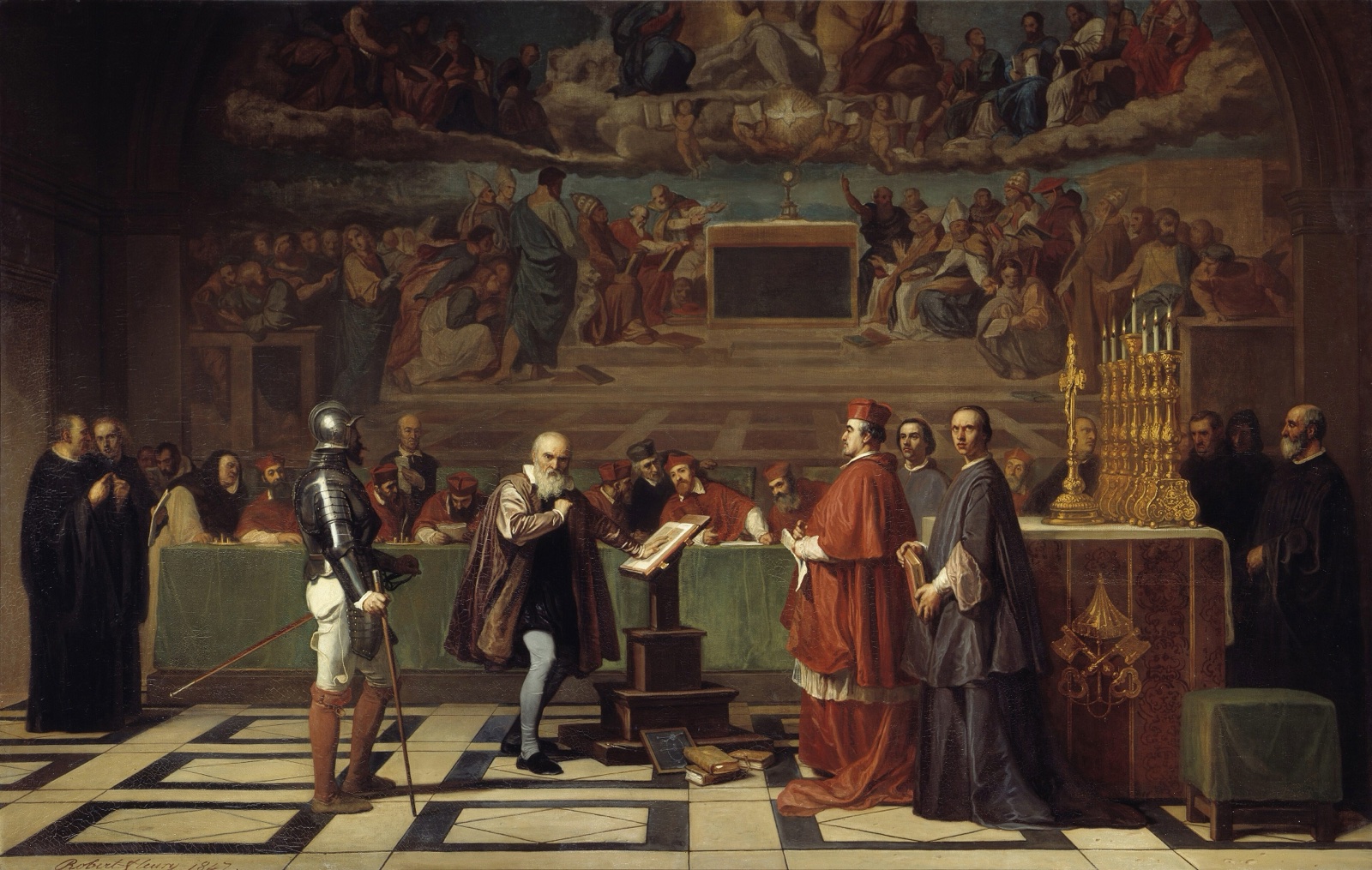
Public domain via Wikimedia Commons · Source and licence

- The Claim Examined
3 cases, 3 different outcomes. In 1252 a papal bull obliged civil rulers to force confessions from heretics, short of maiming or killing them.[105] Giordano Bruno, handed to the Roman Inquisition, was held
for six years
, condemned in January 1600,handed over to the secular power
andburned at the stake in the Campo dei Fiori
on 17 February; the Catholic Encyclopedia insists he was condemnedfor his theological errors
.[106] Galileo was sentenced on 22 June 1633 asvehemently suspected of heresy
for teaching that the Sun stands still at the centre, made toabjure, curse and detest
it, condemnedto the formal prison of this Holy Office during our pleasure
, and his book prohibited.[107]- The Temple’s Answer
A papal law made torture the procedure. A man was burned at the stake for his theology, and the Church’s encyclopedia offers that as the mitigating fact.
A scientist was condemned to prison at the Inquisition’s pleasure for describing the heavens, and the institution took 359 years to say its theologians had confused their reading of scripture with scripture.[108] Every one of these is an exercise of authority over the mind.
- For Your Decision
The Temple asks you to search and evaluate before you commit. Read how dedication follows understanding.
C48 The Witch Persecution Had Its Verse, Its Bull and Its Handbook
Exodus 22:18, Innocent VIII’s bull of 1484 and the Malleus Maleficarum of 1487: Levack estimated about 60,000 executed.
Read the dossier
Innocent VIII, Summis desiderantes affectibus, 5 December 1484, 1928 English translation as excerpted · Read the bull and its context
Many persons of both sexes, unmindful of their own salvation … have abandoned themselves to devils, incubi and succubi …
- The Claim Examined
The witch trials are often blamed on superstition outside the Church. The Church’s texts sit at their centre. The verse:
Thou shalt not suffer a witch to live
(Exodus 22:18).[109] The bull: in 1484 Innocent VIII authorised his inquisitors in Germany to proceed against such persons,correcting, imprisoning, punishing and chastising
. The handbook: the bull was printed in the preface of the inquisitor Heinrich Kramer’s Malleus Maleficarum, which appeared in 1487.[110] Brian Levack’s standard study estimated in 1987 thatEuropean communities executed about 60,000 witches
in the early modern period; other historians give other figures.[111]- The Temple’s Answer
Catholic and Protestant courts alike worked from the same scripture, the same demonology and the same conviction that converse with spirits was traffic with the devil. The verse, the papal commission and the handbook supplied the theology the courts applied. The theology they applied drew no line between the healer and the poisoner.
- For Your Decision
The practices once punished as witchcraft are part of the inheritance you are returning to. Read the Temple’s The Inquisition Is Not Over.
C49 The Index: Rome Decided What the Faithful Could Read, for 407 Years
From 1559 to 1966 a Roman office banned books under pain of censure, Copernicus among them.
Read the dossier
Decree of the Congregation of the Index, 5 March 1616, tr. M. A. Finocchiaro, The Essential Galileo (2008) · Read the decree
… the false Pythagorean doctrine, altogether contrary to the Holy Scripture, that the earth moves and the sun is motionless …
- The Claim Examined
The Church presents itself as the patron of learning. In 1559 Paul IV issued the first Roman Index of Prohibited Books, which the Catholic Encyclopedia calls
very severe
.[112] The 1616 decree ordered Copernicus’s On the Revolutionssuspended until corrected
and Foscarini’s defence of itcompletely prohibited and condemned
.[113] In 1633 the Holy Office ordered Galileo’s Dialogue prohibitedby public edict
.[107] Only on 14 June 1966 did the Congregation for the Doctrine of the Faith declare that the Indexno longer has the force of ecclesiastical law with the attached censure
, and on 15 November 1966 those under the censures of canon 2318 were declared absolved.[114]- The Temple’s Answer
Name the authority, the date and the penalty, and the system speaks for itself. For 407 years, from 1559 to 1966, a Roman office decided which books a Catholic could read under pain of ecclesiastical censure, and among its targets was the motion of the earth. Even at the end, the 1966 notification declared that the Index
remains morally binding, in light of the demands of natural law
while removing its legal force.[114] Zevism teaches the opposite discipline: search and evaluate, read the sources for yourself, and test every claim, including the Temple’s.- For Your Decision
Read freely; then choose. The Temple’s sources are open to you in Instructions for New People.
C50 Luther’s Programme Against the Jews, and His Church’s Repudiation
In 1543 Luther urged the princes to burn the synagogues, raze Jewish houses and seize their books; the Evangelical Lutheran Church in America repudiated it in 1994.
Read the dossier
Martin Luther, On the Jews and Their Lies (1543), Luther’s Works 47 (Fortress Press, 1971) · Read the excerpt
First to set fire to their synagogues or schools and to bury and cover with dirt whatever will not burn …
- The Claim Examined
Luther is honoured as the father of the Reformation and of a recovered gospel. In 1543 he set out a programme: burn the synagogues;
their houses also be razed and destroyed
; their prayer books and Talmudic writingsbe taken from them
; their rabbisforbidden to teach henceforth on pain of loss of life and limb
.[115] In 1994 the Evangelical Lutheran Church in America declared:we reject this violent invective
, and expresseddeep and abiding sorrow over its tragic effects on subsequent generations
.[116]- The Temple’s Answer
The Temple’s invitation rejects hostility to any people, and its criticism falls on this text and its author alone. Notice what the text shows about exclusive religious authority. The man who freed Christians from Rome’s claim to bind their consciences claimed the power to burn another people’s houses of prayer. The Evangelical Lutheran Church in America formally rejected the programme 451 years later, in concert with the Lutheran World Federation. Exclusive truth breeds exactly this: a sure conviction that the other’s worship has no right to stand.
- For Your Decision
A faith is known by what it does to the worship of others. See the Temple’s commitment in Why This Temple.
C51 The Day of Pardon Confessed Categories of Sin, Not Particular Cases
On 12 March 2000 the pope confessed 7 categories of sin and asked pardon of God alone.
Read the dossier
John Paul II, Universal Prayer for the Day of Pardon, section V, St Peter’s, 12 March 2000 · Read the prayer
Yet Christians have often denied the Gospel; yielding to a mentality of power, they have violated the rights of ethnic groups and peoples, and shown contempt for their cultures and religious traditions …
- The Claim Examined
On 12 March 2000 the pope led 7 confessions: sins in general; sins
committed in the service of truth
; against the unity of the Body of Christ; against the people of Israel; againstlove, peace, the rights of peoples, and respect for cultures and religions
; against the dignity of women and the unity of the human race; and against the fundamental rights of the person. The second admitted thateven men of the Church, in the name of faith and morals, have sometimes used methods not in keeping with the Gospel
.[117] The preparatory document namedintolerance and even the use of force in the service of truth
, and set limits:Subjective responsibility ceases with the death of the one who performed the act
, andGeneralization must be avoided
.[118]- The Temple’s Answer
The Day of Pardon named categories. Within those categories stands a confession that Christians showed
contempt
for other peoples’religious traditions
. The pardon was asked of the Christian God.It wasn’t asked of the peoples whose sanctuaries were taken, and it restored nothing to the Gods whose worship was outlawed. Many readers descend from those traditions. Their restoration is yours to make.
- For Your Decision
An admitted contempt for your ancestors’ religion is a reason to recover it. Begin at Begin Your Return.
C52 Abuse and Accountability: What Each Count Measures and Who Made It
John Jay counted 4,392 accused priests in the United States and CIASE about 216,000 abused children in France.
Read the dossier
Francis, Letter to the People of God, Vatican City, 20 August 2018 · Read the letter
With shame and repentance, we acknowledge as an ecclesial community that we were not where we should have been …
- The Claim Examined
The Church claims the moral authority to judge your soul. Its own pope wrote this letter after a report that
detailed the experiences of at least a thousand survivors
overapproximately seventy years
.[119] The main counts measure different things:- United States, 2004. The John Jay College study, commissioned by the US Conference of Catholic Bishops, counted allegations reported by dioceses: 4,392 clergy accused between 1950 and 2002, about 4% of the 109,694 clergy of the period, by 10,667 individuals.[120] Allegations are not convictions.
- Pennsylvania, 2018. A state grand jury, convened under the Attorney General and independent of the Church, examined 6 dioceses and named over 300
predator priests
;More than 1,000 child victims were identifiable from the church’s own records
, and the jurors wrote thatWe believe that the real number
is in the thousands.[121] These are a grand jury’s findings, not trial verdicts. - France, 2021. The CIASE, commissioned by the French bishops’ conference and the conference of religious orders, estimated from a population survey of 28,010 adults about 216,000 victims of clergy and religious from 1950 to 2020 (95% interval 165,000 to 270,000), 330,000 including lay people in Church settings, and 2,900 to 3,200 abusers as a lower limit.[122] These are statistical estimates.
- The Temple’s Answer
On the Church’s own commissioned studies, an independent grand jury’s findings and its pope’s own words, the institution that claims to stand between you and God failed to protect children in its care, across decades and continents. Its authority over your conscience was never greater than its conduct. Zevism places no required mediator between you and the Gods, and its Declaration applies its diagnosis of spiritual pathology
to us with the same force it applies to others
.[104]- For Your Decision
Authority must be earned under Ma’at, by every institution, the Temple included. See Why This Temple.
IX. The Record: Crimes Committed in the Name of Christianity
Here are the acts themselves, year by year, each with the law, letter, chronicle or report that records it. Emperors, bishops, popes, councils, kings, religious orders and churches did them in the name of Christ, and their own documents keep the count.
Nothing here is drawn from an enemy of the Church. No Christian reading this did any of it.
Against the Gods and Those Who Kept Them, 380 to 529
The new faith took the empire’s law within 70 years of Constantine’s conversion. First it named every other belief madness. Then it closed the temples, made sacrifice a crime against the state, and ended with a law of death.
| Year | What Was Done | The Record |
|---|---|---|
| 380 | The emperors Gratian, Valentinian II and Theodosius I order every subject to hold the faith of the bishops of Rome and Alexandria. Its followers alone may be called Catholic Christians. All others are judged dementes vesanosque, demented and insane, and threatened with divine and imperial punishment. | The Edict of Thessalonica, Codex Theodosianus 16.1.2[123] |
| 385 | The ascetic bishop Priscillian and 6 of his followers are put to death at Trier on the emperor Magnus Maximus’s decree, accused by fellow bishops. He is the first Christian executed for heresy. | Sulpicius Severus, Chronica 2.46 to 51[124] |
| 388 | Christians, at the instigation of their bishop, burn the synagogue of Callinicum. Theodosius orders it rebuilt. Ambrose, bishop of Milan, claims the deed for himself, I declare that I set fire to the synagogue, or at least that I ordered those who did it, and the emperor withdraws his order. | Ambrose, Letters 40.8 and 41.27 to 28[125] |
| 391 to 392 | 3 laws in 21 months forbid sacrifice, entering a temple and honouring a statue of a God, then every worship of the Gods in public or at home, down to the household Lar honoured with fire, the Genius with wine and the Penates with incense. Sacrifice and divination become treason. A house where incense was offered is confiscated. | Codex Theodosianus 16.10.10, 16.10.11 and 16.10.12[126] |
| 391 | Theophilus, bishop of Alexandria, with the governor and the commander of the troops in Egypt, demolishes the temples of Alexandria. The Serapeum falls and its images are broken and melted down. | Socrates Scholasticus, Church History 5.16; Sozomen 7.15[127] |
| 415 | Hypatia, the philosopher and mathematician of Alexandria, is dragged by a Christian crowd led by a reader of the church named Peter into the church called the Caesareum, stripped and killed. Her body is cut apart and burned. | Socrates Scholasticus, Church History 7.15[128] |
| 529 | Justinian’s law: death for the baptised who still adhere to pagan error; for those who refuse baptism, the loss of civil rights and of all property; for the households that keep away from church, confiscation and exile; for secret sacrifice, death. Children are to be baptised at once, and no follower of the Gods may teach. | Codex Justinianus 1.11.10[129] |
| 529 | Justinian sends an order to Athens that no one is to teach philosophy there or explain the laws. | John Malalas, Chronographia 18.47[130] |
The emperors Valentinian II, Theodosius I and Arcadius, 24 February 391, Codex Theodosianus 16.10.10, Latin from the edition at droitromain.univ-grenoble-alpes.fr, tr. Temple of Zeus · Read the law
Nemo se hostiis polluat, nemo insontem victimam caedat, nemo delubra adeat, templa perlustret et mortali opere formata simulacra suspiciat
Let no one pollute himself with sacrificial victims, let no one slay an innocent victim, let no one approach the shrines, walk through the temples or look up to images formed by mortal labour.
Public domain via Wikimedia Commons · Source and licence

Socrates Scholasticus on the death of Hypatia, 415, Church History 7.15, tr. A. C. Zenos (Nicene and Post-Nicene Fathers, 1890) · Read the chapter
they took her to the church called Cæsareum, where they completely stripped her, and then murdered her with tiles.
Conversion by the Sword, 615 to 1000
In Spain a Christian king baptised the Jews by force, and a council of bishops kept them bound to it. North of the old empire the new faith arrived with armies.
Charlemagne made baptism the price of life in Saxony. In Norway a king offered the same choice with fire and serpents.
| Year | What Was Done | The Record |
|---|---|---|
| 615 | The Visigothic king Sisebut orders the baptism of the Jewish subjects of his kingdom; when they refuse, he uses force. | C. Nemo-Pekelman, “Divine Justice and Freedom: On Canon 57 of the Fourth Council of Toledo”[186] |
| 633 | The Fourth Council of Toledo, presided over by Isidore of Seville, forbids forced baptism from then on, and binds those already baptised by force to the faith: those who ad christianitatem venire coacti sunt, compelled to come to Christianity under Sisebut, must keep it. Its canons 59 and 60 take Jewish children from their families. | Fourth Council of Toledo, canons 57, 59 and 60[186] |
| 782 | After a Saxon rising, the Saxon leaders hand over those held responsible to Charlemagne ad occidendum, to be killed: 4,500 men (2 manuscripts read 4,000). The revised annals add that all were beheaded on one day at Verden on the Aller. | Annales regni Francorum and the revised annals, year 782[131] |
| 782 to 785 | Charlemagne’s law for conquered Saxony sets death for refusing baptism, for burning the dead by the old rite, for eating meat in Lent out of contempt, and for 8 more offences against the Church. A father who leaves his child unbaptised a year pays 120 solidi if noble. | Capitulatio de partibus Saxoniae, chapters 3 to 19[132] |
| 995 to 1000 | Olaf Tryggvason, king of Norway, has those who refuse baptism tortured or killed. Eyvind Kinrifa dies with a pan of glowing coals set on his belly. An adder is forced down the throat of Raud the Strong, and Raud’s men are baptised, killed or tortured. | Snorri Sturluson, Heimskringla, Saga of Olaf Tryggvason, chapters 83 and 87[133] |
Charlemagne, Capitulatio de partibus Saxoniae, chapter 8, tr. D. C. Munro (1900) · Read the capitulary
… shall have scorned to come to baptism and shall have wished to remain a pagan, let him be punished by death.
Crusade, Inquisition and the Fire, 1096 to 1415
The Church turned the sword on Jews, on Muslims, on pagans of the Baltic, on other Christians and on its own dissenters. A pope wrote torture into law. Its councils sent men to the stake and dug up the bones of the dead.
| Year | What Was Done | The Record |
|---|---|---|
| 1096 | Crusader bands on their way to the East fall on the Jews of the Rhineland: Speyer on 3 May, Worms on 18 May, Mainz on 27 May, Cologne on 30 May. At Mainz, Albert of Aachen writes, Breaking the bolts and doors, they killed the Jews, about seven hundred in number, who in vain resisted. Solomon bar Samson counts 1,100 dead there in one day. At Worms about 800 die. | Albert of Aachen and Ekkehard of Aura, tr. A. C. Krey; Solomon bar Samson, tr. J. R. Marcus[134] |
| 1099 | The First Crusade takes Jerusalem on 15 July and kills the people it finds, above all those who fled to the Temple Mount. Raymond of Aguilers, a chaplain of the army: in the Temple and porch of Solomon, men rode in blood up to their knees and bridle reins.Fulcher of Chartres counts almost 10,000 killed in the Temple alone. The Gesta Francorum: no one knows their number except God alone. | Gesta Francorum, Raymond of Aguilers and Fulcher of Chartres, tr. A. C. Krey[135] |
| 1147 | Bernard of Clairvaux calls Christians to crusade against the pagan Slavs beyond the Elbe with the indulgence of Jerusalem, forbids any truce with them for money, and gives the aim: war until, with God’s help, either their rite or their nation is wiped out, aut ritus ipse, aut natio deleatur. | Bernard of Clairvaux, Letter 457[136] |
| 1204 | The Fourth Crusade, raised to free Jerusalem, storms Christian Constantinople on 12 April and plunders it for 3 days, Hagia Sophia with it. Pope Innocent III writes to his own legate that the crusaders have spared neither age nor sex. Nicetas Choniates, who lived through it: Alas, the images, which ought to have been adored, were trodden under foot! | Innocent III to his legate, tr. J. Brundage; Nicetas Choniates, tr. D. C. Munro[137] |
| 1209 | The crusade against the Cathars takes Béziers on 22 July. The papal legates report to Innocent III that their men killed nearly twenty thousand(fere viginti millia hominum). Peter of Vaux-de-Cernay counts 7,000 killed inside the church of the Madeleine. Caesarius of Heisterbach records the words given to the abbot of Cîteaux when asked how to tell Catholics from heretics: Kill them all for the Lord knoweth them that are His. | The legates Arnaud Amalric and Milo to Innocent III; Peter of Vaux-de-Cernay; Caesarius of Heisterbach, Dialogue on Miracles 5.21[138] |
| 1215 | The Fourth Lateran Council orders that Jews and Muslims in every Christian land shall be marked off in the eyes of the public from other peoples through the character of their dress: the origin of the Jewish badge. Its canon 3 binds secular rulers by oath to exterminare, drive out of their lands, every heretic the Church points out. | Fourth Lateran Council, canons 3 and 68[139] |
| 1226 to 1283 | The Teutonic Order, armed with an imperial bull and the protection of the Holy See, conquers and baptises the pagan Prussians. Their rising of 1260 is called in the Order’s own chronicle the second apostasy, and it takes 15 years to crush. | Peter of Dusburg, Chronicle of the Land of Prussia, part 3[140] |
| 1242 | After Pope Gregory IX orders the Jewish books of France seized and the Talmud tried in Paris, 24 wagon loads of books totaling thousands of volumes were handed to the executioner for public burning. | Encyclopaedia Judaica, “Burning of the Talmud”[187] |
| 1244 | The archbishop of Narbonne, the bishop of Albi and the royal seneschal take Montségur, the great fortress of the Cathar perfect. The chronicler of Toulouse: castrum Montis Securi obsidetur et capitur, et heretici CC vel circiter comburuntur, the castle is besieged and taken, and about 200 heretics are burned. | Guillaume de Puylaurens, Chronica, ch. 44[188] |
| 1252 | Pope Innocent IV’s bull Ad extirpanda orders the rulers of the Italian cities to force every heretic they hold to confess and to accuse others, citra membri diminutionem, et mortis periculum, short of the loss of a limb and danger of death. Torture enters papal law. | Innocent IV, Ad extirpanda, law 25[141] |
| 1290 | Edward I orders every Jew out of England. Writs go to the sheriffs on 18 July: cum Judaeis regni nostri universis certum tempus praefixerimus a regno illo transfretandi, the king has set all the Jews of his realm a time to pass out of it, by 1 November. Around 3,000 are forced to leave. | Close Rolls, The National Archives C 54/107, m. 5[189] |
| 1307 to 1312 | Every Templar in France is arrested on 13 October 1307 and tried for heresy. On 12 May 1310, 54 who withdrew their confessions are burned as relapsed. Clement V abolishes the order not by definitive sentence, but by apostolic provision or ordinance, and its grand master Jacques de Molay is burned. | Clement V, Vox in excelso, Council of Vienne[142] |
| 1349 | Blamed for the Black Death, the Jews of Strasbourg are burned on a wooden scaffold in their own cemetery on 14 February, about 2,000 of them. Those who accept baptism are spared, and children are pulled from the fire and baptised against their parents’ will. The chronicler of the city: The money was indeed the thing that killed the Jews.About 300 Jewish communities are struck in those years. | Jacob von Königshofen, tr. J. R. Marcus; Encyclopaedia Judaica[143] |
| 1415 | The Council of Constance condemns Jan Hus and decrees that he is to be relinquished to the secular court. He is burned the same day, 6 July. The same council had ordered the body and bones of John Wyclif, dead for 30 years, exhumed. | Council of Constance, sessions 8 and 15[144] |
Pope Innocent IV, Ad extirpanda, 15 May 1252, law 25, Latin as transcribed from the Bullarium Taurinense, tr. Temple of Zeus · Read the bull
Teneatur praeterea Potestas, seu Rector omnes haereticos, quos captos habuerit, cogere citra membri diminutionem, et mortis periculum
The podestà or ruler shall moreover be bound to force all the heretics he holds captive, short of the loss of a limb and danger of death, …
The Inquisitions, the Witch Hunts and the Expulsions, 1478 to 1700
The tribunals of the faith ran for 356 years in Spain alone. Popes gave the witch hunters their authority, Catholic and Protestant states burned their dissenters, and Jews were baptised by force or driven out.
| Year | What Was Done | The Record |
|---|---|---|
| 1478 to 1834 | Pope Sixtus IV authorises Ferdinand and Isabella to name inquisitors for their kingdoms. The Spanish Inquisition burns about 2,000 people under its first grand inquisitor, Tomás de Torquemada, alone, and isn’t abolished until 15 July 1834. | Sixtus IV, Exigit sincerae devotionis affectus; Encyclopaedia Britannica[145] |
| 1484 | Pope Innocent VIII’s bull confirms 2 Dominican inquisitors against witchcraft in Germany, because many persons of both sexes, heedless of their own salvation and forsaking the catholic faith, give themselves over to devils male and female. | Innocent VIII, Summis desiderantes affectibus[146] |
| 1486 | The same inquisitors publish the Malleus Maleficarum, the Hammer of Witches, with the pope’s bull at its head. It teaches that the Belief that there are such Beings as Witches is so Essential a Part of the Catholic Faiththat denying it is heresy, sets out the trial and sanctions torture. 28 editions by 1600. | Heinrich Kramer and Jacob Sprenger, Malleus Maleficarum, part 1, question 1[147] |
| 1400 to 1750 | Across Europe and its colonies nearly 100,000 people are tried for witchcraft and between 40,000 and 60,000 executed, most of them women. | Encyclopaedia Britannica, “early modern witch trials”[148] |
| 1492 | Ferdinand and Isabella, at Torquemada’s urging, order every Jew who won’t be baptised to leave Castile and Aragon by the end of the month of July, on pain of death and confiscation. | The Alhambra Decree, 31 March 1492[149] |
| 1497 | Manuel I of Portugal has the Jewish children seized and baptised, then the Jews gathered at Lisbon baptised by force. An eyewitness: they were taken by force in all the king’s provinces, and were beaten with sticks and straps, and carried to the churches. | Isaac ibn Faradj, tr. A. Marx (1908)[150] |
| 1506 | After a Dominican’s Easter sermon a Lisbon crowd hunts down the forcibly baptised Jews and kills more than 1,400. They burnt them in the streets of the city three days on end, till the bodies were consumed and became ashes. | Isaac ibn Faradj, tr. A. Marx (1908)[150] |
| 1543 | Martin Luther urges the princes First to set fire to their synagogues or schools, then to raze the Jews’ houses, take their prayer books, forbid their rabbis to teach on pain of death and put them to forced labour: 7 measures in all. | Martin Luther, On the Jews and Their Lies[151] |
| 1553 | Geneva burns Michael Servetus alive for denying the Trinity, the sentence ordering him to be fastened to a stake and burnt alive. John Calvin had him arrested and pressed for his death. | The sentence of the Council of Geneva; Encyclopaedia Britannica[152] |
| 1555 to 1558 | Under Mary I of England some 300 Protestants are burned at the stake for heresy. | Encyclopaedia Britannica, “Mary I”[153] |
| 1555 | Pope Paul IV shuts the Jews of Rome and the Papal States into a walled quarter with 1 gate: the Roman Ghetto. His bull opens by calling them people quos propria culpa perpetuae servitati submisit, whom their own guilt has subjected to perpetual servitude. | Paul IV, Cum nimis absurdum[154] |
| 1560 to 1812 | The Portuguese Inquisition at Goa tries 16,172 cases between 1561 and 1774, most against converts accused of keeping their old faith. Its records were destroyed, so the number burned is unknown. | A. K. Priolkar, The Goa Inquisition, citing António Baião; Charles Dellon (1687)[155] |
| 1572 | The massacre of Saint Bartholomew’s Day: Catholic nobles and townsmen kill the Protestants of Paris and then of the provinces, 3,000 in Paris alone by modern counts. Pope Gregory XIII celebrates with a Te Deum and strikes a medal: Hugonottorum strages, the slaughter of the Huguenots. | Encyclopaedia Britannica; Catholic Encyclopedia (1912)[156] |
| 1600 | The Roman Inquisition burns Giordano Bruno alive in the Campo de’ Fiori, his tongue gagged, on the order of Clement VIII. | Encyclopaedia Britannica[157] |
| 1633 | The Holy Office forces Galileo to kneel and abjure: I abjure with sincere heart and unfeigned faith, I curse and detest the said errors. He lives out his life under house arrest. Rome acknowledges the error in 1992. | The sentence and abjuration of 22 June 1633; John Paul II, 31 October 1992[158] |
| 1692 | Salem, Massachusetts: 19 hanged for witchcraft, Giles Corey pressed to death under stones, 5 more dead in prison. | Encyclopaedia Britannica[159] |
Conquest, Slavery and Racism, 1452 to 2023
Popes gave the kings of Portugal and Spain the right to enslave every pagan they could reach. Churches owned slaves, branded them and preached the curse of Ham over them. The colour line ran through the churches into the 21st century.
| Year | What Was Done | The Record |
|---|---|---|
| 1452 | Pope Nicholas V grants the king of Portugal the right to attack and subdue Saracens and pagans and illorumque personas in perpetuam servitutem redigendi, to reduce their persons to perpetual slavery. | Nicholas V, Dum diversas[160] |
| 1455 | Nicholas V confirms it for Africa: the right to invade, search out, capture, vanquish, and subdue all Saracens and pagans whatsoeverand to take their lands and goods. The Portuguese slave trade sails under this bull. | Nicholas V, Romanus Pontifex[161] |
| 1493 | Pope Alexander VI gives the lands of the New World to Castile so that barbarous nations be overthrown and brought to the faith itself. | Alexander VI, Inter caetera, 4 May 1493[162] |
| 1513 | The Requerimiento, read in Spanish to the peoples of America before an attack: submit to the Church, the pope and the king, or we shall take you and your wives and your children, and shall make slaves of them. | The Requerimiento, tr. A. Helps (1855)[163] |
| 1542 | The Dominican bishop Bartolomé de las Casas reports that in about 40 years of conquest above Twelve Millions (computing Men, Women, and Children) have undeservedly perished. | Bartolomé de las Casas, A Short Account of the Destruction of the Indies[164] |
| 1550 | At Valladolid the theologian Juan Ginés de Sepúlveda argues from Aristotle that the peoples of America are natural slaves, as inferior to the Spanish as children to adults, or women to men. | Juan Ginés de Sepúlveda, Democrates alter[165] |
| 1667 | Virginia rules that baptism doesn’t free a slave, so that masters may baptise their slaves without losing them: the conferring of baptisme doth not alter the condition of the person as to his bondage or ffreedome. | Act of the Virginia General Assembly, September 1667[166] |
| 1710 to 1838 | The Church of England’s missionary society, the Society for the Propagation of the Gospel, inherits 2 sugar plantations in Barbados with three hundred negros at least, works them with slaves for over a century and, for the first 10 years, brands their chests with the word SOCIETY. In 1836 it’s paid £8,558 compensation for 410 slaves. | The will of Christopher Codrington; UCL, Legacies of British Slavery, claim Barbados 4215[167] |
| 1714 to 1739 | The Church of England’s own fund, Queen Anne’s Bounty, invests in the South Sea Company, which carries 34,000 enslaved Africans on at least 96 voyages. Its report of 2023: Investors in the South Sea Company would have known that it was trading in enslaved people. | Church Commissioners for England, report of January 2023[168] |
| 1845 | The Baptists of the slave states found the Southern Baptist Convention so that slaveholders can serve as missionaries. The 4 founders of its first seminary own more than 50 slaves between them. The Convention apologises in 1995 for condoning and/or perpetuating individual and systemic racism. | Southern Baptist Convention, 1995 resolution; Southern Baptist Theological Seminary, report of 2018[169] |
| 1852 to 1978 | The Church of Jesus Christ of Latter-day Saints bars men of Black African descent from its priesthood and its temples for 126 years, until a revelation of 1978. | Official Declaration 2, 8 June 1978[170] |
| 1856 | The Baptist minister Thornton Stringfellow defends African slavery from the curse of Ham in Genesis 9:25: The first recorded language which was ever uttered in relation to slavery, is the inspired language of Noah. | Thornton Stringfellow, Scriptural and Statistical Views in Favor of Slavery[171] |
| to 1997 | The Dutch Reformed Church gives apartheid its theology. Before the Truth and Reconciliation Commission it admits: We have indeed taught our people wrongly with regard to apartheid as a Biblical instruction. | Truth and Reconciliation Commission, Faith Community Hearings, November 1997[172] |
| 1971 to 2000 | Bob Jones University, citing the Bible, excludes Black students until 1971, then rules that Students who date outside their own race will be expelled. The rule stands until 2000; the Supreme Court upholds the loss of its tax exemption in 1983. | Bob Jones University v. United States, 461 U.S. 574 (1983)[173] |
The Children in Their Care, 1819 to 2021
The last chapter is written by governments, courts and commissions. Churches ran schools, homes and laundries for children and the poor, and the reports of the 21st century count what happened inside them.
| Year | What Was Done | The Record |
|---|---|---|
| 1819 to 1969 | The United States removes Native American children to 417 boarding schools; 210 of them are run by religious bodies, 80 by the Catholic Church. The government’s inquiry documents at least 973 children’s deaths and 74 burial sites, and calls the count incomplete. | US Department of the Interior, Federal Indian Boarding School Initiative, report vol. 2 (2024)[174] |
| 1831 to 1996 | Canada’s residential schools, run with the churches, take at least 150,000 First Nations, Métis and Inuit children. The Truth and Reconciliation Commission registers 3,201 deaths of students by 2014. In 2022 Pope Francis says in Canada: I humbly beg forgiveness for the evil committed by so many Christians. | Truth and Reconciliation Commission of Canada (2015); Francis at Maskwacis, 25 July 2022[175] |
| 1922 to 1996 | Ireland’s Magdalen Laundries, run by 4 religious congregations: 10,012 women and girls pass through them, the youngest known entrant aged 9. | The McAleese Report (2013)[176] |
| 1922 to 1998 | Ireland’s mother and baby homes: about 9,000 children die in the institutions investigated, about 15% of all the children in them. | Commission of Investigation into Mother and Baby Homes, final report (2021)[177] |
| 1936 to 1999 | Ireland’s industrial and reformatory schools, most owned by Catholic congregations: abuse is reported in 216 schools and residences. Physical and emotional abuse and neglect were features of the institutions. | Commission to Inquire into Child Abuse, the Ryan Report (2009)[178] |
| 1950 to 2002 | In the United States 4,392 Catholic priests are accused of abusing minors by 10,667 people. | John Jay College, report for the US bishops (2004)[179] |
| 1950 to 2010 | In Australia 7% of Catholic priests are alleged perpetrators of child sexual abuse; 4,444 people bring claims against Catholic Church authorities. | Royal Commission into Institutional Responses to Child Sexual Abuse (2017)[180] |
| 1950 to 2020 | In France about 216,000 children are abused by Catholic clergy and religious, about 330,000 counting lay staff. the Catholic Church’s immediate reaction was to protect itself as an institution. | Independent Commission on Sexual Abuse in the Catholic Church, CIASE (2021)[181] |
| 1975 to 2004 | In the archdiocese of Dublin the Church’s first concern is the maintenance of secrecy, the avoidance of scandal, the protection of the reputation of the Church, and the preservation of its assets. | The Murphy Report (2009)[182] |
| 1994 | Rwanda: at least 1,500 Tutsi refugees die when Nyange church is bulldozed on 16 April. The parish priest, Athanase Seromba, is convicted of genocide and extermination and sentenced on appeal to life imprisonment. | International Criminal Tribunal for Rwanda, Prosecutor v. Seromba (2006, 2008)[183] |
| to 2018 | In 6 dioceses of Pennsylvania a grand jury finds credible allegations against more than 300 priests and identifies more than 1,000 child victims from the church’s own records. | 40th Statewide Investigating Grand Jury, report 1 (2018)[184] |
The Church itself has confessed the categories. On the Day of Pardon, 12 March 2000, its pope prayed that in certain periods of history Christians have at times given in to intolerance
.[185] The record above gives the dates, the documents and the dead behind the words.
X. How These Politicized Programs Took Power: Forced Conversion & Varvarim
For 16 centuries armies have marched in the name of God and the Cross. Most of the men in them never read the gospel they were told they fought for; for most of those centuries it was read to them in a Latin they didn’t speak.
Emperors, popes, kings and preachers rallied them, gave them a cause they didn’t understand, and told them it was God’s.
The timeline below follows that violence from the temples of the 4th century to the 21st century, across Europe, the Americas, Africa, Asia and the islands. The Record above lists the laws, courts and expulsions; this section follows the wars.
The Temple names its working. The Yehubor claim God’s exclusive favour and condemn every soul outside their circle.
Through Atibilibil, confusion made into a weapon, they darken the judgement of the people they command, until a man will kill his neighbour for a word he can’t read. Their war is Varvarim: violence in the Name of God.
Every campaign here was politics: land, tribute, slaves and the obedience of the conquered. All of it fed Izfet, the dissolution of the order of the Gods, and served the evil souls who commanded the violence and never shared its cost.
These terms name spiritual pathologies, which can take hold of anyone of any people. The men sent to kill were victims of the same sickness, and the Temple accuses no reader of their deeds.
It sets the record down so that the Children of the Gods can see it plainly and step out of it.
- Yehubor The God-sealed hollow ones: those who claim God’s exclusive favour and condemn every soul outside their circle. The Temple defines them by their conduct alone.
- Atibilibil Confusion made into a weapon: the darkening of a people’s judgement until it can’t see what it’s sent to kill for.
- Varvarim War in the Name of God: violence under claimed divine authority, which defiles the Name it invokes and serves those who command it.
- Izfet The force of dissolution that opposes Ma’at, the order of the Gods. Every war below fed it.
The Temples Fall 325 to 600
- after 325 · Aphaca (Mount Lebanon, Phoenicia) and Aegae (Cilicia)Constantine orders temples at Aphaca and Aegae razed
Eusebius wrote that Constantine ordered the temple of Aphrodite (Venus) at Aphaca on Mount Lebanon utterly destroyed, and that military force was used to purge the place. He ordered the healing temple of Asclepius at Aegae in Cilicia razed to the ground to advance the worship of the Christian God, and a band of soldiers laid it in the dust. Eusebius added that the emperor’s agents stripped temples of their doors and roofs and melted down gold and silver images in the provinces.[190]
gave directions that this temple also should be razed to the ground. In prompt obedience to this command, a band of soldiers laid this building, the admiration of noble philosophers, prostrate in the dust
Eusebius of Caesarea, Life of Constantine III.56, tr. Ernest Cushing Richardson (NPNF II.1, 1890) - 341 to 346 · Roman EmpireConstantius II makes pagan sacrifice a capital crime
In 341 Constantius II decreed that superstition should cease and the madness of sacrifices be abolished. A later law, dated 346 in Ayer’s edition, ordered the temples closed in all places and cities so that freedom to sin would be denied the wicked. Anyone who sacrificed was to fall by the sword and lose his goods to the treasury, and governors who failed to punish such acts were themselves to be punished.[191]
We will that all abstain from sacrifices; that if any one should commit any such act, let him fall before the vengeance of the sword.
Codex Theodosianus XVI.10.4, in J. C. Ayer, A Source Book for Ancient Church History, 1913 - c. 371 to 397 · Gaul (Touraine and neighbouring regions)Martin of Tours demolishes and burns pagan temples
Sulpicius Severus, Martin’s disciple, wrote that Martin demolished a very ancient temple in one village, set about cutting down a pine tree beside it because it had been dedicated to a demon, and set fire to another ancient temple elsewhere. At Leprosum, where the villagers had driven him off, Sulpicius wrote that 2 angels with spears and shields put the crowd to flight while Martin razed the temple to its foundations and reduced its altars and images to dust. Wherever he destroyed temples he built churches or monasteries.[192]
while the crowds of heathen looked on in perfect quiet as he razed the pagan temple even to the foundations, he also reduced all the altars and images to dust.
Sulpicius Severus, Life of St Martin ch. 14, tr. Alexander Roberts (NPNF II.11, 1894) - c. 386 · Syria (countryside around Antioch)Libanius protests monks wrecking rural temples
Libanius told Emperor Theodosius I that black-robed monks ran to the temples with wood, stones and iron, uncovered the roofs, pulled down walls, carried off images and overturned altars, while the priests had to keep silent on pain of death. He wrote that this happened in the cities but especially in the countryside, where the monks said they fought the temples and punished those who sacrificed. He added that they seized the peasants’ stores and lands as spoil, claiming the land was sacred.[193]
the roofs are uncovered, walls are pulled down, images are carried off, and altars are overturned: the priests all the while must be silent upon pain of death.
Libanius, Oration 30 (Pro Templis), tr. Nathaniel Lardner, Heathen Testimonies (1830 edition), pp. 76 to 77 - c. 386 · Apamea, SyriaBishop Marcellus destroys the temple of Zeus at Apamea
Theodoret wrote that Marcellus, bishop of Apamea, was the first bishop to enforce the edicts of Theodosius I ordering pagan shrines destroyed. With the prefect of the East, 2 tribunes and their troops in the city, whose presence kept the people quiet, Marcellus prayed for God’s aid in the work of destruction and had 3 columns of the great temple of Zeus (Jupiter) undercut and burned until they fell, dragging 12 more columns and a side of the temple down. He destroyed other shrines in the same way.[194]
This bishop had commanded the demolition of all the temples in the city and villages, under the supposition that it would not be easy otherwise for them to be converted from their former religion.
Sozomen, Church History VII.15, tr. Chester D. Hartranft (NPNF II.2, 1890) - 402 · Gaza, PalestineImperial troops destroy the temples of Gaza and the Marneion
In 402 Bishop Porphyry of Gaza obtained from the empress Eudoxia an imperial order to overturn the idols, and she sent Cynegius, a man fervent in the faith, with soldiers to destroy the temples of Gaza. When the pagans cried out at the reading of the imperial letter, soldiers sent by the governors beat them with clubs and staves; troops and Christians then spent 10 days overthrowing the city’s 8 public temples and burned the Marneion, temple of Zeus Marnas. Idols and sacred books found in searched houses were burned or thrown into latrines.[195]
the idolaters cried out with a loud voice, so that the governors were wroth and threatened them, sending soldiers among them, who beat them with clubs and staves.
Mark the Deacon, Life of Porphyry ch. 63, tr. G. F. Hill (1913) - 428 · Constantinople and western Asia MinorNestorius begins his persecution of heretics
On his ordination as bishop of Constantinople, Nestorius publicly promised the emperor heaven in return for an earth purged of heretics. Socrates wrote that 5 days later he set out to demolish the chapel of the Arians, who set it on fire in despair, and that he later had the Macedonians deprived of their churches. Socrates added that multitudes perished in a popular tumult that Nestorius caused at Miletus and Sardis while he persecuted the Quartodecimans.[196]
Give me, my prince, the earth purged of heretics, and I will give you heaven as a recompense. Assist me in destroying heretics, and I will assist you in vanquishing the Persians.
Nestorius, sermon at his ordination, quoted by Socrates Scholasticus, Church History VII.29, tr. A. C. Zenos (NPNF II.2, 1890) - 507 · Vouillé, near Poitiers, GaulClovis wages war on the Arian Visigoths
Gregory of Tours wrote that Clovis told his people he took it very hard that Arians held part of Gaul and that they should go with God’s help and conquer them. Clovis prayed for a sign that God would surrender this unbelieving nation to him, and Gregory presented the march as guided by miracles against the heretic armies. At Vouillé Clovis killed the Visigothic king Alaric, and Gregory wrote that a great number of the people of Auvergne, who had come with Apollinaris and the leading senators, perished.[197]
I take it very hard that these Arians hold part of the Gauls. Let us go with God’s help and conquer them and bring the land under our control.
Clovis, as reported by Gregory of Tours, History of the Franks II.37, tr. Ernest Brehaut (1916) - c. 529 to 530 · Phrygia and PalestineJustinian’s forced conversions and the Samaritan revolt
Procopius wrote that Justinian ordered the dissenting Christian sects abolished and replaced by orthodox doctrine, and sent agents everywhere to force people to renounce the faith of their fathers; the Montanists of Phrygia shut themselves in their churches and set them on fire. A similar law against the Samaritans drove the country people of Palestine to revolt under a leader named Julian, son of Sabarus. Procopius wrote that 100,000 men were said to have perished when the imperial troops defeated them.[198]
Agents were sent everywhere to force whomever they chanced upon to renounce the faith of their fathers.
Procopius, Secret History ch. 11, tr. Richard Atwater (1927) - c. 535 to 537 · Philae, on the Nile near Elephantine, EgyptJustinian’s general closes the temple of Isis at Philae
Procopius wrote that the sanctuaries of Philae, where the Blemyes and Nobatae worshipped Isis and Osiris, were kept up until his own time, when Emperor Justinian decided to tear them down. Narses, commander of the troops there, tore down the sanctuaries on the emperor’s order, put the priests under guard and sent the statues to Constantinople.[199]
These sanctuaries in Philae were kept by these barbarians even up to my time, but the Emperor Justinian decided to tear them down.
Procopius, History of the Wars I.19, tr. H. B. Dewing (Loeb, 1914) - 542 to 546 · Asia, Lydia, Caria and Phrygia; ConstantinopleJohn of Ephesus converts pagans of Asia Minor for Justinian
In 542 Justinian sent John of Ephesus on a mission to the pagans of Asia, Lydia, Caria and Phrygia, and in 4 years he baptized 70,000 people. In 546 the emperor charged him with hunting out men in Constantinople who professed Christianity but practised pagan rites in secret; the city prefect Phocas, when informed against, took poison, and his corpse was thrown into a ditch without burial on the emperor’s command. The others were ordered to receive Christian instruction, and an edict gave them 3 months to convert.[200]
John, therefore, being directed by a divine mission, made this temple the first object of his attack, and having levelled it to its very foundations, he built this chief monastery
John of Ephesus, Ecclesiastical History, Part 3, III.36 (on the temple at Derira near Tralles), tr. R. Payne Smith (1860) - 576 · Clermont, Auvergne, GaulBishop Avitus forces the Jews of Clermont to convert
On Ascension Day, 14 May 576, a crowd following Bishop Avitus of Clermont in procession demolished the synagogue. Next day the bishop gave the Jews a choice between baptism and banishment, and during the 3 days they delayed many were attacked in their houses and some killed. On 18 May over 500 asked to be baptized, and those who kept their religion left for Marseilles.[201]
if you are willing to believe as I, be one flock with me as your guardian; but if not, depart from the place.
Bishop Avitus’s message to the Jews, in Gregory of Tours, History of the Franks V.11, tr. Ernest Brehaut (1916) - 579 to 580 · Baalbek (Heliopolis), Antioch, Edessa and ConstantinopleTiberius II’s inquisition crucifies and burns pagans
In 579 Emperor Tiberius II sent the officer Theophilus against the pagans of Baalbek, and he arrested many, crucified them and slew them with the sword, and tortured them for the names of other pagans across the East. In Constantinople a crowd of more than 100,000, crying for the faith of the Christians, seized a pagan man and woman from prison and burned them in a boat. Clergy convicted of pagan practices were sentenced to be thrown to wild beasts and their bodies burned.[202]
and the sentence pronounced upon them was, that they should be cast to the wild beasts, and their bodies burnt with fire.
John of Ephesus, Ecclesiastical History, Part 3, III.34, tr. R. Payne Smith (1860) - 582 · Kingdom of Chilperic (Neustria), GaulKing Chilperic orders the baptism of Jews
Gregory of Tours wrote that King Chilperic ordered many Jews to be baptized that year and stood as godfather to some of them. When the Jew Priscus refused, the king had him put in prison to force him to hear and believe.[203]
in the idea that if he did not wish to believe of his own accord he would force him to hear and believe.
Gregory of Tours, History of the Franks VI.17, tr. Ernest Brehaut (1916)
Kings Baptise by the Sword 600 to 1000
- c. 629 · Frankish kingdomDagobert I orders Jews to convert, leave or die
The Jewish Encyclopedia (1906) states that about 629 the Frankish king Dagobert I, to emulate the religious zeal of Emperor Heraclius and the Visigothic king Sisebut, decreed that Jews who hadn’t converted to Christianity by a set date must leave his lands or be put to death. It cites a Jewish chronicler for the claim that many converted and large numbers were slain by the sword.[204]
- 686 · Isle of Wight, EnglandCaedwalla tries to exterminate the Isle of Wight pagans
Bede wrote that Caedwalla, king of the West Saxons, took the Isle of Wight, which was entirely given over to idolatry, and tried by slaughter to destroy all its inhabitants and replace them with his own people. He had vowed a fourth of the land and booty to the Lord, and gave land of 300 of the island’s 1,200 families to Bishop Wilfrid, whose clergy were to bring baptism there. Caedwalla condemned 2 captured brothers of the island’s king; at an abbot’s request they were baptized first and then executed.[205]
he also took the Isle of Wight, which till then was entirely given over to idolatry, and by cruel slaughter endeavoured to destroy all the inhabitants thereof
Bede, Ecclesiastical History of the English Nation IV.16, translation attributed to L. C. Jane (Everyman, 1910) - c. 723 · Geismar (Gaesmere), HesseBoniface fells the sacred Oak of Jupiter at Geismar
Willibald wrote that Boniface, sent back to Hesse as a bishop under the protection of the Frankish ruler Charles Martel, set out to cut down a giant oak the pagans called the Oak of Jupiter at Gaesmere. He did it in front of a great crowd of pagans who were cursing him in their hearts, and then built an oratory from its timber dedicated to Saint Peter.[206]
Boniface in their presence attempted to cut down, at a place called Gaesmere, a certain oak of extraordinary size called in the old tongue of the pagans the Oak of Jupiter.
Willibald, Life of St Boniface ch. 6, tr. C. H. Talbot (1954) - 772 to 804 · SaxonyCharlemagne’s 33 year war to Christianize the Saxons
Einhard wrote that the Franks fought the Saxons for 33 years from 772, describing them as a fierce people given to the worship of devils and hostile to the Christian religion. Whenever the Saxons broke their promises to renounce devil worship and accept Christianity, Charlemagne sent armies to take vengeance, and in 804 he deported 10,000 Saxons living along the Elbe with their wives and children and scattered them through Gaul and Germany. The war ended when the Saxons accepted his terms: renunciation of their religious customs, acceptance of the Christian sacraments and union with the Franks.[207]
renunciation of their national religious customs and the worship of devils, acceptance of the sacraments of the Christian faith and religion, and union with the Franks to form one people.
Einhard, Life of Charlemagne ch. 7, tr. Samuel Epes Turner (1880) - 772 · Eresburg, SaxonyCharlemagne takes Eresburg and destroys the Irminsul, the Saxons’ sacred pillar
In 772 Charlemagne held an assembly at Worms and then marched into Saxony for the first time. The Royal Frankish Annals record that he took the castle of Eresburg, went on to the Irminsul, destroyed the shrine and carried off the gold and silver he found there.
The annal says that during a drought, while the king meant to stay 2 or 3 days to finish destroying the shrine, water suddenly flowed for the whole army by divine grace. He then met the Saxons on the Weser, took 12 hostages and returned to Francia.[208]
Eresburgum castrum coepit, ad Ermensul usque pervenit et ipsum fanum destruxit et aurum vel argentum, quod ibi repperit, abstulit.
Royal Frankish Annals (Annales regni Francorum), entry for 772 - 843 to 844 · Byzantine Armenia and eastern Asia MinorEmpress Theodora’s campaign to convert or exterminate the Paulicians
In 843 or 844 the regent Theodora sent the commanders Leo, Andronikos and Soudales against the Paulician sect with orders to convert or exterminate them. During these attacks the father of the Paulician officer Karbeas was crucified, and Karbeas deserted to the Arabs with 5,000 Paulician followers and made war on the empire from Tephrike.[209]
- 865 to 866 · BulgariaBoris I kills rebel nobles and their children after baptism
After Khan Boris I of Bulgaria was baptized and made his whole people be baptized, the Bulgarians rose against him, saying he hadn’t given them a good law. Boris told Pope Nicholas I that with the help of divine power he defeated them, and all their leaders and magnates were slaughtered by the sword with every one of their children. In 866 the pope replied that killing children who hadn’t borne arms against him was a sin.[210]
how all the leaders and magnates along with every one of their children were slaughtered by the sword, though the mediocre and lesser persons suffered no evil.
Pope Nicholas I, Responses to the Questions of the Bulgars, ch. 17, tr. W. L. North, summarising Boris’s own report - 867 to 886 · Byzantine Empire, including Apulia in southern ItalyBasil I orders the forced conversion of Byzantine Jews
The Chronicle of Ahimaaz, a Jewish family history, records that Emperor Basil I set out to compel the Jews to abandon their Law and accept Christianity, sending couriers and horsemen through all his provinces as far as Apulia. It says his agents were ordered to fall upon the Jews and force them out of their religion, and that the persecution lasted until his death. His translator notes that Byzantine chroniclers praised this zeal in converting Jews, by persuasion, privileges and, as a last resort, compulsory baptism.[211]
He sent couriers and horsemen to the provinces and all parts of his kingdom, to force the Jews out of their religion, and make them adopt his senseless faith.
Ahimaaz ben Paltiel, Chronicle of Ahimaaz (1054), tr. Marcus Salzman (1924), p. 70 - 988 · Kiev, Rus’Vladimir orders Kiev’s idols destroyed and the city baptized
In 988, after his siege of the Greek city of Kherson, Prince Vladimir of Kiev ordered the idols of Kiev overthrown, some cut to pieces and others burned. The statue of the god Perun was tied to a horse’s tail, dragged to the river, beaten by 12 men with sticks to affront, the chronicler wrote, the demon who had deceived men in this guise, and thrown into the Dnieper. Heralds then proclaimed that any inhabitant, rich or poor, who didn’t go to the river would risk the Prince’s displeasure, and the people were baptized in the Dnieper.[212]
He thus ordered that Perun should be bound to a horse’s tail and dragged along Borichev to the river. He appointed twelve men to beat the idol with sticks,
Russian Primary Chronicle, entry for 6496 (988), tr. Samuel H. Cross (1930) - 999 to 1000 · Nidaros, Norway, and IcelandOlaf Tryggvason threatens Icelanders and takes hostages
In 999 the priest Thangbrand came back from his mission to Iceland, and King Olaf Tryggvason, enraged that the Icelanders had mocked him, had all Icelanders in the town assembled and was going to kill them. Christian Icelanders persuaded him to spare them if they were baptized, saying Thangbrand had worked in Iceland with violence and manslaughter. Olaf sent Gissur the White and Hjalte Skeggjason to proclaim Christianity while he kept 4 leading Icelanders as hostages, and in 1000 the Althing made Christianity law.[213]
King Olaf was so enraged at this, that he ordered all the Icelanders to be assembled by sound of horn, and was going to kill all who were in the town,
Snorri Sturluson, Heimskringla, King Olaf Trygvason’s Saga ch. 91, tr. Samuel Laing
The Age of Crusade 1000 to 1300
- 1000 to 1018 · PolandTeeth knocked out for eating meat in Lent
Thietmar of Merseburg, writing in 1018, recorded that in Boleslaw the Brave’s Poland people who ate meat after Septuagesima, the start of a 9-week Lent, had their teeth knocked out. Thietmar treated this severity with understanding, writing that the divine law, newly arisen in those lands, was better upheld by such force than by the fasts imposed by the bishops. Roman Michalowski dates the rule to no earlier than March 1000, when the archbishopric of Gniezno was founded.[214]
people who ate meat after the Septuagesima, had their teeth knocked out
Roman Michalowski, summarising Thietmar of Merseburg, Chronicon VIII.2, in Acta Poloniae Historica 89 (2004), p. 5 - 1018 to 1030 · Uplands and Stiklestad, NorwayOlaf Haraldsson maims and hangs those who keep heathen ways
On his progress through the Uplands in 1018 with 300 men-at-arms, King Olaf Haraldsson examined each district’s Christianity and punished those who wouldn’t renounce heathen ways by banishment, cutting off hands or feet, putting out eyes, hanging or the sword. Before the battle of Stiklestad in 1030 he ordered the 900 heathens in his army to be baptized, saying he would have no heathens with him in battle; 400 accepted and 500 went home. His men painted the holy cross on their helmets and shields and went into battle crying “Forward, forward, Christ-men! cross-men! king’s men!”[215]
mutilated others of hands or feet, or stung their eyes out; hung up some, cut down some with the sword; but let none go unpunished who would not serve God.
Snorri Sturluson, Heimskringla, Saga of Olaf Haraldson ch. 73, tr. Samuel Laing - 1064 · Barbastro, AragonSack of Barbastro
In 1064 an army of Norman, French and Burgundian knights took Barbastro, a Muslim fortress town in Aragon. The monk Amatus of Montecassino wrote that the princes planned the expedition by divine inspiration so that the Christian religion would spread and crush the Saracens. The Cordoban historian Ibn Hayyan wrote that the victors massacred the garrison after promising its soldiers their lives, then killed about 6,000 inhabitants after their surrender, and that their commander took about 1,500 young girls as his share.[216]
- 1071 · Novgorod, Rus’Prince Gleb kills a pagan magician with an axe
The Primary Chronicle records under 1071 that a magician who blasphemed against the Christian faith won over almost all of Novgorod, and the people wanted to kill their bishop. The bishop stood with his cross and called every loyal Christian to his side; Prince Gleb and his retainers joined him while the common people followed the magician. Gleb hid an axe under his garments, approached the magician and killed him with it, and the people dispersed.[217]
But Gleb drew forth the axe and smote him, so that he fell dead, and the people dispersed.
Russian Primary Chronicle, entry for 6579 (1071), tr. Samuel H. Cross (1930) - 1098 · Antioch, SyriaFirst Crusade: the capture of Antioch
The First Crusade took Antioch on 3 June 1098 after a siege of 8 months, the men shouting
God wills it!
as they climbed in. The Gesta Francorum says they killed the Turks and Saracens they found there, except those who fled into the citadel, until the city squares were full of corpses. Anselm of Ribemont wrote to the Archbishop of Reims that God had given the crusaders the city.[218]We, however, devastated the city, and on that same day killed all the pagans in it, except some who were holding out in the castle of the city.
Anselm of Ribemont, letter to Manasses, Archbishop of Reims (1098), in Krey, The First Crusade (1921), p. 160 - 1098 · Ma’arrat al-Nu’man, SyriaFirst Crusade: massacre and cannibalism at Ma’arra
Raymond of Saint-Gilles and Bohemond stormed Ma’arra on 11 December 1098 while priests in vestments prayed that God would exalt Christianity and cast down paganism. The Gesta Francorum says Bohemond promised to protect those who gathered in a palace, then had some of them killed and the rest taken to Antioch for sale. It adds that some crusaders cut the flesh of the dead into pieces and cooked it for food.[219]
However, when day came they killed many of them, whether man or woman, wherever they found them. No corner of the city was free from corpses of the Saracens
Gesta Francorum, tr. Krey, The First Crusade (1921), p. 206 - 1121 to 1124 · Pomerania (Stettin)Polish sword and Bishop Otto’s axes convert Pomerania
Otto of Bamberg’s biographer Ebo wrote that Duke Boleslaw III of Poland raised an army year after year to devastate the pagan lands so that, through fear of the sword, they would submit to the Christian faith. On Otto’s mission of 1124 his party found a town marked by burning and heaps of corpses, its people killed or carried off by the Polish duke. At Stettin, Herbord wrote, the bishop and priests attacked the temples with axes and all 4 were torn down, and Otto sent the heads of the 3-headed idol Triglav to Rome as proof of the conversion.[220]
He was wont year after year to raise a large army and to devastate the lands of the pagans in order that, through fear of the sword, they might be brought into subjection to the Christian faith.
Ebo, Life of Otto, Book II ch. 18, tr. Charles H. Robinson (1920) - 1147 · Lisbon, PortugalSecond Crusade: the sack of Lisbon
Anglo-Norman and Flemish crusaders who sailed from Dartmouth for the Second Crusade in May 1147 helped Afonso I of Portugal besiege the Moors in Lisbon. When the gates were opened, the archbishop and bishops entered with the Lord’s cross and set it on the highest tower to the praise and honor of God. The crusade chronicle De expugnatione Lyxbonensi records that the men of Cologne and the Flemings broke their oaths, plundered the city and cut the throat of its elderly bishop.[221]
They ran hither and yon. They plundered. They broke down doors. They rummaged through the interior of every house.
De expugnatione Lyxbonensi (attributed on the Sourcebook page to Osbernus), tr. James Brundage, The Crusades: A Documentary History (1962) - 1168 · Arkona and Karenz, RügenDanish crusaders hack down Svantevit at Arkona
Persuaded by Absalon, Bishop of Roskilde, to launch a crusade against the Wends, King Valdemar of Denmark landed on Rügen in 1168 and besieged Arkona, whose people agreed to surrender after his forces set fire to the walls and buildings. Valdemar ordered the statue of the god Svantevit destroyed, and his men hacked it down with axes while the townsfolk watched. At Karenz, Saxo Grammaticus wrote, Absalon’s men cut down the idols of Rugevit, Porevit and Porenut, made the people drag them out of town, and Absalon baptized the people.[222]
Every citizen was possessed by sheer panic when our henchmen began to apply their hatchets to its lower legs.
Saxo Grammaticus, Gesta Danorum Book 14, tr. Peter Fisher, ed. Karsten Friis-Jensen (Oxford, 2015), as quoted on Medievalists.net - 1190 · York, EnglandMassacre of the Jews of York
In March 1190 men of York who had taken the cross for Jerusalem joined local debtors in attacking the city’s Jews, offering those they caught outside the castle the choice of baptism or death. A Premonstratensian hermit urged on the siege of the royal castle where the Jews had fled, crying
Down with the enemies of Christ!
William of Newburgh wrote that after many inside killed themselves, the survivors who came out asking for baptism were slaughtered.[223]those cruel swordsmen seized them as enemies, and slaughtered them in the midst of their continual cries for the baptism of Christ.
William of Newburgh, Historia rerum Anglicarum IV.10, tr. Joseph Stevenson (1861) - 1191 · Acre, PalestineThird Crusade: Richard I kills the Acre prisoners
After taking Acre, Richard I of England ordered on 20 August 1191 that 2,700 Muslim hostages be led out of the city and beheaded when Saladin didn’t meet the surrender terms. The crusader chronicle Itinerarium Peregrinorum says Richard wished to confound the Moslem law and vindicate Christianity, and that his men gave thanks for acting with the approval of divine grace. Saladin’s biographer Baha al-Din put the number killed at more than 3,000.[224]
to the number of more than three thousand, all tied together with ropes. The Franks rushed upon them all at once and slaughtered them in cold blood with sword and lance.
Baha al-Din (Beha ed-Din), The Life of Saladin, ch. CXVI, Palestine Pilgrims’ Text Society translation (London, 1897), p. 273 - 1198 · Holm and Riga, LivoniaPope grants crusade indulgence against the Livonians
After pagan Livonians plotted to burn, kill or drown Bishop Berthold, the pope granted remission of sins to all who took the cross against them, and Berthold returned in 1198 with an army. The Livonians offered to let him keep those already baptized and lead others to the faith by words alone; he demanded their sons as hostages, and in the battle that followed Berthold was killed. His army then laid waste the Livonians’ crops with fire and sword until they renewed the peace, and about 50 were baptized at Holm and about 100 at Uexküll.[225]
The lord pope, therefore, granted remission of sins to all those who should take the cross and arm themselves against the perfidious Livonians.
Henry of Livonia, Chronicle, Book I ch. 3, tr. James A. Brundage (1961) - 1210 · Minerve, LanguedocAlbigensian Crusade: Cathars burned at Minerve
In 1210 Simon de Montfort’s crusaders took Minerve, entered behind the cross and raised the Lord’s cross on the tower. Peter of les Vaux-de-Cernay wrote that Montfort urged the assembled heretics to convert to the faith of Christ and, when they refused, had 140 or more of the Cathar perfects thrown together into a great fire. He added that 3 women were pulled from the pyre and reconciled to the Roman Church.[226]
- 1211 · Fellin (Viljandi), EstoniaCaptives slaughtered at Fellin when defenders refuse baptism
In February 1211 an army of Germans, Livonians and Letts, gathered by threats of punishment, besieged the Estonian fort of Fellin after killing many pagans in the surrounding villages. Berthold of Wenden offered to return the captives alive if the defenders would renounce their gods; when they refused, Russin and the Letts slaughtered the captives and threw them into the moat. On the 6th day the survivors asked for the yoke of Christianity, and priests sprinkled the fort with holy water but put off baptism because of the great shedding of blood.[227]
Berthold of Wenden, as reported by Henry of Livonia, Chronicle XV.1, tr. James A. Brundage (1961)If you will renounce the worship of your false gods,
said Berthold, “and will believe with us in the true God, we will return these captives alive to you. - 1211 · Lavaur, LanguedocAlbigensian Crusade: Lavaur taken, heretics burned
In 1211 Montfort’s crusaders stormed Lavaur while the bishops and clergy sang Veni Creator Spiritus, and Peter of les Vaux-de-Cernay wrote that God willed its capture on the feast of the Finding of the Holy Cross. Montfort ordered Aimery of Montréal and about 80 knights hanged; when the gallows collapsed the crusaders killed the rest, and Aimery’s sister Guiraude, lady of the castle, was thrown into a well and stoned. Peter wrote that the crusaders then burned countless heretics with extreme joy.[228]
- 1212 · Las Navas de Tolosa and Úbeda, AndalusiaLas Navas de Tolosa and the destruction of Úbeda
Pope Innocent III granted remission of sins to those who joined Alfonso VIII of Castile against the Almohads, and on 16 July 1212 the Christian kings attacked in God’s name to fight for the Catholic faith. Alfonso wrote to the pope that 100,000 Muslims fell in the battle against some 20 or 30 Christians. At Úbeda, he reported, about 60,000 Saracens perished, some killed and others taken as captives, and the town was razed.[229]
Some 60,000 Saracens perished there: some we killed, others were taken as captives into the service of the Christians and of the monasteries which needed to be repaired in the border regions.
Alfonso VIII of Castile, letter to Pope Innocent III (July 1212), tr. Colin Smith, Christians and Moors in Spain - 1215 to 1216 · Harrien (Harju), EstoniaCrusaders kill all the males of Harrien
In November 1215 a council in Rome under Pope Innocent renewed Bishop Albert’s authority to enlist pilgrims for Livonia for the remission of their sins. On 15 August 1216 the Rigans, Livonians, Letts and pilgrims entered the Estonian province of Harrien. Henry of Livonia, who rode with them, wrote that they burned and devastated everything, killed all the males, captured the women and children and drove off the horses and flocks.[230]
When we arrived there, we divided our army among all the roads, villages, and provinces of that land. We burned and devastated everything, killed all the males
Henry of Livonia, eyewitness, Chronicle XX.2, tr. James A. Brundage (1961) - 1219 to 1220 · Lyndanise (Tallinn) and Wierland, EstoniaDanish crusade at Lyndanise; elder hanged over a rival baptism
In 1219 the king of Denmark, Valdemar II, came with the archbishop of Lund and other bishops to the Estonian province of Reval and built a new fort at Lyndanise. When the Estonians attacked, the Danes and their allies killed more than 1,000 of them, and the king’s men fought the people of Reval throughout that year until they accepted baptism. In the rivalry with Riga that followed, the Danes later hanged Tabelin, elder of Purdiviru, because he had been baptized by the Rigan priests.[231]
The bishops remained there with the king’s men, who throughout that year fought with the people of Reval until at last they received the sacrament of baptism.
Henry of Livonia, Chronicle XXIII.2, tr. James A. Brundage (1961) - 1219 · Marmande, GasconyAlbigensian Crusade: massacre at Marmande
When Marmande fell in June 1219 to the crusade forces of Louis of France and Amaury of Montfort, the crusaders massacred the population. The historian Malcolm Barber writes that for the crusaders, heretics and their defenders fell into the same category as Saracens, and quotes the Song of the Cathar Wars on lords, ladies, children, women and men cut to pieces. The poem says Marmande was then razed and set alight.[232]
Not a man or a woman was left alive, neither old nor young, no living creature, unless any had managed to hide.
Song of the Cathar Wars (anonymous continuator of William of Tudela), as quoted by Malcolm Barber (2001) - 1227 · Mona (Muhu) and Waldia (Valjala), OeselCrusade over the ice to baptize Oesel
After the legate, Bishop William of Modena, preached the cross against the Oeselians, an army of nearly 20,000 Germans, Livonians, Letts and Estonians crossed the frozen sea to Oesel in January 1227 to bring the islanders to baptism. Henry wrote that the defenders of the fort of Mona deserved to be killed rather than baptized; the Germans stormed it, killed or captured its people and burned it. The people of Waldia, dismayed by the slaying at Mona, begged for baptism, and priests baptized many thousands and threw out their god Tharapita.[233]
They deserved to be killed, rather than to be baptized.
Henry of Livonia, Chronicle XXX.4, tr. James A. Brundage (1961) - 1229 · MallorcaJames I of Aragon conquers Mallorca
James I of Aragon wrote that he came to Mallorca to serve God and conquer it, and the Bishop of Barcelona told him that pursuing the enemies of the faith and the cross would win him the kingdom of Heaven. When his army stormed the city, James wrote, 30,000 Muslim men and women fled to the hills, and of those who hid in the houses 20,000 were killed. At the gate of the Almudaina his men killed 300 who had been shut out.[234]
they did not hide themselves so well as that twenty thousand were not killed at the taking of the city.
James I of Aragon, Llibre dels Fets, ch. LXXXVI, tr. John Forster (1883) - 1232 to 1234 · Steding and Altenesch, near BremenCrusade against the Stedinger peasants
In October 1232 Pope Gregory IX ordered bishops to preach the cross against the Stedinger, free peasants of the lower Weser whom a synod at Bremen had banned as heretics in 1230 during their long dispute with the archbishop over tithes and lordship. In June 1233 crusaders devastated eastern Steding, killing without regard to age or sex and burning every man they captured. At Altenesch on 27 May 1234 a much larger crusader army broke the Stedinger and left 6,000 dead on the field, besides those drowned in the Weser.[235]
Six thousand were left dead upon the field, besides those drowned in the Weser in the vain attempt at flight,
Henry Charles Lea, A History of the Inquisition of the Middle Ages, vol. 3 (1888), ch. 4 - 1242 to 1289 · Kurland and Semigallia (Latvia)Kurs killed until baptized; Semigallia starved out
In the conquest of Kurland from about 1242, the Master of the Teutonic Knights in Livonia built the castle of Goldingen and attacked Amboten; the Livonian Rhymed Chronicle says many Kurs were killed before they grudgingly accepted baptism. In the winter of 1288 to 1289 an army of more than 6,000 men attacked the Semigallian castles of Racketen and Doblein and killed everyone caught in the outerworks. Repeated raids that cut down the ripe grain brought famine, until the Semigallians abandoned both castles and fled, some to Lithuania.[236]
Many Kurs were killed before the land was conquered, but to break a stubborn stone, one has to strike hard.
Livonian Rhymed Chronicle (anonymous, c. 1290), tr. Jerry C. Smith and William L. Urban (1977) - 1248 to 1254 · France and Caesarea, PalestineLouis IX: defend the faith with the sword
Louis IX of France told Jean de Joinville that only a very good scholar should argue with Jews, and that a layman who heard the Christian law defamed should defend it with the sword alone. Joinville wrote that the king had foul oaths about God or the Virgin severely punished, and that at Caesarea, which Louis fortified during his crusade, he saw a goldsmith put on a ladder with a pig’s entrails hung round his neck. He heard that Louis later had a Paris burgher seared through the nose and lips for the same offence.[237]
a layman, if he hear the Christian law defamed, should undertake its defence with the sword alone, and that he should use to run them straight through the body as far in as it will go!
Louis IX, as reported by Jean de Joinville, Life of Saint Louis, tr. Ethel Wedgwood (1906)
Heretics, Jews and the Last Pagans of Europe 1300 to 1492
- 1306 to 1307 · Vercelli and Biella, PiedmontCrusade against Fra Dolcino and the Apostolic Brethren
Pope Clement V issued bulls for a crusade against Fra Dolcino’s Apostolic Brethren and offered plenary indulgence to all who served 30 days in the army of the Lord against them. When the crusaders took the last entrenchments on 23 March 1307, the chronicler of Dolcino’s heresy wrote, more than 1,000 heretics died by fire, river and sword. After an assembly at Vercelli abandoned the captives to the secular arm, Margherita was burned before Dolcino’s eyes on 1 June 1307 and he was torn to pieces with red-hot pincers.[238]
Thus they who made sport of God the Eternal Father and of the Catholic faith came, on the day of the Last Supper, through hunger, steel, fire, pestilence, and all wretchedness, to shame and disgraceful death, as they deserved.
anonymous Historia Dulcini heresiarchae (Muratori IX, 439), as translated in Lea, vol. III, ch. II - 1320 · Southern FranceShepherds’ Crusade massacres the Jews of the south
In 1320 a popular crusade movement of shepherds in southwestern France, aiming at war on the Muslims of Spain, turned on the Jews and put to death those who refused baptism. At Toulouse they invaded the Jewish quarter, looting houses and killing anyone who refused baptism, and at Verdun-sur-Garonne and Castelsarrasin several hundred Jews were killed or killed themselves. Jewish chroniclers counted 120 communities that suffered, and the Inquisition wouldn’t let the forcibly baptized return to Judaism.[239]
- 1336 · Pilėnai, LithuaniaPilėnai defenders burn their goods and die
On 25 February 1336 a large army of the Teutonic Knights attacked the Lithuanian castle of Pilėnai. The Order’s chronicler Wigand of Marburg, who called the attackers “the Christian army” and the defenders “idolaters”, wrote that the Prussians hurled fire, logs and rocks at the castle. Losing hope, the defenders threw their wealth into the fire and killed themselves, and their duke pierced his wife with a sword and threw her into the flames.[240]
Upon seeing the Christian army, the idolaters became very afraid, losing hope of defending the castle. They threw a heap of the wealth into the fire and killed themselves.
Wigand of Marburg, Chronicle (Latin version), quoted in English by Darius Baronas, Orbis Lituaniae - 1387 · Vilnius, LithuaniaJagiełło destroys Lithuania’s temple, groves and sacred fire
Jan Długosz wrote that Władysław Jagiełło, bound by oath under his treaty with Poland to turn the Lithuanians from idolatry, went to Lithuania in 1387 to baptize it. The king ordered the temple and its sacrificial altar destroyed, the sacred groves cut down and their fences broken, the household snakes killed, and the sacred fire at Vilnius put out before the eyes of the people. Długosz wrote that the people wept and wailed but didn’t dare to grumble, and that they were baptized in groups and given woollen clothes from Poland.[241]
The king also ordered to destroy the temple and the altar on which the sacrifices were slain; moreover, he ordered the groves in the forests, which were considered sacred, to be cut down and their fences broken down
Jan Długosz, Annales (written 1460s to 1480), as translated in Augustinas Dainys (2025) from the Russian edition of 1962 - 1391 · Seville, Castile and AragonMassacres and forced baptisms of Jews in Spain
Ferrand Martinez, archdeacon of Ecija, preached for years against the Jews of Seville, and on 8 December 1390, as vicar-general, he ordered the clergy to demolish all synagogues in their parishes. On 6 June 1391 the people of Seville attacked the Jews, killing several thousand and forcing many to accept baptism. The violence spread through Castile, Aragon and Majorca, where many thousands were slain or forced into the Church.[242]
- 1402 to 1496 · Lanzarote and Tenerife, Canary IslandsThe conquest and conversion of the Canary Islanders
In 1402 Jean de Béthencourt and Gadifer de La Salle began the conquest of the Canary Islands from Lanzarote, and Béthencourt asked the King of Castile for leave to conquer the islands and bring them to the Christian faith. Le Canarien, the expedition’s chronicle by Pierre Bontier and Jean Le Verrier, records that more than 80 men, women and children of Lanzarote were baptised at Pentecost, and that the island’s king, who asked for baptism on 20 February 1404, was baptised with his household and named Louis.
In 1435 Pope Eugene IV’s bull Sicut dudum ordered Christians to free within 15 days the islanders they had enslaved, some of them already baptised, on pain of excommunication. During the conquest of Tenerife in 1494, Alonso de Espinosa records, Spaniards lured allied Guanches onto their ships and carried them off
to be sold as slaves
.[243]to kill all the men of the country who bore arms, and to save the women and children, and have them baptised
Le Canarien, ch. 34, the resolution of Gadifer de La Salle and his companions on Lanzaroteif they saw no other course open to them
; tr. R. H. Major, The Canarian (Hakluyt Society, 1872), p. 59 - 1419 to 1421 · BohemiaPapal crusade against the Hussites of Bohemia
In March 1420 a legate of Pope Martin V, empowered to proclaim a crusade with Holy Land indulgences, had the Prague merchant John Krasa dragged at a horse’s tail and burned at Breslau for defending Jan Hus, and 2 days later proclaimed the crusade. Henry Charles Lea put the crusading army that invaded Bohemia in 1421 at 150,000 men, and wrote that during the siege of Prague all Bohemians captured were burned as heretics. Earlier, German Catholic miners of Kutná Hora (Kuttenberg) threw every Calixtin they could seize into abandoned mines.[244]
Conquest and Conversion Across the World 1492 to 1600
- 1493 to 1504 · Hispaniola (Haiti and the Dominican Republic)Hispaniola: gibbets of 13 and the Xaragua burning
Las Casas, who wrote that he was an eyewitness, said Spaniards on Hispaniola built low gibbets holding 13 people each, which they said honoured the Redeemer and his 12 apostles, and burned the victims as they hung. He wrote that in the kingdom of Xaragua a governor with 60 horse and 30 foot summoned about 300 nobles, burned the leading ones in a thatched barn and speared the rest. The queen, Anacaona, was hanged.[245]
Thirteen Persons in Honour and Reverence (as they said blasphemously) of our Redeemer and his Twelve Apostles, under which they made a Fire to burn them to Ashes whilst hanging on them
Bartolomé de las Casas, Brief Account of the Destruction of the Indies (1552),Of the Island Hispaniola
, anonymous English translation, London 1689 - 1499 to 1501 · Granada and the AlpujarrasForced conversion of Granada’s Muslims
In 1499 Francisco Jiménez de Cisneros (Ximenes) pressed the conversion of Granada’s Muslims despite their surrender guarantees, chaining those who resisted and having 5,000 of their religious books publicly burned. After a riot he offered the people the choice of baptism or punishment, and 50,000 to 70,000 were baptized in the city and the Vega. Henry Charles Lea wrote that in the Alpujarras revolts that followed, until January 1501, massacre and baptism went hand in hand.[246]
- 1502 · Castile and LeonCastile orders its Muslims to convert or leave
Under Queen Isabella, whose clerical advisers included Ximenes, Castile issued a pragmática on 12 February 1502 ordering all Moors to leave the kingdoms of Leon and Castile by the end of April, citing the gratitude due to God, to be shown by expelling his enemies. Exiles had to leave behind boys under 14 and girls under 12, couldn’t take gold or silver, and could sail only from ports of Biscay. Henry Charles Lea concluded that these conditions made departure so hard that conversion was the real intent.[247]
- 1511 to 1512 · CubaCuba: Hatuey burned alive after a friar’s offer of heaven
Las Casas wrote that the Spaniards crossed to Cuba in 1511 and that the cacique Hatuey (Hathney in this translation), a refugee from Hispaniola, fought them until he was captured and burned alive. At the stake a Franciscan friar promised him eternal glory if he believed the articles of the faith and everlasting torment if he didn’t. Told that heaven was open to all who were good, Hatuey said he would rather go to hell than share it with the Spaniards.[248]
that he would rather go to Hell then Heaven, for fear he should cohabit in the same Mansion with so Sanguinary and Bloody a Nation
Bartolomé de las Casas, Brief Account of the Destruction of the Indies (1552),Of the Isle of Cuba
, anonymous English translation, London 1689 - 1519 · Cholula, MexicoCholula: Cortés’s surprise attack kills more than 3,000
At Cholula Cortés shut the city’s lords in a chamber and, at the firing of a musket, had his men fall on the crowds near his quarters. He wrote to Charles V that more than 3,000 people died within 2 hours. His editor Francis MacNutt wrote that Cortés held the land to be Spain’s by Pope Alexander’s bull and saw rescuing idolaters for the faith as a chief part of his mission.[249]
we did such execution that, in two hours, more than three thousand persons had perished.
Hernán Cortés, Second Letter to Charles V (30 October 1520), tr. Francis Augustus MacNutt, Letters of Cortes, vol. 1 (1908) - 1519 to 1520 · Tenochtitlan (Mexico City)Tenochtitlan: Cortés casts the idols down the temple steps
In the great temple of Tenochtitlan Cortés threw the principal idols from their pedestals down the temple steps and put images of Our Lady and the saints in their chapels. He wrote that Moctezuma and the inhabitants protested that the people would rise against him if this became known. He answered that they must learn there was but one God, whom they were bound to adore.[250]
the principal ones, in which the people have greatest faith and confidence, I precipitated from their pedestals, and cast them down the steps of the temple
Hernán Cortés, Second Letter to Charles V (1520), in Oliver J. Thatcher, ed., The Library of Original Sources, vol. 5 (1907), Internet Modern History Sourcebook, Fordham University - 1520 · Tenochtitlan (Mexico City)Toxcatl: Alvarado’s men massacre the dancers at the temple
While Cortés was away in May 1520, Pedro de Alvarado refused to let the statue of Huitzilopochtli be restored to its place in the great temple, from which it had been thrown out to make room for altars to the Virgin and Saint Christopher. At the feast of Toxcatl he tortured 3 youths meant for sacrifice, one of whom died, to obtain testimony of a plot. His men then fell on some 600 unarmed nobles and priests dancing at the great temple before about 3,000 spectators and slaughtered them without quarter.[251]
This slaughter in the Sacred Patio went on for three hours.
Aztec account of the massacre, in Miguel León-Portilla, ed., The Broken Spears: The Aztec Account of the Conquest of Mexico (Boston: Beacon Press, 1962), pp. 129 to 131, Internet Modern History Sourcebook, Fordham University - 1521 to 1526 · ValenciaForced baptism of the Muslims of Valencia
After Germanía rebels forcibly baptized Muslims around Valencia in 1521, Pope Clement VII released Charles V from his 1518 oath not to force conversions, and in 1525 Charles told the Muslims he had been inspired by Almighty God that His law should prevail and commanded their baptism. A decree ordered every Moor to be baptized by 8 December or leave; Fray Antonio de Guevara boasted of baptizing 20,000 families, and the Moriscos said they were penned and sprinkled with water. The revolt in the Sierra de Espadán was put down with considerable slaughter, and the converts’ Korans were burned.[252]
- 1521 · Tenochtitlan (Mexico City)Fall of Tenochtitlan: Cortés counts tens of thousands dead
Cortés’s ordinances issued at Tlaxcala declared, in his editor MacNutt’s summary, that the war would be unjust if fought for any motive other than overthrowing idolatry and converting the Indians. In his Third Letter Cortés wrote that on one day of the siege the dead and prisoners numbered more than 40,000, and that more than 50,000 had died from salt water, starvation and pestilence. In his Fifth Letter he listed destroying idolatries and planting the Catholic faith among his services to the emperor.[253]
It appears they had perished to the number of more than fifty thousand, from the salt water which they drank, or from starvation, and pestilence.
Hernán Cortés, Third Letter to Charles V (1522), tr. Francis Augustus MacNutt, Letters of Cortes, vol. 2 (1908) - 1521 to 1525 · Kingdom of Valencia, Crown of AragonThe Germanía rebels force baptism on Valencia’s Muslims, and Charles V makes conversion compulsory
In July 1521, after Muslim vassals fought for the nobles against the Germanía revolt, rebel bands forced baptism on the Muslims (Mudéjars) of the places they took; at Polop about 800 Muslims who’d surrendered on a promise of safety were massacred. Witnesses told a 1524 inquiry that friars carrying crucifixes proclaimed that all Moors must turn Christians or die.
In 1525 a junta under Inquisitor-General Manrique ruled the baptisms valid, and on 25 November Charles V ordered every Muslim of Valencia out of Spain by 31 December 1525, and those of Aragon and Catalonia by 31 January 1526. A further edict set 8 December for baptism, and the friar Antonio de Guevara claimed he had baptised 27,000 Muslim families in Valencia.[254]
Long live the faith of Christ and war to the Saracens!
A Franciscan friar brandishing a crucifix at the gate of his convent in the city of Valencia, 4 July 1521, as reported by Henry Charles Lea, The Moriscos of Spain (1901), p. 63, citing Danvila y Collado, La Germanía de Valencia, pp. 146 and 471 - 1522 to 1539 · Texcoco and central MexicoNew Spain: friars burn temples; a Texcoco lord burned
Bancroft wrote that at Texcoco the friars led a chanting procession to the chief temple, broke its idols and set the building on fire, and that the Franciscans claimed to have destroyed more than 500 temples and 20,000 images within 7 years. Bishop Juan de Zumárraga had a lord of Texcoco, Don Carlos, burned for making sacrifices to idols. When this became known in Spain, the Inquisition was forbidden to proceed against Indians.[255]
A chief of Tezcuco, Carlos de Mendoza, was burned by order of Bishop Zumarraga for having made sacrifices to idols.
Hubert Howe Bancroft, History of Mexico, vol. 2 (1883), chapter on church government, note 25 - 1525 · Alsace, Thuringia and Franconia, Holy Roman EmpireLuther urges the princes to slay the rebel peasants
In May 1525 Martin Luther urged the German princes to kill the rebel peasants and promised heaven to those who fell in the fight. Duke Anthony of Lorraine treated the repression as a crusade against Luther, and on 27 May the Bavarian chancellor reported that Anthony had already destroyed 20,000 peasants in Alsace. A moderate estimate put the victims across Germany at 100,000, and at Kitzingen Casimir, brother of Margrave George, put out the eyes of 59 townsfolk.[256]
Stab, smite, slay, whoever can. If you die in doing it, well for you! A more blessed death can never be yours, for you die in obeying the divine Word and commandment in Romans xiii
Martin Luther, Against the Robbing and Murdering Hordes of Peasants (May 1525), trans. Charles M. Jacobs, Works of Martin Luther, Philadelphia edition, vol. 4 (1931), p. 253; - 1532 to 1533 · Cajamarca, PeruCajamarca: Valverde’s Bible, the ambush and Atahualpa’s garrotting
At Cajamarca in November 1532 the Dominican friar Vicente de Valverde approached the Inca Atahualpa with a cross and a Bible and urged him, on the part of God, to be the Christians’ friend. When Atahualpa threw the book down, Pizarro seized him and the Spaniards charged; Pizarro’s secretary Francisco de Xerez counted 2,000 killed in the square and on the plain. Atahualpa was later baptised by Valverde at his execution and strangled at a pole instead of being burned.[257]
We come to conquer this land by his command, that all may come to a knowledge of God, and of His Holy Catholic Faith
Francisco Pizarro to the captive Atahualpa, as reported by his secretary Francisco de Xerez (1534), tr. Clements R. Markham (Hakluyt Society, 1872) - 1534 to 1535 · Münster, Westphalia, Holy Roman EmpireAnabaptist Münster: expulsions, siege and death by red-hot pincers
In February 1534 the Anabaptist prophet Jan Matthys demanded in the name of God the expulsion from Münster of all who refused conversion, and old people, mothers with infants and barefoot children were driven out into the snow. Bishop Franz von Waldeck besieged the city for a year and a half and took it by treachery on the night of 24 June 1535, and a slaughter followed. Jan of Leyden and Knipperdollinck were tortured to death in the market place with red-hot pincers, and the Bishop’s authority and Catholicism were re-established.[258]
- 1541 to 1567 · Goa and Salsete, IndiaSalsete, Goa: viceroy orders temples burned; 280 destroyed
In 1541 a policy called
Rigour of Mercy
was adopted in Goa and Hindu temples there were destroyed. In 1567 the viceroy, urged by the archbishop and the provincial, ordered Diogo Rodrigues, captain of the fort of Rachol, to burn down as many temples of Salsete as possible. Working with the missionaries, Rodrigues burned temples and broke their images, some of which were melted into candlesticks for local churches; the chronicler Francisco de Souza counted 280 temples destroyed.[259] - 1545 · Mérindol, Cabrières and the Luberon, Provence, FranceMassacre of the Waldensians of Mérindol and Cabrières
On 1 January 1545 royal letters patent, obtained by the Parlement of Aix, ordered that all found guilty of the Waldensian heresy be exterminated. After the First President, Jean Meynier d’Oppède, read the decree to the Parlement on 12 April, Mérindol, Cabrières and other villages were in ashes within a week, and A. A. Tilley records 800 people, including women and children, put to death at Cabrières alone. After nearly 2 months it was computed that 3,000 men, women and children had been killed and 22 villages burned, and the strongest men were sent to the galleys.[260]
- 1561 · San Sisto, La Guardia and Montalto, Calabria, Kingdom of NaplesInquisition and viceregal troops destroy the Waldensians of Calabria
In March 1561 the Roman Inquisition’s commissioner in Calabria wrote to Rome that little could be done with the Waldensians except extermination, and the viceroy of Naples sent troops and offered a bounty of 10 ducats for a heretic brought in dead. On 1 June soldiers set fire to San Sisto, on 5 June they sacked La Guardia and took about 700 prisoners to Montalto, and on 11 June at Montalto an executioner cut the throats of 88 Waldensians. A Catholic witness wrote that 2,000 souls had been executed in 11 days and 1,600 prisoners condemned.[261]
Pocho rimedio credo si possi fare [con questi popoli] se non l’esterminio se non de tucti, almeno d’alchuni
The commissioner of the Roman Inquisition in Calabria, letter to Rome, March 1561, as quoted by Peyronel Rambaldi and Fratini (source page, p. 48) - 1562 · Maní, Yucatán, MexicoManí: Landa’s idolatry inquiry, torture and burned books
In 1562 the Franciscan provincial Diego de Landa led an inquiry into idolatry in the province of Maní in which testimony was extracted by torture, and he held an auto de fe at Maní on 12 July 1562. Testimony cited by Alfred Tozzer counted 4,549 people tortured and 6,330 whipped, shorn and fined, and later testimony said 157 died from torture that year. Of the Maya books Landa wrote that
we burned them all
.[262]we burned them all, which they regretted to an amazing degree
Diego de Landa, Relación de las cosas de Yucatán (about 1566), tr. Alfred M. Tozzer (1941) - 1562 to 1587 · Japan (Ōmura domain, Kyushu)Japan: a Christian daimyo burns temples; Hideyoshi’s 1587 edicts
Historian Alec Ryrie wrote that Ōmura Sumitada, baptised in 1562 as the first Christian daimyo, purged Buddhist worship from his territory, burning temples and destroying statues, against Jesuit advice. In 1587 Toyotomi Hideyoshi’s edict expelling the missionaries charged that they made their converts destroy shrines and temples. A second edict banned lords from forcing farmers registered at temples to become followers of the padres.[263]
let them destroy shrines and temples. This is an unheard of outrage.
Toyotomi Hideyoshi, Expulsion of Missionaries (1587), art. 2, tr. David J. Lu, Japan: A Documentary History (1997), via Columbia University Asia for Educators: - 1562 · Wassy (Vassy), Champagne, FranceThe Duke of Guise’s men fire on Huguenots at Wassy
On Sunday 1 March 1562 the Duke of Guise and a large band of armed retainers came upon a Huguenot service in a barn at Vassy; when some of his men tried to push in, stones flew, the Duke was struck, and his attendants fired on the crowd. Of 600 or 700 worshippers 60 were killed and many wounded. Catholic apologists compared the Duke to Moses and Jehu, another slaughter of Huguenots followed at Sens, and by April war was seen as inevitable.[264]
- 1567 to 1573 · Brussels, Mechelen and Naarden, Spanish NetherlandsAlba’s Council of Troubles and the sacks of 1572
Philip II sent the Duke of Alba with 10,000 Spanish and Neapolitan soldiers in August 1567 to make the 17 provinces a secure bulwark of the Church of Rome, and Alba’s Council of Troubles, called the Blood Council, became his chief instrument against heretics and agitators. More than 1,000 people were executed under Alba and 11,130 lost their property. In 1572 he gave Mechelen to his soldiers for 3 days of plunder although it had surrendered without a fight, and after the punishment of Naarden in December he reported to the king that not one child had escaped.[265]
»Nicht ein Kind ist entkommen.«
The Duke of Alba to Philip II after the sack of Naarden, December 1572, as quoted in German translation by Gorch Pieken (source page); English:Not one child has escaped.
- 1568 to 1571 · Kingdom of GranadaWar of the Alpujarras and deportation of Granada’s Moriscos
A decree published in Granada on 1 January 1567 banned Arabic, Moorish dress, names and baths, and Espinosa refused any suspension because religious men had told Philip II he was responsible for the souls of the apostates. The Moriscos rose in December 1568, and Henry Charles Lea wrote that the war, which lasted into 1571, was waged with ferocious greed and cruelty, the men often massacred and women and children sold by the thousands. On 25 October 1570 Philip ordered Don John of Austria to deport all the Moriscos of Granada to other provinces.[266]
- 1578 to 1579 · Brunei, Borneo, and the southern PhilippinesBrunei: Sande demands an end to Muslim preaching
Governor Francisco de Sande wrote to the ruler of Brunei that the Castilians were sent
to proclaim the law of the true God
, and demanded that Brunei admit Christian preachers and send no more preachers of Islam to the islands. His fleet took the city in April 1578 and he had objects removed from its mosque. His instructions of January 1579 ordered the house where Islam was taught on Mindanao burned and reported that the mosque at Brunei was already burned.[267]inasmuch as the doctrine of Mahoma is a false and evil law, and the religion of the Christians alone is true, holy, and good.
Governor Francisco de Sande, letter to the king of Borneo (1578), in Blair and Robertson, The Philippine Islands, vol. 4 - 1588 · Dondra (Devinuwara), southern Sri LankaDondra, Ceylon: Portuguese raze the great Tenavaram temple
In 1588 the Portuguese captain Thomé de Sousa raided the south coast of Ceylon. Diogo do Couto wrote that he swore to destroy the great Vishnu temple at Dondra, the island’s most visited shrine after Adam’s Peak, to rid the
heathens
of their belief in its god; his soldiers broke more than 1,000 idols, demolished the shrines and burned what they didn’t carry off.For greater insult
they slaughtered cows inside the temple.[268]swore to destroy that pagode, in order to rid the imagination of the heathens of that superstition
Diogo do Couto, Da Ásia, Decade 10, Book 10, ch. 15, tr. Donald Ferguson (1908) - 1599 · Acoma Pueblo, New MexicoAcoma: friars define a just war; captives’ feet cut off
After Acoma warriors killed Juan de Zaldívar and a dozen of his men, Governor Juan de Oñate asked Fray Alonso Martínez to define a just war; the friar concluded that a Christian prince might destroy any obstacle to peace, and 5 Franciscan priests agreed. In January 1599 Spanish troops sacked Acoma and took more than 500 men, women and children captive. Oñate sentenced Acoma men aged 25 and older to lose one foot and serve 20 years as slaves.[269]
wage war and destroy any obstacle in the way of peace until it is effectively achieved
Fray Alonso Martínez, opinion on just war for Governor Oñate (January 1599), as quoted by John L. Kessell, Kiva, Cross, and Crown (National Park Service, 1979)
Wars of Religion and Missions 1600 to 1800
- 1609 to 1614 · SpainExpulsion of the Moriscos from Spain
After Archbishop Juan de Ribera of Valencia sent memorials urging expulsion, Philip III’s edict expelling Valencia’s Moriscos was published on 22 September 1609, and Ribera declared that the royal resolution came from heaven. Over 150,000 people were shipped out of Valencia, and in the Val del Aguar, where some resisted, 3,000 Moriscos were slain and only 1 Spaniard died. Lea notes contemporary estimates of all the exiles from Spain ranging from 300,000 to 3,000,000, and a Lucchese envoy’s report of 600,000 in 1610.[270]
- 1617 to 1621 · Archdiocese of Lima, PeruPeru: extirpators burn huacas and ancestor mummies
The Jesuit Pablo José de Arriaga accompanied the idolatry inspector Hernando de Avendaño from February 1617 to July 1618 and published an eyewitness tally of what they found in 31 towns. He counted 679
ministers of idolatry
given penance, 603 principal huacas and 3,418 household idols (conopas) taken, and 617 ancestor mummies (malquis), and described ancestral bodies and huacas being burned. He wrote that everything that could be burned was burned at once and the rest broken to pieces.[271]Todo lo que se puede quemar, se quema luego, y lo demás se haze pedaços.
Pablo José de Arriaga, Extirpación de la idolatría del Pirú (Lima, 1621), ch. 1; Spanish original (Everything that can be burned is burned at once, and the rest is broken to pieces
) - 1620 · Tirano, Teglio and Sondrio, Valtelline, northern ItalyCatholic rising massacres the Protestants of the Valtelline
On 19 July 1620 Catholic Valtelliners led by Robustelli began a planned murder of all Protestants in the valley, then ruled by the Grisons. At Tirano about 60 people died and the preacher Basso’s head was placed on his own pulpit for the derision of Catholic children; at Sondrio the minister and 140 of his flock were killed in the square while the crowd cried revenge for the Catholic archpriest Rusca. The killing lasted 14 days and took about 600 lives.[272]
This is our revenge for Rusca.
Cry of the Catholic crowd at Sondrio, July 1620, as reported by Horatio F. Brown, Cambridge Modern History, vol. 4, ch. 2, p. 49 - 1621 to 1627 · Prague and the Kingdom of BohemiaFerdinand II executes Bohemian rebels and drives out Protestants
After the rout of the Bohemian rebels at the White Hill in 1620, 27 condemned leaders of the Bohemian revolt were put to death in Prague on 21 June 1621. Emperor Ferdinand II, set on his vow to extirpate heresy, expelled all Protestant clergy from Bohemia in 1623, banned every service except the Catholic in 1624, and enforced conversion by billeting soldiers on those who refused. In 1627 Protestant recusants were given 6 months to sell up and leave, and more than 30,000 families abandoned Bohemia.[273]
- 1622 to 1632 · EthiopiaEthiopia: imposed Catholicism ends in civil war and 8,000 dead
Emperor Susenyos proclaimed Roman Catholicism the religion of Ethiopia in 1622, and after the Catholic patriarch Afonso Mendes arrived in 1624 the religious quarrel turned into rebellion and open warfare. After the battle of Wayna Dega on 2 June 1632, his son Fasilidas reminded him that the 8,000 dead on the field were his own subjects, some of them kinsmen. Susenyos restored the Ethiopian Orthodox Church and abdicated.[274]
- 1631 · Magdeburg, Holy Roman EmpireImperial and Catholic League troops sack Protestant Magdeburg
On 20 May 1631 Imperial troops and the army of the Catholic League, led into the breach by Pappenheim, stormed the Protestant city of Magdeburg; fires spread and soldiers plundered and murdered at will. The mayor Otto von Guericke, an eyewitness, wrote that the soldiers were driven partly by hatred of those who held to the Augsburg Confession, that women were raped, and that some 20,000 people died. General Tilly had the burnt corpses carted off and dumped into the Elbe.[275]
These had all become very violent and cruel, partly from their common hatred for those who adhered to the Confession of Augsburg
Otto von Guericke, mayor of Magdeburg, chronicle of the siege and destruction of Magdeburg, ed. F. W. Hoffmann (1860), pp. 82 to 87, trans. Julie K. Tanaka (GHDI) - 1637 · Mystic River, ConnecticutMystic: Pequot fort burned, 600 to 700 killed
Captain John Mason’s force attacked the Pequot fort on the Mystic River and set its wigwams on fire. Mason wrote that in little more than an hour 600 or 700 people were destroyed, with 7 captured and about 7 escaping, and that the Lord judged
among the Heathen, filling the Place with dead Bodies
. Captain John Underhill answered critics that theyhad sufficient light from the word of God
.[276]Sometimes the Scripture declareth women and children must perish with their parents.
Captain John Underhill, Newes from America (London, 1638), reprinted in History of the Pequot War (Cleveland, 1897) - 1649 · Drogheda, IrelandCromwell storms Drogheda and puts its defenders to the sword
On 10 September 1649 Oliver Cromwell’s army stormed Drogheda after its governor refused to surrender, and Cromwell forbade his men to spare any in arms. He reported that about 2,000 were put to the sword that night, near 1,000 of them in St Peter’s church where Catholics had lately said public Mass, that he had the church steeple set on fire with men inside, and that all the friars but 2 were knocked on the head. He called it a righteous judgment of God and wrote that God alone should have the glory.[277]
I am persuaded that this is a righteous judgment of God upon these barbarous wretches, who have imbrued their hands in so much innocent blood
Oliver Cromwell to William Lenthall, Speaker of the Parliament of England, Dublin, 17 September 1649 (Letter CV in Carlyle’s edition) - 1655 · Waldensian valleys of Piedmont (Luserna, Angrogna), Duchy of SavoySavoyard troops massacre the Waldensians of Piedmont
On 25 January 1655 Andrea Gastaldo, the Duke of Savoy’s Conservator General of the Holy Faith, ordered every Protestant family in Luserna and neighbouring villages to leave within 3 days on pain of death, unless they showed within 20 days that they had become Catholics. Troops and irregulars under the Marquis of Pianezza then attacked the Waldensian valleys. Captain du Petit Bourg, who commanded a regiment sent to join Pianezza, declared in November 1655 that he saw people of every age and sex massacred, dismembered, hanged, burned and raped, and that Pianezza ordered prisoners given no quarter.[278]
to give them no quarter at all, because (said he) his Highness is resolved to have none of the Religion in any of his Dominions
Declaration of the Sieur du Petit Bourg, first captain of the Regiment of Grancey, signed at Pinerolo in November 1655, reporting the order of the Marquis of Pianezza; English version printed by Samuel Morland, 1658 - 1675 to 1680 · Santa Fe and the Pueblos, New MexicoNew Mexico: 47 Pueblo religious leaders tried for sorcery
Franciscans in New Mexico smashed Pueblo sacred objects and burned piles of kachina masks and prayer sticks. In 1675 Governor Juan Francisco Treviño had 47 men of the Tewa pueblos accused of sorcery tried in Santa Fe: 3 were hanged, 1 hanged himself, and the rest were sentenced to lashing, prison or servitude. After the revolt of 1680 an old Tiwa man told Governor Otermín that the Pueblos had long resented that the friars and Spaniards took away their idols and forbade their ceremonies.[279]
because the religious and the Spaniards took away their idols and forbade their sorceries and idolatries
Testimony of a Southern Tiwa man of Alameda to Governor Antonio de Otermín (1680), as quoted by John L. Kessell, Kiva, Cross, and Crown (National Park Service, 1979) - 1680 to 1695 · Guam and Saipan, Mariana IslandsMarianas: Quiroga’s campaigns to subdue and Christianize the Chamorros
Guampedia describes José de Quiroga y Losada as dedicated to the Christianization of the Chamorros,
killing many of them in the process
, and records that by 1680 Chamorros on Guam were forced into church-centred villages. On Saipan in 1684 he urged his soldiers to avengeso many sacrileges
and at one village killed more than 200 men, many of them, in Guampedia’s words,apparently while they slept
. Back on Guam he ordered the towns of the rebels burned.[280]encouraged his soldiers with greater vigor that with the sword they might avenge so many sacrileges
Contemporary Jesuit account of Quiroga’s 1684 Saipan campaign, as quoted in Guampedia,José de Quiroga y Losada
- 1681 to 1685 · Poitou, Béarn and other provinces, FranceDragonnades and the Revocation of the Edict of Nantes
Louis XIV told the Protestant deputy general Ruvigny that he was bound to convert all his subjects and extirpate heresy. From 1681 soldiers were quartered on Protestant households with a hint that their excesses would be overlooked, and in 1685 tens of thousands of Protestants in Béarn and other provinces escaped outrage and torture by professing Catholicism. In October 1685 the king revoked the Edict of Nantes, exiled Protestant ministers, closed their schools and sentenced men caught leaving France to the galleys.[281]
wholly to obliterate the memory of the troubles, the confusion, and the evils which the progress of this false religion has caused in this kingdom
Louis XIV, Edict of Fontainebleau revoking the Edict of Nantes, October 1685, preamble, trans. J. H. Robinson, Readings in European History, vol. 2 (1906); - 1682 · Pustozersk, northern RussiaArchpriest Avvakum and 3 companions burned in a log house
Archpriest Avvakum, a leader of the Old Believers who rejected Patriarch Nikon’s church reforms, was defrocked and anathematized with his companions by the church council in Moscow in 1666 and exiled to Pustozersk with Lazar and Epifanii, whose tongues had been cut. On 14 April 1682, at the instigation of Patriarch Joachim, Avvakum was burned alive in a log house with Lazar, Feodor and Epifanii, officially for great blasphemies against the royal house.[282]
великие на царский дом хулы
The official charge against Avvakum (great blasphemies against the royal house
), as quoted by L. K. Gavryushina (source page) - 1685 to 1689 · Russia (Moscow, the north and Lake Onega)Regent Sophia’s decree orders unrepentant Old Believers burned alive
In 1685 the regent Sophia decreed that Old Believers be tortured 3 times and, if they didn’t recant, burned alive, and that anyone who had rebaptized a convert be put to death even if he repented. Communities facing capture by troops burned themselves alive; at the Paleostrov monastery on Lake Onega the deacon Ignatius and 2,700 followers perished in the flames in March 1687. The historian Pavel Milyukov estimated that as many as 20,000 Old Believers burned themselves alive by the end of 1689.[283]
- 1702 to 1704 · Cévennes, Languedoc, FranceRoyal troops burn the Cévennes to crush the Camisards
After the Revocation of 1685 Protestant churches in France were destroyed and Reformed worship forbidden, and in 1702 the Cévennes rose in the Camisard war. On 1 April 1703 Marshal de Montrevel massacred the participants of a secret meeting at the Moulin de l’Agau near Nîmes. Between October and mid-December 1703, with the king’s permission, royal troops under Brigadier Julien destroyed 466 villages and hamlets and moved the population to Catholic areas.[284]
- 1704 to 1706 · Kingdom of Kongo (northern Angola)Kongo: Dona Beatriz Kimpa Vita burned alive
Dona Beatriz Kimpa Vita said she was possessed by Saint Anthony and taught that Christ and the saints had lived in Kongo; the Capuchin Bernardo da Gallo charged her with apostasy, and the Duke of Mbamba led an army under a large cross against her followers. King Pedro IV tried her for witchcraft under Kongo law, the missionaries having decided against a religious trial. On 2 July 1706 she was burned alive with her follower João Barro.[285]
- 1712 to 1726 · Western Siberia (Khanty and Mansi lands), Russian EmpireForced baptism of the Khanty and burning of their gods
In 1701 Tsar Peter I ordered the Russian Orthodox Church to baptize the peoples of Siberia and gave it power to use all means necessary. Metropolitan Filofei Leshchinsky toured Khanty settlements from 1712 to 1726 accompanied by troops, and according to official reports 40,000 Khanty, Mansi, Selkups, Nenets and others were baptized. Orthodox missionaries seized and burned hundreds of Khanty images of gods and destroyed sacred places of worship and sacrifice.[286]
- 1731 to 1732 · Archbishopric of Salzburg, Holy Roman EmpireArchbishop Firmian expels 20,000 Lutherans from Salzburg
In 1731 the Archbishop of Salzburg, Leopold Anton von Firmian, expelled some 20,000 Lutheran Protestants from his territory, forcing them to seek refuge in other German principalities. Between April and July 1732 many of the exiles made their way to Prussia in 26 groups of about 800 people each, where the Calvinist King Frederick William I settled them in East Prussia.[287]
- 1742 · Kazan, Siberian and Astrakhan provinces, Russian EmpireRussian authorities destroy 418 of 536 mosques around Kazan
A decree of 19 November 1742 became the legal basis for the wholesale destruction of mosques in the Volga region, at a time when the Russian Orthodox Church saw Islam as its rival for influence over the region’s pagan peoples. In the missionaries’ logic, as historian F. G. Islaev put it, destroying the mosques would destroy the Muslim clergy and so Islam itself. In a short time 418 of the 536 mosques in Kazan and its district were destroyed, with 98 of 133 in Siberian province and 29 of 40 in Astrakhan province, and the schools attached to them disappeared.[288]
- 1769 to 1834 · Alta CaliforniaCalifornia missions: flogging, shackles and hunted runaways
From 1769 the Spanish missions in California
reduced
Indians into settled communities to make them subjects of the king and children of God, and the mission authorities sent armed parties after runaways. In 1799 Padre Antonio de la Concepción Horra of Mission San Miguel reported heavy flogging, shackles and the stocks, and was declared insane and removed under armed guard. After a revolt in 1824 that began at a flogging, 7 Indians were put to death.[289]For the slightest things, they receive heavy flogging, are shackeled and put in the stocks, and treated with so much cruelty that they are kept whole days without water.
Padre Antonio de la Concepción Horra of Mission San Miguel, report to the viceroy (1799), as quoted in Five Views (1988) from Heizer (1978)
The Modern Era 1800 to the Present
- 1827 to 1859 · Russian EmpireJewish child conscripts pressed into Orthodox baptism
Under Nicholas I’s statute of 26 August 1827 Jewish communities had to supply conscripts aged 12 to 25, and Jewish boys were sent to some 25 cantonist battalions. In 1842 Nicholas I authorized the baptism campaign, sending additional parish priests to the battalions and paying money rewards to the newly baptized. Reports prepared for the tsar counted about 1 in 3 of some 15,050 Jewish cantonists converted between 1827 and 1840, and hundreds baptized under duress were later refused a return to Judaism.[290]
Jewish cantonists were not infrequently forced into the Russian Orthodox creed
Yohanan Petrovsky-Shtern,Military Service in Russia
, YIVO Encyclopedia of Jews in Eastern Europe - 1850 to 1864 · Southern and central ChinaTaiping rebels smash temples and idols for one God
Hong Xiuquan found what he took to be the explanation of his visions in
Good Words for Exhorting the Age
, tracts by Liang Afah, a Chinese convert, which the missionary T. Hamberg said contained whole chapters of the Bible. Lindley records that Hong and 3 friends, including Feng Yunshan, went to the temple of the idol Kan-wang-ye in Guangxi, where Hong smashed the idol with a stick, and thatthe destruction of many images
followed. A Taiping follower told the missionary Dr. Medhurst that they were demolishing temples and destroying idols everywhere.[291]we all of us worship one God (Shang-te), and believe in Jesus, while we do our utmost to put down idolatry; everywhere demolishing the temples and destroying the idols
A Taiping follower speaking in Shanghai, quoted in a letter of the Rev. Dr. Medhurst (London Missionary Society), as reproduced in Lindley, Ti-Ping Tien-Kwoh, vol. 1 - 1858 · Bologna, Papal StatesPapal soldiers seize Edgar Mortara after secret baptism
A former servant, Anna Morisi, confessed to a priest that she had secretly baptized the Jewish child Edgar Mortara when he was ill, and the Congregation of the Inquisition ordered him removed from his parents to be raised a Christian. On 23 June 1858 at 10 o’clock at night papal soldiers under a Swiss officer took the 6-year-old from his family in Bologna. Petitions from German rabbis, Moses Montefiore and Catholic sovereigns failed, and the boy was educated in a convent and later entered the Augustinian order.[292]
the Congregation of the Inquisition gave orders that the child be taken forcibly from his parents and that he be educated as a Christian.
Gotthard Deutsch,Mortara Case
, Jewish Encyclopedia (1906) - 1903 · Kishinev, Bessarabia, Russian EmpireRitual murder accusation precedes Kishinev pogrom
Before Passover 1903 the Kishinev newspaper Bessarabets, edited by Pavolachi Krushevan, accused the city’s Jews of the ritual murder of a Christian child. It was shown that Jews hadn’t killed the child. A mob attacked the Jews anyway on 6 and 7 April, killing 49 people, maiming 586 and destroying 1,350 Jewish houses and 588 shops.[293]
the newspaper accused Kishinev’s Jews of the ritual murder of a Christian child.
Wolf Moskovich,Kishinev
, YIVO Encyclopedia of Jews in Eastern Europe - 1910 to 1970 · AustraliaThe Stolen Generations: Aboriginal children removed to missions and church homes
Australia’s Human Rights and Equal Opportunity Commission concluded in 1997 that between 1 in 3 and 1 in 10 Indigenous children were forcibly removed from their families from about 1910 to 1970. It found that, under protection laws, children were housed in dormitories with family contact strictly limited,
with a view to encouraging the conversion of the children to Christianity
.Government officials carried out most removals, but in early cases missionaries took children without their parents’ consent, and the report found that
the churches share some responsibility
. Witnesses described being forbidden their languages and given religious instruction 7 days a week, and the Aboriginal Legal Service of WA found that 85% of the removed people it interviewed had spent time in a mission.[294][In the Home] they used to tell us not to talk that language, that it’s devil’s language. And they’d wash our mouths with soap.
Confidential evidence 170, South Australia, a woman placed at Umewarra Mission, in Bringing Them Home (HREOC, April 1997), ch. 10 ’Children’s Experiences’ - 1915 · Stone Mountain, Georgia, United StatesThe second Ku Klux Klan is founded under a burning cross as a white Protestant order
On Thanksgiving evening 1915 William J. Simmons and 16 others climbed Stone Mountain, Georgia, lit a flaming cross and proclaimed the revival of the Knights of the Ku Klux Klan, open only to white, American-born Protestant men. The Klan’s ritual book, the Kloran, required each candidate to affirm belief in
the tenets of the Christian religion
and had the Kludd, or chaplain, lay a Bible open at Romans 12 on the altar whilethe fiery cross illumines the klavern
.The Klan attracted an estimated 5 million members in the early 1920s, and much of its appeal came from its advocacy of white supremacy, anti-Catholicism, anti-Semitism and immigration restriction. In Alabama its members committed thousands of acts of violence and intimidation; African Americans were its principal target, and Klansmen also attacked many Jews and Catholics.[295]
Are you a native-born white, Gentile American citizen? ... Do you believe in the tenets of the Christian religion?
Knights of the Ku Klux Klan, Kloran,Qualifying Interrogatories
nos. 2 and 4, p. 25, 5th edition (Atlanta: Imperial Palace, copyright 1918 by W. J. Simmons); scan at https://archive.org/details/KloranOfTheKKK_201404 - 1936 to 1937 · Mallorca, SpainMallorca executions with a priest absolving between volleys
Georges Bernanos, a Catholic writer living on Mallorca, wrote that 200 inhabitants of Manacor judged suspect were taken from their beds at night, shot in the head at the cemetery and burned in a heap, while a priest delegated by the bishop of Majorca gave absolutions between volleys. He wrote that by early March 1937 the island’s repression counted 3,000 killings, a figure he said came from a chief of the repression in Palma. On 1 July 1937 the Spanish bishops’ joint letter, signed by Cardinal Gomá, said the rising had been seen as the force needed against
the enemies of God
.[296]that of the Religious sense, which considered it as the force necessary to reduce to impotence the enemies of God
Joint Letter of the Spanish Bishops to the Bishops of the Whole World: The War in Spain, 1 July 1937 (English edition, The America Press, New York, 1937) - 1941 · Bucharest, RomaniaLegion of the Archangel Michael’s Bucharest pogrom
The Wiesel Commission found that the Legion of the Archangel Michael, or Iron Guard, glorified spiritual struggle grounded in the mystical imagery of the Romanian Orthodox Church and cast its fight as a battle against Satan, meaning the Jews. During the Legion’s rebellion in January 1941 almost 2,000 Jews were taken to its 14 torture centres; 15 were tortured or shot in the Bucharest slaughterhouse, and 86 bodies were found in the Jilava forest. The Commission counts 125 Jews killed, synagogues burned with their Torah scrolls and 1,274 buildings destroyed.[297]
The bodies of the dead were hanged on the hooks used by slaughterers.
Antonescu’s military prosecutor investigating the pogrom, as quoted in the Final Report of the International Commission on the Holocaust in Romania, ch. 5 - 1941 to 1945 · Independent State of Croatia (Croatia and Bosnia)Ustaša killings and forced conversion of Orthodox Serbs
After April 1941 the Ustaša regime of the Independent State of Croatia set out to
purge Croatia of foreign elements
, which Yad Vashem’s encyclopedia says mainly meant the Eastern Orthodox Serb minority,greatly despised by the Catholic Ustasa
. The same entry gives more than 500,000 Serbs murdered, mostly in the summer of 1941, 250,000 expelled and 200,000 forced to convert to Catholicism. The entry adds that the Ustaša also hated Jews, Communists and non-Catholics.[298]More than 500,000 Serbs were murdered in horribly sadistic ways (mostly in the summer of 1941), 250,000 were expelled and another 200,000 were forced to convert to Catholicism.
Robert Rozett and Shmuel Spector (eds.), Encyclopedia of the Holocaust (Facts On File, 2000), entryCroatia
, as reproduced by Yad Vashem - 1971 · Manili, Carmen, North Cotabato, PhilippinesIlaga militia massacre inside the Manili mosque
The Transitional Justice and Reconciliation Commission describes the Ilaga as armed bands of Christian paramilitaries, mainly Ilonggo settlers, and records reports of the Ilaga rampaging across Cotabato targeting Muslims and indigenous peoples. On 19 June 1971 Moro villagers in Manili were killed in a mosque and outlying houses. A participant in the Commission’s listening sessions said the Constabulary and Ilaga members called the Muslim residents into the mosque, gave a Moro commander 30 minutes to surrender, then executed those inside, women and children among them.[299]
True enough, after 30 minutes, the people inside the mosque were summarily executed
Participant in a TJRC Listening Process session, North Cotabato, 23 March 2015, quoted in the TJRC report, note 84 - 1987 to 1997 · Acholiland (Gulu and Kitgum), northern UgandaHoly Spirit Movement and Lord’s Resistance Army in northern Uganda
In late 1987 Alice Lakwena, who claimed to be possessed by the Holy Spirit, led thousands of Acholi fighters anointed with shea butter oil against Ugandan government troops, and thousands were killed. Human Rights Watch found that Joseph Kony’s Lord’s Resistance Army grew out of her movement, that Kony claimed to do the bidding of the Holy Spirit, and that his rebels mixed Christian, Acholi and Islamic rites, marking abducted children with oil in the sign of the cross. Between 6 and 10 January 1997 the rebels killed 400 civilians in an attack in Kitgum.[300]
This also is why some people must be killed: we must become pure
George, 14, a child abducted by the LRA, repeating what the rebels told him, in Human Rights Watch, The Scars of Death (September 1997) - 1992 · Bosanska Krajina, Bosnia and HerzegovinaBosnian Serb forces demolish mosques and Catholic churches
The ICTY found beyond reasonable doubt that Bosnian Serb forces deliberately targeted Muslim and Roman Catholic religious buildings in the Krajina, with the campaign peaking in summer 1992. In Šipovo on 7 August 1992 they bombed the Staro Šipovo, Bešnjevo and Pljeva mosques, destroying the mosques and their minarets. A VRS Main Staff analysis of April 1993 said the army had grown by relying on
the Serbian Orthodox Church
, and a document of 6 August 1992 reported that places of worship outside that church were being demolished.[301]All places of worship not belonging to the Serbian Orthodox Church are being demolished
Document dated 6 August 1992 (ICTY exhibit P1789), quoted in Prosecutor v. Brđanin, Trial Judgement, note 1673 (to para. 654 on Prnjavor) - 1995 · Srebrenica, Bosnia and HerzegovinaSrebrenica: 7,000 to 8,000 Bosnian Muslim men and boys killed; a priest blesses the Scorpions unit
After Bosnian Serb forces took the UN safe area of Srebrenica in July 1995, 7,000 to 8,000 Bosnian Muslim men and boys were executed, the ICTY Trial Chamber found in the Krstić judgment of 2 August 2001. The Chamber took the destruction of Srebrenica’s principal mosque soon after the attack as evidence of intent to destroy the Bosnian Muslims of Srebrenica as a group.
On 1 June 2005, in the Milošević trial, prosecutor Geoffrey Nice played a video of the Scorpions unit being blessed by a priest at Djeletovci; the same video showed a lorry load of 6 young men from Srebrenica whom, Nice said, the unit then executed. Radio Free Europe identified the priest as a Serbian Orthodox priest, Father Gavrilo.[302]
we see here a ceremony of the Skorpions being blessed by a priest, and this is happening at Djeletovci
Prosecutor Geoffrey Nice, cross-examination of Obrad Stevanović, Prosecutor v. Slobodan Milošević (IT-02-54), ICTY open-session transcript, 1 June 2005, p. 40275 - 2000 · Sintuwu Lemba (Kilo Nine), Poso, Central Sulawesi, IndonesiaChristian fighters kill Muslims at Wali Songo school
On 28 May 2000 a group of Christians surrounded the Muslim village of Sintuwu Lemba near Poso, captured the women and children and sexually assaulted some of the women. Some 70 men fled to the Wali Songo pesantren, a Muslim school, where many were killed with guns and machetes whether or not they surrendered; 39 bodies were found in 3 mass graves. In nearby Tabalo the
red
Christian fighters burned the houses but left the Christian ones.[303]First they burnt the houses near the road. We ran and hid and then they burnt the rest, but left the Christian houses.
Muslim resident of Tabalo village interviewed by Human Rights Watch, in Breakdown (2002) - 2004 · Yelwa, Plateau State, NigeriaChristian attackers kill about 700 Muslims in Yelwa
On 2 and 3 May 2004 large numbers of well-armed Christians from several ethnic groups surrounded Yelwa and specifically targeted its Muslim population. Human Rights Watch judged credible the residents’ count of about 660 Muslims killed, saying the real figure may be closer to 700, and found mosques burned and Muslim women and children abducted. Some abducted women were held as
wives
, raped and fed pork and alcohol, both forbidden in Islam.[304]They [the victims] were all Muslims.
Yelwa witness interviewed by Human Rights Watch, in Revenge in the Name of Religion (2005) - 2013 to 2014 · Central African RepublicAnti-balaka militias drive out and kill Muslims
Amnesty International described the anti-balaka as mostly Christian militias whose attacks on Muslims were carried out with the stated intent of forcing them out of the country. In Bossemptélé on 18 January 2014 they killed at least 100 Muslims, among them women, old men and an imam in his mid-70s. Mosques were particularly targeted, and the Fouh mosque in Bangui was reduced to rubble.[305]
Many anti-balaka fighters and their supporters maintain that Muslims are
Amnesty International, Ethnic Cleansing and Sectarian Killings in the Central African Republic (February 2014)foreigners
who should leave the country or be killed. - 2022 to 2024 · Ukraine and MoscowChurch council calls the war on Ukraine a Holy War
On 27 March 2024, at a congress chaired by Patriarch Kirill in Moscow’s Cathedral of Christ the Saviour, the World Russian People’s Council approved a decree calling the
special military operation
a Holy War from a spiritual and moral point of view. In that war OHCHR documented the killings of 73 civilians in Bucha, held by Russian troops from 5 to 30 March 2022. At least 14 civilians were shot dead and left where they fell on a 150 metre stretch of Yablunska Street.[306]С духовно-нравственной точки зрения специальная военная операция является Священной войной
Decree (Nakaz) of the XXV World Russian People’s Council,The Present and Future of the Russian World
, section 1, as published by the Moscow Patriarchate (text read via
The record ends where it began: with men who didn’t choose the war, sent to it by men who did. Zeus asks no one to kill for Him. Return to the Gods by your own free act, with understanding.
XI. The Authority You Are Asked to Grant
52 dossiers lead to one question. What authority are you being asked to grant? The claim is exclusive: that one institution, or one family of institutions, holds the only door to the Divine, may define what you must believe, and may threaten you with eternal fire if you walk through another door.
Its own record answers. Councils voted and emperors enforced. Popes defined, reversed and were anathematised. Forgeries carried authority for centuries before the Church’s scholars exposed them. Its writers preserved the older sacred world while calling its Gods devils, kept its temples while removing their worship, and wrote its punishment in the vocabulary of Zeus’s cosmos. Its laws followed the worshipper of the Gods to the household hearth. Its own commissions, prayers and letters admit contempt for other peoples’ religions and failure to protect children. None of this requires you to hate a Christian. All of it removes the ground for an exclusive claim on the Divine.
The Zevist Teaching
No institution holds a monopoly on the Divine. Zeus is Father and King of the Gods, and the Gods endure; political and doctrinal change never extinguished Them. The inversion deprived people of their spiritual inheritance and potential. Return restores the relationship.
Here is what you return to. The Temple teaches that the Gods are Eternal Essences, living divine intelligences whose existence and powers transcend nations, languages and historical periods.[70] Its Declaration of Principles says it plainly: Zeus lives. Athena lives. Atum lives. Shiva lives.
[104] Its law is Satya, the Eternal Truth that Zeus embodies and upholds, known in Egypt as Ma’at.[65] Its aim is ὁμοίωσις θεῷ κατὰ τὸ δυνατόν, becoming like God as far as possible.[56] Its path runs through meditation, ethics, a life lived toward that aim, and theurgy, and the Gods guide the one who dedicates.
- Divine kinship. You approach Zeus as Father and the Gods as family, never as a defendant awaiting sentence.
- Freedom of belief. The Temple holds that freedom of belief is ordained by the Gods, and it doesn’t force or coerce anyone into its religion.[65] You study first and commit when you understand.
- No required mediators. Teachers and the community offer instruction; your relationship with the Divine develops through your own participation.[70]
- A daily path. Prayer, meditation, study and right conduct give your return a form you can practise today and continue tomorrow.
The record above belongs to the past. Your choice belongs to the years ahead of you. You can carry the old prohibition into them, or you can stand before the Gods your ancestors knew, light the lamp the law once forbade, and begin. The door is open, and no council, edict or anathema has the power to close it.
Scribes copied these books, councils chose them and bishops defined them. The Gods were before them all, and the Gods remain: return to Them.
Continue
- Next. The life Zevism offers. Why Zevism
- Then. The first prayer and 7 days. Begin Your Return
- For Christians. The main case in one sitting. For Christians
Sources
- Temple of Zeus, Welcome. templeofzeus.org
- The Holy Bible, New Revised Standard Version (1989), National Council of the Churches of Christ in the USA, read in the oremus Bible Browser. bible.oremus.org
- United States Conference of Catholic Bishops, New American Bible, Revised Edition, Introduction to the Gospel according to Mark. bible.usccb.org
- Irenaeus, Against Heresies III.1.1 and III.3.3, tr. A. Roberts and W. Rambaut (ANF 1, 1885). newadvent.org
- J. P. Kirsch, “Pope St. Eleutherius”, The Catholic Encyclopedia, vol. 5 (1909). newadvent.org
- Eusebius, Church History III.39.15-16, quoting Papias, tr. A. C. McGiffert (NPNF 2.1, 1890). ccel.org
- J. H. Thayer, Greek-English Lexicon of the New Testament, entry Ματθαῖος (Strong’s 3156), citing Papias in Eusebius III.39 for the Greek wording. biblehub.com
- The Greek New Testament, Nestle 1904 text, read in Bible Hub’s parallel Greek pages (for example Matthew 9:6 and Mark 2:10). biblehub.com
- United States Conference of Catholic Bishops, New American Bible, Revised Edition, Introduction to the Gospel according to Matthew. bible.usccb.org
- “Rylands Library Papyrus P52” (Papyrus Rylands Greek 457), Wikipedia, summarising C. H. Roberts (1935), B. Nongbri (2005) and P. Orsini and W. Clarysse (2012) on its dating. en.wikipedia.org
- The Holy Bible, King James Version (1611), read in Bible Hub. biblehub.com
- NET Bible, translators’ textual note on 1 Timothy 3:16 (Biblical Studies Press). bible.org
- NET Bible, textual note on Luke 22:43-44. bible.org
- NET Bible, textual note on Mark 16:9-20 and the shorter ending. bible.org
- Codex Sinaiticus Project (British Library, Leipzig University Library, St Catherine’s Monastery, National Library of Russia), “Content” and “Date”. codexsinaiticus.org
- J. W. Burgon, The Last Twelve Verses of the Gospel According to S. Mark (1871), ch. V, translating Eusebius, To Marinus 1, from A. Mai, Nova Patrum Bibliotheca IV, pp. 255-257. ccel.org
- United States Conference of Catholic Bishops, New American Bible, Revised Edition, notes on Mark 16:9-20, the Shorter Ending and the Freer Logion. bible.usccb.org
- NET Bible, textual note on John 7:53-8:11. bible.org
- United States Conference of Catholic Bishops, New American Bible, Revised Edition, note on John 7:53-8:11. bible.usccb.org
- NET Bible, textual note on 1 John 5:7-8. bible.org
- Catholic Answers, “What is the Johannine gloss?” (question and answer). catholic.com
- Flavius Josephus, Antiquities of the Jews XVIII.1.1 and XVIII.2.1, tr. W. Whiston. sacred-texts.com
- NET Bible, notes on Matthew 2 (Herod the Great; Matthew 2:23). bible.org
- NET Bible, notes on Luke 2:1-2 (the census). bible.org
- NET Bible, notes on John 19:14. bible.org
- Isaiah 7:14, Hebrew text with vowel points, read in Bible Hub (cantillation marks omitted here). biblehub.com
- United States Conference of Catholic Bishops, New American Bible, Revised Edition, Isaiah 7:14 and its note. bible.usccb.org
- Septuagint, Isaiah 7:14 and 7:16, Greek text with the English of L. C. L. Brenton, read at Elpenor. ellopos.net
- NET Bible, note on Isaiah 7:14. bible.org
- NET Bible, notes on Matthew 27:9-10. bible.org
- Eusebius, Church History III.3.1 and III.25, tr. A. C. McGiffert (NPNF 2.1, 1890). newadvent.org
- Athanasius, Festal Letter 39 (for 367), tr. R. Payne-Smith (NPNF 2.4, 1892). newadvent.org
- Eusebius, Church History VI.25.8-14, reporting Origen, tr. A. C. McGiffert (NPNF 2.1, 1890). newadvent.org
- United States Conference of Catholic Bishops, New American Bible, Revised Edition, Introduction to the First Letter to Timothy. bible.usccb.org
- Temple of Zeus, Zeus Horkios (on 2 Maccabees 6:2 and Zeus Xenios, Protector of Strangers). templeofzeus.org
- NET Bible, textual note on Luke 23:34. bible.org
- M. Foord, “The ‘Epistle of Straw’: Reflections on Luther and the Epistle of James”, Themelios 45.2, quoting Luther, Luther’s Works, vol. 35, pp. 362 and 395. thegospelcoalition.org
- Plato, Theaetetus 176b, Greek with the English of B. Jowett, read at Elpenor. ellopos.net
- Aristotle, Nicomachean Ethics X.7, tr. W. D. Ross. classics.mit.edu
- Socrates Scholasticus, Church History I.8-9, including Constantine’s letter against Arius (NPNF 2.2). newadvent.org
- Codex Theodosianus XVI.1.2 (Thessalonica, 27 February 380), Latin text. thelatinlibrary.com
- Codex Theodosianus XVI.1.2 and XVI.10.4, tr. O. J. Thatcher, The Library of Original Sources IV (1907), reprinted in Ancient Civilizations, Oregon State University open textbook, ch. 21. open.oregonstate.education
- Augustine, Contra duas epistulas Pelagianorum IV.4.7 (NPNF 1.5, Book IV ch. 7). newadvent.org
- Romans 5:12, Greek text of Nestle (1904) with interlinear; English of the King James Version (1611). biblehub.com; KJV
- High Priest Zevios Metathronos, Becoming an Initiate: The Rite To Dedicate Your Soul to Zeus and The Ancient Gods, Temple of Zeus, including the Petelia gold tablet as given there. templeofzeus.org
- Augustine, Enchiridion 93, tr. J. F. Shaw. logoslibrary.org
- International Theological Commission, The Hope of Salvation for Infants Who Die Without Being Baptised (2007), summary and paras 26, 41 and 79. vatican.va
- Boniface VIII, Unam Sanctam, 18 November 1302, English text. papalencyclicals.net
- Eugene IV and the Council of Florence, bull of union with the Copts Cantate Domino, 4 February 1442, Latin text. vatican.va
- Second Vatican Council, Lumen Gentium 14 and 16, 21 November 1964. vatican.va
- Third Council of Constantinople (680-681), Session XIII, The Sentence Against the Monothelites (NPNF 2.14). ccel.org
- J. Chapman,
Pope Honorius I
, The Catholic Encyclopedia 7 (1910), quoting Leo II’s confirmation of the council. newadvent.org - First Vatican Council, Session 4, Pastor Aeternus ch. 4, 18 July 1870. papalencyclicals.net
- Thomas Aquinas, Summa Theologiae, Supplement, Q.94 aa.1 and 3. newadvent.org
- Tertullian, De Spectaculis 30, tr. S. Thelwall (ANF 3). newadvent.org
- Plato, Theaetetus 176a-b, Greek text with tr. B. Jowett. ellopos.net
- Ecclesiastes 9:5 and 9:10; Daniel 12:2; 2 Peter 2:4, New Revised Standard Version Updated Edition (2021). biblegateway.com
- 2 Peter 2:4, Greek text of Nestle (1904) with lexical note on ταρταρώσας. biblehub.com
- Hesiod, Theogony 713-735, tr. H. G. Evelyn-White (Loeb, 1914). theoi.com
- Justin Martyr, First Apology 21, 54, 66 and 67, tr. M. Dods and G. Reith (ANF 1). ch. 54; ch. 66; ch. 67; ch. 21 at newadvent.org
- Tertullian, The Prescription Against Heretics 40 (ANF 3). ccel.org
- Fourth Lateran Council (1215), constitutions 1 and 3, English text. papalencyclicals.net
- Pius IX, Ineffabilis Deus, 8 December 1854. papalencyclicals.net
- Pius XII, Munificentissimus Deus 44-45, 1 November 1950. vatican.va
- High Priest Zevios Metathronos, Welcome, Temple of Zeus. templeofzeus.org
- Ephesians 4:5, King James Version (1611). biblehub.com
- Council of Trent, Session VI, 13 January 1547, canons on justification, canon 9. papalencyclicals.net
- Martin Luther, Smalcald Articles (1537), Second Part, Article IV, Concordia Publishing House edition of The Book of Concord. bookofconcord.cph.org
- Paul VI and Patriarch Athenagoras, Joint Catholic-Orthodox Declaration, 7 December 1965, para 4. vatican.va
- High Priest Zevios Metathronos, Zevism: Instructions for New People, Temple of Zeus. templeofzeus.org
- Codex Iustinianus 3.12.2, Constantine to Helpidius, 3 March 321, Latin text. droitromain.univ-grenoble-alpes.fr
- F. H. Blume, tr., Annotated Justinian Code, 2nd ed., C. 3.12.2. uwyo.edu
- The Chronography of 354, part 6 (calendar, December) and part 12 (Depositio Martyrum), ed. T. Mommsen, transcribed by R. Pearse (2006). calendar; martyrs
- Leo the Great, Sermon 27.4, tr. C. L. Feltoe (NPNF 2.12). newadvent.org
- K. Fowler,
Tomb of the Julii (Mausoleum M)
, Judaism and Rome. judaism-and-rome.org - Harvard University, History of Art and Architecture image collection, Ceiling mosaic from the Tomb of the Julii, Vatican Necropolis, Rome, 3rd century. harvard.edu
- University of Sussex, Corpus of Byzantine mosaics, Old St. Peter’s, entry listing
Tomb of Julii/Mausoleum M: Christ on Chariot; Jonah and the ship; fisherman (all 4C)
. sussex.ac.uk - Malachi 4:2, King James Version (1611). biblehub.com
- Bede, Ecclesiastical History of England I.30 (Gregory to Mellitus, 601) and II.4 (the Pantheon), revised translation ed. A. M. Sellar (London, 1907). I.30; II.4
- Bede, The Reckoning of Time 15, tr. F. Wallis (1999), Latin and English as given by R. Pearse,
Eostre in a manuscript of Bede’s De ratione temporum in Berlin
(2024). roger-pearse.com - Zosimus, New History IV.36, anonymous English translation (London: Green and Chaplin, 1814). tertullian.org
- Tertullian, On Modesty 1, tr. S. Thelwall (ANF 4). newadvent.org
- Façade inscription of St Peter’s Basilica (1612), as transcribed and translated in St. Peter’s: Guide to the Basilica and Square. stpetersbasilica.info
- J. P. Kirsch,
Donation of Constantine
, The Catholic Encyclopedia 5 (1909). newadvent.org - L. Saltet,
False Decretals
, The Catholic Encyclopedia 5 (1909). newadvent.org - J. Stiglmayr,
Dionysius the Pseudo-Areopagite
, The Catholic Encyclopedia 5 (1909). newadvent.org - P. E. Damon and others,
Radiocarbon dating of the Shroud of Turin
, Nature 337 (1989), pp. 611-615. nature.com - H. Thurston,
The Holy Shroud
, The Catholic Encyclopedia 13 (1912). newadvent.org - P. Schaff, History of the Christian Church VIII, §122,
Against the Worship of Relics. 1543
. ccel.org - Cambridge University Library, A satirical Calvinist inventory of Catholic relics (exhibition, with the Geneva edition of 1601). lib.cam.ac.uk
- Aleteia, article of 14 September 2016 on the relics of the True Cross, reporting the measurements of C. Rohault de Fleury (1870). aleteia.org
- Ephesians 6:5, King James Version (1611). biblehub.com
- Augustine, City of God XIX.15 (NPNF 1.2). ccel.org
- Nicholas V, Romanus Pontifex, 8 January 1455, tr. F. G. Davenport, European Treaties bearing on the History of the United States (1917). papalencyclicals.net
- Dicasteries for Culture and Education and for Promoting Integral Human Development, Joint Statement on the “Doctrine of Discovery”, 30 March 2023. press.vatican.va
- 1 Timothy 2:11-14 and 1 Corinthians 14:34-35, King James Version (1611). 1 Timothy; 1 Corinthians
- Tertullian, On the Apparel of Women I.1, tr. S. Thelwall (ANF 4). newadvent.org
- Romans 16:1, Greek text of Nestle (1904). biblehub.com
- Codex Theodosianus XVI.10.12, 392, tr. C. Pharr, The Theodosian Code (1952), as quoted on the site Ostia: Harbour City of Ancient Rome, Private Religion in Ostia. ostia-antica.org
- P. Schaff, History of the Christian Church III, §7,
The Downfall of Heathenism
. ccel.org - Arnaud Amalric to Innocent III, August 1209, Patrologia Latina 216, col. 139, Latin and English with the population estimate and the Caesarius report, as given in
Arnaud Amalric
, Wikipedia. wikipedia.org - Niketas Choniates, Annals, tr. H. J. Magoulias, O City of Byzantium (1984); the same passage in D. C. Munro’s translation (1912): fordham.edu
- John Paul II, Address to Archbishop Christodoulos, Athens, 4 May 2001. vatican.va
- Temple of Zeus, Declaration of Principles, 15 March 2026, Articles III and IV. templeofzeus.org
- Innocent IV, Ad extirpanda, 15 May 1252, Lex 25, Latin text. documentacatholicaomnia.eu
- W. Turner,
Giordano Bruno
, The Catholic Encyclopedia 3 (1908). newadvent.org - Sentence of the Holy Office against Galileo, Rome, 22 June 1633, Museo Galileo. museogalileo.it
- John Paul II, Address to the Pontifical Academy of Sciences, 31 October 1992, paras 9-10, L’Osservatore Romano English ed., 4 November 1992. evangelizationstation.com
- Exodus 22:18, King James Version (1611). biblehub.com
- Innocent VIII, Summis desiderantes affectibus, 5 December 1484, excerpts of the 1928 English translation and its printing with the Malleus Maleficarum, as given in
Summis desiderantes affectibus
, Wikipedia. wikipedia.org - B. P. Levack, The Witch-Hunt in Early Modern Europe (Longman, 1987), estimate as quoted in The Holocaust History Project’s archived page on witch-hunt estimates. phdn.org
- J. Hilgers,
Index of Prohibited Books
, The Catholic Encyclopedia 7 (1910). newadvent.org - Decree of the Congregation of the Index, 5 March 1616, tr. M. A. Finocchiaro, The Essential Galileo (2008), pp. 176-178. inters.org
- Congregation for the Doctrine of the Faith, Notification regarding the Abolition of the Index of Books, 14 June 1966, and decree of 15 November 1966. 14 June; 15 November
- Martin Luther, On the Jews and Their Lies (1543), Luther’s Works 47 (Philadelphia: Fortress Press, 1971), pp. 268-293, excerpt. jewishvirtuallibrary.org
- Evangelical Lutheran Church in America, Declaration of the ELCA to the Jewish Community (Church Council, 1994). elca.org
- John Paul II, Universal Prayer: Confession of Sins and Asking for Forgiveness, Day of Pardon, 12 March 2000, sections II and V. vatican.va
- International Theological Commission, Memory and Reconciliation: The Church and the Faults of the Past (December 1999), sections 4.2, 5.1 and 5.3. vatican.va
- Francis, Letter to the People of God, 20 August 2018. vatican.va
- John Jay College of Criminal Justice, The Nature and Scope of the Problem of Sexual Abuse of Minors by Catholic Priests and Deacons in the United States 1950-2002 (USCCB, 2004); figures as summarised in
John Jay Report
, Wikipedia. wikipedia.org - Pennsylvania Office of Attorney General, Report of the Fortieth Statewide Investigating Grand Jury (August 2018), with quotations as reported by NBC News, 14 August 2018. attorneygeneral.gov; bishop-accountability.org
- Commission indépendante sur les abus sexuels dans l’Église (CIASE), Summary of the Final Report, 5 October 2021. ciase.fr
- Codex Theodosianus 16.1.2, the Edict of Thessalonica (27 February 380), Latin text. droitromain.univ-grenoble-alpes.fr; Adolf Lippold, “Theodosius I”, Encyclopaedia Britannica. britannica.com
- Sulpicius Severus, Sacred History (Chronica) 2.46 to 51, tr. Alexander Roberts (Nicene and Post-Nicene Fathers, 2nd series, vol. 11, 1894). newadvent.org
- Ambrose of Milan, Letters 40 and 41, tr. H. de Romestin, E. de Romestin and H. T. F. Duckworth (Nicene and Post-Nicene Fathers, 2nd series, vol. 10, 1896). Letter 40; Letter 41
- Codex Theodosianus 16.10.10 (24 February 391), 16.10.11 (16 June 391) and 16.10.12 (8 November 392), Latin text with their dates. droitromain.univ-grenoble-alpes.fr
- Socrates Scholasticus, Church History 5.16 to 17, tr. A. C. Zenos, and Sozomen, Church History 7.15, tr. Chester D. Hartranft (Nicene and Post-Nicene Fathers, 2nd series, vol. 2, 1890). Socrates; Sozomen
- Socrates Scholasticus, Church History 7.15, tr. A. C. Zenos (Nicene and Post-Nicene Fathers, 2nd series, vol. 2, 1890). newadvent.org
- Codex Justinianus 1.11.10, tr. Fred H. Blume, Annotated Justinian Code, ed. Timothy Kearley, University of Wyoming, 2nd online edition. uwyo.edu
- John Malalas, Chronographia 18.47, ed. L. Dindorf (Bonn, 1831), p. 451. archive.org; Edward Watts, “Justinian, Malalas, and the End of Athenian Philosophical Teaching in A.D. 529”, Journal of Roman Studies 94 (2004), pp. 168 to 182.
- Annales regni Francorum and the revised annals, year 782, ed. F. Kurze, Monumenta Germaniae Historica, Scriptores rerum Germanicarum 6 (Hannover, 1895), pp. 62 to 65. archive.org
- Charlemagne, Capitulatio de partibus Saxoniae, tr. D. C. Munro (1900), from Boretius, MGH Capitularia I, no. 26. Fordham Medieval Sourcebook
- Snorri Sturluson, Heimskringla, Saga of Olaf Tryggvason, chapters 83 and 87, tr. Samuel Laing, revised by R. B. Anderson (1889), vol. 2. archive.org
- Albert of Aachen and Ekkehard of Aura, “Emico and the Slaughter of the Rhineland Jews”, tr. A. C. Krey, The First Crusade (Princeton, 1921), pp. 53 to 56. Fordham; Solomon bar Samson, “The Crusaders in Mainz”, in J. R. Marcus, The Jew in the Medieval World (1938), pp. 115 to 120. Fordham; “The Crusades”, Encyclopaedia Judaica (2007). jewishvirtuallibrary.org
- “The Siege and Capture of Jerusalem: Collected Accounts” (Gesta Francorum, Raymond of Aguilers, Fulcher of Chartres), tr. A. C. Krey (1921). Fordham
- Bernard of Clairvaux, Letter 457, in Sancti Bernardi Opera, vol. 8, ed. J. Leclercq and H. Rochais (Rome, 1977), pp. 432 to 433, as quoted by Marian Dygo, Kwartalnik Historyczny 127 (2020), no. 1. kh-ihpan.edu.pl
- Innocent III, “Reprimand of Papal Legate”, tr. James Brundage, The Crusades: A Documentary History (1962), pp. 208 to 209. Fordham; Nicetas Choniates, “The Sack of Constantinople (1204)”, tr. D. C. Munro (1912). Fordham
- Arnaud Amalric and Milo to Innocent III, Regesta 12.108, Patrologia Latina 216, cols. 139 to 140. archive.org; Peter of Vaux-de-Cernay, Historia Albigensis, ch. 16 (French, Guizot collection, 1824). gutenberg.org; Caesarius of Heisterbach, Dialogue on Miracles 5.20 to 22. Fordham
- Fourth Lateran Council (1215), canons, tr. H. J. Schroeder (1937). Fordham; tr. N. P. Tanner (1990). papalencyclicals.net
- Peter of Dusburg, Chronicon terrae Prussiae (1326), part 3, ed. M. Töppen, Scriptores rerum Prussicarum 1 (Leipzig, 1861). archive.org; M. Hellmann, “Teutonic Knights”, New Catholic Encyclopedia. encyclopedia.com
- Innocent IV, Ad extirpanda (15 May 1252), Latin from the Bullarium Taurinense, transcribed by G. R. Pinho (2015). jus.com.br; English. cathar.info
- Clement V, Vox in excelso (22 March 1312), Council of Vienne, tr. N. P. Tanner. papalencyclicals.net; Charles Moeller, “The Knights Templars”, Catholic Encyclopedia 14 (1912). newadvent.org
- “The Black Death and the Jews, 1348 to 1349” (Jacob von Königshofen), in J. R. Marcus, The Jew in the Medieval World (1938), pp. 43 to 48. Fordham; H. H. Ben-Sasson, “Black Death”, Encyclopaedia Judaica (2007). jewishvirtuallibrary.org
- Council of Constance (1414 to 1418), sessions 8 and 15, tr. N. P. Tanner. papalencyclicals.net
- Sixtus IV, Exigit sincerae devotionis affectus (1 November 1478), Spanish text. es.wikisource.org; E. A. Ryan, “Spanish Inquisition”, Encyclopaedia Britannica. britannica.com
- Innocent VIII, Summis desiderantes affectibus (5 December 1484). Fordham
- Heinrich Kramer and Jacob Sprenger, Malleus Maleficarum, tr. Montague Summers (1928), part 1, question 1. archive.org
- E. Doyle White, “early modern witch trials”, Encyclopaedia Britannica. britannica.com
- Edict of the Expulsion of the Jews from Spain, Granada, 31 March 1492, tr. Edward Peters. cojs.org
- Isaac ibn Faradj, in Alexander Marx, “The Expulsion of the Jews from Spain: Two New Accounts”, Jewish Quarterly Review 20 (1908), pp. 267 to 269. archive.org
- Martin Luther, On the Jews and Their Lies (1543), tr. M. H. Bertram, Luther’s Works 47 (1971), pp. 268 to 293. jewishvirtuallibrary.org
- The sentence of the Council of Geneva, 27 October 1553, in Philip Schaff, History of the Christian Church, vol. 8, ch. 16. ccel.org; “Michael Servetus”, Encyclopaedia Britannica. britannica.com
- E. N. Simons, “Mary I”, Encyclopaedia Britannica. britannica.com
- Paul IV, Cum nimis absurdum (14 July 1555), Bullarium Romanum, Turin edition, vol. 6. archive.org
- A. K. Priolkar, The Goa Inquisition (Bombay, 1961), citing António Baião; Charles Dellon, Account of the Inquisition at Goa (1687; Hull, 1812). archive.org
- “Massacre of St. Bartholomew’s Day”, Encyclopaedia Britannica. britannica.com; G. Goyau, “Saint Bartholomew’s Day”, Catholic Encyclopedia 13 (1912). newadvent.org
- “Giordano Bruno”, Encyclopaedia Britannica. britannica.com
- “The Crime of Galileo: Indictment and Abjuration of 1633”. Fordham; John Paul II to the Pontifical Academy of Sciences, 31 October 1992. vatican.va
- “Salem witch trials”, Encyclopaedia Britannica. britannica.com
- Nicholas V, Dum diversas (18 June 1452), Latin in F. G. Davenport, European Treaties bearing on the History of the United States (Carnegie Institution, 1917), p. 17. archive.org
- Nicholas V, Romanus Pontifex (8 January 1455), tr. F. G. Davenport (1917), Doc. 1. papalencyclicals.net
- Alexander VI, Inter caetera (4 May 1493), tr. F. G. Davenport (1917), Doc. 7. papalencyclicals.net
- The Requerimiento (1513), tr. Arthur Helps, The Spanish Conquest in America, vol. 1 (1855), pp. 379 to 382. archive.org
- Bartolomé de las Casas, Brevísima relación de la destrucción de las Indias (1552), English (London, 1689). gutenberg.org
- Juan Ginés de Sepúlveda, Democrates alter, in Introduction to Contemporary Civilization in the West, 3rd ed. (Columbia University Press, 1960), vol. 1, pp. 523 to 529. thelatinlibrary.com
- “An act declaring that baptisme of slaves doth not exempt them from bondage” (September 1667), in W. W. Hening, The Statutes at Large, vol. 2 (1823), p. 260. encyclopediavirginia.org
- The will of Christopher Codrington, as quoted by Fulham Palace. fulhampalace.org; UCL, Legacies of British Slavery, claim Barbados 4215. lbs.ucl.ac.uk; Jo Sadgrove (USPG, the successor of the Society), “On Propagating Christian Slavery”:
For the first ten years of SPG’s oversight, the chests of enslaved people were branded with the word ‘Society’ to indicate ownership
. uspg.org.uk - Church Commissioners for England, Research into Historic Links to Transatlantic Chattel Slavery (January 2023). churchofengland.org
- Southern Baptist Convention, “Resolution on Racial Reconciliation on the 150th Anniversary of the Southern Baptist Convention” (1995). sbc.net; Southern Baptist Theological Seminary, Report on Slavery and Racism in the History of the Southern Baptist Theological Seminary (2018).
- The Church of Jesus Christ of Latter-day Saints, Doctrine and Covenants, Official Declaration 2 (8 June 1978). churchofjesuschrist.org
- Thornton Stringfellow, Scriptural and Statistical Views in Favor of Slavery, 4th ed. (Richmond, 1856), p. 8. docsouth.unc.edu
- Truth and Reconciliation Commission, Faith Community Hearings, East London, 17 to 19 November 1997, transcript part 2. justice.gov.za
- Bob Jones University v. United States, 461 U.S. 574 (1983). law.cornell.edu
- US Department of the Interior, Federal Indian Boarding School Initiative Investigative Report, vol. 2 (July 2024). bia.gov
- Truth and Reconciliation Commission of Canada, The Survivors Speak (2015) and Missing Children and Unmarked Burials, Final Report vol. 4 (2015). nctr.ca; Francis, address at Maskwacis, 25 July 2022. vatican.va
- Report of the Inter-Departmental Committee to establish the facts of State involvement with the Magdalen Laundries (the McAleese Report, 5 February 2013), Executive Summary. gov.ie
- Final Report of the Commission of Investigation into Mother and Baby Homes (12 January 2021), Executive Summary. gov.ie
- Report of the Commission to Inquire into Child Abuse (the Ryan Report, 20 May 2009), Executive Summary. industrialmemories.ucd.ie
- John Jay College of Criminal Justice, The Nature and Scope of Sexual Abuse of Minors by Catholic Priests and Deacons in the United States 1950 to 2002 (2004), Executive Summary. usccb.org
- Royal Commission into Institutional Responses to Child Sexual Abuse, Final Report, vol. 16, Religious institutions (December 2017). childabuseroyalcommission.gov.au
- CIASE, Sexual Violence in the Catholic Church, France 1950 to 2020: Summary of the Final Report (5 October 2021). ciase.fr
- Commission of Investigation, Report into the Catholic Archdiocese of Dublin (2009), part 1, ch. 1, para. 1.15. gov.ie
- International Criminal Tribunal for Rwanda, The Prosecutor v. Athanase Seromba, Judgement (13 December 2006), paras. 284 to 285, and Appeals Chamber Judgement (12 March 2008). irmct.org
- Commonwealth of Pennsylvania, 40th Statewide Investigating Grand Jury, Report 1 (August 2018). attorneygeneral.gov
- Holy See, Universal Prayer: Confession of Sins and Asking for Forgiveness, Day of Pardon, 12 March 2000. vatican.va
- Capucine Nemo-Pekelman, “Divine Justice and Freedom: On Canon 57 of the Fourth Council of Toledo (633)”, Visigothic Symposium 1 (2016 to 2017), pp. 151 to 153, quoting the canon’s Latin after Amnon Linder, Jews in the Legal Sources of the Early Middle Ages (1997), p. 486. visigothicsymposia.org
- “Christian-Jewish Relations: Burning of the Talmud”, Encyclopaedia Judaica (2007). jewishvirtuallibrary.org
- Guillaume de Puylaurens, Chronica, ch. 44, ed. and tr. Jean Duvernoy (Paris: CNRS, 1976), pp. 172 to 173. archive.org; “Cathari”, Encyclopaedia Britannica. britannica.com
- The National Archives (UK), “Jews in England 1290”, with Edward I to the sheriff of Gloucester, 18 July 1290, Close Rolls C 54/107, m. 5. nationalarchives.gov.uk
- Eusebius of Caesarea, Life of Constantine, Book III, ch. 54 to 56, tr. Ernest Cushing Richardson, NPNF Second Series vol. 1, 1890 (New Advent). newadvent.org
- Joseph Cullen Ayer, A Source Book for Ancient Church History (New York: Scribner, 1913), section 67, Codex Theodosianus XVI.10.2 and XVI.10.4 (Project Gutenberg edition). gutenberg.org
- Sulpicius Severus, On the Life of St. Martin, ch. 13 to 14, tr. Alexander Roberts, NPNF Second Series vol. 11, 1894 (New Advent). newadvent.org
- Libanius, Oration 30, For the Temples (Pro Templis), tr. Nathaniel Lardner, Heathen Testimonies, in Lardner’s Works (1830), pp. 72 to 96 (tertullian.org). tertullian.org
- Theodoret, Ecclesiastical History V.20 to 21, tr. Blomfield Jackson, NPNF Second Series vol. 3, 1892 (New Advent). newadvent.org
- Mark the Deacon, The Life of Porphyry, Bishop of Gaza, ch. 41 to 71, tr. G. F. Hill (Oxford: Clarendon Press, 1913), Fordham Internet Medieval Sourcebook. sourcebooks.fordham.edu
- Socrates Scholasticus, Church History, Book VII, ch. 29 and 31, tr. A. C. Zenos, NPNF Second Series vol. 2, 1890 (New Advent). newadvent.org
- Gregory of Tours, History of the Franks, Book II, ch. 37, tr. Ernest Brehaut (New York: Columbia University Press, 1916), Fordham Internet Medieval Sourcebook. sourcebooks.fordham.edu
- Procopius, Secret History (Anecdota), ch. 11, tr. Richard Atwater (New York: Covici Friede, 1927), Fordham Internet Medieval Sourcebook. sourcebooks.fordham.edu
- Procopius, History of the Wars, Book I, ch. 19, tr. H. B. Dewing (Loeb Classical Library, 1914), Project Gutenberg edition. gutenberg.org
- R. Payne Smith, Preface to The Third Part of the Ecclesiastical History of John, Bishop of Ephesus (Oxford: University Press, 1860), summarising John’s lost Part 2 (tertullian.org). tertullian.org
- Jewish Encyclopedia (1906),
Avitus of Auvergne
, drawing on Gregory of Tours V.11 and Venantius Fortunatus. jewishencyclopedia.com - John of Ephesus, Ecclesiastical History, Part 3, Book III, ch. 27 to 34, tr. R. Payne Smith (Oxford: University Press, 1860), tertullian.org. tertullian.org
- Gregory of Tours, History of the Franks, Book VI, ch. 14 and 17, tr. Ernest Brehaut (New York: Columbia University Press, 1916), Fordham Internet Medieval Sourcebook. sourcebooks.fordham.edu
- Jewish Encyclopedia (1906),
Dagobert
. jewishencyclopedia.com - Bede, The Ecclesiastical History of the English Nation, Book IV, ch. 16 [A.D. 686], translation probably L. C. Jane (London: J. M. Dent, 1910), Fordham Internet Medieval Sourcebook. sourcebooks.fordham.edu
- Willibald, The Life of Saint Boniface, ch. 6, tr. C. H. Talbot, The Anglo-Saxon Missionaries in Germany (London and New York: Sheed and Ward, 1954), Fordham Internet Medieval Sourcebook. sourcebooks.fordham.edu
- Einhard, The Life of Charlemagne, ch. 7, tr. Samuel Epes Turner (New York: Harper and Brothers, 1880), Fordham Internet Medieval Sourcebook. sourcebooks.fordham.edu
- Annales regni Francorum, 741 to 829, Latin text, entry for 772 (DCCLXXII), Latin Wikisource (the page does not name its edition). la.wikisource.org
- Prosopography of the Byzantine Empire (King’s College London), entries
Karbeas 1
,Leo 109
andAnonymus 202
, citing Theophanes Continuatus IV.16 and Scylitzes p. 92. pbe.kcl.ac.uk - Pope Nicholas I, The Responses to the Questions of the Bulgars, A.D. 866 (Letter 99), ch. 17, tr. W. L. North from MGH Epistolae VI (1925), Fordham Internet Medieval Sourcebook. sourcebooks.fordham.edu
- Ahimaaz ben Paltiel, The Chronicle of Ahimaaz, tr. Marcus Salzman, Columbia University Oriental Studies vol. 18 (New York: Columbia University Press, 1924), text pp. 70 to 74 and introduction pp. 16 to 18 (archive.org full text). archive.org
- The Russian Primary Chronicle, tr. Samuel H. Cross, Harvard Studies and Notes in Philology and Literature, vol. 12 (1930), entry for 6496 (988), pp. 204 to 205. archive.org
- Snorri Sturluson, Heimskringla, tr. Samuel Laing (Project Gutenberg eBook #598), King Olaf Trygvason’s Saga, chapters 88, 91 and 103. gutenberg.org
- Roman Michałowski, ’The Nine-Week Lent in Boleslaus the Brave’s Poland: A Study of the First Piasts’ Religious Policy’, Acta Poloniae Historica 89 (2004), pp. 5 to 50 (citing Thietmar, Chronicon VIII.2 to 3, ed. Holtzmann, MGH 1935). rcin.org.pl
- Snorri Sturluson, Heimskringla, tr. Samuel Laing (Project Gutenberg eBook #598), Saga of Olaf Haraldson, chapters 73, 215, 216 and 238. gutenberg.org
- Reinhart Dozy, Recherches sur l’histoire et la littérature de l’Espagne pendant le moyen âge, 3rd ed., vol. 2 (Leiden: Brill, 1881), pp. 335 to 345: French translations of Amatus of Montecassino and of Ibn Hayyan (as preserved by Ibn Bassam). archive.org
- The Russian Primary Chronicle, tr. Samuel H. Cross, Harvard Studies and Notes in Philology and Literature, vol. 12 (1930), entry for 6579 (1071), pp. 243 to 244. archive.org
- August C. Krey, The First Crusade: The Accounts of Eye-Witnesses and Participants (Princeton, 1921), pp. 152 to 160: Gesta Francorum and the letter of Anselm of Ribemont. archive.org
- Gesta Francorum, in August C. Krey, The First Crusade: The Accounts of Eye-Witnesses and Participants (Princeton, 1921), pp. 205 to 207. archive.org
- Ebo and Herbordus, The Life of Otto, Apostle of Pomerania, 1060 to 1139, tr. Charles H. Robinson (SPCK, 1920), Ebo II.18 and Herbordus II.31, 32 and 38 (bracketed sections). archive.org
- De expugnatione Lyxbonensi (The Capture of Lisbon), ed. William Stubbs, tr. James Brundage, The Crusades: A Documentary History (Milwaukee, 1962), pp. 97 to 104; Internet Medieval Sourcebook, Fordham University. sourcebooks.fordham.edu
- Medievalists.net,
How to kill a God: Christians against Pagans in the Middle Ages
(31 December 2023), quoting Saxo Grammaticus, Gesta Danorum Book 14, tr. Fisher and Friis-Jensen (OUP 2015). medievalists.net - William of Newburgh, Historia rerum Anglicarum, Book IV, chs. 9 to 10, tr. Joseph Stevenson, The Church Historians of England, vol. IV, part II (London, 1861); Internet Medieval Sourcebook, Fordham University. sourcebooks.fordham.edu
- Itinerarium Peregrinorum et Gesta Regis Ricardi IV.2 and 4, ed. William Stubbs (1864), tr. James Brundage, The Crusades: A Documentary History (1962), pp. 183 to 184; Internet Medieval Sourcebook, Fordham University. sourcebooks.fordham.edu
- Henry of Livonia, The Chronicle of Henry of Livonia, tr. James A. Brundage (University of Wisconsin Press, 1961), Book I (II), ch. 2 to 7, pp. 31 to 33. archive.org
- Peter of les Vaux-de-Cernay (Pierre de Vaulx-Cernay), Histoire de l’hérésie des Albigeois, French translation in F. Guizot, Collection des mémoires relatifs à l’histoire de France (Paris, 1824) (Project Gutenberg ebook 38313), ch. XXXVII. gutenberg.org
- Henry of Livonia, The Chronicle of Henry of Livonia, tr. James A. Brundage (University of Wisconsin Press, 1961), XIV.12 and XV.1, pp. 104 to 107. archive.org
- Peter of les Vaux-de-Cernay (Pierre de Vaulx-Cernay), Histoire de l’hérésie des Albigeois, French translation in F. Guizot, Collection des mémoires relatifs à l’histoire de France (Paris, 1824) (Project Gutenberg ebook 38313), chs. XLIX to LII. gutenberg.org
- Alfonso VIII of Castile, letter to Pope Innocent III (1212), tr. Colin Smith, Christians and Moors in Spain (Aris & Phillips, 1989 to 1992), republished as
Three Sources on the Battle of Las Navas de Tolosa in 1212
, De Re Militari (Society for Medieval Military History), 2014. deremilitari.org - Henry of Livonia, The Chronicle of Henry of Livonia, tr. James A. Brundage (University of Wisconsin Press, 1961), XIX.7 and XX.1 to 2, pp. 152 and 155 to 156. archive.org
- Henry of Livonia, The Chronicle of Henry of Livonia, tr. James A. Brundage (University of Wisconsin Press, 1961), XXIII.1 to 2 and XXIV.1, pp. 173 to 174 and 188. archive.org
- Malcolm Barber,
The Albigensian Crusades: Wars Like Any Other?
, in Dei gesta per Francos: Etudes sur les croisades dédiées à Jean Richard (2001), republished by De Re Militari, 2013. deremilitari.org - Henry of Livonia, The Chronicle of Henry of Livonia, tr. James A. Brundage (University of Wisconsin Press, 1961), XXX.1 to 5, pp. 238 to 245. archive.org
- The Chronicle of James I, King of Aragon, Surnamed the Conqueror (Written by Himself), tr. John Forster, vol. 1 (London: Chapman and Hall, 1883), chs. LIII, LXXIX, LXXXVI. archive.org
- Henry Charles Lea, A History of the Inquisition of the Middle Ages, vol. 3 (New York, 1888),
The Stedingers
, pp. 182 to 188 (Project Gutenberg eBook #39580). gutenberg.org - The Livonian Rhymed Chronicle, tr. Jerry C. Smith and William L. Urban (Indiana University Publications, Uralic and Altaic Series 128, 1977), lines c. 2420 to 2450 and c. 10990 to 11470. archive.org
- Jean de Joinville, The Memoirs of the Lord of Joinville, tr. Ethel Wedgwood (London: John Murray, 1906); Internet Medieval Sourcebook, Fordham University. sourcebooks.fordham.edu
- Henry Charles Lea, A History of the Inquisition of the Middle Ages, vol. III (New York: Harper, 1888), ch. II,
Guglielma and Dolcino
(Project Gutenberg ebook 39580). gutenberg.org - Bernhard Blumenkranz,
Pastoureaux
, Encyclopaedia Judaica, as reproduced on a University of Texas at Austin course page. laits.utexas.edu - Darius Baronas,
Pilėnai and Margiris
, Orbis Lituaniae (Vilnius University), after D. Baronas and D. Mačiulis, Pilėnai ir Margiris: istorija ir legenda (Vilnius, 2010). ldkistorija.lt - Augustinas Dainys,
Jan Długosz as the Teacher of St. Kazimierz as a Young Prince
, in Dziecko w historii, vol. 3, ed. E. J. Kryńska and Ł. Kalisz (Wydawnictwo Uniwersytetu w Białymstoku, 2025), pp. 281 to 293, DOI 10.15290/dhmgz.03.2025.17. repozytorium.uwb.edu.pl - Jewish Encyclopedia (New York, 1901 to 1906),
Martinez, Ferrand
. jewishencyclopedia.com - Pierre Bontier and Jean Le Verrier, Le Canarien, tr. R. H. Major, The Canarian, or Book of the Conquest and Conversion of the Canarians in the Year 1402 (London: Hakluyt Society, 1872), ch. 26 p. 43, ch. 34 p. 59, ch. 46; Eugene IV, Sicut dudum, Florence, 13 January 1435; Alonso de Espinosa, The Guanches of Tenerife (1594), tr. Clements Markham (London: Hakluyt Society, 1907), pp. 96 to 99. archive.org
- Henry Charles Lea, A History of the Inquisition of the Middle Ages, vol. II (New York: Harper, 1888), ch. VIII,
The Hussites
(Project Gutenberg ebook 39458). gutenberg.org - Bartolomé de las Casas, A Brief Account of the Destruction of the Indies (Brevísima relación, Seville 1552), sections
Of the Island Hispaniola
andOf the Kingdoms contained in Hispaniola
, anonymous English translation (London: R. Hewson, 1689), Project Gutenberg eBook 20321. gutenberg.org - Henry Charles Lea, A History of the Inquisition of Spain, vol. 3 (New York: Macmillan, 1907), Book VIII, ch. II
Moriscos
(Project Gutenberg eBook #46509). gutenberg.org - Henry Charles Lea, A History of the Inquisition of Spain, vol. 3 (New York: Macmillan, 1907), Book VIII, ch. II
Moriscos
(Project Gutenberg eBook #46509). gutenberg.org - Bartolomé de las Casas, A Brief Account of the Destruction of the Indies (Seville 1552), section
Of the Isle of Cuba
, anonymous English translation (London: R. Hewson, 1689), Project Gutenberg eBook 20321. gutenberg.org - Hernán Cortés, Second Letter to Charles V, in Letters of Cortes: the five letters of relation to the Emperor Charles V, tr. and ed. Francis Augustus MacNutt, vol. 1 (New York and London: Putnam, 1908), pp. 215 to 219 with MacNutt’s notes. archive.org
- Hernán Cortés, from the Second Letter to Charles V, 1520, in Oliver J. Thatcher, ed., The Library of Original Sources (Milwaukee: University Research Extension Co., 1907), vol. 5, pp. 317 to 326; Internet Modern History Sourcebook, Fordham University. sourcebooks.fordham.edu
- Francis Augustus MacNutt, ed. and tr., Letters of Cortes: the five letters of relation to the Emperor Charles V, vol. 1 (New York and London: Putnam, 1908), Appendix VI
Massacre of the Mexican Nobles
, pp. 348 to 350. archive.org - Henry Charles Lea, A History of the Inquisition of Spain, vol. 3 (New York: Macmillan, 1907), Book VIII, ch. II
Moriscos
(Project Gutenberg eBook #46509). gutenberg.org - Hernán Cortés, Third and Fifth Letters to Charles V, in Letters of Cortes, tr. and ed. Francis Augustus MacNutt, vol. 2 (New York and London: Putnam, 1908), pp. 119 to 126 and 347 to 348. archive.org
- Henry Charles Lea, The Moriscos of Spain: Their Conversion and Expulsion (Philadelphia: Lea Brothers, 1901), ch. 3
The Germania
, pp. 62 to 81, and ch. 4Conversion by Edict
, pp. 82 to 92. archive.org - Hubert Howe Bancroft, History of Mexico, vol. 2, 1521 to 1600 (San Francisco: A. L. Bancroft, 1883), ch. 9
Apostolic Labors
(pp. 178 to 179) and church government chapter, note 25. archive.org - A. F. Pollard,
Social Revolution and Catholic Reaction in Germany
, The Cambridge Modern History, vol. 2: The Reformation, ch. 6, Cambridge University Press, 1903 (Wikisource transcription). en.wikisource.org - Francisco de Xerez, Report on the Discovery of Peru (1534), in Reports on the Discovery of Peru, tr. and ed. Clements R. Markham (London: Hakluyt Society, 1872), pp. 53 to 58 and 102. archive.org
- A. F. Pollard,
The Conflict of Creeds and Parties in Germany
, The Cambridge Modern History, vol. 2: The Reformation, ch. 7, Cambridge University Press, 1903 (Wikisource transcription). en.wikisource.org - Anant Kakba Priolkar, The Goa Inquisition (Bombay, 1961), ch. on religious persecution in India, pp. 68 and 78 to 79, citing Francisco de Souza, Oriente Conquistado (1710), and a report of 12 December 1567. archive.org
- Arthur Augustus Tilley,
The Reformation in France
, The Cambridge Modern History, vol. 2: The Reformation, ch. 9, Cambridge University Press, 1903 (Wikisource transcription). en.wikisource.org - Susanna Peyronel Rambaldi and Marco Fratini, 1561. I valdesi tra resistenza e sterminio. In Piemonte e in Calabria, Claudiana, Turin, 2011, pp. 46 to 50 (PDF published by the Società di Studi Valdesi). studivaldesi.org
- Landa’s Relación de las cosas de Yucatán: a translation, ed. with notes by Alfred M. Tozzer, Papers of the Peabody Museum of American Archaeology and Ethnology, Harvard University, vol. 18 (Cambridge, Mass., 1941), notes 340 and 342. archive.org
- Alec Ryrie,
The Japanese Martyrs
, lecture transcript, Gresham College, London, 11 March 2020. gresham.ac.uk - A. J. Butler,
The Wars of Religion in France
, The Cambridge Modern History, vol. 3: The Wars of Religion, ch. 1, Cambridge University Press, 1904, p. 1 (archive.org scan, Cornell copy). archive.org - Gorch Pieken,
Voor een vryen Staet: Die Niederlande, das Reich und Tyrannen in den Krisenjahren 1572 und 1672
, ch. 2Die Schreckensherrschaft des Herzogs Alba
, Deutsches Historisches Museum, Berlin (online exhibition magazine). dhm.de - Henry Charles Lea, A History of the Inquisition of Spain, vol. 3 (New York: Macmillan, 1907), Book VIII, ch. II
Moriscos
(Project Gutenberg eBook #46509). gutenberg.org - Emma Helen Blair and James Alexander Robertson, eds., The Philippine Islands, 1493 to 1898, vol. 4, 1576 to 1582 (Cleveland: A. H. Clark, 1903): Sande’s expedition to Borneo, notarial record, and ’Captain Ribera’s Instructions’; Project Gutenberg eBook 12635. gutenberg.org
- Diogo do Couto, Da Ásia, Decade 10, Book 10, ch. 15, in Donald Ferguson, tr. and ed.,
The History of Ceylon, from the earliest times to 1600 A.D., as related by João de Barros and Diogo do Couto
, Journal of the Ceylon Branch of the Royal Asiatic Society, vol. 20, no. 60 (1908, publ. 1909), pp. 373 to 375. archive.org - John L. Kessell, Kiva, Cross, and Crown: The Pecos Indians and New Mexico, 1540 to 1840 (Washington, D.C.: National Park Service, U.S. Department of the Interior, 1979), pp. 84 to 87. archive.org
- Henry Charles Lea, A History of the Inquisition of Spain, vol. 3 (New York: Macmillan, 1907), Book VIII, ch. II
Moriscos
(Project Gutenberg eBook #46509). gutenberg.org - Pablo José de Arriaga, Extirpación de la idolatría del Pirú (Lima: Gerónimo de Contreras, 1621), ch. 1 and 2, transcription published by Biblioteca Antológica. biblioteca-antologica.org
- Horatio F. Brown,
The Valtelline (1603 to 1639)
, The Cambridge Modern History, vol. 4: The Thirty Years’ War, ch. 2, Cambridge University Press, 1906, pp. 48 to 49 (archive.org scan, Cornell copy). archive.org - A. W. Ward,
The Protestant Collapse (1620 to 1630)
, The Cambridge Modern History, vol. 4: The Thirty Years’ War, ch. 3, Cambridge University Press, 1906, pp. 71 to 74 (archive.org scan, Cornell copy). archive.org - Dictionary of African Christian Biography (Boston University),
Fasilidas
, reprinted from The Encyclopaedia Africana Dictionary of African Biography, vol. 1, Ethiopia to Ghana (New York: Reference Publications, 1997). dacb.org - German History in Documents and Images (German Historical Institute, Washington DC),
A Local Apocalypse: The Sack of Magdeburg (1631)
, abstract and excerpts from Otto von Guericke’s chronicle, trans. Julie K. Tanaka. germanhistorydocs.org - John Mason, A Brief History of the Pequot War (1736), and John Underhill, Newes from America (1638), in History of the Pequot War: the contemporary accounts of Mason, Underhill, Vincent and Gardener, ed. Charles Orr (Cleveland: Helman-Taylor, 1897). archive.org
- Thomas Carlyle, ed., Oliver Cromwell’s Letters and Speeches, vol. 2, Part 5
Campaign in Ireland
, Letter CV, Chapman and Hall, London, 1897 edition (archive.org scan, University of Toronto copy). archive.org - Samuel Morland, The History of the Evangelical Churches of the Valleys of Piemont, London, 1658, Book 2 (Order of Gastaldo) and Book 3 (Declaration of Mr du Petit Bourg) (archive.org scan, Princeton Theological Seminary copy). archive.org
- John L. Kessell, Kiva, Cross, and Crown: The Pecos Indians and New Mexico, 1540 to 1840 (Washington, D.C.: National Park Service, U.S. Department of the Interior, 1979), pp. 224 to 238. archive.org
- Guampedia (University of Guam),
José de Quiroga y Losada
. guampedia.com - A. J. Grant,
The Government of Louis XIV
, The Cambridge Modern History, vol. 5: The Age of Louis XIV, ch. 1, Cambridge University Press, 1908, pp. 23 to 25 (archive.org scan, Cornell copy). archive.org - L. K. Gavryushina,
Протопоп Аввакум
(The Archpriest Avvakum), Institute of Slavic Studies, Russian Academy of Sciences, 2020, DOI 10.31168/0436-7.6. inslav.ru - Frederick C. Conybeare, Russian Dissenters, Harvard Theological Studies 10, Harvard University Press, 1921, pp. 87 to 89 and 154 (archive.org scan). archive.org
- Musée protestant (Fondation Pasteur Eugène Bersier),
The progress of the war 1702-1704
, with bibliography including Philippe Joutard, Les camisards (Gallimard, 1994). museeprotestant.org - John K. Thornton,
Kimpa Vita (D)
, Dictionary of African Christian Biography (Boston University), 2023, CC BY 4.0. dacb.org - Elena Glavatskaia (Urals State University),
Religious and ethnic identity among the Khanty: processes of change
, Senri Ethnological Studies 56, National Museum of Ethnology, Osaka. minpaku.repo.nii.ac.jp - German History in Documents and Images (German Historical Institute, Washington DC),
The Salzburg Protestants are Driven out of Austria and Settle in Prussia in the Year 1732 (1732-1734)
, image abstract. germanhistorydocs.org - A. Kh. Makhmutova (Kazan Federal University),
Возрождение и развитие системы образования татар-мусульман в Волго-Уральском регионе в конце XVIII - начале XX вв.
, Научный Татарстан, 2011, no. 1, citing F. G. Islaev (1999) and Istoriia Tatarii (1937). tatarica.org - California Department of Parks and Recreation, Office of Historic Preservation, Five Views: An Ethnic Historic Site Survey for California (December 1988),
A History of American Indians in California: 1769 to 1848
(online edition via NPS history e-library). npshistory.com - Yohanan Petrovsky-Shtern,
Military Service in Russia
(the YIVO entryCantonists
redirects here), The YIVO Encyclopedia of Jews in Eastern Europe, YIVO Institute for Jewish Research, online edition 2010. encyclopedia.yivo.org - Augustus F. Lindley, Ti-Ping Tien-Kwoh: The History of the Ti-Ping Revolution, vol. 1 (London, 1866), Project Gutenberg eBook 39180. gutenberg.org
- Gotthard Deutsch,
Mortara Case
, The Jewish Encyclopedia, vol. 9 (New York, 1906), online at JewishEncyclopedia.com. jewishencyclopedia.com - Wolf Moskovich,
Kishinev
, The YIVO Encyclopedia of Jews in Eastern Europe, YIVO Institute for Jewish Research, online edition. encyclopedia.yivo.org - Human Rights and Equal Opportunity Commission, Bringing Them Home: Report of the National Inquiry into the Separation of Aboriginal and Torres Strait Islander Children from Their Families (April 1997), ch. 2
National Overview
, ch. 10 ’Children’s Experiences’, ch. 19Responses of Churches and Other Non-Government Agencies
. web.archive.org - Shawn Lay,
Ku Klux Klan in the Twentieth Century
, New Georgia Encyclopedia (Georgia Humanities and University of Georgia Press), first published 2005, last edited 12 August 2020; Kloran, 5th ed. (1918); Keith S. Hébert,Ku Klux Klan in Alabama from 1915 to 1930
, Encyclopedia of Alabama, 2012, updated 2025. georgiaencyclopedia.org - Georges Bernanos, Les Grands Cimetières sous la lune (1938), part 1; Bibliothèque numérique romande edition, archive.org OCR text. archive.org
- International Commission on the Holocaust in Romania (Wiesel Commission), Final Report (2004), ch. 5
The Holocaust in Romania
and ch. 1Background and Precursors to the Holocaust
. jewishvirtuallibrary.org - Yad Vashem, press release of 31 October 2001 (visit of President Stjepan Mesić), reproducing the entries
Croatia
andUstasa
from R. Rozett and S. Spector (eds.), Encyclopedia of the Holocaust (New York: Facts On File, 2000). yadvashem.org - Transitional Justice and Reconciliation Commission (Bangsamoro peace process), Report of the Transitional Justice and Reconciliation Commission (2016), chapter on violence and note 84; copy hosted by McMaster University’s truth commissions archive. truthcommissions.humanities.mcmaster.ca
- Human Rights Watch / Africa and Human Rights Watch Children’s Rights Project, The Scars of Death: Children Abducted by the Lord’s Resistance Army in Uganda (New York: Human Rights Watch, September 1997). hrw.org
- ICTY, Prosecutor v. Radoslav Brđanin, Case IT-99-36-T, Trial Judgement, 1 September 2004, paras. 640 to 658, notes 591 and 1673. icty.org
- ICTY, Prosecutor v. Slobodan Milošević, transcript of 1 June 2005, pp. 40275 to 40286; ICTY Trial Chamber, Prosecutor v. Radislav Krstić (IT-98-33-T), Judgement, 2 August 2001, paras 580, 595 and 720; RFE/RL Balkan Report, 10 June 2005. icty.org
- Human Rights Watch, Breakdown: Four Years of Communal Violence in Central Sulawesi, vol. 14, no. 9 (C), December 2002, Part Two,
Third Phase
. hrw.org - Human Rights Watch, Revenge in the Name of Religion: The Cycle of Violence in Plateau and Kano States, vol. 17, no. 8(A), May 2005, section
The attack of May 2-3, 2004
. hrw.org - Amnesty International, Ethnic Cleansing and Sectarian Killings in the Central African Republic, AFR 19/004/2014, February 2014. amnesty.org
- Office of the UN High Commissioner for Human Rights, Killings of Civilians: Summary Executions and Attacks on Individual Civilians in Kyiv, Chernihiv, and Sumy Regions in the Context of the Russian Federation’s Armed Attack against Ukraine, December 2022, section on Bucha. ohchr.org