



9 min read
Sacred Geometry · Layer 13 · Level III · The Bodies
The Flower of Life
Τὸ Ἄνθος τῆς Ζωῆς
author: High Priest Zevios Metathronos
Zevist Numerology 6 · The Hexad
Living harmony · Sacred service · The perfection of the parts
Core meanings · Foundational Temple text
Material and Spiritual, connection, life, stability, habituation, karmic, marriage, macrocosmic/ microcosmic, priesthood, cleanliness
Take the 7 circles of Layer 7 and keep going. Draw a circle of the same radius about every crossing, and then about every new crossing, and the plane fills with a lattice of circles in which every figure of this study can be found: the vesica, the triangle, the hexagon, the hexagram, the Tetractys, and the shadows of the solids. The pattern is cut into the thresholds of Nineveh from the 7th century BCE. Its modern name, the Flower of Life, is from the 1990s; its geometry is Euclid's first proposition repeated without end.
I. The Figure
Τὸ Σχῆμα
The grid has 1 rule: every circle has the same radius, and every circle's centre lies on another circle's circumference. That rule puts the centres on the hexagonal lattice of Layer 6, each point 1 radius from its 6 neighbours, and the lattice has rings: 1 centre, then 6, then 12, then 18, each ring 6 more than the last. The 7-circle figure of Layer 7 is the first ring complete; the 19-circle figure above is the second; a third would give 37.1 The usual drawing stops at 19 and cuts the outer petals with a bounding circle of radius 3r, doubled, so that the pattern reads as a finished flower rather than a fragment of an infinite field.
Everything built so far is in it. The lens between any 2 neighbouring circles is the vesica piscis, and there are 42 of them in the 19-circle figure. Join any 3 neighbouring centres and the triangle of Euclid I.1 appears, 6 of them in each circle. Join the 6 centres around any centre and the hexagon appears; alternate them and the hexagram. Take 4 rows of centres and the Tetractys is there. The 6-petalled rosette inside each circle, which the Assyrian carvers saw as a flower, is the hexagram's outline drawn in arcs. One radius, applied under 1 rule, generates the whole of Level I.
A second family uses the same lattice with the circles shrunk to half, so that they touch instead of overlapping: 7 touching circles, then 13 with the next ring of 6 at twice the distance. The 13 centres of that figure are the centres of the 19-circle flower's inner ring and of 6 circles in its outer ring, and if every pair of the 13 is joined by a straight line, 78 segments result.2 That drawing has been called Metatron's Cube since 1999; the name is examined below. Within its 78 lines the outlines of the cube and the octahedron seen corner-on, and the hexagram, can be traced exactly; the dodecahedron and the icosahedron can be approximated but not drawn true, because the lattice has no φ in it.2
II. The Construction
Ἡ Κατασκευή
- Draw a circle of radius r about O. Step the radius around it 6 times and draw the 6 circles about those points: the 7-circle figure of Layer 7.
- Neighbouring circles of the first ring cross at 6 new points, each at distance r√3 from O and midway in angle between 2 centres of the ring; the first ring's own circles also pass through 6 points at 2r in line with their centres. Draw a circle about each of these 12 points: 19 circles in all, the second ring of the lattice.
- Draw the bounding circle of radius 3r about O, and a second just outside it. Erase, or leave faint, the arcs that fall outside the bound.
- For the touching figure, draw circles of radius r ⁄ 2 about O, about the 6 points at r, and about the 6 points at 2r in line with them: 13 circles that touch and don't overlap.
The construction needs 1 compass setting from start to finish. The Assyrian carvers used exactly that: the British Museum's description of the Nineveh threshold says the field of interlocking circles was "drawn with a compass".3
III. Number and Form
Ἀριθμὸς καὶ Σχῆμα
The grid counts by 6. Its rings hold 1, 6, 12, 18 circles, and the totals 1, 7, 19, 37, 61 are the centred hexagonal numbers, each 3n(n + 1) + 1, the numbers of the Hexad's lattice.1 Nineteen is the standard flower; 19 is also the Metonic cycle, the number of years after which the phases of the Moon return to the same days of the solar year, which the Greek astronomer Meton announced at Athens in 432 BCE.4 The Temple's page on double-digit numbers reads the numbers beyond the Decad by Iamblichean principles; 19 is 10 + 9, the Decad crowned by the Ennead.5
Thirteen is 1 + 12, the centre and the 12 around it, and in the touching figure the 12 are 2 rings of 6. The dodecahedron's 12 faces around its centre, the 12 Ruling Gods around Zeus, the 12 signs around the Sun: the figure of 13 is the Decad's completeness with the whole counted in. Its 78 lines are the twelfth triangular number, 1 + 2 + … + 12, which is also the number of cards in a tarot deck, a coincidence of counting and nothing more.
IV. In the Ancient Witnesses
Παρὰ τοῖς Ἀρχαίοις
The oldest dated example is Assyrian. Two door-sills from the North Palace of Ashurbanipal at Nineveh, carved between 645 and 635 BCE and now in the British Museum, carry the pattern across their whole field, bordered by rosettes and a fringe of lotus and bud; the museum's record reads "a field of interlocking circles, drawn with a compass, giving the effect of flowers with six petals", and its curators note that the slabs imitate the carpets that lay on the throne-room floor.3 The pattern was a textile design turned to stone, laid at the feet of the king of Assyria 2,600 years ago. That's the figure's secure beginning.
The Osireion at Abydos is the example most often cited and the least secure. The temple behind the temple of Seti I carries several of the patterns in red ochre on its granite; they're accompanied by Greek letters that appear to be in the same hand, which places the drawings in the Greek or Roman period at the earliest, and Margaret Murray's 1904 excavation report, which catalogues the building's graffiti, doesn't record them.6 The claim that they're 6,000 years old has no excavation behind it. The honest date for Abydos is after Alexander, 3 centuries after Nineveh.
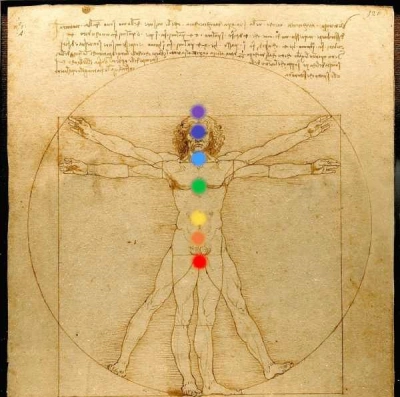
Leonardo da Vinci drew the pattern and its variants in the Codex Atlanticus, exploring the areas of the lunes and petals.2 The names came last. "Flower of Life", "Seed of Life", "Fruit of Life" and "Metatron's Cube" were given currency by Drunvalo Melchizedek's The Ancient Secret of the Flower of Life, published in 1999, and MathWorld cites Melchizedek (1999) for the terminology in which a 7-circle subconfiguration is the Seed of Life and a 13-circle selection the Fruit of Life.7 Metatron is an angel of Jewish mysticism of the early centuries CE, unknown to the Assyrians who cut the figure and to the Greeks who proved it. The pattern is older than all its names, and its geometry is Euclid's.
V. The Zevist Reading
Ἡ Ζευϊστικὴ Ἀνάγνωσις
The grid is Ma'at drawn. One law, 1 radius, applied at every point without exception, and the result is a field in which every figure of the Decad can be found and nothing is out of measure. That's the Temple's cosmology: Satya, the Cosmic Truth, from which Ma'at, the Universal Order, emanates, and under Zeus the powers of existence held in structured relation.8 The pattern has no edge of its own. The bounding circle is the drawer's choice, the limit set on an order that would otherwise fill the plane, and the Temple's Monad is "the point in infinity" for that reason: the centre is fixed and the field is open.
The pattern grows from the centre outward, and nothing in it is reached except through what's already drawn. Each new circle is set on a crossing that older circles made. The Temple's doctrine of Light and Darkness reads unexplored darkness as what one walks into with light, and explored darkness as what becomes light, knowledge and wisdom; the grid is that doctrine as a drawing, ring by ring, the lattice beyond the last circle unexplored and the compass carrying order into it.8 The 7 circles of the soul's field in Layer 7 are the first ring; the awakened soul draws the second.
The Temple reads the figure as what it is: Greek geometry on an Assyrian floor, the Monad's circle under the Dyad's rule, generating the Hexad's lattice. The 20th-century names are set aside with their angel, and the drawing is restored to the chain of all spirituality from its inception, which is where Zevism holds that one must stand. Whoever draws it with a compass and 1 setting has done what the carvers of Nineveh did and what Euclid's first proposition does: brought a third point out of 2 circles, and then a fourth, and then the whole.
Contemplation of the Grid
Set the compass once and don't change it. Draw the first circle, the 6 about it, and the 12 beyond, 19 in all, each centre on a crossing already made. Then the bounding ring. Count the petals, find a hexagon, a hexagram, a Tetractys and a triangle in the field.
Hold the finished drawing as 1 law applied everywhere. Seal with 1 AUM.
VI. Measure
Τὸ Μέτρον
| Quantity | Value | Note |
|---|---|---|
| Circles by ring | 1, 6, 12, 18, 24 … | 6n in the nth ring |
| Circles in n rings | 3n(n + 1) + 1 | 1, 7, 19, 37, 61: the centred hexagonal numbers |
| Bounding radius of the 19-circle figure | 3r | Centres at 2r plus 1 radius |
| Petals (vesicae) in the 19-circle figure | 42 | One for each pair of neighbouring centres within 2 rings |
| Petal, width and length | r and r√3 | Layer 2 |
| Touching figure of 13 | centres at 0, r, 2r; radius r ⁄ 2 | Half-radius circles on the same lattice; 1 + 6 + 6 |
| Lines joining the 13 centres | 78 | 13 × 12 ⁄ 2, the twelfth triangular number |
| Nineveh door-sill 118913 | 127 × 124 × 7.5 cm | Limestone, 645 to 640 BCE3 |
VII. Sources and Reading
Πηγαί
- Eric W. Weisstein, "Flower of Life" and "Hex Number", MathWorld. Flower of Life · Hex Number.
- Eric W. Weisstein, "Metatron's Cube", MathWorld: mathworld.wolfram.com; and "Flower of Life" (above) on Leonardo's studies in the Codex Atlanticus.
- British Museum, door-sill 118913 (1856,0909.44), North Palace of Ashurbanipal, Nineveh: collection record; door-sill 118910 (1856,0909.45): collection record.
- Encyclopaedia Britannica, "Meton": britannica.com.
- Temple of Zeus, Double Digit Numbers.
- Margaret A. Murray, The Osireion at Abydos (London: Quaritch, 1904): archive.org. On the circle drawings and their Greek letters: Malcolm Stewart, "The 'Flower of Life' and the Osirion": davidfurlong.co.uk (a field report, not a peer-reviewed study).
- Drunvalo Melchizedek, The Ancient Secret of the Flower of Life, vol. 1 (Light Technology, 1999): Open Library record. MathWorld, "Flower of Life" and "Metatron's Cube" (above), cite Melchizedek (1999, pp. 158 to 160) for the terms.
- Temple of Zeus, 1 · The Monad; Light and Darkness: The Cosmic Forces Under Ma'at and Izfet.