



9 min read
Sacred Geometry · Layer 1 · Level I · The Figures of the Decad
The Point and the Circle
Τὸ Σημεῖον καὶ ὁ Κύκλος
author: High Priest Zevios Metathronos
Zevist Numerology 1 · The Monad
Undivided source · Divine command · The unity of all
Core meanings · Foundational Temple text
The 'all', divine monad, undivided, command, the point in infinity, universe, source of creation, primary cause
Everything drawn begins here. The point has no part, no length, no breadth: it marks a place and nothing more. Give it one distance and turn that distance about it, and the circle appears, the first figure of the plane and the one that holds every other figure in this study. Point and circle are the Monad seen twice: the source as a centre, and the source as a boundary that encloses the whole.
I. The Figure
Τὸ Σχῆμα
Euclid opens the Elements with the point: σημεῖόν ἐστιν, οὗ μέρος οὐθέν, "a point is that which has no part".1 Nothing in geometry is smaller, and nothing is simpler. A point has position and no magnitude. It can't be divided, because there's nothing in it to divide. Every later figure is built from points: the line has points for its ends, the circle has a point for its centre.
The circle follows at Definition 15: a plane figure contained by one line, such that all the straight lines falling upon it from one point within the figure are equal to one another. That point is the centre (Definition 16), and a straight line drawn through the centre and ending on the circumference in both directions is a diameter, which also cuts the circle in half (Definition 17).1 The circle is the only figure whose definition needs a single length. Everything about it, its circumference, its area, its symmetry under every rotation, follows from the radius alone.
Aristotle gave the point its place among the numbers. In the Metaphysics he separates what is indivisible in every way and has no position, the unit (μονάς), from what is indivisible in every way and has position, the point (στιγμή).2 In On the Soul he records the formula outright: ἡ γὰρ στιγμὴ μονάς ἐστι θέσιν ἔχουσα, "the point is a monad having position".3 Proclus repeats the same definition as Pythagorean in his commentary on Euclid's first definition.4 The point is the Monad placed. The number 1 and the dot on the page are 1 principle in 2 registers.
II. The Construction
Ἡ Κατασκευή
Euclid's third postulate grants the compass: a circle may be described with any centre and any distance.1 That's the whole construction. The point does nothing by itself; the circle is what the point does once it's given a distance to command.
- Mark the point. Press the needle of the compass into the page and leave it there. This is the centre, and it won't move again.
- Open the compass to the chosen distance. This is the radius, the first measure in the drawing. Every circle in this study, and every polygon inscribed in one, is sized by it.
- Turn the pencil through a full revolution until the line closes on itself. The closed line is the circumference. The centre now lies inside a boundary that it created and that it alone governs.
Two facts of the finished figure deserve attention. First, the centre is not on the circle. The source stands apart from what it brings forth, and remains equidistant from all of it. Second, the circle has no beginning and no end on its own line. Wherever the pencil started, the finished circumference carries no mark of it. The Monad is like that: the Temple's phrase for it is "the point in infinity", a centre that's present while the field of unfolding stays open.5
III. Number and Form
Ἀριθμὸς καὶ Σχῆμα
The Pythagorean account of magnitude, as Sextus Empiricus reports it, sets the point under the Monad, the line under the Dyad, the plane under the Triad and the solid under the Tetrad.6 A second account in the same passage lets the figures flow: the point in motion traces the line, the line in motion sweeps the plane, the plane in motion fills the solid, so that from one point all things are built.6 Either way, the point is the seed of extension and the number 1 is its principle.
One is also the first of every figurate number. One dot is the first triangular number, the first square number, the first pentagonal number: every polygonal series begins at the same single point. The Temple's numerology makes the same observation in its own terms: multiplying a quantity by 1 preserves it, and the Monad holds the principles of the succeeding numbers in potency.5 The dot on this page and the dot on the page of the Monad are the same dot. 1 · The Monad is read there; its figure is read here.
IV. In the Ancient Witnesses
Παρὰ τοῖς Ἀρχαίοις
The circle's perfection is an old Greek judgement. Parmenides describes what is as "complete on every side", εὐκύκλου σφαίρης ἐναλίγκιον ὄγκῳ, "like the mass of a rounded sphere, equally poised from the centre in every direction".7 Diogenes Laertius records that Xenophanes held the substance of God to be spherical, in no way resembling man.8 Plato's Demiurge shapes the body of the Cosmos as a sphere, "which of all shapes is the most perfect and the most self-similar".9 The sphere is the circle's body, and it receives its own layer at the end of this study.
The point and the circle also carry the oldest theorem on record. Diogenes Laertius, citing Pamphila, says that Thales learnt geometry from the Egyptians and was the first to inscribe the right-angled triangle in a circle, and that he sacrificed an ox for it.10 The theorem behind the story is still taught: any angle drawn from the ends of a diameter to a point on the circumference is a right angle. The diameter commands the angle from within the circle.
A later Latin text, attested from the 12th century and quoted by Alan of Lille, puts the point and the circle into a single sentence about God: Deus est sphaera infinita cuius centrum est ubique, circumferentia nusquam, "God is an infinite sphere whose centre is everywhere and whose circumference is nowhere".11 The sentence belongs to the Hermetic current of the Latin Middle Ages, far downstream of the Greek sources above. It's included here as a witness to how long the figure kept its theological force, and as an exact description of what the compass can't draw: a centre with no boundary at all.
V. The Zevist Reading
Ἡ Ζευϊστικὴ Ἀνάγνωσις
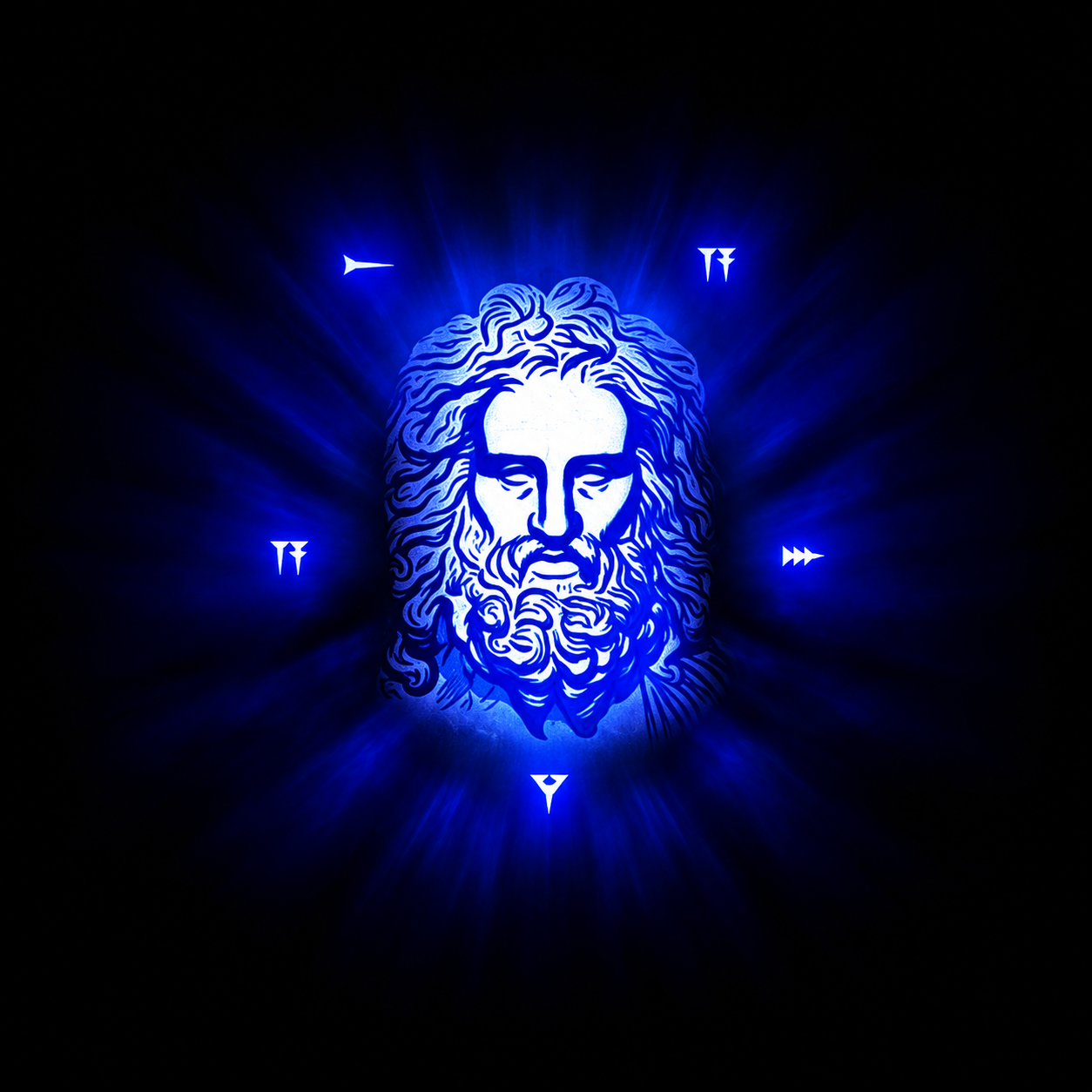
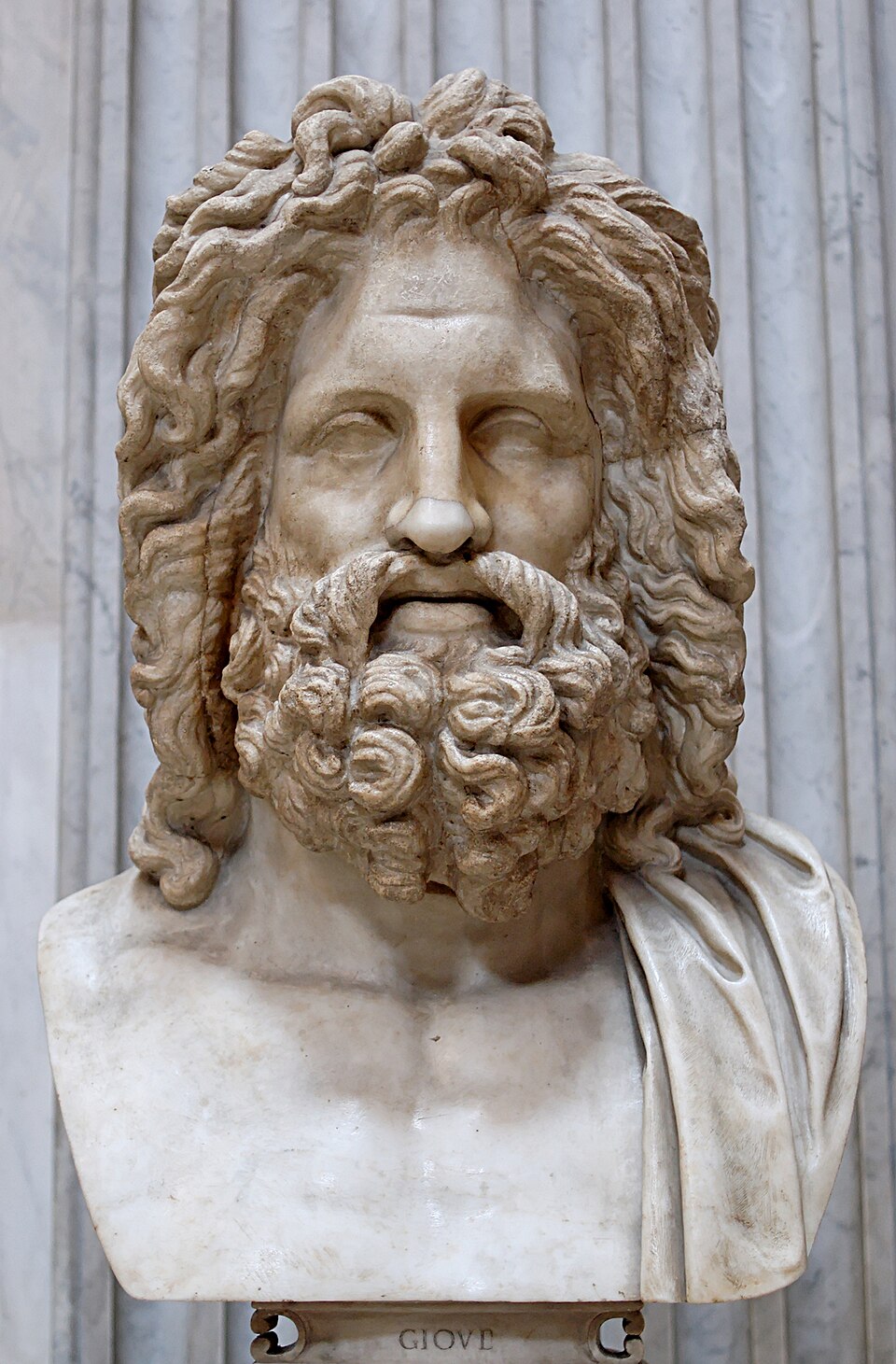
Zeus is the Cosmic Sovereign, and the point is His figure: the centre from which order radiates and to which every radius returns. The Temple's emblem sets the Head of Zeus at the centre of the 5 elements for the same reason; the Divine centre gives the arrangement its governing meaning.12 The omphalos at Delphi is the same teaching in stone: a sacred centre where the ordering power of Zeus and the illumination of Apollo converge.13 To contemplate the point is to contemplate command: the one intention that gathers the scattered powers of a life, a rite or a Cosmos into a whole.
The circle is Ma'at made visible. Ma'at is the Universal Cosmic Order that emanates from Satya, the Cosmic Truth, and under Zeus it holds the powers of existence in structured relation. A circle is the simplest structured relation there is: one law, equal distance, applied to every point without exception. Within the boundary the powers act in harmony; outside it, or when the boundary dissolves, is Izfet, the fall back into unstructured chaos. The ritual circle, the sacred enclosure, the aura around the body all draw on this figure. In the Temple's teaching of the soul, aether occupies the centre and the aura, which is to say the point and the circle at once.14
The soul has its own point. The solar centre is the powerhouse of the soul, the seat of sovereign will through which Divine power becomes established; the Temple reads the number 666 there.15 Gather attention into that centre and the circle of the aura steadies around it. Let the centre scatter and the circle loses its law. The whole discipline of the Monad in meditation is the discipline of the compass needle: it stays where it's placed.
Contemplation of the Point and the Circle
Place a single dot on a clean page and rest the gaze on it until the many concerns of the moment gather around one intention. Then take a compass, set the needle on the dot, and draw the circle in one unbroken turn. Watch the line close on itself. Hold the finished figure: the centre that doesn't move, the boundary that it governs, the field that lies between.
Seal the exercise with a single AUM, pronounced AHH-UUUUU-MMMM, as the Temple's guide to the numbers in magick and meditation prescribes for a work of unity.16 One point, one circle, one sound.
VI. Measure
Τὸ Μέτρον
| Quantity | Value | Note |
|---|---|---|
| Circumference | 2πr | π = 3.14159 26535…, the ratio of circumference to diameter in every circle |
| Area | πr² | Archimedes proved the circle equal to a right triangle with legs r and 2πr (Measurement of a Circle, Proposition 1)17 |
| Archimedes' bounds on π | 3 10⁄71 < π < 3 1⁄7 | 3.1408… < π < 3.1429…, from inscribed and circumscribed 96-gons (Measurement of a Circle, Proposition 3)17 |
| Angle in a semicircle | 90° | The theorem attributed to Thales by Pamphila10 |
| Symmetry | every rotation, every diameter | No regular polygon shares this; the circle is the limit all of them approach |
VII. Sources and Reading
Πηγαί
- Euclid, Elements I, Definitions 1 to 4 and 15 to 17, Postulate 3. Greek (Heiberg): Perseus, Book I Definitions. English (Heath), with D. E. Joyce's edition: Book I.
- Aristotle, Metaphysics Δ 6, 1016b24 to 31. Greek (Ross) · English (Tredennick).
- Aristotle, On the Soul I.4, 409a6. Greek (Ross), Scaife Viewer.
- Proclus, A Commentary on the First Book of Euclid's Elements, on Definition 1 (Friedlein 95.21 to 22); translated by Glenn R. Morrow (Princeton University Press, 1970). Morrow translation, 1992 printing.
- Temple of Zeus, 1 · The Monad and More Information About Numbers.
- Sextus Empiricus, Against the Physicists II (= Adversus Mathematicos X) 278 to 282. Greek (Mutschmann and Mau), Scaife Viewer.
- Parmenides, fragment B8.42 to 44 (Diels and Kranz). Greek · English (Burnet) · Stanford Encyclopedia of Philosophy, "Parmenides".
- Diogenes Laertius, Lives of Eminent Philosophers IX.19 (Xenophanes). Greek · English (Hicks).
- Plato, Timaeus 33b. Greek (Burnet) · English (Loeb).
- Diogenes Laertius, Lives I.24 to 25 (Thales). Greek · English (Hicks).
- Liber XXIV philosophorum, proposition II. Latin and English: Matheson Trust edition (PDF). Critical edition: Françoise Hudry, Liber viginti quattuor philosophorum, Corpus Christianorum Continuatio Mediaevalis 143A (Brepols, 1997); earliest witness a 12th-century manuscript at Laon.
- Temple of Zeus, The Head of Zeus.
- Temple of Zeus, The Omphalos: Sacred Center at Delphi.
- Temple of Zeus, The Equal-Armed Cross (aether at the centre and the aura) and The Chakras.
- Temple of Zeus, 666 and the Solar Center.
- Temple of Zeus, How to Use the Numbers in Magick & Meditation.
- Archimedes, Measurement of a Circle, Propositions 1 and 3, in T. L. Heath, The Works of Archimedes (Cambridge, 1897). archive.org.