



11 min read
Sacred Geometry · Layer 14 · Level IV · The Whole
The Sphere and the Body of the Cosmos
Ἡ Σφαῖρα καὶ τὸ Σῶμα τοῦ Κόσμου
author: High Priest Zevios Metathronos
Zevist Numerology 10 · The Decad
All in All · The Divine Father · The completed Cosmos
Core meanings · Foundational Temple text
A key, All in All, fate and karma, an end of path, double union, Universe - Pan, Cosmos, Perfection, The Self-Created one, 'Divine Father', Totality
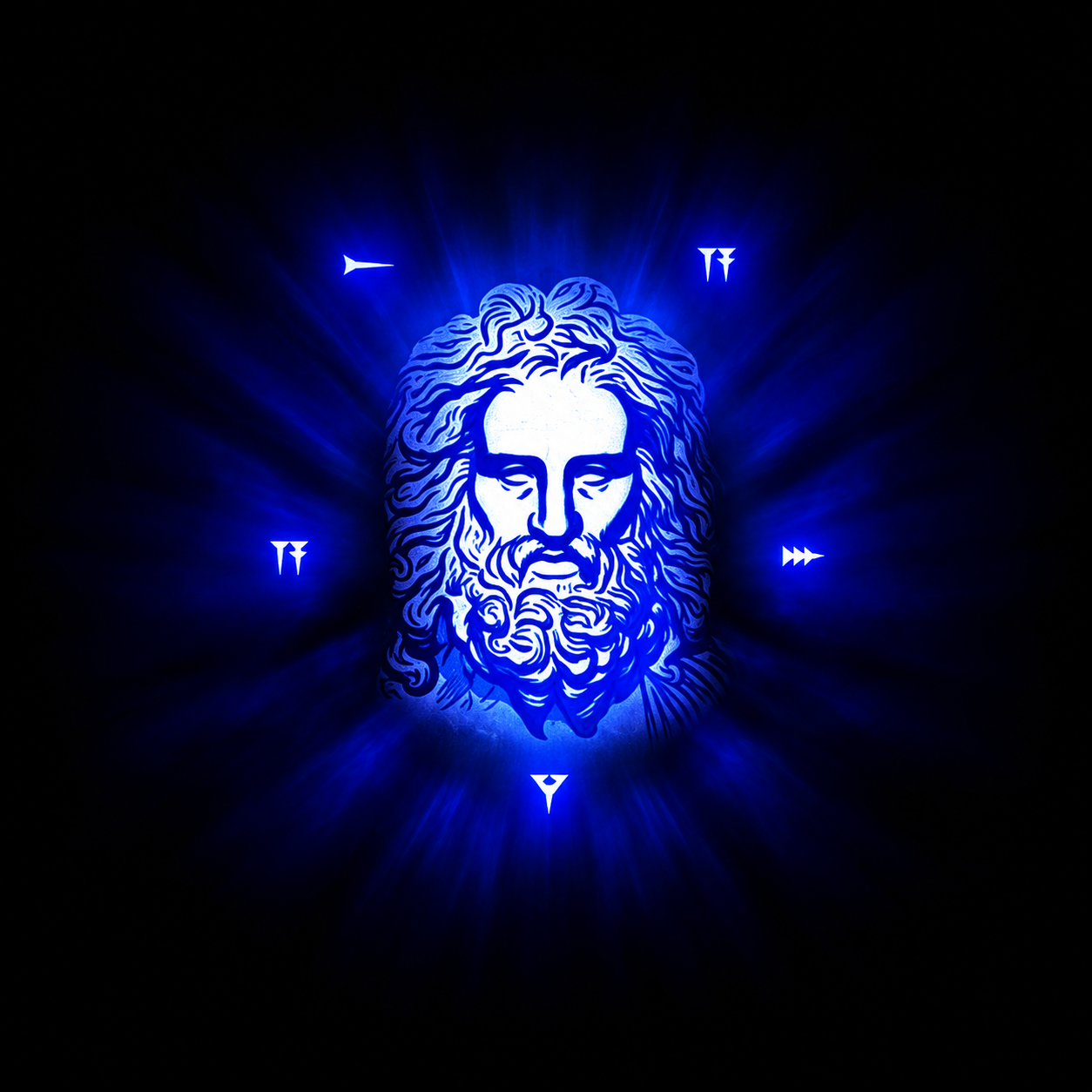
The study ends where it began, in the figure of 1 centre and 1 radius, now turned through every direction. The sphere is the circle's body, the shape Plato's Demiurge gave the Cosmos because of all shapes it's the most perfect and the most like itself, and the shape within which Euclid built each of the 5 regular bodies. Archimedes measured it against its cylinder and asked for the figure on his tomb. The Temple reads it as the aura of the soul and the body of the whole under Zeus: the Monad returned, with everything inside it.
I. The Figure
Τὸ Σχῆμα
Euclid defines the sphere by motion: when a semicircle is turned about its fixed diameter until it returns to where it started, the figure it sweeps out is a sphere, its axis is that diameter, and its centre is the semicircle's.1 The definition carries the circle of Layer 1 into the third dimension by the same act that made it, 1 distance turned about 1 point, and the result keeps the circle's property in every direction: every point of the surface is equidistant from the centre.
Aristotle makes it the first of solids. The heaven must be spherical, he argues, because the sphere is the shape most appropriate to its substance and by nature primary: as the circle is first among plane figures, being bounded by 1 line, so the sphere holds the same position among solids, and the body that moves in a circle must have the shape that turns in its own place.2 Plato had said it first and said why. The Demiurge "wrought it into a round, in the shape of a sphere, equidistant in all directions from the center to the extremities, which of all shapes is the most perfect and the most self-similar".3 Self-similar is the point: no part of a sphere differs from any other, and nothing is in it that isn't everywhere in it.
Archimedes measured it. In On the Sphere and Cylinder he proves that any sphere is 4 times the cone with its greatest circle as base and its radius as height, and draws the corollary that the cylinder whose base is the sphere's greatest circle and whose height is its diameter is 1½ times the sphere in volume, and its surface, with its 2 bases, is 1½ times the sphere's surface.4 Sphere to cylinder is 2 : 3 twice over. He thought it his best result. Cicero, as quaestor in Sicily in 75 BCE, found his tomb outside Syracuse by the small column rising above the brambles with the figure of a sphere and a cylinder on it, as the Syracusans had forgotten.5
II. The Construction
Ἡ Κατασκευή
- Draw the circle of Layer 1. It's the sphere's outline from every side, and its great circle from 1.
- Draw an ellipse across its middle, as wide as the circle and about a third as tall: the equator, seen from 18° above its plane as in the figure. Draw a second ellipse through the top and bottom of the circle: a meridian, the great circle through the poles. Draw a third that crosses the equator at 2 opposite points and is inclined to it by 23.4°: the ecliptic, the Sun's yearly path against the sphere of the sky. Each is a great circle foreshortened, as wide as the sphere along its longest axis.
- Mark the centre and 1 radius. Every great circle of the sphere passes through the centre and has that radius; the 3 drawn are 3 of infinitely many.
- Inscribe the solids. Euclid XIII.13 to 17 place each of the 5 bodies in a given sphere, every vertex on the surface; the circumradius R in the table of Layer 12 is the sphere's radius for edge 1.
III. Number and Form
Ἀριθμὸς καὶ Σχῆμα
The sphere is the number of the whole, which is to say it has none of its own. A polygon has a number of sides, a polyhedron a number of faces; the sphere is what every regular polygon and polyhedron approaches as its count rises, and what Euclid uses as the vessel of all 5 bodies. In the Temple's numerology the Decad is "a key", "All in All", "Universe - Pan", "Cosmos" and "Totality", and the sphere is the Decad's body as the Tetractys is its figure: the 10 points gathered into 1 shape with no points at all.6 The Theology of Arithmetic gives the Decad the names cosmos and heaven, and the heaven is a sphere.
Its measures are Archimedes'. The volume is 4⁄3 πr³ and the surface 4πr², 4 times the greatest circle; the ratio of sphere to circumscribing cylinder is 2 : 3 in both.4 The Earth is 1 such sphere, and a Greek measured it: Eratosthenes, in the 3rd century BCE, compared the Sun's noon shadow at Alexandria with its absence at Syene on the solstice, took the arc between them as a fiftieth of the circle, and found the circumference of the Earth at 250,000 stadia, later rounded to 252,000.7 The point of Layer 1 and the sphere of Layer 14 are the 2 ends of the same measure.
Kepler drew the last ancient diagram. With the 5 solids of Layer 12 and 6 known planets he built a nest of spheres and bodies from Saturn to Mercury and argued that there are 6 planets because there are only 5 regular solids; the scheme failed as astronomy and led him to the laws of planetary motion that replaced it, and in the Harmonices Mundi of 1619 he kept the solids and added the harmonies of the planets' speeds, the Sirens' notes made arithmetic.8 The ratio of each sphere to the next in his nest is the ratio r ⁄ R of the solid between them, given in Layer 12: a third for the tetrahedron, 0.577 for the cube and the octahedron, 0.795 for the dodecahedron and the icosahedron.
IV. In the Ancient Witnesses
Παρὰ τοῖς Ἀρχαίοις
The sphere was the Greek figure of what's complete before it was the figure of the sky. Parmenides describes what is as perfected from every side, "like the bulk of a well-rounded globe, from the middle equal every way".9 Empedocles made the Sphairos the state of the world when Love is wholly dominant and all things are 1.10 Xenophanes said the substance of God is spherical, resembling man in nothing.11 These are the 3 earliest philosophical sentences about the figure, and all 3 are about the One.
Plato put music in it. In the myth of Er the Spindle of Necessity turns 8 whorls fitted 1 inside another, the outermost the fixed stars and the 7 within the planets, and "up above on each of the rims of the circles a Siren stood, borne around in its revolution and uttering one sound, one note, and from all the eight there was the concord of a single harmony".12 The Tetractys of Layer 10 gave the intervals; the spheres give the voices. Aristotle rejected the music as physics while granting its grace, "in spite of the grace and originality with which it has been stated", and the tradition kept it as what it was, a figure of order heard rather than seen.13
Plato also said what the sphere is for. At the end of the Timaeus the circuits of the heaven are the pattern for the circuits of the soul: by learning the harmonies and revolutions of the universe a man makes the thinking part of himself like the object of its thought, and so attains the end of the best life that the Gods have set before mankind.14 That's the sentence this study was built toward, and it was written about a sphere.
V. The Zevist Reading
Ἡ Ζευϊστικὴ Ἀνάγνωσις
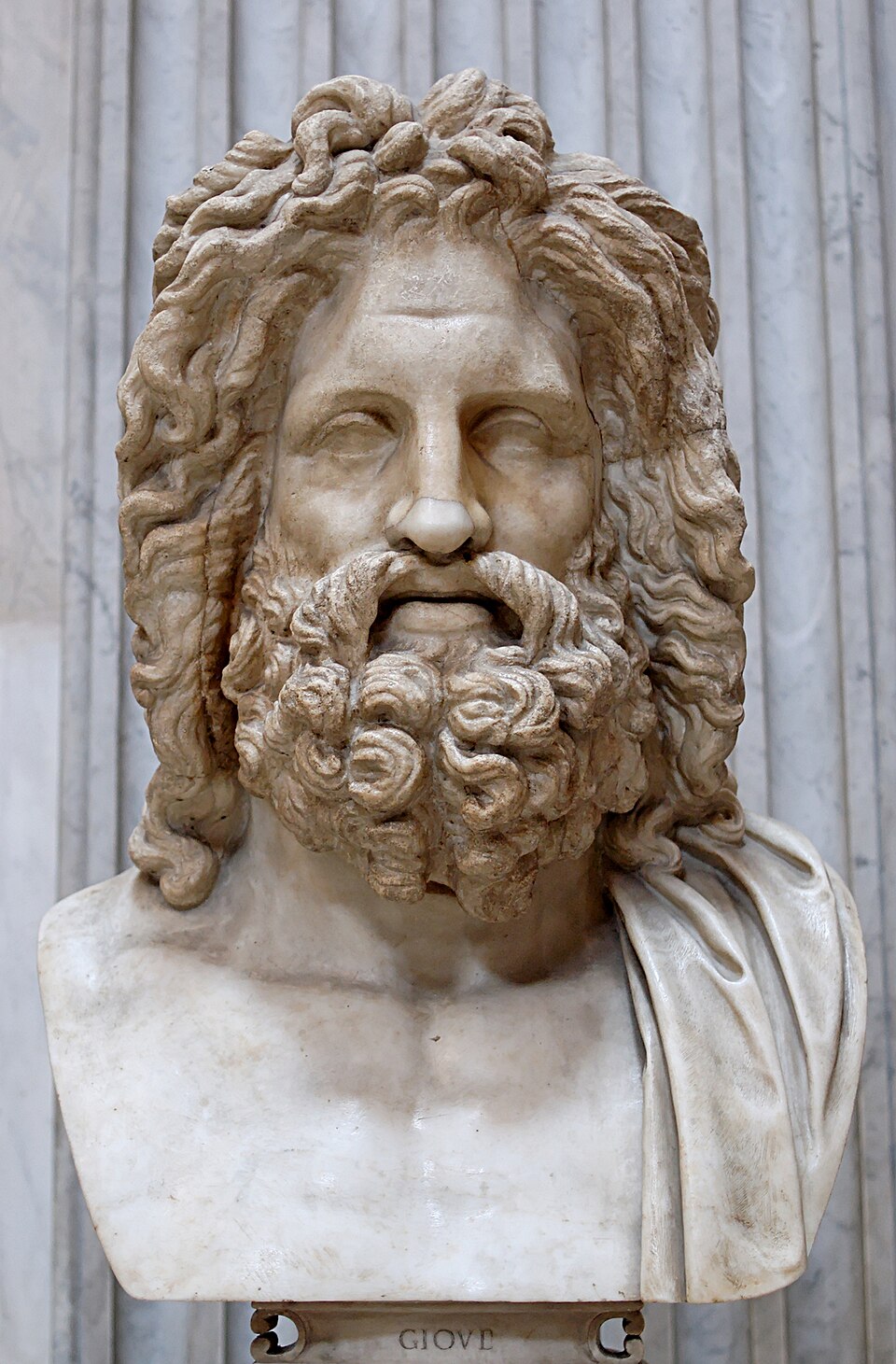
Zeus is the Sky-Father, Dyeus Pater, worshipped under that name and its cognates for at least 6,000 years, and the sky is a sphere.15 The body of the Cosmos in the Timaeus is a living creature with a soul set in its centre and stretched through the whole, and its shape is the one most like itself; the Temple reads that body as the field of Zeus's sovereignty, the whole within which Ma'at holds every power in structured relation.3 The sphere has no privileged point on its surface. Under the Cosmic Sovereign nothing on the circumference rules anything else; the centre rules all of it, equally, at 1 distance.
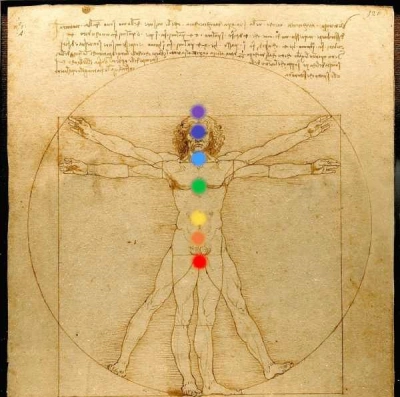
The soul has the same body. In the Temple's teaching aether occupies the centre and the aura, and the aura is the sphere of the awakened soul: the solar centre of Layer 1 at its middle, the 7 centres of Layer 7 along its axis, the 4 elemental quarters of Layer 4 about them, the 5 bodies of Layer 12 within it, and the surface everywhere at 1 distance from the governing point.16 The Temple's purpose, ὁμοίωσις θεῷ κατὰ τὸ δυνατόν, is the Timaeus's instruction: make the circuits of the soul like the circuits of the whole. The Theophoros, the soul that bears the Gods within it, is a soul become spherical, equal from its centre in every direction, which is the shape the Gods gave the Cosmos and the shape Xenophanes gave God.14
And the sphere returns to the point. "God is an infinite sphere whose centre is everywhere and whose circumference is nowhere": the Latin sentence of Layer 1 is the sphere with its radius removed, the centre alone, the Monad.17 The Decad gathers the 10 and the next count begins at 1; the Tetractys read from the base ends at the summit; the sphere contemplated to its end is the point from which it was drawn. The Temple's numerology closes the Decad with the end of a path that opens another, and this is the geometry of that doctrine. Draw the point. Give it 1 distance. Turn.
Contemplation of the Sphere
Draw the sphere with its 3 great circles and set the 5 bodies within it in thought, each with its vertices on the surface and its element at its quarter. Follow the 8 circles inward from the fixed stars to the Moon, 1 note on each. Then let the circles go and hold the centre alone.
Speak the Decad's affirmation 10 times for the whole, then the Monad's once for the centre: "All parts of this work are gathered into one complete and ordered whole." "My intention is one, clear, and steadfast."18 Seal with 1 AUM. The study is complete; begin it again at Layer 1.
VI. Measure
Τὸ Μέτρον
| Quantity | Value | Note |
|---|---|---|
| Surface | 4πr² | Four times the greatest circle; Archimedes, Sphere and Cylinder I.33 |
| Volume | (4⁄3) πr³ | Four times the cone on the greatest circle with height r; I.34 |
| Sphere : circumscribing cylinder | 2 : 3 | In volume and in total surface alike |
| Great circles | infinitely many, all of radius r | Any plane through the centre cuts one |
| Obliquity of the ecliptic | ≈ 23.4° | The tilt of the third circle in the figure |
| Circumradius of the 5 solids, edge 1 | 0.6124, 0.8660, 0.7071, 1.4013, 0.9511 | Tetrahedron, cube, octahedron, dodecahedron, icosahedron |
| Kepler's nest, ratio of consecutive spheres | 0.5774, 0.3333, 0.7947, 0.7947, 0.5774 | Cube, tetrahedron, dodecahedron, icosahedron, octahedron |
| Eratosthenes' Earth | 250,000 stadia, rounded to 252,000 | Arc Alexandria to Syene taken as 1⁄50 of the circle7 |
| Whorls of the Spindle | 8 | Fixed stars, Saturn, Jupiter, Mars, Mercury, Venus, Sun, Moon |
VII. Sources and Reading
Πηγαί
- Euclid, Elements XI, Definitions 14 to 16. Joyce, Book XI.
- Aristotle, On the Heavens II.4, 286b10 to 287a. English (Stocks), Part 4 · Greek, Scaife Viewer.
- Plato, Timaeus 33b and 34a to b. English (Loeb) · Greek.
- Archimedes, On the Sphere and Cylinder I.33 to 34 with corollary, and the preface to Book II, in T. L. Heath, The Works of Archimedes (Cambridge, 1897). archive.org · MacTutor, Archimedes.
- Cicero, Tusculan Disputations V.64 to 66. Latin, Perseus.
- Temple of Zeus, 10 · The Decad.
- MacTutor, "Eratosthenes of Cyrene": mathshistory.st-andrews.ac.uk.
- MacTutor, "Johannes Kepler": mathshistory.st-andrews.ac.uk. Kepler, Mysterium Cosmographicum (1596): e-rara.
- Parmenides, fragment B8.42 to 49. Stanford Encyclopedia of Philosophy, "Parmenides" · Greek, lexundria.
- Empedocles, fragments B27 and B29. Stanford Encyclopedia of Philosophy, "Empedocles".
- Diogenes Laertius, Lives IX.19. English (Hicks) · Greek.
- Plato, Republic X, 616c to 617b. English (Shorey) · Greek.
- Aristotle, On the Heavens II.9, 290b12 to 29. English (Stocks), Part 9 · Greek, Scaife Viewer.
- Plato, Timaeus 90c to d. English (Loeb) · Greek. Plato, Theaetetus 176b: English (Fowler).
- Temple of Zeus, Our Eternal Head God: Zeus and Our Declarations.
- Temple of Zeus, The Equal-Armed Cross and The Chakras.
- Liber XXIV philosophorum, proposition II. Matheson Trust edition (PDF).
- Temple of Zeus, How to Use the Numbers in Magick & Meditation.