



8 min read
Sacred Geometry · Layer 5 · Level I · The Figures of the Decad
The Pentagon and the Pentacle
Τὸ Πεντάγωνον καὶ τὸ Πεντάγραμμον
author: High Priest Zevios Metathronos
Zevist Numerology 5 · The Pentad
Living union · Eros · Beauty and the five elements
Core meanings · Foundational Temple text
The five elements, union, connection, eros, shape and form, beauty, splendor, balance, harmony
Five points on a circle, joined in order, make the pentagon; joined every second point, the pentagram, the star the Pythagoreans wore as their sign and called Health; set within its circle, the pentacle. The figure of the Pentad is the first polygon whose construction needs a proportion rather than a right angle, and the proportion it needs is the golden cut. The Temple's Pythagorean Star page reads the star's 2 orientations; this layer builds it.
I. The Figure
Τὸ Σχῆμα
Euclid inscribes the regular pentagon in a circle at IV.11, and to do it he first needs IV.10: an isosceles triangle whose 2 base angles are each double the angle at the apex, that is, a triangle of 72°, 72° and 36°.1 To build that triangle he needs II.11, the cutting of a line so that the rectangle contained by the whole and 1 segment equals the square on the other segment.2 That cut is the extreme and mean ratio of Book VI, Definition 3, the golden section of Layer 11.3 The pentagon can't be drawn without it. Where the triangle needed 2 circles and the square a right angle, the Pentad asks for a proportion.
The proportion comes back inside the finished figure. Euclid XIII.8 proves that when 2 diagonals of a regular pentagon cut each other, each divides the other in extreme and mean ratio, and the greater segment equals the side of the pentagon.4 In the diagram above, AB : AD = AD : DB = φ, and AD is a side. The 5 diagonals together are the pentagram, and they enclose a second pentagon, inverted and smaller by φ² in its side. Draw its diagonals and a third pentagon appears, and so on without end. The star contains itself.
Lucian, in the 2nd century CE, records that the Pythagoreans used the pentagram as a token among themselves and called it Health, ὑγίεια: "The Pentagram, that interlaced triple triangle which served them as a sort of password, they called by the name Health".5 It's the earliest surviving statement of the sign's Pythagorean use, later than Pythagoras by 7 centuries and to be cited as Lucian's report. The Temple's Pythagorean Star page sets this testimony in its place.6
II. The Construction
Ἡ Κατασκευή
Euclid's route runs through the 36° triangle. A shorter one, equivalent in result, uses the golden cut directly and is given here.
- Draw a circle with centre O and 2 perpendicular diameters. Call the top of the vertical diameter A.
- Find the midpoint M of 1 horizontal radius. With centre M and radius MA, draw an arc cutting the other horizontal radius at N. ON is the golden cut of the radius: ON = r ⁄ φ.
- AN is the side of the inscribed pentagon. Open the compass to AN and step it around the circle from A: 5 steps return to A.
- Join the 5 points in order for the pentagon, every second point for the pentagram. The circle that carried the construction is the pentacle's ring.
Step 2 is the whole secret. The side of a regular decagon inscribed in a circle is the radius cut in extreme and mean ratio (Euclid XIII.9), and the side of the pentagon is the hypotenuse of a right triangle whose legs are the radius and the decagon's side (XIII.10).7 Every length in the figure is a function of r and φ.
III. Number and Form
Ἀριθμὸς καὶ Σχῆμα
Five is 2 + 3, the first even number joined to the first odd, and the Pythagoreans named it marriage for that reason. Plutarch records the teaching at Delphi: "the Pythagoreans called Five a 'Marriage'", because it is born of 2 and 3 mingled together.8 The Theology of Arithmetic and the Temple's numerology say the same, and the figure shows it: the pentagon's 5 corners can be read as a square with a fifth point raised above it, or as 2 of its points and 3 of its points taken across the star.9
The pentagonal numbers run 1, 5, 12, 22, 35, each n(3n − 1) ⁄ 2, pebbles laid in nested pentagons sharing a corner.10 Five is also the Pentad's own count in the Theology of Arithmetic: it names the 5 elements, earth, water, air, fire and aether, and considers the 5 regular solids within its account of the world's order.9 There are exactly 5 such solids, and Euclid proves it in the last proposition of the Elements; Layer 12 follows that proof.11
IV. In the Ancient Witnesses
Παρὰ τοῖς Ἀρχαίοις
The Greeks named the sign, proved its geometry and made it a token of recognition, and the proof is the part that lasts: Euclid's constructions of the pentagon in Book IV and his theorem on its diagonals in Book XIII are the first exact account of the figure in any language.1 Plutarch's dialogue on the E at Delphi treats 5 at length: the marriage of 2 and 3, the 5 worlds of the elements, the 5 regular solids and the 5 classes of living beings all pass through it, in a temple of Apollo.8
The sky draws the same star. Five synodic periods of Venus take 8 years, and plotting the planet's successive conjunctions with the Sun against the zodiac traces a near-repeating pentagram, which the European Southern Observatory describes as the pentagram of Venus.12 The repetition is close rather than exact, and Venus doesn't travel the straight sides of the figure; the Temple's star page states both limits. The association of the star with Venus, and so with Aphrodite, rests on this cycle.6
V. The Zevist Reading
Ἡ Ζευϊστικὴ Ἀνάγνωσις
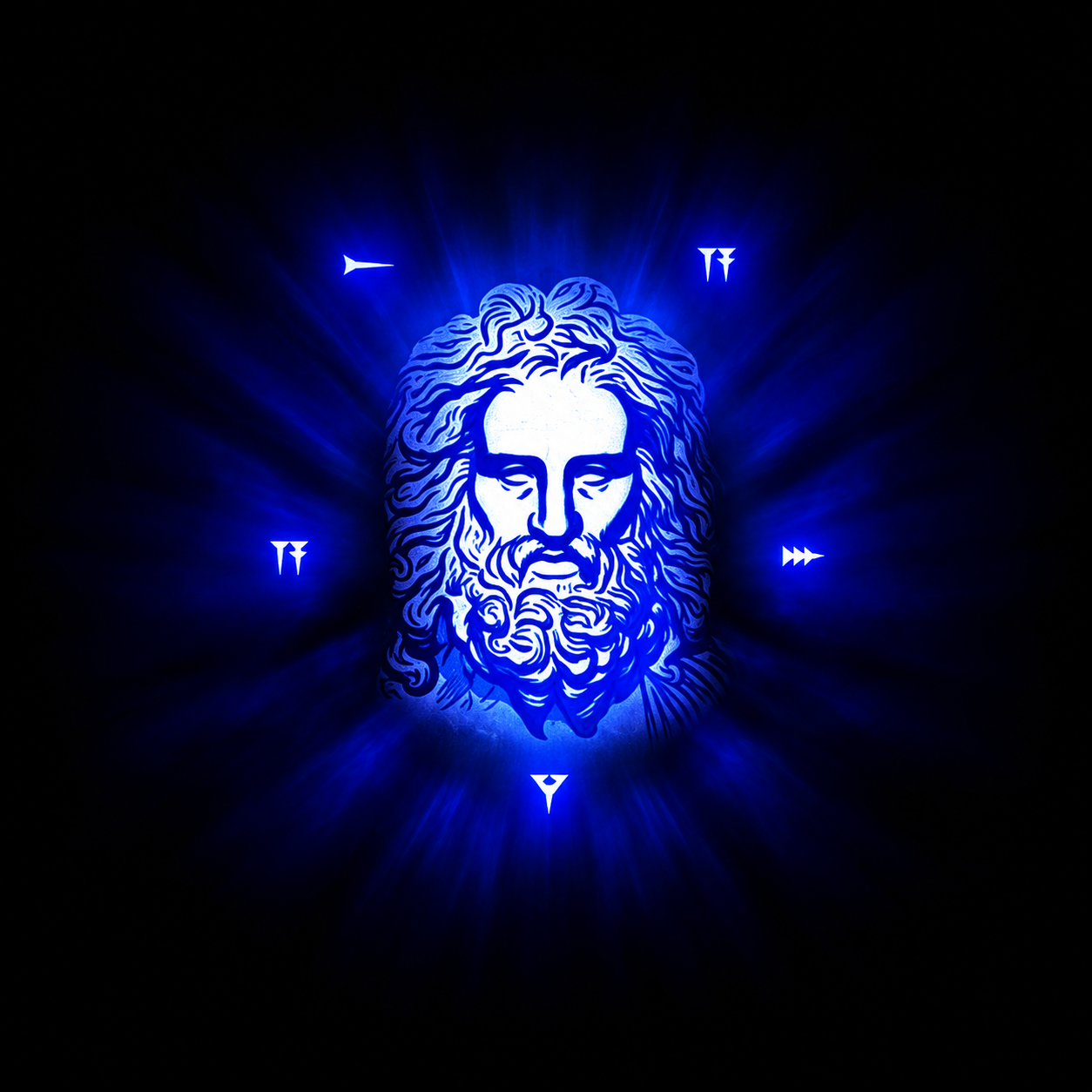
The Pentad adds aether to the Tetrad's 4. In the Temple's teaching earth, water, air and fire take the 4 quarters of the soul, and aether holds the centre and the aura; the pentagram gathers all 5 into 1 continuous line, each point participating in a whole greater than itself, with Zeus presiding over the powers as the sovereign source of their order.6 The Temple's emblem sets the Head of Zeus at the centre of the 5 elements for the same reason.12 The cross of Layer 4 showed the 4 and the centre; the star shows the 5 as 1 unbroken circuit, which is what the Pentad's core meanings call union, connection and harmony.9
The 2 orientations are the 2 movements of spiritual life. Point upward, the star is the serpent's ascent and the soul's aspiration toward the Gods; point downward, it's the answering reception, power entering through the crown and made available to the soul and the Earth.6 The Temple honours both. The geometry agrees: turning the pentagram through 36° changes nothing in its proportions, only its relation to the vertical, and the inverted pentagon inside every pentagram shows that each orientation already carries the other within it.
Health is the Pythagorean name, and Aphrodite's harmony is the Temple's. A body in health is 5 powers in proportion, and a soul in health is the same: stability, receptivity, movement, force and the unifying medium, each at its measure. The Temple's Hexad will call that measure marriage through multiplication; the Pentad calls it marriage through addition, 2 + 3, the meeting of what differs.9 Eros, in the Temple's core meanings, is the attraction toward a fitting union, and the golden cut is its figure: the part that stands to the whole as the smaller part stands to it.
Contemplation of the Pentacle
Construct the pentagon as above and draw the star through it, point upward, in 1 unbroken line of 5 strokes. Follow the line with the eye from point to point without lifting the attention, 5 times around. Then hold the whole star within its circle.
Speak the Pentad's affirmation 5 times, 1 at each point: "The parts of this work join in beauty, balance, and harmony."12 Seal with 1 AUM.
VI. Measure
Τὸ Μέτρον
| Quantity | Value | Note |
|---|---|---|
| Interior angle of the pentagon | 108° | Sum of angles 540° |
| Angle at each point of the pentagram | 36° | The 5 points together: 180° |
| Diagonal : side | φ = (1 + √5) ⁄ 2 ≈ 1.6180 | Euclid XIII.8 |
| Side, for circumradius R | 2R sin 36° ≈ 1.1756 R | |
| Inradius, for side s | s ⁄ (2 tan 36°) ≈ 0.6882 s | |
| Area of the pentagon | ¼ √(25 + 10√5) s² ≈ 1.7205 s² | |
| Inner pentagon of the pentagram, side | s ⁄ φ² ≈ 0.3820 s | Each nested star shrinks by φ² in linear size |
| Pentagonal numbers | n(3n − 1) ⁄ 2 | 1, 5, 12, 22, 35, 51, 70 … |
| Venus cycle | 5 synodic periods ≈ 8 years | Synodic period about 584 days12 |
VII. Sources and Reading
Πηγαί
- Euclid, Elements IV.10 and IV.11. IV.10 · IV.11.
- Euclid, Elements II.11. Joyce.
- Euclid, Elements VI, Definition 3. Joyce.
- Euclid, Elements XIII.8. Joyce.
- Lucian, A Slip of the Tongue in Salutation 5. Greek, Scaife Viewer · English (Fowler, 1905).
- Temple of Zeus, The Pythagorean Star and the Two Orientations.
- Euclid, Elements XIII.9 and XIII.10. XIII.9 · XIII.10.
- Plutarch, The E at Delphi, chapters 8, 11 and 13 (387f and following). Greek (Bernardakis) · English (Babbitt, Loeb), chapter 8 · chapter 11 · chapter 13.
- Temple of Zeus, 5 · The Pentad and 6 · The Hexad; The Theology of Arithmetic, On the Pentad, Greek text, Wikisource.
- Eric W. Weisstein, "Pentagonal Number", MathWorld. mathworld.wolfram.com.
- Euclid, Elements XIII.18 and the remark that follows it. Joyce.
- European Southern Observatory, Venus Transit 2004, Education Sheet 1, Appendix 5, "Pentagram of Venus". eso.org.
- Temple of Zeus, The Head of Zeus.
- Temple of Zeus, How to Use the Numbers in Magick & Meditation.