



9 min read
Sacred Geometry · Layer 4 · Level I · The Figures of the Decad
The Square and the Cross
Τὸ Τετράγωνον καὶ ὁ Σταυρός
author: High Priest Zevios Metathronos
Zevist Numerology 4 · The Tetrad
Order · Justice · The boundary of manifestation
Core meanings · Foundational Temple text
Order, justice, four directions of the physical, the 'boundary', four elements without aether, part of the material world
Four equal sides, 4 right angles, 4 corners that answer one another across 2 equal diagonals. The square is the figure of the Tetrad: the boundary, the foundation, the 4 directions of the physical world and the 4 elements that fill it. Open its corners into arms and it becomes the equal-armed cross; raise it into the third dimension and it becomes the cube that Plato gave to earth.
I. The Figure
Τὸ Σχῆμα
Euclid defines the square as a quadrilateral that is both equilateral and right-angled, and he constructs one on a given line at the end of Book I, one proposition before the theorem of the right triangle.1 The order isn't an accident. I.47 is a theorem about squares: the square on the hypotenuse equals the 2 squares on the legs. The square is the unit of area, the figure by which every other area is measured, and the Greek word for squaring, τετραγωνίζειν, meant finding the square equal to a given figure.
The square's diagonal is the first irrational. Draw the square with side 1 and the diagonal is √2, 1.4142…, and no ratio of whole numbers equals it. In the Theaetetus Plato has Theodorus prove the sides of squares of 3, 5 and so on up to 17 square feet incommensurable with the unit, stopping at 17 for some reason, which shows the case of 2 was already settled.2 In the Meno Socrates leads an untaught boy to the diagonal: asked to double a square of 4 feet, the boy tries a side of 4 and then of 3 before he sees that the square on the diagonal of the original is the one with 8 feet.3 The square that answers the problem stands on the diagonal of the square that posed it.
The Tetrad is the number of the solid, as the Triad is the number of the plane. Sextus Empiricus sets the solid body, such as the pyramid, under the Tetrad, since 4 points not in 1 plane are the fewest that enclose a volume.4 The Temple's numerology makes the same passage: point, line, plane and solid mark the kinds of extension, and the Tetrad belongs to the passage into bodily configuration.5 The square is the Tetrad's figure in the plane; the tetrahedron and the cube are its figures in the solid, and both return in Layer 12.
II. The Construction
Ἡ Κατασκευή
- Draw the line AB. At A raise a perpendicular (Euclid I.11) and cut off AD equal to AB on it.
- Through D draw a line parallel to AB, and through B a line parallel to AD (I.31). They meet at C.
- ABCD has 4 equal sides and 4 right angles: a square (I.46).1
- Draw the diagonals AC and BD. They're equal, they bisect each other at right angles, and their crossing is the centre of the square: the centre of the circle through its 4 corners and of the circle touching its 4 sides.
The second construction is the cross. Draw the 2 diameters of a circle at right angles: 4 equal arms meeting at 1 centre. Join their ends and the square appears again, turned through 45°, its corners on the circle and its sides at the 4 quarters. The equal-armed cross and the square are 1 figure read 2 ways: the cross is the square's 2 axes of symmetry, and the square is the cross with its ends joined.
III. Number and Form
Ἀριθμὸς καὶ Σχῆμα
Lay pebbles in a square and the square numbers appear: 1, 4, 9, 16, 25, each n². Add the next odd number around 2 sides of a square, in the shape the Greeks called a gnomon, and the next square is complete; the sum of the first n odd numbers is n².6 Nicomachus sets the square numbers immediately after the triangular ones, each square being 2 consecutive triangular numbers joined along their diagonal.7 The Temple's numerology draws 4 as 4 dots at the corners of a square and 9 as 3 rows of 3; both are square numbers, and both appear in this study, 4 here and 9 in Layer 9.5
The Theology of Arithmetic names the Tetrad justice through a square whose side is 4: its area is 16 and so is its perimeter, the only square for which the 2 agree.5 The Greeks made the same figure a word for character. Simonides praised the man made good "in hands and feet and mind foursquare, fashioned without reproach", τετράγωνον ἄνευ ψόγου τετυγμένον, and Plato has Protagoras and Socrates argue over the poem; Aristotle cites the metaphor of the good man as square in the Rhetoric.8 A square man stands however he's set down.
IV. In the Ancient Witnesses
Παρὰ τοῖς Ἀρχαίοις
Plato gives the square to earth. In the Timaeus the cube, built of 6 square faces each made of 4 isosceles right triangles, is assigned to earth because earth is the most immobile of the 4 kinds and the most plastic, and the body with the most stable bases is the one fit for it.9 Aristotle, arguing against the whole scheme, still reports it: "Earth, again, they call a cube because it is stable and at rest", and notes that of the regular bodies only the pyramid and the cube were thought to fill space.10 The cube does. Stack cubes and no gap remains, which is why the brick and the block are square.
The oldest geometry is the geometry of the square field. Herodotus says that Sesostris divided the land of Egypt among its inhabitants in equal square plots, taxed each, and sent surveyors to measure what the Nile took away; from this, he judges, the Greeks learnt geometry.11 The 4 directions are older still: the great pyramids of Giza are set square to the cardinal points with an error of a few minutes of arc, an alignment the Egyptians took from the stars.17 The Temple's core meaning for the Tetrad, "four directions of the physical", is the surveyor's number.5
V. The Zevist Reading
Ἡ Ζευϊστικὴ Ἀνάγνωσις
The Temple's sacred map assigns earth to the front and north, fire to the back and south, water to the left and west, and air to the right and east; aether occupies the centre and the aura.12 The equal-armed cross is that map drawn on the body. Its 4 arms are the 4 elements without aether, the Tetrad's own count in the Temple's numerology, and its centre is the fifth that the Pentad will name.5 The soul is contemplated as a living field whose directions carry distinct powers: stability before, force behind, receptivity to the left, direction to the right, and at the crossing the aether that holds them together.
The square is the boundary. The Temple's Tetrad is order, justice and "the boundary", and a boundary is what makes a sacred work maintainable: a space, a duration, a measure, an obligation, each with a clear edge.5 The Greek temenos was land cut off and set apart for a God; the ritual square and the ritual circle are the same act of enclosure, the square by measure and the circle by command. Ma'at is kept at the edges. A square with 1 corner out of true is no longer a square, and the diagonals will show it at once; justice is the agreement of the diagonals.
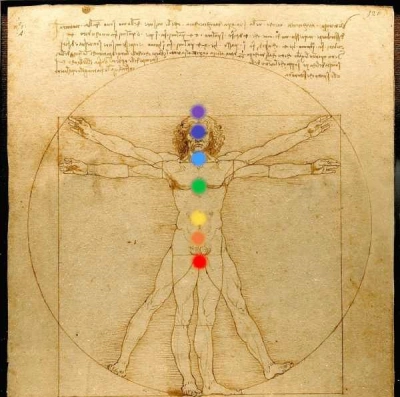
The cross also aligns the chakras. The Temple describes 7 principal centres along the spine and paired centres at hips, shoulders and temples; the chakra cross reads the aligned soul as an axis with extension, the descent and establishment of Divine power through the solar architecture of the inward temple.13 The vertical arm is the spine, the horizontal arm the reach of the awakened centres, and the crossing is the solar centre of Layer 1. The upright cross and the ankh carry the same axis in Egyptian and later form, and the Temple's pages on each set their histories in order.14 The swastika is the cross in motion, 4 arms turning about the centre, and the Temple reads it as ancient revolving geometry under Zeus with an explicit rejection of its political misuse.15
Contemplation of the Square and the Cross
Draw the square and its 2 diagonals. Set a point at each corner and 1 at the crossing. Face the figure as the Temple's map: earth before, fire behind, water left, air right, aether at the centre where the diagonals meet.
Speak the Tetrad's affirmation 4 times, following 1 corner with each repetition: "This work stands in order, with a clear boundary and a firm foundation."16 After the fourth, hold the whole figure, centre and corners together. Seal with 1 AUM.
VI. Measure
Τὸ Μέτρον
| Quantity | Value | Note |
|---|---|---|
| Each angle | 90° | Four right angles; sum 360° |
| Diagonal | s√2 ≈ 1.4142 s | Incommensurable with the side |
| Area | s² | The unit of area |
| Circumradius | s ⁄ √2 ≈ 0.7071 s | Half the diagonal |
| Inradius | s ⁄ 2 | Half the side |
| The square of justice | side 4: area 16, perimeter 16 | The only square whose area and perimeter agree in number |
| Square numbers | n² = 1 + 3 + 5 + … + (2n − 1) | 1, 4, 9, 16, 25, 36, 49, 64, 81, 100 … |
| Doubling the square | side × √2 | Meno 85b: the square on the diagonal |
VII. Sources and Reading
Πηγαί
- Euclid, Elements I, Definition 22; I.11, I.31, I.46. Joyce, Book I · I.46.
- Plato, Theaetetus 147d to 148b. Greek · English (Fowler).
- Plato, Meno 82b to 85b. Greek · English (Lamb).
- Sextus Empiricus, Against the Physicists II 280. Greek, Scaife Viewer.
- Temple of Zeus, 4 · The Tetrad and 9 · The Ennead.
- Eric W. Weisstein, "Square Number", MathWorld. mathworld.wolfram.com.
- Nicomachus of Gerasa, Introduction to Arithmetic II.9 and II.12, translated by Martin Luther D'Ooge (Macmillan, 1926).
- Plato, Protagoras 339b (Simonides fr. 37). Greek · English (Lamb). Aristotle, Rhetoric III.11, 1411b27. English (Freese).
- Plato, Timaeus 55d to 56b. English (Loeb), page 55 · Greek.
- Aristotle, On the Heavens III.8, 306b to 307a. Greek, Scaife Viewer · English (Stocks), Part 8.
- Herodotus, Histories II.109. English (Godley) · Greek.
- Temple of Zeus, The Equal-Armed Cross.
- Temple of Zeus, The Chakra Cross and Descending Power and The Chakras.
- Temple of Zeus, The Upright Cross and The Ankh: Life, Breath, and the Heart.
- Temple of Zeus, The Swastika and the Thunderbolt.
- Temple of Zeus, How to Use the Numbers in Magick & Meditation.
- Kate Spence, "Ancient Egyptian chronology and the astronomical orientation of pyramids", Nature 408 (2000) 320 to 324. doi:10.1038/35042510.