



8 min read
Sacred Geometry · Layer 8 · Level I · The Figures of the Decad
The Octagon and the Eight-Pointed Star
Τὸ Ὀκτάγωνον καὶ ὁ Ὀκτάκτινος Ἀστήρ
author: High Priest Zevios Metathronos
Zevist Numerology 8 · The Octad
The Divine Mother · Firm foundation · Power held in depth
Core meanings · Foundational Temple text
Mystery, drive, power, permanence, firm foundation, the hidden sphere, 'Divine Mother', supernal justice, multiplication 'ad infinitum'
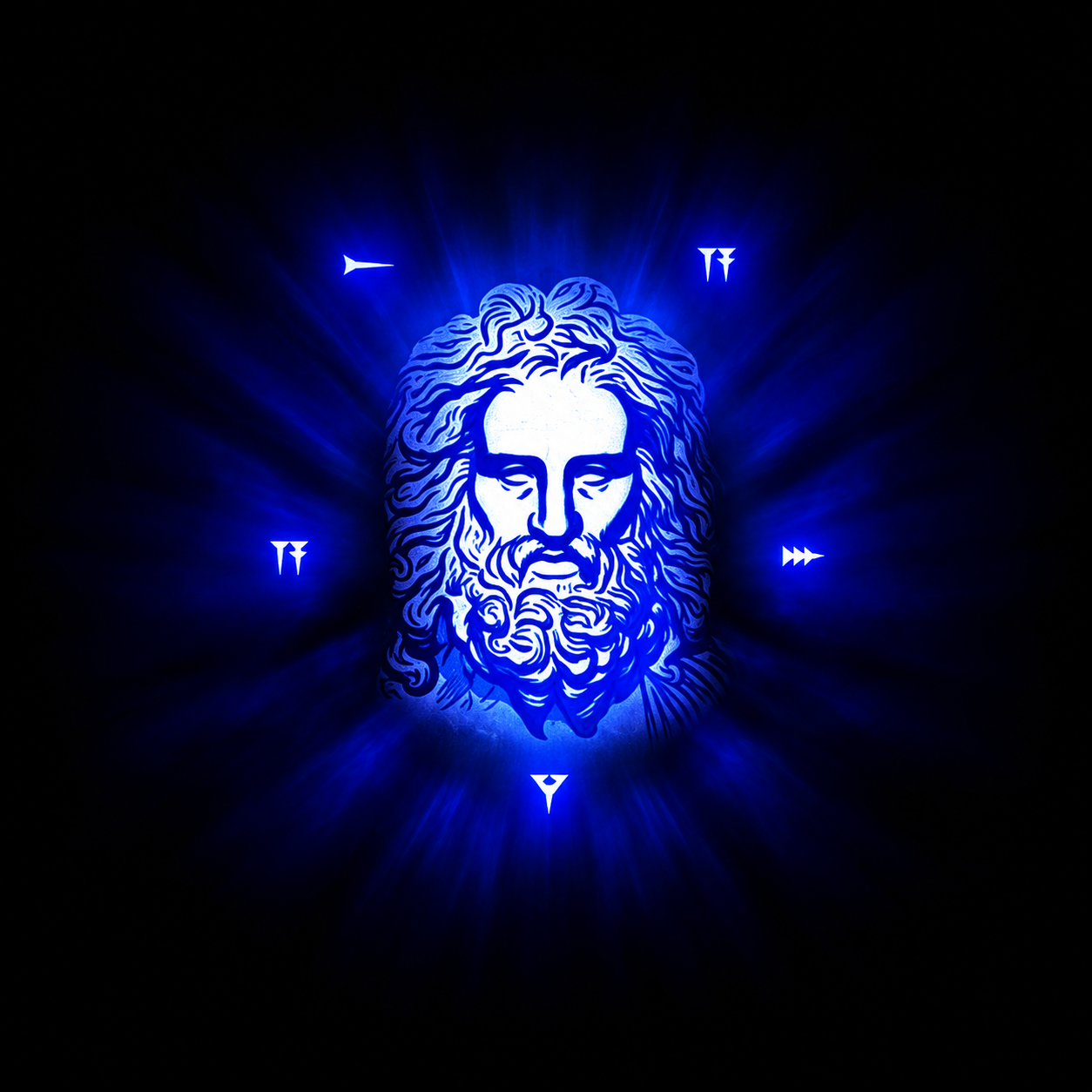
Turn the square through 45° and lay it over itself: the 8 corners make the octagon, and the 8 sides of the 2 squares make the first eight-pointed star. Eight is the Tetrad doubled and the first cube, 2 × 2 × 2, and its figure stands between the square and the circle: the builders of Athens raised the Tower of the Winds on it, and Babylon set the star of 8 rays over Ishtar. The Octad is foundation deepened, the square given a third dimension.
I. The Figure
Τὸ Σχῆμα
The octagon is the square's child and needs nothing the square didn't. Bisect the 4 right angles of a square about its centre, cut the circle through its corners at the 4 new points, and the 8 points together are a regular octagon. Each interior angle is 135°, 3 right angles halved and added to 1, and the 8 of them sum to 1,080°. Because 8 is a power of 2, the octagon is constructible, and so is the 16-gon, the 32-gon and every doubling after; bisection is the one operation the compass never refuses.1
The octagon has 2 stars. Join every second corner and the line closes after 4 steps: {8/2} is 2 squares, 1 upright and 1 turned, the star that crowns the Byzantine and Islamic ornament of 1,000 years. Join every third corner and the line runs through all 8 before it closes: {8/3} is a single unbroken octagram. The hexagon fell into 2 triangles and the heptagon held together in 2 ways; the octagon does both, 1 star of pieces and 1 of a single line.
In the Theology of Arithmetic the Octad is the first cube, 2 × 2 × 2, and its names are security, foundation and Mother; the text connects it with Rhea, the Mother of the Gods, and with Harmonia, and speaks of an eighth sphere encompassing the rest.2 The Temple's numerology receives all of these: the Divine Mother, firm foundation, the hidden sphere, and multiplication without a final bound, the doubling 1, 2, 4, 8, 16 that can go on forever.2 The octagon is the plane figure of a number whose true body is the cube.
II. The Construction
Ἡ Κατασκευή
- Draw a circle with centre O and 2 perpendicular diameters, as for the cross of Layer 4. Their 4 ends are the corners of the first square.
- Bisect each right angle at O (Euclid I.9) and extend the bisectors to the circle: 4 more points, the corners of the second square.
- Join the 8 points in order for the octagon. Join each set of alternate points for the 2 squares, {8/2}; join every third point for {8/3}.
- For the star of rays, draw 8 narrow triangles from a small central circle to the 8 points: the eight-rayed star of Ishtar, which the Temple's Astarte and Infinity pages carry.
III. Number and Form
Ἀριθμὸς καὶ Σχῆμα
Eight is the number of the cube's corners, and the cube is the Tetrad's square carried into depth: 4 corners below, 4 above, 12 edges, 6 faces. Euclid builds it and comprehends it in a sphere at XIII.15, where the square on the sphere's diameter is triple the square on the cube's side.3 The Temple's numerology draws 8 as 2 rows of 4 and notes that the number also admits the cubic form; the figure above gives it that form.2 Four is the square and 8 is the cube: the Octad is the Tetrad's foundation made solid.
The octagonal numbers run 1, 8, 21, 40, 65, each n(3n − 2).4 Eight is also the sum of 4 distinct pairs, 1 + 7, 2 + 6, 3 + 5 and 4 + 4, which the Theology counts as its harmony, and it's the third term of the doubling that the Pythagoreans used for the octave: 1, 2, 4, 8 are 3 octaves above the fundamental.2 The octagon's own ratio is the silver one: in a regular octagon of side 1 the second diagonal is 1 + √2, 2.4142…, and the figure's proportions are built from it as the pentagon's are from φ.1
IV. In the Ancient Witnesses
Παρὰ τοῖς Ἀρχαίοις
The Tower of the Winds stands in the Roman Agora of Athens, an octagonal marble tower of the 1st century BCE built by Andronikos of Kyrrhos as a clock and weather-vane, with the 8 winds carved on its 8 faces, each facing the quarter it blows from. Vitruvius describes it when he explains why there are 8 winds and not 4, and names its builder.5 Boreas, Kaikias, Apeliotes, Euros, Notos, Lips, Zephyros and Skiron are the Octad drawn on the sky, and the tower's plan is the figure above with its doors at 2 of the 8 sides.
In Babylon the star of 8 rays was Ishtar's. The Sun God Tablet of Nabu-apla-iddina, found at Sippar and dated 860 to 850 BCE, shows the Sun God enthroned and above him 3 signs: a lunar disc, a solar disc and an eight-pointed star, the symbols of Sin, Shamash and Ishtar.6 Ishtar is Inanna, Astarte, Aphrodite in her eastern form, and the Temple's Infinity page gathers her 8 rays with Astarte and Demeter under the number 8.7 Venus, which is her planet, keeps the 8-year cycle that drew the pentagram in Layer 5: 5 synodic periods in 8 years. The star of 5 and the star of 8 are 1 planet's 2 counts.
Egypt's 8 are older. The Ogdoad of Hermopolis, the City of the Eight, consists of 4 pairs of primordial deities, Nun and Naunet, Heh and Hauhet, Kek and Kauket, Amun and Amaunet, the waters, the infinity, the darkness and the hidden, who together bring forth the Sun.8 Amun is among them, and Herodotus says the Egyptians call their highest God Amun and the Greeks know him as Zeus.9 The Octad's "hidden sphere" in the Temple's numerology has its name in Hermopolis: Amun means the Hidden One, and he is 1 of the 8.
V. The Zevist Reading
Ἡ Ζευϊστικὴ Ἀνάγνωσις
The Temple associates 8 with Astarte, Inanna and Demeter, and describes 8 rays extending from the solar centre: the soul's power to communicate its radiance, the Temple of the Sun opened.7 The star of rays above is that teaching drawn. The infinity sign, the sideways 8, carries the same number as a single continuous line, the reciprocal movement of spiritual power through a shared centre; the octagram {8/3}, 1 line through 8 points, is its angular form.7
The octagon is the figure between earth and heaven. The square is earth, the circle is the whole, and the octagon is the square halfway to the circle: more sides, smaller angles, closer to the ring. The builders knew it. A dome can't sit on a square, so from Byzantium to Isfahan the square room is first turned into an octagon by squinches at its corners, and the circle of the dome rises from the octagon. The Octad's "firm foundation" and "permanence" in the Temple's core meanings are the architect's: the octagon is what lets the circle stand on the square.2
The Divine Mother is the number's deepest name, and the cube explains it. The Dyad is the maternal principle in seed, the Theology says, and the Octad is that principle extended through cubing: 2 × 2 × 2, receptivity given length, breadth and depth, the capacity to contain, nourish and sustain an unfolding.2 Astarte's emblem in the Temple's symbols expresses the balanced activity of Ida and Pingala and the awakening of Sushumna; her star of 8 is the balanced Dyad raised to its full body.10 Eight is the foundation that the Ennead will complete and the Decad will crown.
Contemplation of the Octagon and the Star
Draw the circle, the cross and the second cross between its arms. Join the 8 points for the octagon and draw the 2 squares within it. Then draw the 8 rays from the centre. Hold the figure as the square that has begun to become the circle.
Speak the Octad's affirmation 8 times, 1 at each point: "This worthy work is established in strength, steadiness, and enduring order."11 Seal with 1 AUM.
VI. Measure
Τὸ Μέτρον
| Quantity | Value | Note |
|---|---|---|
| Interior angle | 135° | Sum of angles 1,080° |
| Side, for circumradius R | 2R sin 22.5° ≈ 0.7654 R | |
| Inradius, for side s | (1 + √2) s ⁄ 2 ≈ 1.2071 s | |
| Area | 2(1 + √2) s² ≈ 4.8284 s² | |
| Second diagonal : side | 1 + √2 ≈ 2.4142 | The silver ratio |
| Octagram {8/3}, angle at each point | 45° | {8/2}: 90°, the squares' corners |
| The cube | 8 vertices, 12 edges, 6 faces | 2 × 2 × 2 = 8; Euclid XIII.15 |
| Octagonal numbers | n(3n − 2) | 1, 8, 21, 40, 65, 96 … |
| Venus | 8 years = 5 synodic periods = 13 orbits | Approximately12 |
VII. Sources and Reading
Πηγαί
- Eric W. Weisstein, "Regular Octagon" and "Constructible Polygon", MathWorld. Regular Octagon · Constructible Polygon.
- Temple of Zeus, 8 · The Octad; The Theology of Arithmetic, On the Octad, Greek text, Wikisource.
- Euclid, Elements XIII.15. Joyce.
- Eric W. Weisstein, "Octagonal Number", MathWorld. mathworld.wolfram.com.
- Vitruvius, On Architecture I.6.4. English (Morgan), Perseus · English (Gwilt), LacusCurtius. On the Tower: Encyclopaedia Romana, "The Tower of the Winds".
- British Museum, the Sun God Tablet of Nabu-apla-iddina, Sippar, 860 to 850 BCE, museum number 91000 (1881,0428.34.a). Collection record.
- Temple of Zeus, Infinity and the Temple of the Sun.
- Global Egyptian Museum, glossary, "Ogdoad": globalegyptianmuseum.org. Encyclopaedia Britannica, "Ogdoad of Hermopolis": britannica.com.
- Herodotus, Histories II.42. English (Godley) · Greek.
- Temple of Zeus, Astarte's Symbol: Balance and the Living Center.
- Temple of Zeus, How to Use the Numbers in Magick & Meditation.
- European Southern Observatory, "Pentagram of Venus". eso.org.