



12 min read
Sacred Geometry · Layer 12 · Level III · The Bodies
The Five Platonic Solids
Τὰ Πέντε Στερεὰ Σχήματα
author: High Priest Zevios Metathronos
Zevist Numerology 4 · The Tetrad
Order · Justice · The boundary of manifestation
Core meanings · Foundational Temple text
Order, justice, four directions of the physical, the 'boundary', four elements without aether, part of the material world
4 · The Tetrad5 · The Pentad6 · The Hexad8 · The OctadNumerology index
Out of the plane and into the body. A regular solid has faces that are all 1 regular polygon, meeting in the same number at every corner, and there are exactly 5 of them: the tetrahedron, the cube, the octahedron, the dodecahedron and the icosahedron. Plato gave 4 of them to the 4 elements and the fifth to the whole; Euclid built each inside a sphere and proved that no sixth exists; Kepler set them between the planets. The Temple's 5 elements, earth, water, air, fire and aether, have 5 bodies, and this layer raises them.
I. The Figure
Τὸ Σχῆμα
A regular solid is bounded by equal regular polygons with the same number meeting at every vertex. The count is forced by 1 fact: the angles of the faces at a corner must add up to less than 360°, or the corner won't fold. Equilateral triangles hold 60° each, so 3, 4 or 5 of them can meet at a corner, giving the tetrahedron, the octahedron and the icosahedron; 6 would lie flat. Squares hold 90°, so only 3 can meet: the cube. Pentagons hold 108°, so only 3 can meet: the dodecahedron. Hexagons hold 120° and 3 of them already make 360°. Euclid states the result after the last proposition of the Elements: "no other figure, besides the said five figures, can be constructed which is contained by equilateral and equiangular figures equal to one another".1
Book XIII builds each of the 5 inside a given sphere and measures its edge against the sphere's diameter: for the pyramid the square on the diameter is 1½ times the square on the edge; for the octahedron, double; for the cube, triple; the icosahedron's edge is the irrational line called minor, and the dodecahedron's the apotome, both reached through the golden section of Layer 11.2 Proclus says Euclid was a Platonist and made the construction of the so-called Platonic figures the goal of the Elements as a whole: the work "starts from the simple figures and ends with the complexities involved in the structure of the cosmic bodies".3 That's also the plan of this study.
The solids are older than Plato's name for them. A scholium to Book XIII, probably from Geminus, says that 3 of the 5, the cube, the pyramid and the dodecahedron, are due to the Pythagoreans, and the octahedron and the icosahedron to Theaetetus; the Suda says Theaetetus was the first to write about the 5 so-called solids.4 Aetius reports that Pythagoras himself assigned the 5 bodies to the elements, earth from the cube, fire from the pyramid, air from the octahedron, water from the icosahedron and "the globe of the universe" from the dodecahedron, and adds that in this Plato follows Pythagoras.5
II. The Elements of the Timaeus
Τὰ Στοιχεῖα τοῦ Τιμαίου
Plato builds the bodies from the 2 triangles of Layer 3. Six half-equilaterals make the equilateral face; 4 such faces make the first body, 8 the second, 20 the third. Four isosceles right triangles make the square; 6 squares make the fourth body, the cube. Then he distributes them. To earth he gives the cube, as the most immobile of the 4 kinds and the most plastic, since its bases are the most stable. Of the rest, the least mobile to water, the most mobile to fire, the intermediate to air: so the pyramid is the element and seed of fire, the second in order of generation is air, and the third is water.6 Plato never uses the words octahedron and icosahedron; he describes them by construction, and every reader since has named them.
The fifth he keeps apart: "And seeing that there still remained one other compound figure, the fifth, God used it up for the Universe in his decoration thereof."7 The dodecahedron isn't an element. It's the figure of the whole, the shape nearest the sphere among the 5, and its 12 faces answer to the 12 signs through which the heaven is divided. In the Phaedo the true earth, seen from above, looks like a ball covered with 12 pieces of leather, variegated in colour, which is a dodecahedron described to a friend.8 Aristotle later gave the heavens a fifth element of their own, aether, "which runs always", and the dodecahedron has been aether's body in the tradition ever since.9
Aristotle also objected. In On the Heavens he calls the attempt to give the simple bodies a shape unsound: only 3 plane figures fill a space, the triangle, the square and the hexagon, and only 2 solids, the pyramid and the cube, so bodies of the other shapes would leave void between them.10 He was wrong about the pyramid, which doesn't fill space, and right that the Timaeus is a model and not a chemistry. Plato knew it; he calls the whole account a likely story. The model's power is its order: 5 bodies, 1 sphere, 2 triangles, and the elements as geometry.
III. Number and Form
Ἀριθμὸς καὶ Σχῆμα
The 5 are 3 pairs. The cube has 6 faces and 8 vertices; the octahedron has 8 faces and 6 vertices; each is the other turned inside out, face for vertex. The dodecahedron's 12 faces and 20 vertices answer the icosahedron's 20 faces and 12 vertices in the same way, and the tetrahedron, with 4 and 4, is its own partner.11 Every pair shares its number of edges: 12 for the cube and the octahedron, 30 for the other 2, 6 for the tetrahedron with itself.
In every one of them the vertices less the edges plus the faces make 2. Euler wrote the relation to Goldbach on 14 November 1750, "H + S = A + 2", faces plus solid angles equal edges plus 2, coining the word acies for edge because none existed, and published it in 1758.12 The 2 on the right is the Dyad again: the sphere that every convex solid is a copy of has that number as its character, and no solid that can be blown up into a sphere escapes it. Check it on the table below; it holds for all 5.
IV. In the Ancient Witnesses
Παρὰ τοῖς Ἀρχαίοις
The bodies were made as well as thought. A dodecahedron of soapstone with pentagonal faces incised with figures was found at Monte Loffa near Verona and published in 1885; it's Etruscan, and the standard histories date it before 500 BCE.13 Roman bronze dodecahedra, hollow, with holes of different sizes in the faces and knobs at the corners, survive in about 130 examples across the Empire, their purpose unrecorded; the one dug up at Norton Disney in Lincolnshire in 2023 stands 8 cm tall, weighs 245 g, and lay with pottery of the 4th century CE.14 The dodecahedron was handled in Italy before Plato wrote and across Britain after Euclid.
One famous claim fails and is set aside here. Carved stone balls of the Scottish Late Neolithic, about 3000 to 2500 BCE, have been shown since 1979 as "the five Platonic solids" 2,000 years before Plato; the 5 balls in the Ashmolean Museum have 14, 7, 4, 6 and 6 bosses, none has 12, and the bands drawn on the photograph to make them look like the solids don't match the carving.15 The Ashmolean's own record claims only an appreciation of symmetry. The solids' first appearance in stone is the Etruscan dodecahedron, and their first appearance in thought is Greek.
Kepler closed the ancient line. In the Mysterium Cosmographicum of 1596 he nested the 5 solids between the 6 planetary spheres, cube between Saturn and Jupiter, tetrahedron between Jupiter and Mars, dodecahedron between Mars and Earth, icosahedron between Earth and Venus, octahedron between Venus and Mercury, and argued that there are 6 planets because there are only 5 regular solids, "as is proved in Euclid's Elements, Book 13".16 Layer 14 takes up the sphere that holds them.
V. The Zevist Reading
Ἡ Ζευϊστικὴ Ἀνάγνωσις
The Temple's 5 elements have 5 bodies, and the Temple's map of the soul gives each a quarter. Earth, before and north, is the cube: 6 square faces, the most stable of bases, the foundation that Layer 4 drew as the square and Layer 8 raised to the Octad. Fire, behind and south, is the tetrahedron: 4 faces, the sharpest corners, the fewest parts, the body that rises. Water, to the left and west, is the icosahedron: 20 faces, the roundest of the 4, the body that flows. Air, to the right and east, is the octahedron: 8 faces, the body between.17 Aether, at the centre and in the aura, is the dodecahedron, the figure of the whole, which holds the other 4 as the aura holds the quarters.17
The dodecahedron's 12 faces are the Temple's 12 as well. Zevism names Twelve Ruling Gods, and the sky through which Apollo's astrology reads them is divided in 12; the figure of the whole wears the number of the Gods who rule it.18 Its 20 vertices are the icosahedron's faces, so the body of aether and the body of water are 1 pair, as the body of earth and the body of air are: the elements come in dual couples, and only fire stands alone, its own dual, the single element whose body is a copy of itself. The Temple's doctrine of Light and Darkness names 2 forces bound by Ma'at; the duality of the solids is that binding in geometry, each body holding its partner's vertices at the centres of its faces.21
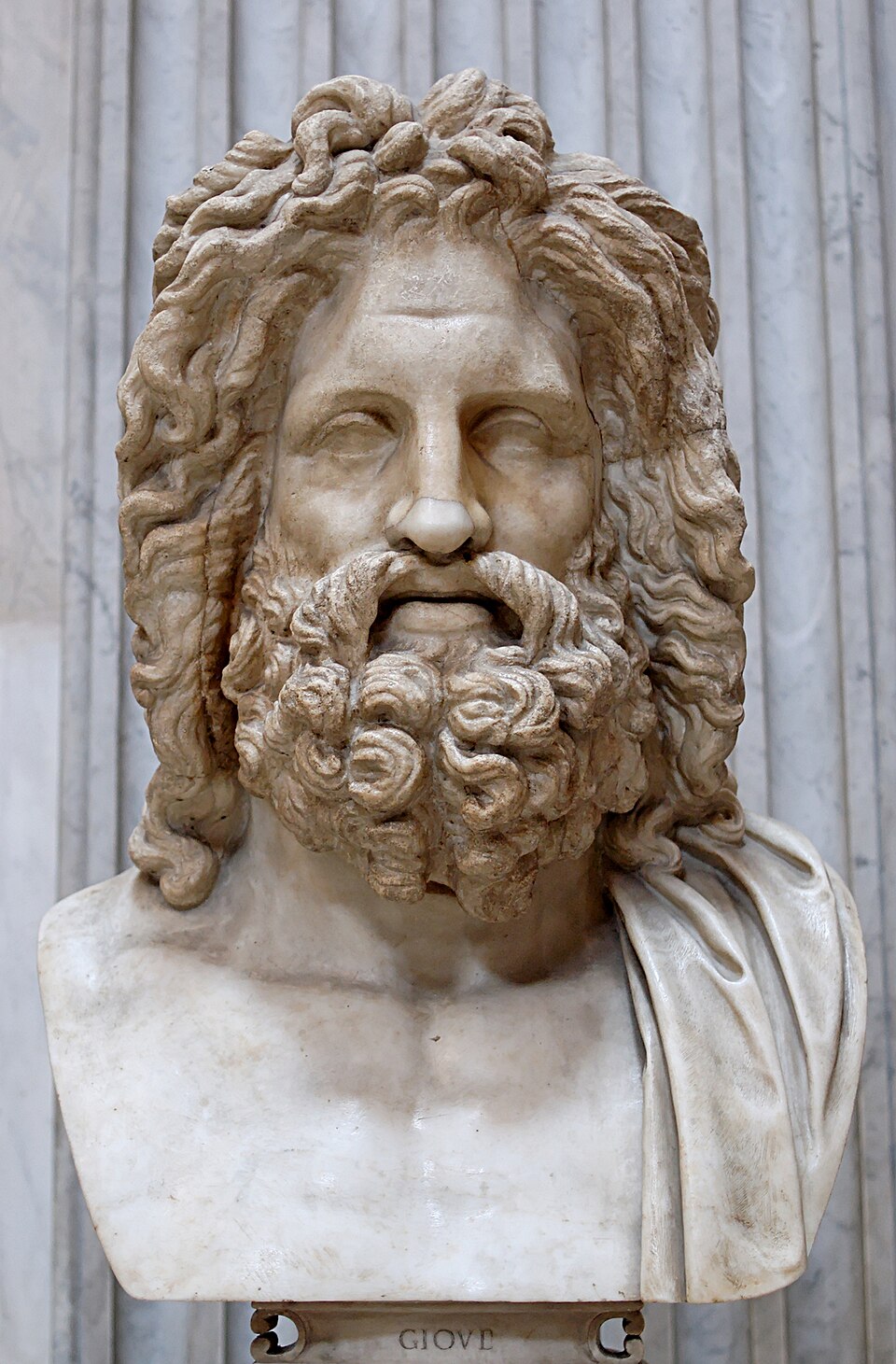
The living temple within the soul, in the Temple's reading of the Head of Zeus, is the formation of the 5 elemental powers under a sovereign intelligence: its foundation must sustain its height, its power must remain joined to knowledge, its capacity to receive must be matched by its capacity to act.19 The 5 solids are that temple's stones. Proclus said the Elements starts from the simple figures and ends in the cosmic bodies; the Zevist ascent starts from the point of the solar centre and ends in a soul built of 5 regular bodies around 1 sphere, which is the subject of the last layer.
Contemplation of the Five Bodies
Take the 5 figures in the order of the Timaeus: the cube before you as earth, the tetrahedron behind as fire, the icosahedron to the left as water, the octahedron to the right as air, and the dodecahedron about you as aether. Count the faces of each, and find in each pair the other's vertices.
Speak the Pentad's affirmation 5 times, 1 for each body: "The parts of this work join in beauty, balance, and harmony."20 Hold the 5 within 1 sphere, and seal with 1 AUM.
VI. Measure
Τὸ Μέτρον
Edge length 1 throughout. R is the radius of the circumscribed sphere, r of the inscribed sphere. Every value below was computed from the solids' coordinates and checked against the standard tables.11
| Solid | Faces | V · E · F | Dihedral angle | R | r | Volume | Dual |
|---|---|---|---|---|---|---|---|
| Tetrahedron · fire | 4 triangles, 3 at a vertex | 4 · 6 · 4 | 70.5288° | 0.6124 | 0.2041 | 0.1179 | tetrahedron |
| Cube · earth | 6 squares, 3 at a vertex | 8 · 12 · 6 | 90° | 0.8660 | 0.5000 | 1.0000 | octahedron |
| Octahedron · air | 8 triangles, 4 at a vertex | 6 · 12 · 8 | 109.4712° | 0.7071 | 0.4082 | 0.4714 | cube |
| Dodecahedron · the whole | 12 pentagons, 3 at a vertex | 20 · 30 · 12 | 116.5651° | 1.4013 | 1.1135 | 7.6631 | icosahedron |
| Icosahedron · water | 20 triangles, 5 at a vertex | 12 · 30 · 20 | 138.1897° | 0.9511 | 0.7558 | 2.1817 | dodecahedron |
| Relation | Value | Note |
|---|---|---|
| Euler's formula | V − E + F = 2 | 4 − 6 + 4, 8 − 12 + 6, 6 − 12 + 8, 20 − 30 + 12, 12 − 30 + 20 |
| Angle sum at a vertex | 180°, 270°, 240°, 324°, 300° | Each below 360°; the deficit over all vertices is always 720° |
| Sphere diameter² : edge² | 3⁄2, 3, 2 | Pyramid, cube, octahedron: Euclid XIII.13 to 15 |
| r ⁄ R | 0.3333, 0.5774, 0.5774, 0.7947, 0.7947 | Equal within each dual pair; the ratios of Kepler's nesting |
| Dodecahedron edge, cube in the same sphere | a ⁄ φ | Euclid XIII.17 |
VII. Sources and Reading
Πηγαί
- Euclid, Elements XIII.18 and the remark following it. Joyce.
- Euclid, Elements XIII.13 to 17. Joyce, Book XIII.
- Proclus, Commentary on the First Book of Euclid's Elements, Prologue II (Friedlein 68.20 to 23 and 70.19 to 71.5), translated by Glenn R. Morrow (Princeton, 1970), pp. 56 to 58. archive.org.
- Suda, theta 93, "Theaetetus": Suda On Line. The scholium to Book XIII in T. L. Heath, The Thirteen Books of Euclid's Elements, vol. III (Cambridge, 1926), p. 438: archive.org. MacTutor, Theaetetus.
- Aetius, Placita II.6 (Pseudo-Plutarch, On the Opinions of the Philosophers). English (Goodwin) · Greek.
- Plato, Timaeus 54d to 56b. English (Loeb), page 55 · page 56 · Greek, page 56.
- Plato, Timaeus 55c. English (Loeb) · Greek. See also Stanford Encyclopedia of Philosophy, "Plato's Timaeus".
- Plato, Phaedo 110b. English (Fowler) · Greek.
- Aristotle, On the Heavens I.3, 270b20 to 25. English (Stocks), Part 3 · Greek, Scaife Viewer.
- Aristotle, On the Heavens III.8, 306b to 307a. English (Stocks), Part 8 · Greek, Scaife Viewer.
- Eric W. Weisstein, "Platonic Solid", "Regular Tetrahedron", "Cube", "Regular Octahedron", "Regular Dodecahedron", "Regular Icosahedron", MathWorld. Platonic Solid · Tetrahedron · Cube · Octahedron · Dodecahedron · Icosahedron.
- Leonhard Euler to Christian Goldbach, Berlin, 14 November 1750: Euler Archive, letter OO863 (PDF). Euler, "Elementa doctrinae solidorum" (E230) and "Demonstratio nonnullarum insignium proprietatum" (E231), Novi Commentarii academiae scientiarum Petropolitanae 4 (1758): E230 · E231.
- Stefano De' Stefani, "Intorno un dodecaedro quasi regolare di pietra a facce pentagonali scolpite con cifre, scoperto nelle antichissime capanne di pietra del Monte Loffa", Atti del Reale Istituto Veneto (1885); discussed in Amelia Carolina Sparavigna, "An Etruscan Dodecahedron" (2012): arXiv 1205.0706.
- University of Nottingham, "Norton Disney dodecahedron" (2025): nottingham.ac.uk. Norton Disney History and Archaeology Group, the dodecahedron: nortondisneyhag.org.
- Ashmolean Museum, carved stone balls AN1927.2727 to 2731: britisharchaeology.ashmus.ox.ac.uk. George W. Hart, "Neolithic Carved Stone Polyhedra": georgehart.com. Lieven Le Bruyn, "The Scottish solids hoax": neverendingbooks.org.
- MacTutor, "Johannes Kepler": mathshistory.st-andrews.ac.uk. Kepler, Prodromus dissertationum cosmographicarum, continens mysterium cosmographicum (Tübingen, 1596): e-rara, ETH Zürich.
- Temple of Zeus, The Equal-Armed Cross and The Pythagorean Star and the Two Orientations.
- Temple of Zeus, The Ancient Gods and Apollo's Astrology for Zevists.
- Temple of Zeus, The Head of Zeus.
- Temple of Zeus, How to Use the Numbers in Magick & Meditation.
- Temple of Zeus, Light and Darkness: The Cosmic Forces Under Ma'at and Izfet.