



9 min read
Sacred Geometry · Layer 7 · Level I · The Figures of the Decad
The Heptagon and the Seven Circles
Τὸ Ἑπτάγωνον καὶ οἱ Ἑπτὰ Κύκλοι
author: High Priest Zevios Metathronos
Zevist Numerology 7 · The Heptad
Sacred discernment · Consequence · The armour of the just
Core meanings · Foundational Temple text
Karma, consequence, Goddess Nemesis, purification, the divine scale, Armor of the Just, luck, birth of mind, priesthood, virginity
Seven stands apart. The regular heptagon is the first polygon of the decade that the ruler and the compass cannot draw: Gauss proved that no construction exists, and the ancients knew it couldn't be found, since Archimedes had to bend the rules to get one. The Pythagoreans called 7 the virgin, unbegotten and unbegetting within the 10, and likened it to Athena. The figure of the Heptad is a centre guarded by 6, the 7 circles of the seed, and a star that won't be born of 2 lines alone.
I. The Figure
Τὸ Σχῆμα
The heptagon is regular when its 7 sides and 7 angles are equal, and its measures are as exact as any other polygon's: each interior angle is 900⁄7°, 128.571…°, and the side is 2R sin(π⁄7), 0.8678 R, for a circumradius R. What's missing is a construction. Euclid inscribes the triangle, the square, the pentagon, the hexagon and the 15-gon in Book IV and says nothing of the heptagon, and in 1801 Gauss showed why: a regular polygon can be drawn with ruler and compass only when its number of sides is a power of 2 times distinct primes of the form 2^m + 1, and he warns the reader against seeking constructions for 7, 11, 13 and 19.1 Pierre Wantzel supplied the proof that the condition is necessary in 1837.2 The heptagon isn't hard to draw; it's impossible with those 2 instruments.
Archimedes drew one anyway, by a neusis, a sliding of a marked ruler that the 2 instruments don't allow. His construction survives in an Arabic translation by Thābit ibn Qurra of the 9th century, the Book of the Construction of the Circle Divided into Seven Equal Parts.3 The heptagon demands a third instrument. It can be reached, but not by the way that reaches every figure before it.
The ancient arithmetic saw the same thing in the number. Within the decade 7 is neither a product of 2 smaller numbers, as 4, 6, 8, 9 and 10 are, nor a factor of any number up to 10, as 2, 3, 4 and 5 are. Philo, drawing on the Pythagoreans, says that 7 "neither produces nor is produced", and likens it to Victory, who had no mother, and to the virgin Goddess who sprang from the head of Zeus.4 The Theology of Arithmetic calls the Heptad virgin and Athena for the same reason, and the Temple's numerology receives it so.5 The number that no multiplication produces has the polygon that no construction produces. Arithmetic and geometry agree about 7 across 2,000 years.
II. The Construction
Ἡ Κατασκευή
Two constructions are given: the exact one, which needs a protractor or a marked ruler, and the figure of 7 circles, which needs only the compass of Layer 6.
- Exact heptagon. Draw a circle with centre O. From O lay off 7 angles of 360⁄7°, 51.43° each, with a protractor, or divide the circle by Archimedes' neusis. Join the 7 points in order.
- For the heptagrams, join every second point for {7/2} and every third for {7/3}. Both are single unbroken lines, since 7 is prime; neither falls into pieces as the hexagram did.
- Seven circles. Draw a circle of radius r about O. Step the radius around its circumference 6 times, as in Layer 6, and draw a circle of radius r about each of the 6 marks. The 6 close around the first.
- Draw the circle of radius 2r about O. It touches all 6 outer circles at their far points and bounds the figure.
The 7-circle figure is the honest geometry of the Heptad. Its symmetry is sixfold, not sevenfold: the 6 outer circles sit at the corners of a hexagon. Seven is here as a count, 1 + 6, the centre and what surrounds it, exactly as the Temple's numerology draws it: "a centre with six surrounding points, an expository image of guarded integrity".5 The heptagon's own sevenfold symmetry lives in the star, not the circles.
III. Number and Form
Ἀριθμὸς καὶ Σχῆμα
The heptagon has 2 kinds of diagonal, the short and the long, and they stand in a relation that no other polygon shares in this form: the reciprocal of the side equals the sum of the reciprocals of the 2 diagonals, 1⁄s = 1⁄d₁ + 1⁄d₂.6 The pentagon's single diagonal gave φ; the heptagon's 2 give the ratios 1.8019… and 2.2470…, roots of a cubic equation, which is the algebraic reason the compass fails: the compass solves quadratics and nothing higher.
Seven is the number of the planets of the old sky. Plato's Spindle of Necessity carries 8 whorls, the fixed stars and the 7 wanderers, and on each a Siren sings a single note; the 7 within the 1 are the figure's count again.7 Seven days, 7 vowels of the Greek alphabet, 7 strings of the lyre of Terpander, 7 Sages: the Greeks counted their world in sevens, and Philo gathers the sevens of nature and the soul at length in the passage cited above.4
IV. In the Ancient Witnesses
Παρὰ τοῖς Ἀρχαίοις
Athena is the number's Goddess by ancient consent, and her birth explains it: she came from the head of Zeus with no mother, armed, and remained a virgin. The Theology of Arithmetic adds the images of a stronghold and of guarding, and makes the Heptad kairos, the fitting moment, and tyche, fortune.5 The Temple's aegis page holds the Goddess's protective power: the luminous aura, clear inner sight and a will established in Divine guardianship.8 The circle guarded by 6 is the aegis drawn with a compass.
The 7-circle pattern is cut into stone in the Assyrian palaces of the 7th century BCE, where it grows into the full grid of circles that Layer 13 examines; the door-sills of Ashurbanipal's North Palace at Nineveh carry "a field of interlocking circles, drawn with a compass, giving the effect of flowers with six petals".9 The pattern's modern name, Seed of Life, is of the 20th century; the figure itself is 2,600 years old in that carving, and as old as the compass in principle.
V. The Zevist Reading
Ἡ Ζευϊστικὴ Ἀνάγνωσις
The Temple's Heptad is Nemesis, the Divine scale, consequence and the Armor of the Just.5 The geometry gives each its figure. The centre guarded by 6 is the armour: a core that the surrounding powers enclose without touching, each circle passing through the centre's circumference and no further. The scale is the heptagon's own balance of 2 diagonals against 1 side, a relation held exactly and reachable by no shortcut. Consequence is the rule of Gauss: what can't be constructed by the permitted means won't be, however long the compass is turned.
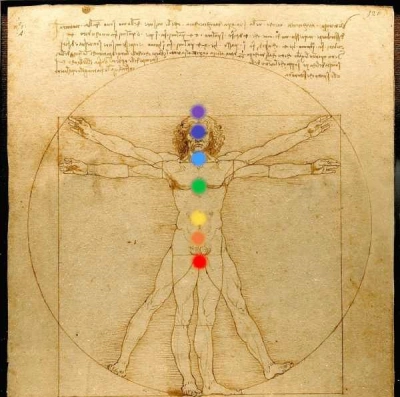
The soul's 7 are the 7 principal chakras along the spine in the Temple's teaching, with the paired centres at hips, shoulders and temples supporting them.10 Seven is the count of the ascent, from the base to the crown, and the Temple's pages on the third eye and the sixth centre set the upper steps of it.11 The 7 circles are a map of the awakened field seen from above: the solar centre of Layer 1 and the 6 directions of Layer 6 about it, aether at the middle and the aura as the bounding circle of radius 2r.
Purification is the Heptad's work in practice. The unbegotten number asks what in a life has been produced by the proper instruments and what has been forced by a slid ruler. The Temple's reading of 7 names the birth of mind and the fitting moment: discernment perceives the relation between a purpose and the time suited to it, and an action is ripe when its figure can be closed by the means at hand.5 Athena's virginity in the number is integrity, the keeping of one's own principle under changing conditions.
Contemplation of the Seven
Draw the 7 circles and the bounding circle. Receive the central circle as the guarded centre and the 6 as its companions. Then draw the heptagon beside it by angle, and the star {7/3} through it, and note what the compass alone couldn't give.
Speak the Heptad's affirmation 7 times, 1 at the centre and 1 at each surrounding circle: "I stand in purity, discernment, and just measure."12 Seal with 1 AUM.
VI. Measure
Τὸ Μέτρον
| Quantity | Value | Note |
|---|---|---|
| Interior angle | 900⁄7° ≈ 128.571° | Sum of angles 900° |
| Central angle | 360⁄7° ≈ 51.429° | |
| Side, for circumradius R | 2R sin(π⁄7) ≈ 0.8678 R | |
| Area, for side s | (7⁄4) s² cot(π⁄7) ≈ 3.6339 s² | |
| Short diagonal : side | ≈ 1.8019 | 2 cos(π⁄7) |
| Long diagonal : side | ≈ 2.2470 | 1 + 2 cos(2π⁄7) |
| The heptagon identity | 1⁄s = 1⁄d₁ + 1⁄d₂ | 0.5550 + 0.4450 = 1.0000 for s = 1 |
| Constructible with ruler and compass | no | Gauss 1801, Wantzel 1837; neusis construction by Archimedes |
| Seven circles, bounding radius | 2r | The outer circles reach 2r from the centre |
VII. Sources and Reading
Πηγαί
- Carl Friedrich Gauss, Disquisitiones Arithmeticae (Leipzig, 1801), articles 365 to 366. Latin first edition, archive.org. On the last chapter: arXiv 2110.01355. Eric W. Weisstein, "Constructible Polygon", MathWorld: mathworld.wolfram.com.
- Pierre Wantzel, "Recherches sur les moyens de reconnaître si un problème de géométrie peut se résoudre avec la règle et le compas", Journal de mathématiques pures et appliquées 2 (1837) 366 to 372. MacTutor, Wantzel · Eric W. Weisstein, "Regular Heptagon", MathWorld: mathworld.wolfram.com.
- Jan P. Hogendijk, "Greek and Arabic constructions of the regular heptagon", Archive for History of Exact Sciences 30 (1984) 197 to 330. Springer. Wilbur Knorr, "On Archimedes' construction of the regular heptagon", Centaurus 32 (1989) 257 to 271; listed at MacTutor.
- Philo of Alexandria, On the Creation 99 to 100, translated by C. D. Yonge. earlychristianwritings.com.
- Temple of Zeus, 7 · The Heptad; The Theology of Arithmetic, On the Heptad, Greek text, Wikisource.
- Leon Bankoff and Jack Garfunkel, "The Heptagonal Triangle", Mathematics Magazine 46, no. 1 (1973) 7 to 19. Eric W. Weisstein, "Heptagon", MathWorld: mathworld.wolfram.com.
- Plato, Republic X, 616c to 617b. English (Shorey) · Greek.
- Temple of Zeus, The Aegis and The Owl of Athena: Vigilance and Discernment.
- British Museum, door-sill from the North Palace of Ashurbanipal, Nineveh, 645 to 640 BCE, museum number 118913 (1856,0909.44). Collection record.
- Temple of Zeus, The Chakras and The Equal-Armed Cross.
- Temple of Zeus, 3rd Eye, Pineal Breathing Meditation and 6th Chakra Meditation.
- Temple of Zeus, How to Use the Numbers in Magick & Meditation.