



11 min read
Sacred Geometry · Layer 10 · Level I · The Figures of the Decad
The Tetractys and the Decad
Ἡ Τετρακτὺς καὶ ἡ Δεκάς
author: High Priest Zevios Metathronos
Zevist Numerology 10 · The Decad
All in All · The Divine Father · The completed Cosmos
Core meanings · Foundational Temple text
A key, All in All, fate and karma, an end of path, double union, Universe - Pan, Cosmos, Perfection, The Self-Created one, 'Divine Father', Totality
10 · The Decad1 · The Monad2 · The Dyad3 · The Triad4 · The TetradNumerology index
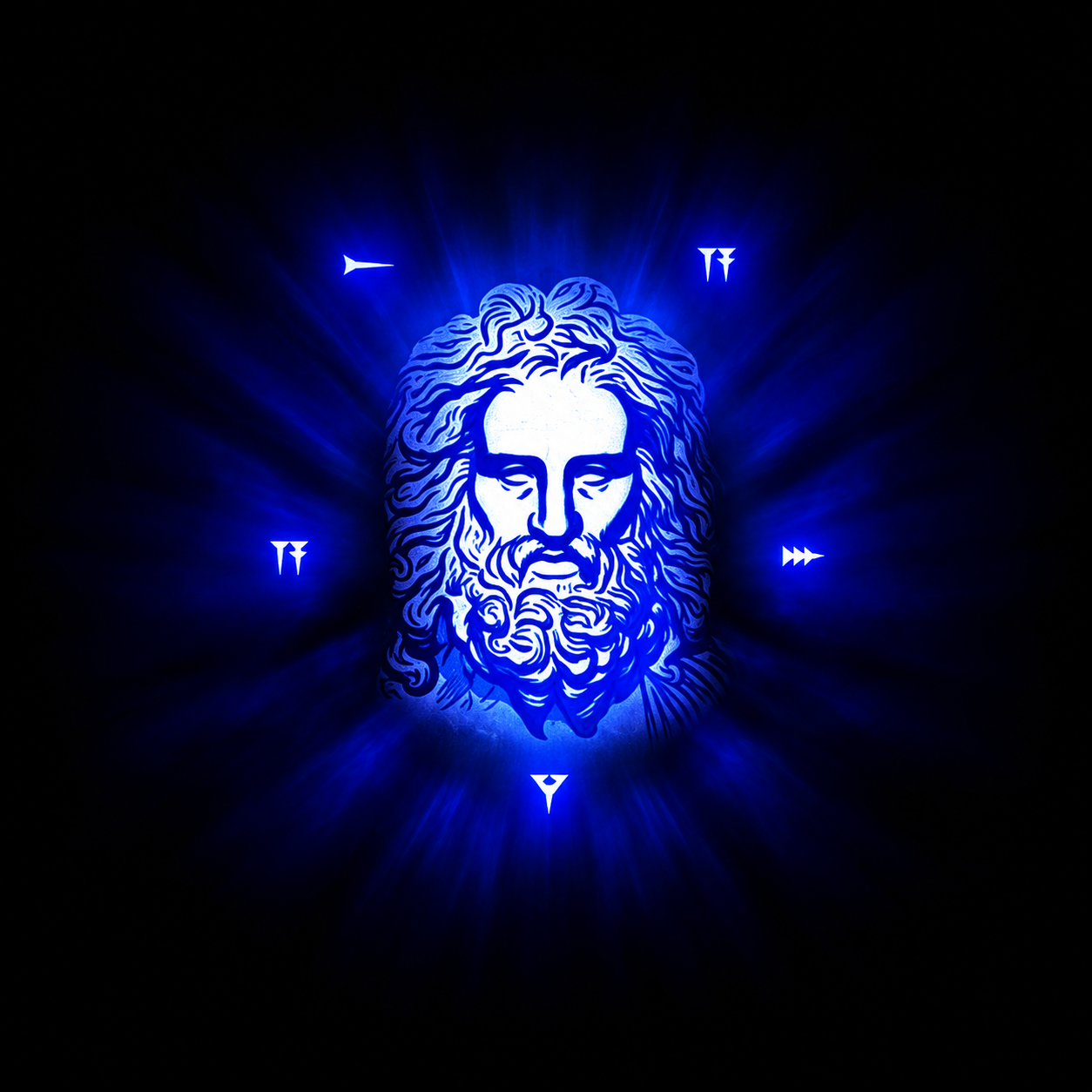
Ten points in 4 rows: 1, then 2, then 3, then 4. The Tetractys is the figure the Pythagoreans swore by, the triangle that holds the Monad, the Dyad, the Triad and the Tetrad in 1 shape and sums them to the Decad. Every layer before this one is a row of it. The point is its summit, the line its second row, the triangle its third, the square's 4 elements its base, and the consonances of music lie between its rows. The Temple's symbol page reads the Tetractys for the soul; this layer builds it and sets it among its witnesses.
I. The Figure
Τὸ Σχῆμα
The Tetractys is the fourth triangular number drawn as pebbles. Its name is from τετράς, a group of 4: 4 rows, 4 numbers, and the 4 kinds of magnitude that Layer 1 set out from Sextus Empiricus, point, line, plane and solid, under 1, 2, 3 and 4.1 The 10 points lie at the corners and along the edges of an equilateral triangle whose side is 3 intervals, with 1 point inside; the whole figure is the triangle of Layer 3 filled with the counting of Layer 1.
The Pythagoreans swore by it. Sextus Empiricus preserves the oath: οὐ μὰ τὸν ἁμετέρᾳ κεφαλᾷ παραδόντα τετρακτύν, παγὰν ἀενάου φύσεως ῥιζώματ᾽ ἔχουσαν, "No, by him who handed down the Tetractys to our generation, which holds the fount and root of ever-flowing nature", and he explains it at once: 1 and 2 and 3 and 4 make 10, and this number is the first Tetractys.2 Aetius records the same oath, Theon of Smyrna quotes it and counts 11 tetractyes after the first, and Iamblichus places it in the Pythagorean life.3 Lucian puts it in the mouth of Pythagoras on the auction block: "Four (as you call it) is ten. Four the perfect triangle. Four the oath of our school".4
One of the oldest Pythagorean sayings survives in Iamblichus, here in Taylor's 1818 rendering, as a question and answer: "What is the oracle at Delphi? The tetractys. What is harmony? That in which the Syrens subsist."5 The Stanford Encyclopedia notes that this acusma in Iamblichus probably derives from Aristotle, which carries the figure back into the 4th century BCE, and that the later tradition treated the Tetractys as the summary of all Pythagorean wisdom, the Pythagoreans swearing by Pythagoras as "the one who handed down the tetraktys to our generation".6 The Temple's Tetractys page cites the same witnesses.7
II. The Construction
Ἡ Κατασκευή
- Draw a horizontal line and mark 4 points on it at equal intervals: the base, the Tetrad.
- Above each pair of neighbours, at the apex of an equilateral triangle on that interval, mark a point: 3 points, the Triad. The vesica of Layer 2 finds each apex.
- Above each pair of those, mark a point: 2 points, the Dyad. Above the last pair, 1 point: the Monad, the summit.
- Count: 1 + 2 + 3 + 4 = 10. Join the 3 corner points and the triangle encloses all 10. Every point is 1 interval from its neighbours; the figure is a fragment of the hexagonal lattice of Layer 6.
The music is in the rows. The first 4 numbers contain the 3 consonances of Greek harmonics, the octave 2 : 1, the fifth 3 : 2 and the fourth 4 : 3; a string stopped at half its length sounds the octave, at 2⁄3 of it the fifth, at 3⁄4 the fourth.8 The Temple's tribute to Pythagoras adds the identity that binds them: a fifth and a fourth span an octave, (3⁄2) × (4⁄3) = 2.9 That's why the acusma could answer "harmony" with the Sirens: in Plato's myth of Er a Siren sits on each of the 8 whorls of the Spindle and sings 1 note, and the 8 together are 1 harmony.10 The Tetractys is the sheet music of the spheres.
III. Number and Form
Ἀριθμὸς καὶ Σχῆμα
Ten gathers the first 4 numbers and, through them, everything the first 4 figures contain. Aristotle reports that the Pythagoreans held the Decad to be perfect and to embrace the whole nature of number, so firmly that when they counted only 9 bodies moving in the heavens they invented a tenth, the counter-earth, to complete it.11 The Theology of Arithmetic names the Decad cosmos, heaven, the All, fate, eternity, power, necessity and keyholder, and connects it with Pan; the Temple's numerology receives every one of those names and adds the Divine Father and the Self-Created One.12
Philolaus, the first Pythagorean whose words survive, makes number the condition of knowledge itself: "all things that are known have number; for it is not possible that anything whatsoever be understood or known without this".13 The Tetractys is where that claim is drawn. Within its 10 points the Pythagorean distinctions are already present, odd and even, unity and plurality, the plane and the solid, and the Temple's Decad page reads the figure the same way: unity opens into distinction, distinction receives a complete relation, relation gains determinate form, and all 4 remain within the finished whole.12
The Decad's polygon returns to the Pentad's proportion. Euclid XIII.9 proves that the side of the hexagon and the side of the decagon inscribed in the same circle, laid end to end, make a line cut in extreme and mean ratio, with the hexagon's side, which is the radius, as the greater segment.14 So the decagon's side is r ⁄ φ, 0.618 r. The Temple's Decad page reads "double union" as 2 Pentads, 5 + 5; the decagon is that reading in the plane, 2 pentagons turned 36° to one another, which is the compound {10/2}, and the decagram {10/4} is 2 pentagrams.12 Ten is the pentagon doubled as 8 was the square doubled.
IV. In the Ancient Witnesses
Παρὰ τοῖς Ἀρχαίοις
The Tetractys is Greek in every surviving witness, and the Decad's perfection is Pythagorean before it's anyone else's. 8 centuries after the oath, the Sefer Yetzirah, composed between the 3rd and 6th centuries CE, counts its 10 sefirot with the insistence "ten and not nine, ten and not eleven", and the Kabbalistic tree that grew from it arranges 10 emanations in a figure descending from unity through pairs to a base.15 The structure is the Decad's, and the Temple holds that the 10 sefirot are the Tetractys concept taken from the Pythagoreans; the Kabbalah's real merits derive strongly from Greek thought, and its tree is read here as a late inheritor of the figure on this page.16 The Greek Tetractys is a triangle, not a tree: its 10 are 1 shape, closed by 3 lines, and nothing in it hangs from anything else.
The oldest 10 in stone is the decade of fingers, and the oldest 10 in text is the Egyptian count by tens, which the Greek numerals share. The Theology of Arithmetic ends its account of the Decad with the return of the greater groupings: 100 is 10 tens, 1,000 is 10 hundreds, and every count that passes 10 begins again at 1.12 The Tetractys is the figure of that return: its summit is the 1 that the base of 4 makes possible, and the whole triangle is 1 figure again.
V. The Zevist Reading
Ἡ Ζευϊστικὴ Ἀνάγνωσις
The Temple's Tetractys page reads the 4 rows through the soul. The summit directs the soul toward unity under Zeus and signifies a common spiritual purpose. The second row brings the receptive and directing powers into view, the Dyad of Layer 2. The third reveals their relationship to a central path, Ida, Pingala and Sushumna, the Triad of Layer 3. The fourth row extends contemplation toward the 4 elemental quarters, earth, water, air and fire, held together through the spiritual centre that aether gives them, the Tetrad and the cross of Layer 4.7 Ten points express the fullness of the arrangement, and the ascent of attention toward the summit gathers the whole work back toward its governing Divine principle.
Read from the summit down, the figure is the descent of power into a fuller field of expression; read from the base up, it's the gathering of differentiated faculties into concentrated awareness, and the Temple holds that both movements belong together in the Zevist work: the devotee receives from the Gods and develops the inward order needed to carry Their influence into life.7 The Pythagorean Star of Layer 5 made the same 2 movements its 2 orientations. The Tetractys makes them 1 triangle read in 2 directions.
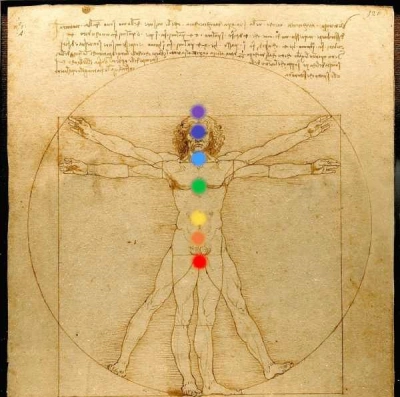
The harmony in the rows is the harmony the chakras must find. The Temple teaches that the 7 centres possess different functions within 1 luminous soul, and the Tetractys allows the devotee to contemplate the principle by which difference becomes harmony: an octave, a fifth and a fourth are 3 different intervals and 1 concord.7 Apollo's harmony and Hermes's communication find their companion in the figure, and the Temple's guide to the numbers gives the Decad 10 utterances followed through the points, 1 at each, until all 10 are held together.17 The Decad is the key, in the Temple's core meanings, because the completed order both contains its powers and gives access to the relations by which they operate.12
Contemplation of the Tetractys
Lay the 10 points as pebbles or draw them. Move the attention through the 4 rows from the base to the summit, naming each row by the Temple's reading: the 4 elements, the 3 channels, the 2 powers, the 1 purpose under Zeus. Then descend, and then receive all 10 at once.
Speak the Decad's affirmation 10 times, 1 at each point, base to summit: "All parts of this work are gathered into one complete and ordered whole."17 Hold the full figure, and seal with 1 AUM.
VI. Measure
Τὸ Μέτρον
| Quantity | Value | Note |
|---|---|---|
| Points | 1 + 2 + 3 + 4 = 10 | The fourth triangular number, 4 × 5 ⁄ 2 |
| Side of the enclosing triangle | 3 intervals | Angles 60°; the figure is a piece of the hexagonal lattice |
| Rows against rows | 2 : 1 · 3 : 2 · 4 : 3 | Octave, fifth, fourth; (3⁄2)(4⁄3) = 2 |
| Lines through 3 or more points | 6 | The 3 sides, with 4 points each, and 3 inner lines parallel to them, with 3 |
| Decagon, interior angle | 144° | Central angle 36° |
| Decagon, side for circumradius r | r ⁄ φ ≈ 0.6180 r | Euclid XIII.9 |
| Decagon, area for side s | (5⁄2) s² cot 18° ≈ 7.6942 s² | |
| Decagram {10/3}, angle at each point | 72° | {10/4}: 2 pentagrams, 36° each |
| Sum of 1 to 10 | 55 | The tenth triangular number |
VII. Sources and Reading
Πηγαί
- Sextus Empiricus, Against the Physicists II 278 to 282. Greek, Scaife Viewer.
- Sextus Empiricus, Against the Logicians I (= Adversus Mathematicos VII) 94 to 95. Greek, Scaife Viewer.
- Aetius, Placita I.3.8: English, CSUN. Theon of Smyrna, Mathematics Useful for Understanding Plato, Music, chapter 38, translated by J. Dupuis (Paris, 1892): French, remacle.org · Greek and French, archive.org. Iamblichus, Life of Pythagoras 150 and 162, translated by Thomas Taylor (1818): Project Gutenberg.
- Lucian, Philosophies for Sale 4, translated by H. W. and F. G. Fowler (1905). ToposText.
- Iamblichus, Life of Pythagoras 18.82, translated by Thomas Taylor (1818), chapter XVIII. Project Gutenberg · K. S. Guthrie's translation at ToposText.
- Carl Huffman, "Pythagoras", Stanford Encyclopedia of Philosophy, section 5. plato.stanford.edu.
- Temple of Zeus, The Tetractys.
- Carl Huffman, "Philolaus", Stanford Encyclopedia of Philosophy. plato.stanford.edu.
- Temple of Zeus, In Honor of a Great Teacher: Pythagoras.
- Plato, Republic X, 617b. English (Shorey) · Greek.
- Aristotle, Metaphysics A 5, 986a8 to 12. Greek · English (Tredennick).
- Temple of Zeus, 10 · The Decad; The Theology of Arithmetic, On the Decad, Greek text, Wikisource.
- Philolaus, fragment B4 (Diels and Kranz), from Stobaeus, in Carl Huffman, "Philolaus", Stanford Encyclopedia of Philosophy. plato.stanford.edu.
- Euclid, Elements XIII.9. Joyce.
- Sefer Yetzirah 1:4, translated by W. W. Westcott (1887): sacred-texts.com. On its date: Gershom Scholem, Kabbalah (Keter, 1974), pp. 23 to 30.
- Temple of Zeus, Advanced Zevist Philosophy, the sermons on the Kabbalah and its Greek sources.
- Temple of Zeus, How to Use the Numbers in Magick & Meditation.