




9 min read
Sacred Geometry · Layer 11 · Level II · Proportion
The Golden Section
Ὁ Ἄκρος καὶ Μέσος Λόγος
author: High Priest Zevios Metathronos
Zevist Numerology 5 · The Pentad
Living union · Eros · Beauty and the five elements
Core meanings · Foundational Temple text
The five elements, union, connection, eros, shape and form, beauty, splendor, balance, harmony
Cut a line so that the whole stands to the greater part as the greater part stands to the lesser. That's all. Euclid calls it the extreme and mean ratio; the Renaissance called it the divine proportion; the 19th century named it the golden section and the 20th gave it the letter φ. It's the ratio hidden in the pentagon's diagonals, the decagon's side, the dodecahedron and the icosahedron, and it's the only proportion in which the part is a likeness of the whole. Level II is 1 layer long because 1 cut is enough.
I. The Figure
Τὸ Σχῆμα
Euclid states the definition in Book VI: "A straight line is said to have been cut in extreme and mean ratio when, as the whole line is to the greater segment, so is the greater to the less".1 He had already constructed the cut in Book II, without naming it, as the division of a line so that the rectangle contained by the whole and 1 segment equals the square on the other segment, and he needed it there for the 36° triangle and the pentagon.2 Book XIII opens with 6 propositions on the properties of the cut and uses them to build the icosahedron and the dodecahedron.3 The golden section is the thread that runs from the plane figures to the solids.
Call the ratio φ. From the definition, φ = 1 + 1⁄φ, so φ² = φ + 1, and φ is the positive root of x² − x − 1 = 0: φ = (1 + √5) ⁄ 2 = 1.6180339887….4 Its reciprocal is φ − 1 = 0.618…, and its square is φ + 1 = 2.618…. No other number keeps its own digits after the point when inverted or squared. Written as a continued fraction it's 1 + 1⁄(1 + 1⁄(1 + …)), all ones, the slowest of all irrationals to be approached by fractions, which is why it governs the spacing of leaves and seeds that must never line up.4
The cut returns wherever 5 appears. In the regular pentagon the diagonals cut one another in extreme and mean ratio and the greater segment is the side (XIII.8). In the same circle the hexagon's side and the decagon's side together are cut in the ratio, the hexagon's side being the greater (XIII.9). When the side of a cube is cut in extreme and mean ratio, the greater segment is the side of the dodecahedron inscribed in the same sphere (XIII.17).3 The 12 vertices of the icosahedron sit at the corners of 3 golden rectangles set at right angles to one another: with edge 2 they lie at (0, ±1, ±φ) and its permutations.5
II. The Construction
Ἡ Κατασκευή
- Draw the line AB to be cut. At B raise a perpendicular and mark D on it so that BD is half of AB.
- Join AD. With centre D and radius DB, cut AD at E.
- With centre A and radius AE, cut AB at C. Then AB : AC = AC : CB. C is the golden cut of AB, and AC is the greater segment.
- Golden rectangle. On AC raise a square ACFG, and extend its base to B: the rectangle on AB with height AC has sides in the ratio φ : 1. Cut the square away and the rectangle that remains, CB by AC, is again golden.
Step 2 is the Pythagorean theorem at work: AD² = AB² + (AB⁄2)², so AD = (√5 ⁄ 2) AB, and AE = AD − AB⁄2 = ((√5 − 1) ⁄ 2) AB = AB ⁄ φ. The same √5 that made the vesica's cousin in Layer 2 makes the golden cut here; the compass that found √3 between 2 circles finds √5 on a half-square's diagonal.
III. Number and Form
Ἀριθμὸς καὶ Σχῆμα
The whole numbers approach φ along the sequence 1, 1, 2, 3, 5, 8, 13, 21, 34, 55, each the sum of the 2 before it. Leonardo of Pisa, called Fibonacci, set the sequence as a problem about breeding rabbits in the Liber Abaci of 1202; its ratios, 3⁄2, 5⁄3, 8⁄5, 13⁄8, 21⁄13, converge on φ from both sides, 1.5, 1.667, 1.6, 1.625, 1.615….6 Kepler stated the convergence in a letter of 1609, and the ratio of the 41st to the 40th term agrees with φ to 15 decimal places.7 The Pentad's 5 and the Octad's 8 are neighbours in the sequence, and their ratio, 1.6, is the first that comes within 2 hundredths of the golden number.
The golden angle follows. Divide the full circle of 360° in extreme and mean ratio and the smaller arc is 360° ⁄ φ² = 137.5078…°; a plant that sets each new leaf or seed at that angle from the last never lets 2 of them align, and the spirals that result on a sunflower or a pine cone are counted in consecutive Fibonacci numbers.8 This is the one place where the golden ratio's presence in nature is measured rather than asserted.
IV. In the Ancient Witnesses
Παρὰ τοῖς Ἀρχαίοις
The ancients knew the cut as a proposition, not as a cult. Euclid's "extreme and mean ratio" is its only classical name; Plato's Timaeus praises proportion in general as the fairest bond, the one that makes itself and the things it binds most completely 1, and the Pythagorean pentagram carried the ratio without naming it.9 The honours came later. Luca Pacioli published De divina proportione in 1509, with figures of the solids drawn by Leonardo da Vinci, and gave the ratio its theological name.10 Kepler, who found the 5 solids in the planetary spheres, called the cut "a precious jewel" beside the theorem of Pythagoras, which he likened to a measure of gold.7 Martin Ohm used the phrase goldener Schnitt, the golden section, in the 1835 edition of his textbook, and the letter φ, for Phidias, was given by Mark Barr early in the 20th century.4
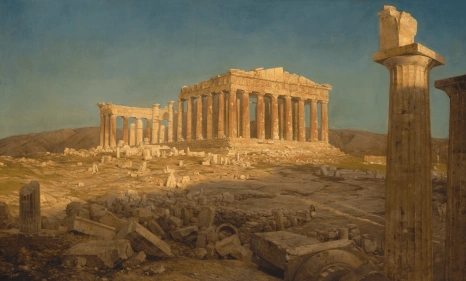
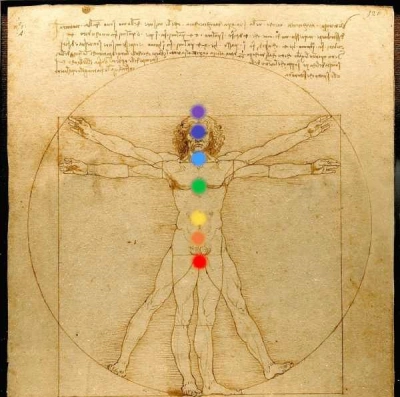
Much that's said of the ratio since is false, and a sacred geometry that wants to be believed should say so. George Markowsky's "Misconceptions about the Golden Ratio" of 1992 examines the claims one by one: the Parthenon's façade doesn't fit a golden rectangle without choosing one's lines to make it; the Great Pyramid's proportions are not based on φ; the human body, the navel, the Mona Lisa and the United Nations building don't carry it; and people don't prefer the golden rectangle in tests.11 What remains after the pruning is what Euclid proved and what the sunflower shows, and that's more than enough.
V. The Zevist Reading
Ἡ Ζευϊστικὴ Ἀνάγνωσις
The golden section is the figure of likeness. In every other division the part has 1 ratio to the whole and another to the remainder; in this one the 2 ratios are the same, and the lesser stands to the greater as the greater stands to the whole. That's the relation Zevism names as its purpose: ὁμοίωσις θεῷ κατὰ τὸ δυνατόν, likeness to God as far as is possible, which Plato states in the Theaetetus and the Temple reads as the transmutation of the human essence into the Divine.12 The soul is the greater segment, the God the whole, and the work is to make the soul's relation to the God the same as the God's relation to the All. Proportion is the bond, as the Timaeus says, and the golden proportion is the bond with the fewest terms.9
Ma'at is measure, and the golden cut is measure that generates. The Temple's Pentad names eros as the attraction toward a fitting union and beauty as the splendour of proportion; the Decad names the key.13 This proportion joins the 2: from the pentagon's star it opens the decagon, from the cube's side it opens the dodecahedron, and from any golden rectangle it opens another without end, each the image of the last. The nested pentagrams of Layer 5 and the spiral above are the same teaching: a form that reproduces its own measure at every scale is a form that can grow without losing its law, which is life under Ma'at.
Zevism holds that one must be at the source, and the source of this proportion is Greek and exact: a definition and a construction, not a mystique. The Temple honours Pythagoras by counting the points and reading the source, and it honours the golden section the same way, by proving it in the pentagon before contemplating it in the sunflower.14 Beauty that can be demonstrated is the kind the Gods gave.
Contemplation of the Golden Cut
Cut a line in extreme and mean ratio with the construction above and mark the 3 lengths: the lesser, the greater and the whole. Measure them and divide: the 2 quotients agree. Then build the golden rectangle on the greater segment and cut away 3 squares in turn, watching the same proportion return smaller each time.
Hold the 3 lengths as the soul, the God and the All, and the equal ratios as likeness. Seal with 1 AUM.
VI. Measure
Τὸ Μέτρον
| Quantity | Value | Note |
|---|---|---|
| φ | (1 + √5) ⁄ 2 = 1.6180339887… | Positive root of x² − x − 1 = 0 |
| 1 ⁄ φ | φ − 1 = 0.6180339887… | |
| φ² | φ + 1 = 2.6180339887… | φ³ = 2φ + 1 = 4.236… |
| Continued fraction | [1; 1, 1, 1, 1, …] | The most slowly converging of all |
| Fibonacci ratios | 3⁄2, 5⁄3, 8⁄5, 13⁄8, 21⁄13, 34⁄21 … | 1.5, 1.667, 1.6, 1.625, 1.615, 1.619 → φ |
| Golden angle | 360° ⁄ φ² ≈ 137.5078° | The circle cut in extreme and mean ratio |
| Pentagon, diagonal : side | φ | Euclid XIII.8 |
| Decagon side, for radius r | r ⁄ φ | Euclid XIII.9 |
| Dodecahedron edge, for cube edge a in the same sphere | a ⁄ φ | Euclid XIII.17, corollary |
| Icosahedron vertices, edge 2 | (0, ±1, ±φ) and cyclic permutations | Three golden rectangles at right angles |
VII. Sources and Reading
Πηγαί
- Euclid, Elements VI, Definition 3. Joyce.
- Euclid, Elements II.11 and IV.10. II.11 · IV.10.
- Euclid, Elements XIII.1 to 6, XIII.8, XIII.9, XIII.16, XIII.17. Joyce, Book XIII · XIII.17.
- Eric W. Weisstein, "Golden Ratio", MathWorld: mathworld.wolfram.com. MacTutor, "The Golden Ratio": mathshistory.st-andrews.ac.uk.
- Eric W. Weisstein, "Regular Icosahedron", MathWorld: mathworld.wolfram.com.
- MacTutor, "Leonardo Pisano Fibonacci": mathshistory.st-andrews.ac.uk.
- Kepler's letter of 1609 on the Fibonacci ratios, reported in MacTutor, "The Golden Ratio" (above). The "precious jewel" sentence is reported in Karl Fink, A Brief History of Mathematics, 2nd edition (Open Court, 1903), p. 223.
- Eric W. Weisstein, "Golden Angle", MathWorld: mathworld.wolfram.com.
- Plato, Timaeus 31c to 32a. English (Loeb) · Greek.
- MacTutor, "Luca Pacioli": mathshistory.st-andrews.ac.uk.
- George Markowsky, "Misconceptions about the Golden Ratio", The College Mathematics Journal 23, no. 1 (January 1992) 2 to 19. JSTOR · ERIC record.
- Plato, Theaetetus 176b. English (Fowler) · Greek. Temple of Zeus, Becoming as the Gods.
- Temple of Zeus, 5 · The Pentad and 10 · The Decad.
- Temple of Zeus, In Honor of a Great Teacher: Pythagoras.